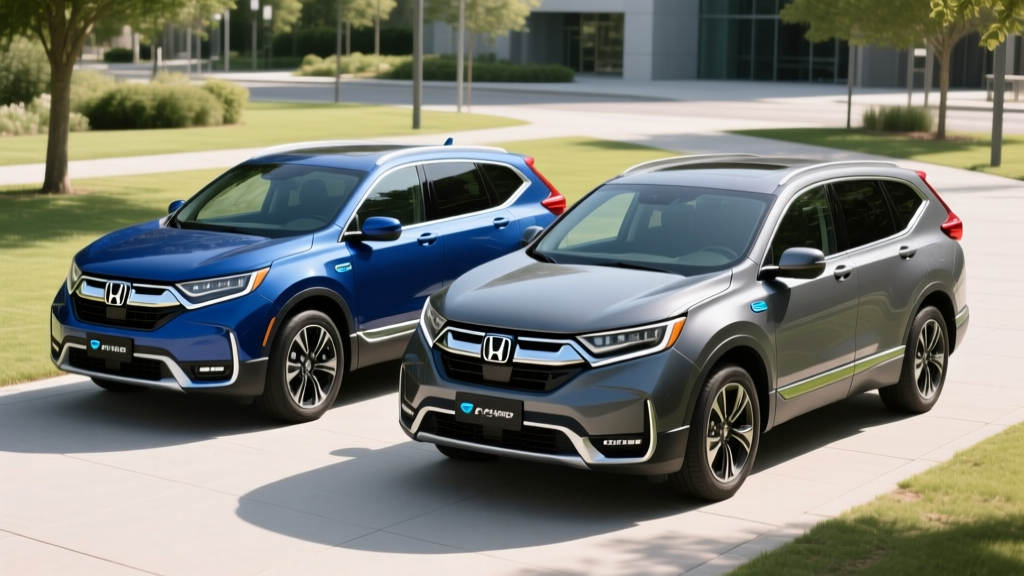
If you're shopping for a Honda hybrid SUV in 2026, the lineup is both broader and more efficient than it has ever been. Honda now offers two-row and three-row electrified SUVs that don't require a plug, a charging app, or a lifestyle change — just fuel and the occasional oil-change reminder. But the choice between the compact CR-V Hybrid and the larger Passport (and CR-V e:PHEV in select trims) hinges on specifics: real-world MPG, cargo trade-offs, powertrain behavior, and whether you actually need a plug-in.
This guide breaks down every current Honda hybrid SUV with the numbers that matter — EPA city/highway/combined MPG, combined horsepower, battery warranty terms, pricing by trim, and the tax-credit reality under current IRS §30D rules — so you can match a model to your actual driving pattern rather than a brochure.
HEV vs PHEV: Which Honda Hybrid SUV Architecture Do You Need?
Before comparing trims, it's critical to separate Honda's two electrified architectures, because the ownership experience, charging requirement, and tax-credit eligibility differ substantially.
| Feature | HEV (Conventional Hybrid) | PHEV (Plug-In Hybrid) |
|---|---|---|
| Plug-in required? | No — self-charging via regen + engine | Yes — for electric-only miles |
| Battery size | ~1.0–1.3 kWh (small buffer) | ~17–18 kWh usable |
| Electric-only range | ~1 mile at low speed | EPA ~37–47 mi (model dependent) |
| Federal tax credit (§30D) | Not eligible | Up to $3,750 (sourcing dependent) |
| Home charging needed | No | Level 2 strongly recommended |
| Best for | No garage/outlet access; highway-heavy | Home charging + short daily commute |
The 2026 CR-V Hybrid and 2026 Passport Hybrid sold in the U.S. are conventional HEVs. The CR-V e:PHEV (plug-in) has been available in Europe and China; U.S. availability has been limited and trim-dependent. If you see a Honda hybrid SUV listed without a charging port, it's an HEV — and you should never need to plug it in.
2026 Honda CR-V Hybrid: MPG, Powertrain & Real-World Efficiency
The CR-V Hybrid remains Honda's volume electrified SUV and one of the best-selling hybrid crossovers in the U.S. For 2026, it carries over the fourth-generation two-motor hybrid system paired with a 2.0-liter Atkinson-cycle four-cylinder.
| Spec | Value |
|---|---|
| Powertrain | 2.0L Atkinson I-4 + two-motor hybrid system |
| Combined horsepower | 204 hp / 247 lb-ft torque |
| Drivetrain | FWD or AWD (e-AWD with rear motor) |
| Battery | ~1.06 kWh lithium-ion (HEV buffer) |
| EPA MPG (AWD) | 40 city / 34 highway / 37 combined |
| EPA MPG (FWD) | 43 city / 36 highway / 39 combined |
| 0–60 mph | ~7.6 seconds (AWD) |
| Cargo (behind 2nd row) | 36.3 cu ft |
| Towing capacity | 1,000 lbs |
| Base MSRP (Sport Hybrid AWD) | ~$36,395 |
| Top trim MSRP (Sport Touring Hybrid) | ~$42,395 |
Real-World MPG vs. EPA Sticker
Like most Toyota/Honda two-motor hybrids, the CR-V Hybrid tends to exceed its EPA city rating in stop-and-go driving because the electric motor handles low-speed propulsion while the engine stays off or acts as a generator. In mixed suburban driving, owners regularly report 38–42 MPG in warm weather. Highway efficiency drops to roughly 31–33 MPG at sustained 75+ mph speeds — the Atkinson-cycle engine is optimized for low-load efficiency, not high-speed cruising. In cold weather (below 32°F), expect a 5–8 MPG reduction as the engine runs longer to heat the cabin and catalytic converter.
2026 Honda Passport Hybrid: Three-Row Efficiency Without a Plug
Honda expanded hybrid availability to the Passport for the 2026 model year, addressing demand for a midsize two-row SUV with hybrid efficiency. The Passport Hybrid uses a retuned version of the two-motor system scaled for the larger platform.
| Spec | Value |
|---|---|
| Powertrain | 2.0L turbo I-4 + two-motor hybrid (i-MMD) |
| Combined horsepower | ~290 hp combined |
| Drivetrain | AWD standard (torque-vectoring rear) |
| EPA MPG | ~25 city / 27 highway / 26 combined (est.) |
| 0–60 mph | ~6.8 seconds |
| Cargo (behind 2nd row) | ~40.0 cu ft |
| Towing capacity | 5,000 lbs |
| Base MSRP | ~$49,000 (estimated) |
The Passport Hybrid's efficiency gains over the gas-only Passport (EPA ~21 combined) are meaningful but modest compared to the CR-V Hybrid's percentage improvement. The larger mass, boxier aero, and standard AWD work against it. Buyers prioritizing MPG over towing should stay with the CR-V Hybrid; buyers who need 5,000-lb towing and still want a hybrid have few alternatives in this price band.
Battery Warranty, Lifespan & Replacement Cost
Honda Hybrid Battery Warranty (2026 models):
- Hybrid battery: 8 years / 100,000 miles (10 years / 150,000 miles in CARB states — CA, CT, MA, ME, MD, NJ, NY, OR, RI, VT, WA, CO, and others adopting CARB rules)
- Hybrid system components: 8 years / 100,000 miles
- Capacity retention threshold: Honda does not publish a specific % SoH threshold; warranty covers defects and abnormal degradation
Source: Honda Warranty Information
How Long Does a Honda Hybrid Battery Actually Last?
Based on long-term data from CR-V and Accord Hybrid owners, the lithium-ion traction battery typically retains 85–92% of its original capacity at 100,000 miles. Full battery failure before 150,000 miles is uncommon. Unlike full EVs, the hybrid battery is small (~1 kWh) and is never deeply cycled — Honda's battery management system keeps the state of charge in a narrow 40–80% window, which dramatically extends cycle life.
Battery Replacement Cost
Out-of-warranty hybrid battery replacement for a CR-V Hybrid typically runs $2,500–$4,500 including labor at a Honda dealer. Independent hybrid specialists often offer refurbished packs for $1,800–$2,800. Because the pack is small and modular, individual cell replacement is sometimes possible, reducing cost further. This is materially cheaper than full EV battery replacement ($8,000–$20,000+).
Federal & State Tax Credit Eligibility for Honda Hybrids
This is where HEV vs. PHEV distinction becomes a wallet issue.
- CR-V Hybrid (HEV): NOT eligible for the federal §30D clean vehicle credit. Conventional hybrids do not qualify under current IRS rules.
- CR-V e:PHEV (if available in your market): May qualify for up to $3,750 (reduced from $7,500 due to critical-mineral and battery-component sourcing rules under the Inflation Reduction Act). Eligibility depends on buyer income caps ($150K single / $300K joint), MSRP cap ($80,000 for SUVs), and final assembly in North America.
- Passport Hybrid (HEV): NOT eligible for §30D credit.
- State incentives: Some states (CA, CO, CT, MD, MA, NY, OR) offer rebates of $500–$2,000 for hybrids. Check your state energy office for current programs.
Source: IRS §30D Clean Vehicle Credit
The practical takeaway: if federal tax credits are central to your purchase math, a Honda HEV will not deliver them. You'd need to look at a PHEV (CR-V e:PHEV, if available) or a full BEV like the Honda Prologue (which qualifies for up to $7,500 under current sourcing rules).
Hybrid vs PHEV vs EV: Which Honda Fits Your Drive Pattern?
The right choice depends on three variables: daily miles, home charging access, and trip profile.
| Your Situation | Best Honda Option | Why |
|---|---|---|
| No garage/outlet; apartment living | CR-V Hybrid (HEV) | No plug needed; 37–39 MPG combined |
| Home Level 2 charger; <40 mi daily commute | CR-V e:PHEV (if available) | Most days on electric; gas for road trips |
| Frequent 300+ mi road trips; towing | Passport Hybrid | 5,000-lb tow; no range anxiety |
| Home charging; want lowest fuel cost | Honda Prologue (BEV) | ~280 mi range; $7,500 credit eligible |
| Cold climate; short trips | CR-V Hybrid (HEV) | Engine heat warms cabin; no range loss |
Pros & Cons: Honda Hybrid SUV Ownership
Pros
- 37–39 MPG combined (CR-V Hybrid) without plug-in behavior change
- Strong reliability record; low battery-replacement cost vs. BEV
- Honda Sensing ADAS standard across trims (Level 2 driver assist)
- High resale value — CR-V Hybrid holds ~55–60% at 5 years
- No charging infrastructure dependency
Cons
- No federal tax credit for HEV trims
- Highway MPG drops below 34 at sustained 75+ mph
- CVT-like drone under hard acceleration (two-motor system)
- 1,000-lb tow limit on CR-V Hybrid (Passport: 5,000 lbs)
- PHEV variant (e:PHEV) not widely available in U.S.
Frequently Asked Questions
How many MPG does the Honda CR-V Hybrid get in real driving?
The EPA rates the 2026 CR-V Hybrid AWD at 40 city / 34 highway / 37 combined. In real-world suburban driving, expect 38–42 MPG in warm weather. Highway-only trips at 75+ mph drop to 31–33 MPG. Cold weather reduces efficiency by roughly 5–8 MPG due to extended engine run time for cabin heat.
Does the Honda CR-V Hybrid need to be plugged in?
No. The CR-V Hybrid is a conventional HEV — it charges its small battery through regenerative braking and the gasoline engine. There is no plug, no charging cable, and no electric-only commuting range beyond roughly 1 mile at very low speeds.
Is the Honda hybrid battery reliable and expensive to replace?
Honda's hybrid battery is covered for 8 years/100,000 miles (10 years/150,000 miles in CARB states). Real-world data shows 85–92% capacity retention at 100K miles. Out-of-warranty replacement costs $2,500–$4,500 at a dealer, or $1,800–$2,800 from independent hybrid specialists using refurbished packs.
Does any Honda hybrid SUV qualify for the federal tax credit?
Conventional Honda hybrids (CR-V Hybrid, Passport Hybrid) do NOT qualify for the §30D federal clean vehicle credit — that credit applies only to plug-in vehicles (PHEVs and BEVs). The CR-V e:PHEV, where available, may qualify for up to $3,750 depending on battery sourcing, buyer income, and MSRP caps. Always verify current eligibility at IRS.gov before purchasing.
Should I buy the Honda CR-V Hybrid or a full EV like the Prologue?
Choose the CR-V Hybrid if you lack reliable home/workplace charging, take frequent road trips over 250 miles, or live in extreme cold. Choose the Honda Prologue (BEV, ~280 mi EPA range) if you have Level 2 home charging, drive under 80 miles daily, and want to access the $7,500 federal credit. The CR-V Hybrid has lower upfront cost and zero range anxiety; the Prologue has lower per-mile energy cost and zero tailpipe emissions.
What is the towing capacity of Honda hybrid SUVs?
The 2026 CR-V Hybrid is rated for 1,000 lbs — suitable for a small utility trailer or bike rack, not a boat or camper. The 2026 Passport Hybrid is rated for 5,000 lbs with the factory tow package, making it one of the few midsize hybrid SUVs that can handle a typical travel trailer.
Verdict: Who Should Buy a Honda Hybrid SUV in 2026?
The Honda CR-V Hybrid is the strongest choice for buyers who want 37+ MPG without changing fueling habits, don't have access to plug-in charging, and prioritize long-term reliability and resale value. The Passport Hybrid fills a narrow but real niche: midsize-SUV buyers who need towing and passenger space but still want a meaningful MPG improvement over the gas-only version.
If your daily commute is under 40 miles and you have a garage with a 240V outlet, a PHEV or full EV (like the Prologue) will deliver lower operating costs and potential tax credits. But if you want a Honda, want hybrid efficiency, and want zero charging dependency, the CR-V Hybrid Sport Touring at ~$42,395 remains one of the most rational SUV purchases in the electrified market — even without a federal credit to sweeten the deal.
For official EPA fuel economy data, cross-reference at fueleconomy.gov.