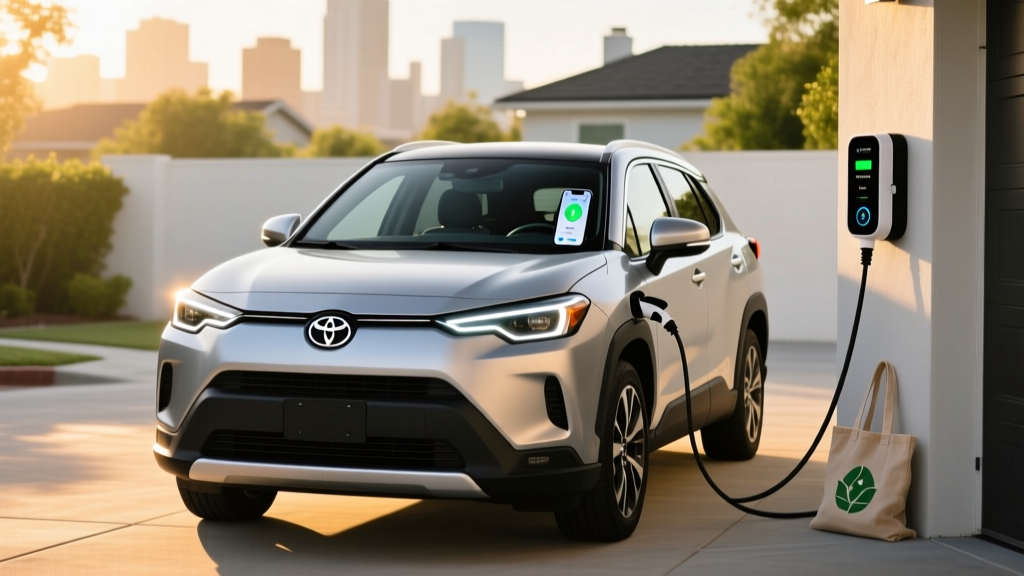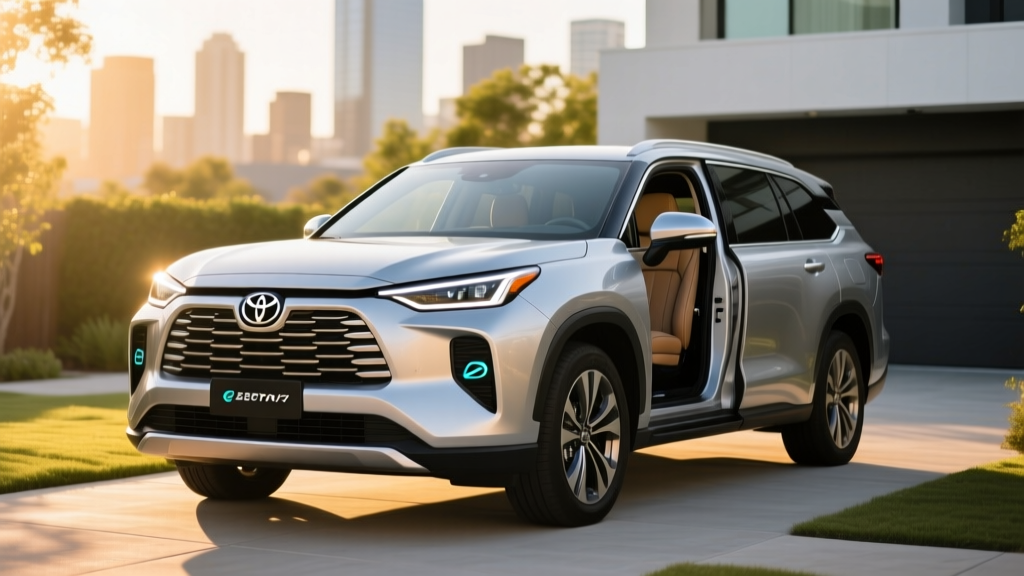
Toyota's three-row family hauler enters the 2027 model year with the same core mission: deliver genuine fuel savings over gas-only rivals without asking buyers to plug in or change habits. The 2027 Toyota Grand Highlander Hybrid pairs a 2.5-liter four-cylinder engine with Toyota's proven Hybrid Synergy Drive system to return class-leading MPG for a vehicle of its size. For buyers weighing a large SUV against rising fuel costs, the Grand Highlander Hybrid remains one of the most pragmatic choices on the market — no range anxiety, no charging infrastructure dependency, just consistent efficiency at every fill-up.
This guide covers the confirmed and projected specifications, real-world fuel economy behavior, battery longevity, tax-credit eligibility, and how the Grand Highlander Hybrid stacks up against plug-in hybrid and full-electric alternatives for family buyers.
Powertrain and Performance Specs
The 2027 Grand Highlander Hybrid uses Toyota's fourth-generation hybrid system, centered on a 2.5-liter inline-four Atkinson-cycle engine paired with front and rear electric motors for standard electronic all-wheel drive (AWD). This is a conventional hybrid (HEV), meaning the battery recharges through regenerative braking and engine power — there is no plug and no electric-only driving mode.
| Specification | Value |
|---|---|
| Powertrain | 2.5L I-4 + dual electric motors (eAWD) |
| Combined Horsepower | 245 hp |
| Transmission | eCVT (planetary gearset) |
| Drivetrain | Electronic AWD (standard) |
| Hybrid Battery | ~1.6 kWh NiMH (sealed, self-charging) |
| 0–60 mph | ~7.8 seconds |
| Towing Capacity | 3,500 lbs (estimated) |
| Seating | 7 or 8 passengers |
| Cargo Volume (behind 3rd row) | ~20.6 cu ft |
The eCVT is not a traditional belt-driven CVT — it uses a planetary gearset to blend engine and motor power seamlessly, which is why Toyota hybrids avoid the rubber-band acceleration feel that plagues some competitors. The 245 hp combined output is adequate for family duties and highway merging, though buyers seeking more aggressive acceleration should look at the Grand Highlander Hybrid MAX powertrain (a turbocharged 2.4L hybrid rated at 362 hp), which trades some efficiency for performance.
Fuel Economy: EPA Ratings vs. Real-World MPG
Fuel economy is the headline reason buyers choose the Grand Highlander Hybrid over the gas-only V6 or turbo four-cylinder variants. Based on the carryover powertrain architecture and Toyota's EPA data for the 2025–2026 Grand Highlander Hybrid, the 2027 model is expected to deliver nearly identical figures.
| Cycle | MPG |
|---|---|
| City | 36 MPG |
| Highway | 32 MPG |
| Combined | 34 MPG |
Toyota's hybrid system tends to exceed EPA city estimates in real-world driving because stop-and-go traffic maximizes regenerative braking and electric-motor assist. Owners routinely report 37–40 MPG in urban and suburban driving. Highway efficiency, however, often falls slightly below the EPA rating — expect 29–31 MPG at sustained 75+ mph speeds, where the gasoline engine carries more of the load. In cold weather (below 30°F), expect a 5–10% efficiency drop as the engine runs longer to heat the cabin and warm the catalytic converter.
For context, the gas-only Grand Highlander with the 2.4L turbo four-cylinder returns roughly 24 MPG combined. That's a 10 MPG gap — over 15,000 miles per year at $3.50/gallon, the hybrid saves roughly $650–$800 annually in fuel costs depending on driving mix.
Hybrid (HEV) vs. Plug-In Hybrid (PHEV) vs. Full EV: Which Fits Your Family?
The Grand Highlander is offered as a conventional hybrid (HEV). Toyota does not currently offer a plug-in hybrid (PHEV) version of the Grand Highlander in the U.S. market. Here's how the three electrified paths compare for a three-row family SUV buyer:
| Factor | Conventional Hybrid (HEV) | Plug-In Hybrid (PHEV) | Battery Electric (BEV) |
|---|---|---|---|
| Plug-in required? | No | Yes (for EV range) | Yes (always) |
| Electric-only range | None | 30–45 mi typical | 250–350+ mi |
| Total range | 550–600+ mi | 450–550+ mi | 250–350 mi |
| Home charging needed? | No | Recommended | Essential |
| Federal tax credit (§30D) | Not eligible | Up to $7,500 (if qualified) | Up to $7,500 (if qualified) |
| Maintenance complexity | Low (proven) | Moderate (two systems) | Lowest (no engine) |
| Best for | No home charger, road trips | Short commutes + road trips | Home charging + mostly local |
- You don't have access to home or workplace charging
- You regularly take road trips exceeding 300 miles
- You want maximum range without fuel-stop planning
- You want proven reliability with minimal ownership complexity
- Your daily commute is under 35 miles and you can charge at home
- You want electric-only driving for school runs and errands
- You still want gas-engine backup for longer trips
- You have reliable Level 2 home charging
- Most trips are under 250 miles or you're comfortable with DC fast charging
- You want the lowest per-mile fuel cost and zero tailpipe emissions
The key trade-off: the Grand Highlander Hybrid sacrifices the electric-only commute capability of a PHEV and the zero-emission operation of a BEV in exchange for absolute convenience — fill up at any gas station, no charging logistics, and over 580 miles of total range on a single tank.
Pricing, Trims, and Tax Credit Eligibility
The 2027 Toyota Grand Highlander Hybrid is expected to carry pricing close to the outgoing model year, with modest adjustments for inflation and feature additions.
| Trim | Est. MSRP |
|---|---|
| XLE (base hybrid) | $47,500 |
| Limited | $52,000 |
| Nightshade | $53,500 |
| Platinum | $56,500 |
Federal tax credit status: The conventional Grand Highlander Hybrid (HEV) does not qualify for the federal §30D clean vehicle tax credit. Under current IRS rules, the §30D credit applies only to plug-in electric vehicles (PHEVs and BEVs) that meet battery-sourcing, critical-mineral, MSRP cap, and buyer income requirements. Since the Grand Highlander Hybrid cannot be plugged in and has a battery under 7 kWh, it is ineligible.
Some states and local utilities offer rebates for conventional hybrids, but these are increasingly rare as incentive programs shift toward plug-in vehicles. Check your state energy office or utility provider for any current hybrid-specific programs.
Battery Longevity, Warranty, and Replacement Cost
Battery lifespan is consistently the top concern for first-time hybrid buyers. Toyota's track record here is among the strongest in the industry — the Prius, Camry Hybrid, and Highlander Hybrid have accumulated decades of real-world data demonstrating hybrid battery durability well beyond warranty periods.
- Coverage: 10 years / 150,000 miles (whichever comes first)
- What's covered: Hybrid battery pack, battery control module, inverter
- Capacity threshold: Toyota warrants the battery against defects and abnormal degradation — unlike BEV warranties, there is no published minimum capacity-retention percentage for HEVs since the battery is small and constantly cycled in a shallow state-of-charge window
- Transferable: Yes, warranty transfers to subsequent owners
The Grand Highlander Hybrid's ~1.6 kWh nickel-metal hydride (NiMH) battery operates in a narrow state-of-charge band — typically between 40% and 80% — which drastically reduces stress on the cells compared to a full EV battery that cycles from 10% to 90%. This shallow-cycling strategy is why Toyota hybrid batteries routinely last 150,000–200,000+ miles before any service is needed.
Replacement cost: If the hybrid battery does eventually need replacement outside of warranty, expect to pay $3,000–$5,000 for a new OEM battery pack installed at a Toyota dealer. Refurbished or reconditioned packs are available from third-party suppliers for $1,500–$2,500. Individual module replacement (only the failed cells) can cost as little as $500–$1,000 at a hybrid-specialist shop.
For comparison, a full EV battery replacement runs $10,000–$20,000+. The hybrid's smaller, shallower-cycled battery is both cheaper to replace and far less likely to need it within typical ownership periods.
Reliability and Safety Ratings
Toyota's hybrid powertrains are among the most reliable in the automotive industry. The eCVT planetary gearset has no belts, clutches, or friction bands to wear out — it's a simple, robust mechanical design. The gasoline engine operates under reduced stress because the electric motors handle initial acceleration loads, which is the highest-wear phase for any internal combustion engine.
The Grand Highlander platform earned strong safety marks from NHTSA and the IIHS in prior model years, with standard Toyota Safety Sense 3.0 including pre-collision braking, lane-departure alert, adaptive cruise control, and automatic high beams. These ADAS features are SAE Level 1–2 driver-assistance — they do not replace an attentive driver.
Key reliability advantages specific to the hybrid powertrain:
- Regenerative braking reduces wear on the friction brake pads and rotors — many Toyota hybrid owners report original brake pads lasting 80,000–100,000 miles
- No traditional starter motor — the hybrid system starts the engine via the MG1 motor-generator, eliminating a common failure point
- No alternator — the hybrid system handles all 12V charging duties through a DC-DC converter
- Engine auto-stop at lights and in low-load conditions reduces total engine runtime hours versus a gas-only vehicle
Grand Highlander Hybrid vs. Hybrid MAX: Efficiency or Power?
Toyota offers two distinct hybrid powertrains in the Grand Highlander, and choosing between them depends on your priorities:
| Attribute | 2.5L Hybrid (HEV) | Hybrid MAX (Turbo) |
|---|---|---|
| Engine | 2.5L I-4 naturally aspirated | 2.4L I-4 turbocharged |
| Combined HP | 245 hp | 362 hp |
| EPA Combined MPG | 34 MPG | 27 MPG |
| 0–60 mph | ~7.8 sec | ~6.3 sec |
| Towing Capacity | 3,500 lbs | 5,000 lbs |
| AWD Type | Electronic (eAWD) | Full-time mechanical AWD |
| Best For | Daily commuting, max efficiency | Towing, performance, mountain driving |
The standard hybrid delivers a 7 MPG advantage in combined driving — roughly $400–$500 in annual fuel savings for the average driver. The Hybrid MAX gives you genuine towing capability and highway-passing confidence but sacrifices the efficiency edge that draws most buyers to the hybrid badge. For families who rarely tow and prioritize fuel cost savings, the 245 hp standard hybrid is the clear recommendation.
Ownership Costs: 5-Year Projection
| Category | Estimated Cost |
|---|---|
| Purchase price (MSRP) | $47,500 |
| Fuel (34 MPG avg, $3.50/gal) | $7,720 |
| Insurance (national avg) | $9,500 |
| Maintenance (hybrid-reduced) | $2,800 |
| Estimated depreciation | $18,000 |
| Total 5-year cost | ~$85,520 |
Compared to the gas-only Grand Highlander (24 MPG combined), the hybrid saves approximately $3,400 in fuel over five years. Toyota hybrids also tend to hold resale value well — the Highlander nameplate consistently ranks among the best-retained values in the midsize SUV segment, which helps offset the slightly higher initial purchase price.
Frequently Asked Questions
How many MPG does the 2027 Toyota Grand Highlander Hybrid get?
The projected EPA ratings are 36 MPG city, 32 MPG highway, and 34 MPG combined. Real-world city driving often exceeds the EPA estimate, reaching 37–40 MPG in stop-and-go traffic. Highway driving at 75+ mph typically returns 29–31 MPG.
Does the Grand Highlander Hybrid need to be plugged in?
No. The Grand Highlander Hybrid is a conventional (self-charging) hybrid. The battery recharges through regenerative braking and the gasoline engine. There is no plug, no charging cable, and no electric-only driving mode.
Does the 2027 Grand Highlander Hybrid qualify for a federal tax credit?
No. The federal §30D clean vehicle credit applies only to plug-in vehicles (PHEVs and BEVs) that meet specific battery-sourcing, MSRP, and income requirements. The conventional hybrid is not eligible. Some state or utility programs may offer smaller hybrid incentives — check locally.
How long will the hybrid battery last?
Toyota warranties the hybrid battery for 10 years or 150,000 miles. Real-world data from Toyota's hybrid lineup shows batteries regularly lasting 150,000–200,000+ miles. The shallow-cycling design (battery stays between ~40–80% charge) minimizes degradation.
What does a hybrid battery replacement cost?
A new OEM hybrid battery pack costs $3,000–$5,000 installed at a dealer. Refurbished packs run $1,500–$2,500, and individual module replacement at a hybrid specialist can cost $500–$1,000.
Hybrid vs. PHEV vs. EV — which is right for a three-row family SUV?
If you lack home charging access or regularly drive 300+ miles without stopping, the conventional hybrid (HEV) offers the most convenience. If you can charge at home and your daily driving is under 35 miles, a PHEV like the RAV4 Prime gives you electric-only commuting with gas backup. If you have reliable home charging and mostly drive under 250 miles, a full EV like the Kia EV9 delivers the lowest operating cost but requires trip planning for longer journeys.
Is the Grand Highlander Hybrid reliable?
Toyota's hybrid powertrain is one of the most proven and reliable systems in the industry. The eCVT has no wearable belts or clutches, regenerative braking extends brake life, and the engine operates under reduced stress. Toyota's 10-year/150,000-mile hybrid battery warranty provides long-term peace of mind.