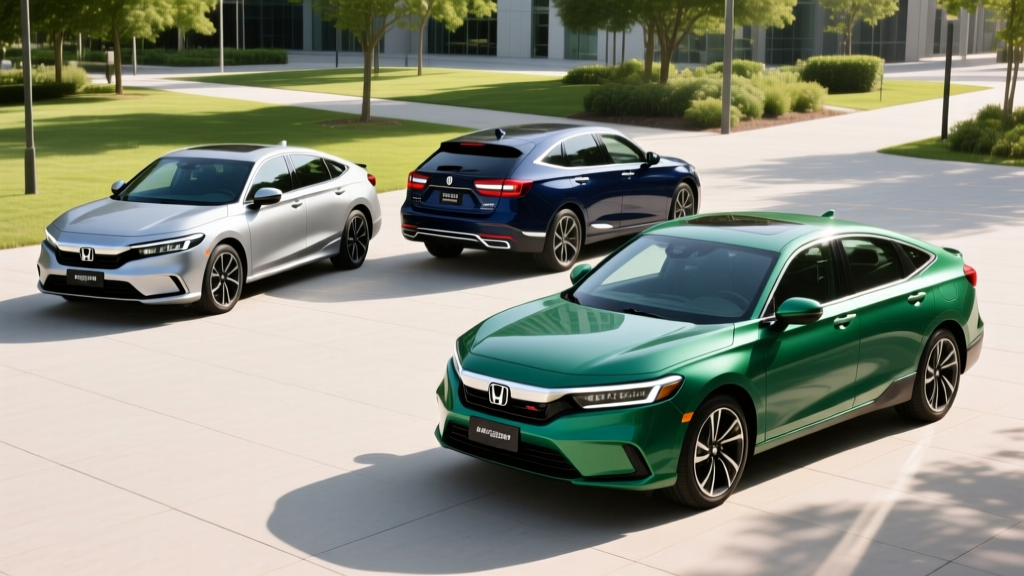
If you're researching Honda hybrid models in 2026, you're looking at a lineup that has quietly become one of the most fuel-efficient in the mainstream market — without requiring a plug, a lifestyle change, or a five-figure battery replacement anxiety. Honda currently offers three core hybrid nameplates in the U.S.: the CR-V Hybrid, the Accord Hybrid, and the Civic Hybrid. All three use Honda's fourth-generation two-motor hybrid system, and all three are conventional hybrids (HEVs), not plug-ins. That distinction matters enormously for your wallet, your daily routine, and your expectations at the pump.
This guide breaks down every current Honda hybrid with exact EPA figures, real-world fuel economy observations, powertrain specs, pricing by trim, battery warranty details, and tax credit reality. Whether you're cross-shopping against a Toyota RAV4 Hybrid, a Hyundai Sonata Hybrid, or a full battery-electric vehicle, you'll leave with the numbers you need to decide.
Understanding Honda's Hybrid Lineup: HEV, Not PHEV
Before diving into individual models, it's essential to clarify what Honda sells — and what it doesn't. Every current Honda hybrid in the U.S. market is a conventional hybrid electric vehicle (HEV). These vehicles pair a gasoline engine with one or more electric motors and a small battery pack (typically 1.0–1.5 kWh). The battery recharges through regenerative braking and engine power. You never plug in an HEV. You simply fuel it with gasoline and drive.
A plug-in hybrid electric vehicle (PHEV), by contrast, carries a much larger battery (typically 12–20+ kWh), offers 25–50 miles of electric-only driving, and requires plugging in to realize its full efficiency benefit. Honda's only recent PHEV offering, the Clarity Plug-In Hybrid, was discontinued after the 2021 model year. As of 2026, Honda does not sell a PHEV in the United States.
HEV vs. PHEV: What Honda Buyers Need to Know
| Feature | Honda HEV (Current Models) | PHEV (e.g., Toyota RAV4 Prime) |
|---|---|---|
| Plug-in required? | No — gasoline only | Yes — for EV range benefit |
| Battery capacity | ~1.0–1.5 kWh | 12–20+ kWh |
| Electric-only range | Less than 1 mile (low-speed assist) | 25–50 miles typical |
| Federal tax credit (§30D) | Not eligible | Up to $7,500 (if eligible) |
| Home charging needed? | No | Yes, for meaningful EV usage |
| Typical price premium over gas | $1,000–$2,500 | $5,000–$10,000+ |
The practical upshot: Honda hybrids are ideal for drivers who want significantly better fuel economy without altering their fueling habits. If you need electric-only commuting range or want to chase the federal tax credit, you'll need to look outside Honda's current lineup.
2026 Honda CR-V Hybrid: MPG, Specs & Pricing
The CR-V Hybrid is Honda's best-selling electrified vehicle and one of the most popular hybrid SUVs in America. For 2026, it continues with the two-motor hybrid system built around a 2.0-liter Atkinson-cycle four-cylinder engine. Honda offers the hybrid powertrain exclusively on the Sport and Sport Touring trims, making the hybrid the more feature-rich choice in the CR-V range.
| Specification | Value |
|---|---|
| Powertrain | 2.0L Atkinson I-4 + two-motor hybrid system |
| Combined horsepower | 204 hp |
| Combined torque | 247 lb-ft |
| Drivetrain | FWD (Sport) / AWD (Sport Touring) |
| EPA MPG (FWD) | 43 city / 36 highway / 40 combined |
| EPA MPG (AWD) | 40 city / 34 highway / 37 combined |
| Battery type | Lithium-ion, ~1.06 kWh |
| 0–60 mph | ~7.6 seconds (AWD) |
| Cargo volume | 36.3 cu ft (rear seats up) |
| Towing capacity | 1,000 lbs |
| Base MSRP (Sport FWD) | $36,395 |
| Top MSRP (Sport Touring AWD) | $42,895 |
Real-World MPG: CR-V Hybrid
The EPA rates the AWD CR-V Hybrid at 37 MPG combined, but real-world results tend to skew higher in city driving — where the hybrid system recovers the most energy through regenerative braking. In mixed suburban and city driving, owners consistently report 38–42 MPG. Highway-only trips at 75+ mph, however, typically yield 32–35 MPG, since the gasoline engine does most of the work at sustained speed. In cold weather (below 30°F), expect a 3–5 MPG reduction due to increased engine idling for cabin heat and reduced battery efficiency.
CR-V Hybrid Battery Warranty
Honda covers the CR-V Hybrid's high-voltage battery for 8 years or 100,000 miles (whichever comes first) in most states. In California Air Resources Board (CARB) states — including California, New York, Massachusetts, and several others — that coverage extends to 10 years or 150,000 miles. Hybrid battery replacement cost, if needed out of warranty, typically ranges from $2,000 to $4,000 including labor, though failures before 150,000 miles are uncommon based on long-term Honda hybrid reliability data.
2026 Honda Accord Hybrid: Efficiency Meets Midsize Sedan Comfort
The Accord Hybrid returns for 2026 as one of the most efficient midsize sedans available, rivaling the Toyota Camry Hybrid and Hyundai Sonata Hybrid. Honda offers the hybrid powertrain on the Sport-L and EX-L trims (and the range-topping Sport-L Hybrid), pairing the same 2.0L Atkinson-cycle engine with the two-motor system.
| Trim | City MPG | Highway MPG | Combined MPG |
|---|---|---|---|
| Sport-L Hybrid | 51 | 44 | 48 |
| EX-L Hybrid | 51 | 44 | 48 |
| Specification | Value |
|---|---|
| Powertrain | 2.0L Atkinson I-4 + two-motor hybrid system |
| Combined horsepower | 204 hp |
| Combined torque | 247 lb-ft |
| Drivetrain | FWD only |
| Battery type | Lithium-ion, ~1.06 kWh |
| 0–60 mph | ~7.0 seconds |
| Cargo volume | 16.7 cu ft |
| Base MSRP (Sport-L Hybrid) | $35,490 |
| Top MSRP (EX-L Hybrid) | $38,990 |
Real-World MPG: Accord Hybrid
The Accord Hybrid's 48 MPG combined EPA rating is among the highest for any non-plug-in midsize sedan. In real-world city driving, the Accord Hybrid regularly exceeds its sticker — many drivers report 50–54 MPG in stop-and-go traffic below 45 mph, where the electric motor handles most propulsion. Highway driving at 70 mph yields closer to 42–45 MPG. For a commuter who spends most of their miles in urban or suburban traffic, the Accord Hybrid is arguably the best-value vehicle Honda sells.
2026 Honda Civic Hybrid: The Compact Efficiency Champion
Reintroduced for the 2025 model year after a brief hiatus, the Civic Hybrid continues into 2026 as the most fuel-efficient vehicle Honda offers. Available in both sedan and (select markets) hatchback body styles, the Civic Hybrid uses a slightly detuned version of the same two-motor system found in the larger Accord and CR-V.
| Body Style | City MPG | Highway MPG | Combined MPG |
|---|---|---|---|
| Sedan (Sport Hybrid) | 50 | 47 | 49 |
| Sedan (Sport Touring Hybrid) | 50 | 45 | 48 |
| Specification | Value |
|---|---|
| Powertrain | 2.0L Atkinson I-4 + two-motor hybrid system |
| Combined horsepower | 200 hp |
| Combined torque | 232 lb-ft |
| Drivetrain | FWD only |
| Battery type | Lithium-ion, ~1.06 kWh |
| 0–60 mph | ~7.4 seconds |
| Cargo volume (sedan) | 14.8 cu ft |
| Base MSRP (Sport Hybrid) | $30,845 |
| Top MSRP (Sport Touring Hybrid) | $34,845 |
Real-World MPG: Civic Hybrid
With a 49 MPG combined EPA rating, the Civic Hybrid sedan is a standout. In city-heavy driving, real-world figures of 52–55 MPG are common. On the highway at 75 mph, expect 43–46 MPG. The Civic Hybrid's lighter curb weight (roughly 3,200 lbs) gives it a measurable efficiency edge over the Accord Hybrid in nearly every scenario. For single drivers or couples without large cargo needs, this is the most fuel you can extract from a Honda without plugging in.
Honda Hybrid Tax Credit & Incentive Reality
Here's where the HEV vs. PHEV distinction directly impacts your wallet: conventional hybrids like the CR-V, Accord, and Civic Hybrid do not qualify for the federal §30D Clean Vehicle tax credit. That credit — up to $7,500 — is reserved for battery-electric vehicles (BEVs) and plug-in hybrids (PHEVs) that meet specific battery sourcing, critical mineral, MSRP cap, and buyer income requirements as defined by the IRS under current §30D rules.
Federal §30D Tax Credit — Why Honda Hybrids Don't Qualify
- ✗ Vehicle must be a BEV or PHEV with ≥4 kWh battery capacity — Honda HEVs have ~1 kWh
- ✗ Vehicle must have external charging capability — Honda HEVs charge only via engine/regen
- ✓ Honda hybrids may qualify for certain state-level incentives (varies by jurisdiction — check your state's energy or DMV website)
- ✓ Some utilities offer rebates for hybrid purchases — check with your local provider
While the lack of a federal tax credit stings compared to a qualifying PHEV like the Toyota RAV4 Prime or a BEV like the Hyundai Ioniq 5, the equation changes when you factor in total cost. A Honda hybrid costs $1,000–$2,500 more than its gasoline-only counterpart, not $5,000–$10,000 more like many PHEVs. The fuel savings alone — typically $500–$900 per year depending on mileage and local gas prices — often pay back the hybrid premium within 2–4 years without any government incentive.
Honda Hybrid Reliability & Battery Longevity
Honda's hybrid systems have proven among the most reliable in the industry. The two-motor architecture is mechanically simpler than traditional planetary-gear hybrid transmissions (like Toyota's eCVT), using a clutch-based system that seamlessly transitions between electric drive, hybrid drive, and engine-direct drive modes. There is no conventional multi-speed automatic transmission in a Honda hybrid — fewer moving parts means fewer failure points.
Based on data from Honda's long-running hybrid vehicles (the Accord Hybrid has been sold in various generations since 2005), hybrid battery degradation is minimal. Most owners report less than 5% capacity loss over 100,000 miles. Complete battery failures before the warranty period expires are rare. According to IIHS safety ratings, Honda's hybrid models maintain top safety scores, adding to their long-term ownership appeal.
| Detail | Value |
|---|---|
| Federal emissions warranty (all states) | 8 years / 100,000 miles |
| CARB-state extended warranty | 10 years / 150,000 miles |
| Typical battery replacement cost (out of warranty) | $2,000 – $4,000 |
| Expected battery lifespan | 150,000 – 200,000+ miles |
| Powertrain warranty (engine + motor) | 5 years / 60,000 miles |
Honda Hybrid vs. Full EV vs. Gas: Which Should You Choose?
Decision Framework: Honda Hybrid, Full EV, or Gasoline?
Choose a Honda Hybrid (HEV) if:
- You want 40–49 MPG without changing your fueling routine
- You don't have access to home Level 2 charging
- You take frequent road trips and don't want to plan around charging stations
- You want a modest price premium ($1,000–$2,500) over a gas model
- You live in an area with sparse public charging infrastructure
Choose a full EV (BEV) if:
- You can install a Level 2 home charger (240V)
- Your daily commute is under 200 miles round-trip
- You want to qualify for the $7,500 federal tax credit (eligibility varies — check IRS §30D requirements)
- You want zero tailpipe emissions and lower per-mile "fuel" cost (electricity vs. gasoline)
- You're willing to plan longer road trips around DC fast charging
Choose a PHEV (not currently offered by Honda) if:
- You want 25–50 miles of electric-only commuting AND unlimited gas range for road trips
- You have home charging access and a short daily commute
- You want to qualify for the federal tax credit
- You're willing to pay a $5,000–$10,000 premium over a gas vehicle
Stick with gasoline if:
- You drive fewer than 8,000 miles per year (fuel savings won't offset hybrid premium)
- Your budget is strictly under $28,000 (no Honda hybrid starts this low)
- You plan to keep the vehicle fewer than 3 years
Honda Hybrid Models Compared: Side-by-Side
| Attribute | Civic Hybrid | Accord Hybrid | CR-V Hybrid |
|---|---|---|---|
| Body style | Compact sedan | Midsize sedan | Compact SUV |
| Combined HP | 200 hp | 204 hp | 204 hp |
| EPA combined MPG | 48–49 | 48 | 37–40 |
| Drivetrain | FWD | FWD | FWD or AWD |
| 0–60 mph | ~7.4 sec | ~7.0 sec | ~7.6 sec (AWD) |
| Cargo (rear seats up) | 14.8 cu ft | 16.7 cu ft | 36.3 cu ft |
| Starting MSRP | $30,845 | $35,490 | $36,395 |
| Federal tax credit | Not eligible | Not eligible | Not eligible |
| Battery warranty | 8 yr/100k mi | 8 yr/100k mi | 8 yr/100k mi |
Source: EPA fuel economy data via fueleconomy.gov; MSRP from Honda's official 2026 model-year pricing.
Pros of Honda Hybrids
- Class-leading fuel economy — up to 49 MPG combined (Civic)
- No plug-in required — zero lifestyle change from a gas car
- Proven reliability with 8–10 year battery warranty
- Modest price premium over gasoline trims ($1,000–$2,500)
- Strong regenerative braking provides smooth one-pedal-like deceleration
- Available AWD on CR-V Hybrid (rare in the hybrid SUV segment at this price)
Cons of Honda Hybrids
- No federal tax credit eligibility (HEV, not PHEV/BEV)
- No electric-only driving range — always burns gasoline
- No PHEV option in Honda's current U.S. lineup
- AWD only available on CR-V (not Accord or Civic)
- Highway MPG advantage diminishes vs. efficient gas models at sustained 75+ mph
- Towing capacity limited to 1,000 lbs (CR-V Hybrid)
Frequently Asked Questions
How many MPG do Honda hybrid models get?
The 2026 Civic Hybrid leads at 49 MPG combined (50 city / 47 highway). The Accord Hybrid achieves 48 MPG combined (51 city / 44 highway). The CR-V Hybrid delivers 37–40 MPG combined depending on FWD or AWD configuration. In real-world city driving, all three models typically exceed their EPA city ratings by 2–5 MPG thanks to aggressive regenerative braking.
Do Honda hybrids need to be plugged in?
No. All current Honda hybrids are conventional hybrids (HEVs). The battery charges automatically through regenerative braking and the gasoline engine. You never plug in — you simply fill up at a gas station as you would with any conventional vehicle.
Does any Honda hybrid qualify for a federal tax credit?
No. The federal §30D Clean Vehicle Credit requires a vehicle to be a battery-electric vehicle (BEV) or plug-in hybrid (PHEV) with at least 4 kWh of battery capacity and external charging capability. Honda's hybrids have ~1 kWh batteries and no plug, making them ineligible. Check IRS.gov for current credit rules, and consult a tax professional for personal eligibility.
How long will a Honda hybrid battery last, and what does replacement cost?
Honda hybrid batteries are designed to last 150,000–200,000+ miles with minimal degradation. They're covered by an 8-year/100,000-mile warranty in most states and 10-year/150,000-mile warranty in CARB states. Out-of-warranty replacement typically costs $2,000–$4,000 including labor, though complete failures are uncommon based on long-term ownership data.
Is the Honda CR-V Hybrid available with AWD?
Yes. The CR-V Hybrid Sport Touring trim comes standard with all-wheel drive. The Sport trim is available in FWD. The Accord Hybrid and Civic Hybrid are FWD only.
Honda hybrid vs. Toyota hybrid — which is more efficient?
It depends on the model. The 2026 Honda Civic Hybrid (49 MPG combined) edges out the Toyota Corolla Hybrid (50–53 MPG combined, depending on trim and FWD/AWD). The Honda Accord Hybrid (48 MPG) trades blows with the Toyota Camry Hybrid (up to 51 MPG combined). The CR-V Hybrid (37–40 MPG) is closely matched with the RAV4 Hybrid (39–41 MPG). In practice, the differences are small enough that features, pricing, and dealer proximity should drive your decision.
Will Honda release a plug-in hybrid (PHEV) in the U.S.?
As of 2026, Honda has not announced a PHEV for the U.S. market. The company discontinued the Clarity Plug-In Hybrid after 2021 and has focused its electrification strategy on conventional hybrids (near-term) and full battery-electric vehicles (long-term, including the Prologue SUV and upcoming models on the Honda 0 Series platform). If PHEV capability is essential to your purchase, you'll need to look at competitors like Toyota, Hyundai, or Jeep.