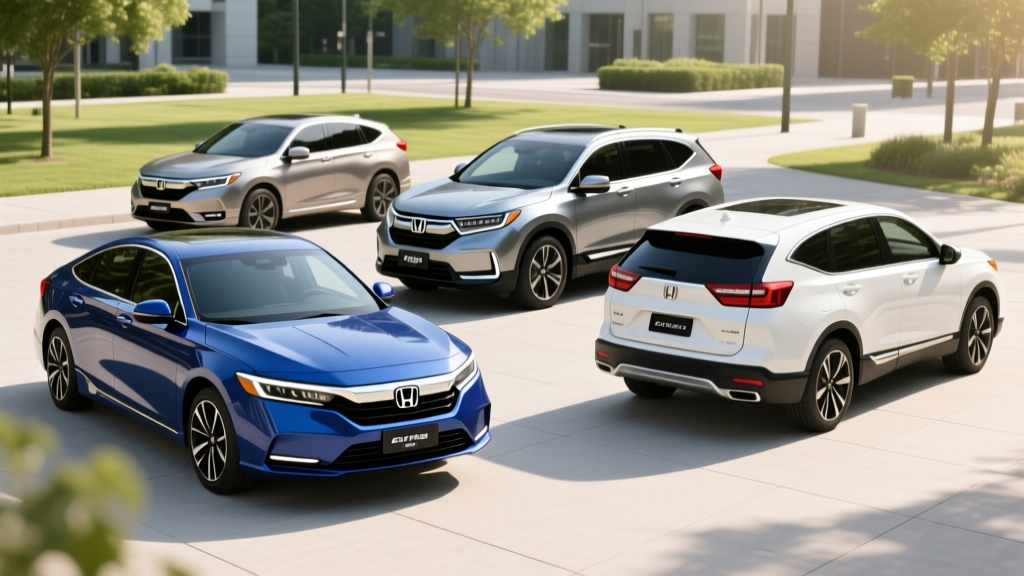
Honda's hybrid strategy in 2025 leans heavily on conventional hybrids (HEVs) rather than plug-ins. If you're researching Honda hybrid models 2025, you'll find four core offerings — the Accord Hybrid, Civic Hybrid, CR-V Hybrid, and the all-new CR-V e:FCEV plug-in — each targeting a different buyer. This guide breaks down every powertrain with exact EPA numbers, real-world expectations, pricing, and whether any qualify for federal tax credits.
HEV vs PHEV: What Honda Actually Offers in 2025
Conventional Hybrid (HEV): Charges itself through regenerative braking and the gas engine. You never plug it in. Honda's Accord, Civic, and CR-V hybrids are all HEVs. Expect 40-50 MPG combined with no behavior change required.
Plug-in Hybrid (PHEV): Has a larger battery you charge via a wall outlet or public charger, giving 20-40 miles of electric-only driving before the gas engine kicks in. Honda's 2025 PHEV offering is limited — the CR-V e:FCEV uses a hydrogen fuel cell with a plug-in battery, not a traditional PHEV powertrain. If you want a conventional PHEV from Honda, you'll need to look at prior model years or wait for announced future models.
This matters because many shoppers confuse the two. Honda's current 2025 lineup is firmly HEV-focused, which is a deliberate choice: HEVs cost less upfront, don't require home charging infrastructure, and deliver strong fuel economy for drivers who can't or won't plug in.
2025 Honda Accord Hybrid: The Efficiency Flagship
The Accord Hybrid remains Honda's most fuel-efficient sedan and one of the best midsize hybrid sedans on the market. For 2025, it uses a 2.0-liter Atkinson-cycle four-cylinder paired with a two-motor hybrid system producing a combined 204 horsepower.
| Spec | 2025 Accord Hybrid |
|---|---|
| Powertrain | 2.0L 4-cyl + 2-motor hybrid (HEV) |
| Combined HP | 204 hp |
| EPA City / Highway / Combined | 51 / 44 / 48 MPG |
| 0-60 mph | ~7.0 seconds |
| Battery | 1.3 kWh lithium-ion (self-charging) |
| Starting MSRP | $34,750 (Sport Hybrid) |
| Federal Tax Credit | None (HEVs do not qualify for §30D) |
Real-world MPG: The Accord Hybrid's EPA rating of 48 MPG combined is conservative for city driving. In stop-and-go traffic, the electric motors do most of the work, and owners routinely report 50-54 MPG in urban conditions. Highway cruising at 75+ MPH drops efficiency to roughly 42-44 MPG. In cold weather (below 35°F), expect a 3-5 MPG reduction as the engine runs more frequently for cabin heat.
The Accord Hybrid is available in Sport Hybrid, Sport-L Hybrid, and EX-L Hybrid trims. All trims share the same powertrain and EPA ratings. Honda Sensing (adaptive cruise, lane keeping, automatic emergency braking) is standard across the lineup.
2025 Honda Civic Hybrid: The Compact Value Pick
Reintroduced for the 2025 model year after a hiatus, the Civic Hybrid brings the Accord's hybrid philosophy to the compact segment. It pairs a 2.0-liter direct-injected four-cylinder with Honda's two-motor e:HEV system for a combined 200 horsepower — making it one of the more powerful compact hybrids available.
| Trim | City MPG | Highway MPG | Combined MPG | MSRP |
|---|---|---|---|---|
| Civic Hybrid Sport | 50 | 47 | 49 | $30,750 |
| Civic Hybrid Sport Touring | 50 | 47 | 49 | $33,750 |
Source: fueleconomy.gov
Real-world MPG: The Civic Hybrid's 49 MPG combined EPA rating holds up well in mixed driving. City-heavy commutes push it into the low 50s. Highway efficiency at 70 MPH averages around 45-46 MPG. Like the Accord, cold weather trims a few MPG off the top.
The Civic Hybrid comes exclusively as a sedan (no coupe for 2025) and slots between the gas-powered Civic EX and the performance-oriented Civic Si in Honda's lineup. It's a compelling alternative to the Toyota Corolla Hybrid (50/43/47 MPG, $23,750 base) for buyers who want more horsepower and a more engaging drive.
2025 Honda CR-V Hybrid: The Family SUV Choice
The CR-V Hybrid is Honda's best-selling electrified model and one of the top hybrid compact SUVs in the US. The 2025 model continues with a 2.0-liter Atkinson-cycle engine and dual-motor system producing 204 combined horsepower, with available all-wheel drive.
| Spec | CR-V Hybrid FWD | CR-V Hybrid AWD |
|---|---|---|
| Combined HP | 204 hp | 204 hp |
| EPA City | 43 MPG | 40 MPG |
| EPA Highway | 36 MPG | 34 MPG |
| EPA Combined | 40 MPG | 37 MPG |
| Cargo Volume | 39.3 cu ft (rear seats up) | 39.3 cu ft |
| Towing Capacity | 1,000 lbs | 1,000 lbs |
| Starting MSRP | $36,200 (Sport) | $37,700 (Sport AWD) |
Source: automobiles.honda.com
Real-world MPG: The CR-V Hybrid AWD's 37 MPG combined EPA figure is realistic for mixed suburban driving. City driving with frequent stops can reach 39-41 MPG thanks to regenerative braking. Highway cruising at 75 MPH yields approximately 33-34 MPG. AWD models lose about 3 MPG vs FWD across all driving conditions — a meaningful trade-off if you don't need all-wheel traction.
For 2025, the CR-V Hybrid is available in Sport, Sport-L, and Sport Touring trims. The Sport Touring adds a 9-inch touchscreen with wireless Apple CarPlay/Android Auto, a Bose 12-speaker audio system, and a hands-free power tailgate.
2025 Honda CR-V e:FCEV: Honda's Plug-in Wild Card
The CR-V e:FCEV is not a traditional PHEV — it's a hydrogen fuel cell vehicle with a plug-in battery. Honda introduced it for 2024 in limited markets (California only) and continues it for 2025. It combines a hydrogen fuel cell stack with a 17.7 kWh plug-in battery that provides approximately 29 miles of electric-only range before the fuel cell takes over.
CR-V e:FCEV Key Specs:
- Battery: 17.7 kWh lithium-ion (plug-in capable)
- Electric-only range: ~29 miles (EPA)
- Level 2 charge time: ~2.5 hours (0-100%)
- DC fast charging: Not available
- Hydrogen range: ~270 miles (total range ~300 miles)
- MSRP: Lease-only, approximately $599/month
This vehicle is only available in California due to hydrogen station infrastructure limitations. If you live outside California, this model is not an option.
For most Honda hybrid shoppers, the e:FCEV is an interesting footnote rather than a practical choice. Honda's core 2025 hybrid lineup — the Accord, Civic, and CR-V HEVs — serves the vast majority of buyers looking for fuel savings without plugging in.
Honda Hybrid Battery Warranty, Reliability & Replacement Cost
Honda's hybrid battery warranty is among the strongest in the industry and a key reason buyers trust the brand's electrified lineup.
Honda Hybrid Battery Warranty (2025 Models):
- Duration: 8 years / 100,000 miles (whichever comes first) in most states
- Extended in CARB states: 10 years / 150,000 miles in states that follow California Air Resources Board emissions standards (CA, CO, CT, ME, MD, MA, NJ, NY, OR, RI, VT, WA, and others)
- Coverage threshold: Battery must retain sufficient capacity to function; Honda covers repair or replacement if it fails to meet performance standards
Reliability data: Honda's hybrid systems have proven durable. The two-motor e:HEV system used in the Accord and CR-V has been in production since 2017 (third-generation IMA predecessor dates back further). There are no widespread reports of premature hybrid battery failure in current-generation models.
Replacement cost: If your hybrid battery fails outside warranty, replacement costs for a Honda hybrid battery pack range from $2,000 to $4,000 including labor, depending on the model. This is significantly less than a full EV battery replacement ($8,000-$20,000+) because hybrid battery packs are much smaller (1-2 kWh vs 60-100 kWh).
Tax Credits: What Honda Hybrids Qualify For
Here's the straightforward answer: none of Honda's 2025 conventional hybrids (Accord, Civic, CR-V HEV) qualify for the federal §30D clean vehicle tax credit. The IRS restricts the $7,500 credit to battery electric vehicles (BEVs) and plug-in hybrids (PHEVs) that meet battery capacity, critical mineral sourcing, and MSRP requirements. Source: irs.gov.
| Model | Type | Federal §30D Credit | Notes |
|---|---|---|---|
| Accord Hybrid | HEV | $0 | Conventional hybrids are ineligible |
| Civic Hybrid | HEV | $0 | Conventional hybrids are ineligible |
| CR-V Hybrid | HEV | $0 | Conventional hybrids are ineligible |
| CR-V e:FCEV | FCEV/PHEV | Potentially eligible | Lease-only; credit typically passes through lessor |
State incentives: Some states offer their own rebates for hybrids. For example, certain utility companies offer $250-$500 rebates for purchasing any hybrid vehicle. Check your state's energy office or local utility for current programs. These vary widely by jurisdiction and change frequently.
Honda Hybrid vs PHEV vs Full EV: Which Fits You?
Choose a Honda HEV (Accord, Civic, or CR-V Hybrid) if:
- You can't install a home charger (apartment, street parking, no garage)
- You want zero behavior change — just fill up with gas less often
- Your budget is $30,000-$40,000 and you want proven reliability
- You drive 12,000-15,000 miles/year and want to cut fuel costs by 35-50%
Choose a PHEV (from another brand — Honda doesn't offer one in 2025) if:
- You can charge at home (Level 2 outlet) and want 25-40 miles of daily electric commuting
- You regularly take longer road trips where EV charging infrastructure is sparse
- You want to qualify for the $7,500 federal tax credit
- Consider: Toyota RAV4 Prime (42 mi electric, $44,000), Hyundai Tucson PHEV (33 mi electric, $39,000)
Choose a full EV if:
- You have reliable home charging (Level 2, 240V)
- Your daily driving is under 250 miles and you're comfortable with public DC fast charging for road trips
- You want the lowest per-mile fuel cost (~$0.04/mi electricity vs ~$0.12/mi hybrid gas)
- You want to maximize the $7,500 federal tax credit and state EV incentives
Honda's 2025 hybrid lineup is purpose-built for the largest segment of buyers: those who want meaningful fuel savings without the complexity, cost, or infrastructure requirements of plug-in vehicles. If you can charge at home and want maximum savings, a BEV or PHEV may serve you better. If you want simplicity and proven technology, Honda's HEVs are among the best in the market.
Frequently Asked Questions
How many MPG does the 2025 Honda Accord Hybrid get in real driving?
The EPA rates the Accord Hybrid at 51 city / 44 highway / 48 combined. In real-world city driving with frequent stops, owners regularly achieve 50-54 MPG. Highway driving at 75+ MPH drops to about 42-44 MPG. Cold weather (below 35°F) reduces efficiency by roughly 3-5 MPG across all conditions.
Does Honda make a plug-in hybrid in 2025?
Not in the traditional sense. Honda's only plug-in offering is the CR-V e:FCEV, which is a hydrogen fuel cell vehicle with a plug-in battery — available only in California as a lease. Honda does not currently sell a conventional PHEV (like the Toyota RAV4 Prime or Ford Escape PHEV) in the US market for 2025.
Is the Honda hybrid battery expensive to replace?
Out-of-warranty hybrid battery replacement costs $2,000-$4,000 depending on the model. However, Honda's hybrid battery warranty covers 8 years/100,000 miles (10 years/150,000 miles in CARB states), and real-world failure rates are low. Most hybrid batteries last well beyond the warranty period.
Do Honda hybrids qualify for any tax credit?
No. Honda's 2025 conventional hybrids (Accord, Civic, CR-V) do not qualify for the federal §30D clean vehicle tax credit, which is limited to BEVs and PHEVs. Some state or utility incentives may apply — check your local programs. The CR-V e:FCEV (California lease-only) may pass through a federal credit via the leasing company.
Which Honda hybrid gets the best MPG?
The 2025 Honda Civic Hybrid leads at 49 MPG combined (50 city / 47 highway). The Accord Hybrid follows at 48 combined, and the CR-V Hybrid AWD achieves 37 combined. For maximum fuel savings, the Civic Hybrid is the most efficient choice in Honda's 2025 lineup.
How does Honda's hybrid system work?
Honda uses a two-motor e:HEV system. At low speeds, the electric drive motor powers the wheels while the gas engine runs a generator to charge the small battery. At highway speeds, a lock-up clutch connects the gas engine directly to the wheels for efficiency. The system transitions seamlessly between EV, hybrid, and engine-direct modes without driver input. You never plug in a conventional Honda hybrid — it charges itself through regenerative braking and the engine generator.
Pros of Honda's 2025 Hybrid Lineup
- Strong real-world MPG that matches or exceeds EPA ratings in city driving
- No plugging in required — zero infrastructure or behavior change
- Competitive pricing ($30,750-$37,700 starting MSRP)
- Robust 8-year/100,000-mile hybrid battery warranty (10/150k in CARB states)
- 200+ horsepower in all models — no sluggish hybrid feel
- Honda Sensing safety suite standard on all trims
Cons to Consider
- No conventional PHEV option — can't access $7,500 federal tax credit
- CR-V Hybrid AWD fuel economy (37 MPG) trails Toyota RAV4 Hybrid (39 MPG)
- Hybrid trims start $3,000-$5,000 above gas-only equivalents
- No DC fast charging on any model (not applicable for HEVs)
- CR-V e:FCEV is California lease-only — not a practical option for most buyers