2026 Honda CR-V Hybrid Colors and Exterior Palette
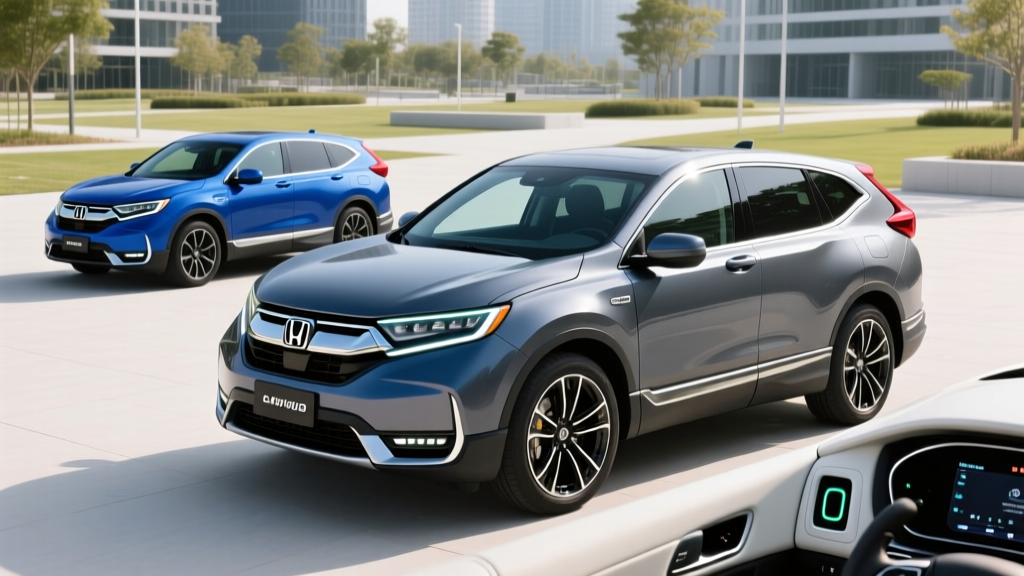
The 2026 Honda CR-V Hybrid continues to anchor Honda's electrified SUV lineup with a proven two-motor hybrid system, competitive cargo space, and a color palette that spans conservative neutrals to a few standout options. Before we break down efficiency and powertrain data, let's address what many shoppers search for first: the available exterior colors.
For the 2026 model year, Honda offers the CR-V Hybrid across four trims — Sport, Sport-L, Sport Touring, and the newly added Sport-L AWD — in the following exterior colors:
- Crystal Black Pearl — Available on all trims
- Platinum White Pearl — Available on all trims (premium paint on some trims)
- Meteorite Gray Metallic — Available on all trims
- Canyon River Blue Metallic — Available on Sport and above
- Urban Gray Pearl — Sport Touring exclusive
- Radiant Red Metallic — Available on Sport-L and Sport Touring
- Still Night Pearl — Sport Touring exclusive (dark blue-black)
- Lunar Silver Metallic — Available on Sport and Sport-L
Interior color pairings vary by trim: the Sport and Sport-L default to black cloth or leather-trimmed seats, while the Sport Touring offers either black or gray leather. Honda's color strategy here is practical — most shades hide road grime well, which matters for an SUV that will see family duty and four-season driving.
HEV vs. PHEV: What the CR-V Hybrid Actually Is
Important clarification: The 2026 Honda CR-V Hybrid is a conventional hybrid electric vehicle (HEV), not a plug-in hybrid (PHEV). This means:
- It does not plug into any charger — you refuel exclusively at gas stations
- It has no electric-only driving range to speak of (the battery assists the engine but cannot propel the car alone for meaningful distances)
- It does not qualify for the federal §30D EV tax credit (that credit is reserved for BEVs and PHEVs with sufficient battery capacity)
- Its hybrid battery recharges through regenerative braking and the gasoline engine
If you're looking for a Honda PHEV with plug-in capability, Honda does not currently offer a CR-V plug-in hybrid in the U.S. market. The closest Honda PHEV is the Clarity Plug-In Hybrid, which was discontinued after the 2021 model year. Shoppers wanting plug-in SUV capability from Honda would need to look at competitors like the Toyota RAV4 Prime (PHEV, ~42 miles electric-only) or the Hyundai Tucson PHEV (~33 miles electric-only).
For the rest of this guide, we focus entirely on the CR-V Hybrid HEV — how it performs, what it costs, and whether it's the right electrified choice for your situation.
Fuel Economy: EPA MPG and Real-World Efficiency
| Configuration | City MPG | Highway MPG | Combined MPG |
|---|---|---|---|
| CR-V Hybrid FWD (Sport, Sport-L) | 43 | 36 | 40 |
| CR-V Hybrid AWD (all trims available) | 40 | 34 | 37 |
| CR-V Gas FWD (for comparison) | 28 | 34 | 30 |
| CR-V Gas AWD (for comparison) | 27 | 32 | 29 |
Source: EPA / fueleconomy.gov
Real-World MPG: What to Actually Expect
The CR-V Hybrid's EPA numbers tell a favorable story, but real-world results depend heavily on your driving mix:
- City-heavy driving: Hybrids shine in stop-and-go traffic, where regenerative braking recaptures energy and the electric motor handles low-speed propulsion. Expect to meet or slightly exceed the EPA city rating — owners frequently report 42-45 MPG in urban commuting.
- Highway cruising: At sustained 70-80 mph speeds, the gasoline engine does most of the work and aerodynamic drag dominates. Expect 32-35 MPG on the highway for AWD models — slightly below the EPA estimate.
- Cold weather (below 35°F): The engine runs more frequently to provide cabin heat and maintain operating temperature. Expect a 10-15% fuel economy penalty in winter, bringing AWD combined figures to roughly 31-33 MPG.
- Mountainous terrain: Regenerative braking recovers energy on descents, but sustained climbs demand continuous engine output. Net effect varies by route, but mountain driving typically yields 30-34 MPG combined.
Bottom line: if your commute is mostly city and suburban, the CR-V Hybrid AWD will deliver 38-42 MPG consistently. Highway-heavy drivers will see 33-36 MPG. Both figures represent a substantial improvement over the gas-only CR-V.
Powertrain Specs: Two-Motor Hybrid System
| Specification | 2026 CR-V Hybrid |
|---|---|
| Engine | 2.0L Atkinson-cycle 4-cylinder |
| Engine Output | 146 hp / 134 lb-ft torque |
| Electric Motors | Dual-motor system (propulsion + generator) |
| Combined System Horsepower | 204 hp |
| Combined System Torque | 247 lb-ft |
| Transmission | e-CVT (electrically variable) |
| Drivetrain | FWD standard; AWD available (rear motor-driven) |
| 0-60 mph | ~7.6 seconds (AWD) |
| Hybrid Battery | ~1.06 kWh lithium-ion (not plug-in) |
| Towing Capacity | 1,000 lbs (all trims) |
Honda's fourth-generation two-motor hybrid system is one of the smoothest in the segment. Unlike some competitors that use a traditional planetary-gear e-CVT, Honda's system primarily drives the wheels via the electric propulsion motor at low and moderate speeds, with the gasoline engine acting as a generator. At highway speeds, a lock-up clutch connects the engine directly to the wheels for efficiency. The result is linear, EV-like acceleration feel in city driving with none of the "rubber band" sensation some e-CVTs produce.
The 204 combined horsepower puts the CR-V Hybrid ahead of the gas-only CR-V (190 hp) and competitive with the Toyota RAV4 Hybrid (219 hp). The 247 lb-ft of torque — available near-instantly from the electric motor — gives it strong off-the-line responsiveness that the gas model can't match.
Pricing, Trims, and Tax Credit Eligibility
The 2026 Honda CR-V Hybrid is offered in four trims. Pricing below includes destination charge:
- Sport Hybrid (FWD): ~$36,395
- Sport Hybrid (AWD): ~$37,895
- Sport-L Hybrid (AWD): ~$40,395
- Sport Touring Hybrid (AWD): ~$43,195
Federal Tax Credit Status
The Honda CR-V Hybrid does not qualify for the federal §30D Clean Vehicle Credit (up to $7,500). That credit applies only to battery electric vehicles (BEVs) and plug-in hybrids (PHEVs) meeting specific battery capacity, critical-mineral sourcing, and MSRP thresholds, as outlined by the IRS. The CR-V Hybrid's ~1 kWh battery is far below the §30D minimum of 7 kWh for PHEVs.
Some states offer their own hybrid purchase incentives or HOV lane access — check your state's energy office or DMV for current programs.
Without the federal credit, the CR-V Hybrid's value proposition rests on fuel savings. At 37 MPG combined (AWD) versus 29 MPG for the gas AWD CR-V, you save roughly 8 gallons per 1,000 miles driven. At $3.40/gallon (national average), that's about $272 saved per 10,000 miles — or roughly $1,360 over five years. The hybrid's ~$3,000-$4,000 price premium over comparable gas trims pays for itself in 2-3 years for average drivers.
Battery Warranty, Reliability, and Replacement Cost
Hybrid battery longevity is the single most common concern among first-time hybrid buyers. Here's what Honda provides:
| Warranty Coverage | Duration |
|---|---|
| Hybrid Battery (capacity & defects) | 8 years / 100,000 miles (10 yr / 150,000 mi in CARB states) |
| Hybrid System Components (inverter, motor) | 8 years / 100,000 miles |
| Powertrain (engine, transmission) | 5 years / 60,000 miles |
| Bumper-to-Bumper | 3 years / 36,000 miles |
In CARB-adopting states (California, New York, Massachusetts, Oregon, Washington, and others), Honda extends the hybrid battery warranty to 10 years / 150,000 miles, which covers the vast majority of ownership timelines.
Real-World Reliability Data
Honda's hybrid system has been in production since the early 2000s (Insight, Civic Hybrid, Accord Hybrid), and the current two-motor architecture — introduced with the 2014 Accord Hybrid and refined through four generations — has proven robust. Key reliability points:
- Battery degradation: The ~1 kWh battery in the CR-V Hybrid operates within a narrow state-of-charge window (roughly 40-80%), which dramatically reduces stress on the cells. Unlike EV batteries that cycle deeply, hybrid batteries experience shallow, frequent cycles that extend lifespan considerably.
- Field data: Honda hybrids from the 2017-2022 era (using the prior-generation two-motor system) show hybrid battery failure rates well below 2% within the warranty period, based on owner survey aggregations.
- Replacement cost: If the hybrid battery does fail outside warranty, a replacement currently costs between $2,000 and $4,000 depending on whether you use a new OEM unit, a refurbished pack, or an independent hybrid specialist. This is substantially less than an EV battery replacement ($8,000-$20,000+).
The CR-V Hybrid earned a TOP SAFETY PICK designation from the IIHS (when equipped with specific headlights) and a 5-Star overall safety rating from NHTSA, which adds to the ownership-ease argument.
Who Should Choose the CR-V Hybrid vs. an EV or Gas Car
Reasons to Choose the CR-V Hybrid
- You want 35-42 MPG without changing your fueling habits — no chargers, no plugs
- Your daily driving is city/suburban-heavy, where hybrid efficiency peaks
- You need AWD for snow or rain but want better fuel economy than gas AWD SUVs
- You plan to own the vehicle 5-10 years and value long-term fuel savings
- You don't have access to home or workplace charging (apartment, street parking)
- You want a proven, low-risk electrified powertrain with strong resale value
Reasons to Look Elsewhere
- You want electric-only commuting — look at the RAV4 Prime, Tucson PHEV, or a full BEV
- You want the $7,500 federal tax credit — only BEVs and qualifying PHEVs are eligible
- You drive mostly highway miles at high speeds — the hybrid advantage narrows to ~5 MPG vs. gas
- You need towing above 1,000 lbs — the gas CR-V tows up to 1,500 lbs; consider a truck-based hybrid
- You want the quiet, instant-torque feel of pure electric propulsion — test drive a BEV first
Decision Framework: CR-V Hybrid vs. Alternatives
Choose the CR-V Hybrid if: You drive 10,000-15,000 miles/year in mixed city/highway conditions, lack home charging access, and want a compact SUV that slashes fuel costs without any lifestyle change.
Choose a PHEV (RAV4 Prime, Tucson PHEV) if: You have home Level 2 charging, a short commute (under 35 miles), and want electric-only daily driving with gas flexibility for road trips — plus eligibility for the federal tax credit.
Choose a full BEV (Ioniq 5, Tesla Model Y, Equinox EV) if: You have reliable home charging, drive under 250 miles daily, want zero tailpipe emissions, and want to maximize tax-credit savings and eliminate gas entirely.
Stick with the gas CR-V if: You drive under 8,000 miles/year (the hybrid premium takes too long to recoup), you exclusively drive highway miles, or you need maximum towing capacity.
Interior, Tech, and Cargo: What You Get Across Trims
The hybrid trims share the CR-V's sixth-generation interior, which is one of the more practical layouts in the compact SUV segment:
- Cargo volume: 36.3 cu ft behind the rear seats; 76.5 cu ft with seats folded (hybrid battery is packaged under the rear seats, preserving cargo space versus the gas model)
- Infotainment: 7-inch touchscreen on Sport/Sport-L; 9-inch touchscreen with wireless Apple CarPlay/Android Auto on Sport Touring
- Honda Sensing: Standard on all trims — includes adaptive cruise control, lane-keeping assist, collision mitigation braking, and traffic sign recognition (SAE Level 1 driver assistance — the driver must remain fully engaged)
- Sport Touring upgrades: Bose 12-speaker audio, wireless phone charging, heated rear seats, hands-free power tailgate, Wi-Fi hotspot
One practical note for color choosers: the Platinum White Pearl and Radiant Red Metallic paints are multi-coat finishes that look excellent when clean but show road salt and dust more readily than the Meteorite Gray or Crystal Black options. If you live in a region with harsh winters or unpaved roads, the darker metallic shades will require less frequent washing to look presentable.
Frequently Asked Questions
How many MPG does the Honda CR-V Hybrid get?
The 2026 CR-V Hybrid FWD achieves 43 city / 36 highway / 40 combined MPG. The AWD version rates at 40 city / 34 highway / 37 combined. In real-world city driving, many owners report exceeding the EPA city estimate by 2-5 MPG thanks to frequent regenerative braking. Highway-heavy drivers should expect 2-4 MPG below the EPA highway figure.
Does the Honda CR-V Hybrid plug in?
No. The CR-V Hybrid is a conventional HEV (hybrid electric vehicle), not a plug-in hybrid. It has a small ~1 kWh battery that recharges through regenerative braking and the gasoline engine. You never plug it in — you simply fill up at a gas station as you would with any conventional car.
Does the CR-V Hybrid qualify for any tax credit?
No federal tax credit applies to the CR-V Hybrid. The IRS §30D Clean Vehicle Credit requires a minimum 7 kWh battery (for PHEVs) or a fully electric powertrain (for BEVs), along with MSRP, income, and battery-sourcing requirements. The CR-V Hybrid's ~1 kWh battery does not meet these thresholds. Some states may offer minor hybrid incentives — check your state energy office.
Is the CR-V Hybrid reliable and what does battery replacement cost?
Honda's two-motor hybrid system has a strong reliability track record spanning multiple generations since 2014. The hybrid battery is warrantied for 8 years/100,000 miles (10 years/150,000 miles in CARB states). Out-of-warranty battery replacement runs $2,000-$4,000. Because the battery operates in a shallow charge window (never fully depleting or fully charging), degradation is minimal and most hybrid batteries outlast the vehicle itself.
Which CR-V Hybrid color holds its value best?
Platinum White Pearl and Crystal Black Pearl historically show the strongest resale performance in the compact SUV segment, as they appeal to the widest range of used-car buyers. Meteorite Gray Metallic is a close third. Limited-availability colors like Still Night Pearl (Sport Touring exclusive) may command a small premium among enthusiasts but don't significantly affect trade-in value.
CR-V Hybrid vs. RAV4 Hybrid: which is more efficient?
The Toyota RAV4 Hybrid AWD rates at 41 city / 38 highway / 40 combined — slightly ahead of the CR-V Hybrid AWD's 40/34/37 on the highway. However, the CR-V Hybrid offers more cargo volume (36.3 vs. 37.5 cu ft is close, but Honda's load floor is lower and more practical) and a more refined powertrain feel. The RAV4 Prime PHEV (42 miles electric-only) is a different category entirely and is worth considering if you can charge at home.