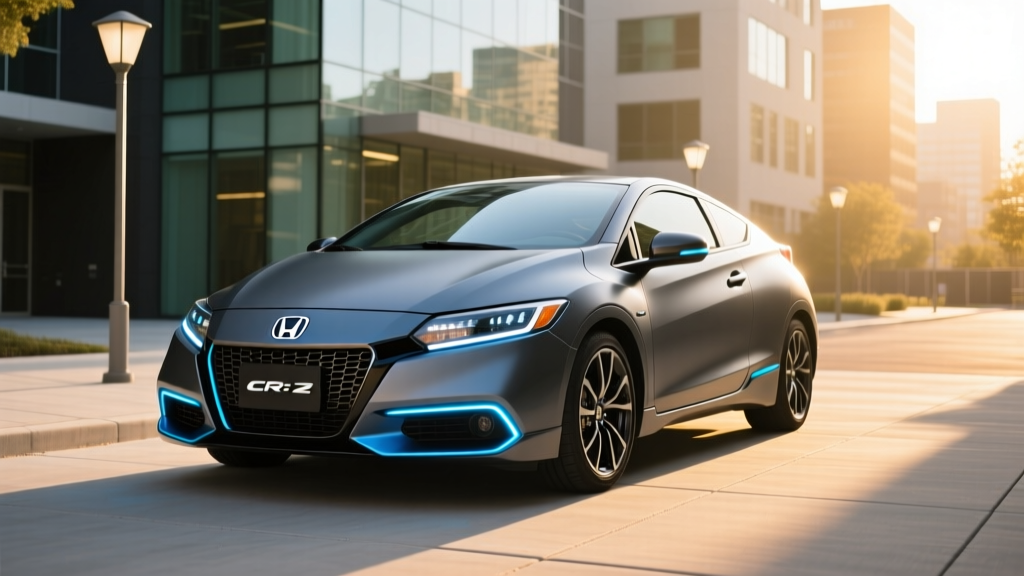
If you're researching the Honda CR-Z hybrid in 2026, you're likely looking at the used market. Honda discontinued the CR-Z after the 2016 model year, making it a discontinued-but-cult-favorite sport hybrid that still turns heads at a time when most hybrids prioritize maximum efficiency over driving engagement. This guide covers everything a current buyer needs to know: real-world MPG, battery longevity, replacement costs, and how the CR-Z stacks up against modern hybrid and EV alternatives.
What Exactly Is the Honda CR-Z Hybrid?
The Honda CR-Z is a conventional hybrid (HEV), not a plug-in hybrid (PHEV). It uses Honda's Integrated Motor Assist (IMA) system — a parallel-hybrid architecture where a small electric motor sits between the gasoline engine and transmission to assist during acceleration and enable regenerative braking. You never plug it in; the battery recharges through regen and engine power.
HEV vs. PHEV — Where the CR-Z Falls
| Feature | Conventional Hybrid (HEV) | Plug-in Hybrid (PHEV) |
|---|---|---|
| Plugs in to charge? | No | Yes |
| Electric-only driving | Minimal/none | 20–50+ miles typical |
| Battery size | 0.5–2 kWh | 8–25+ kWh |
| Federal tax credit (§30D) | No | Up to $7,500 (if eligible) |
| Example | Honda CR-Z, Toyota Prius | Toyota RAV4 Prime, Chrysler Pacifica PHEV |
The CR-Z's IMA battery is a small nickel-metal hydride (NiMH) pack rated at approximately 0.67 kWh. It cannot drive the car on electric power alone at meaningful speeds — the electric motor strictly assists the gas engine.
EPA Fuel Economy: How Many MPG Does the Honda CR-Z Hybrid Get?
The CR-Z was offered with either a 6-speed manual or a continuously variable transmission (CVT), and EPA ratings differ between the two.
| Transmission | City MPG | Highway MPG | Combined MPG |
|---|---|---|---|
| CVT | 36 | 39 | 37 |
| 6-Speed Manual | 31 | 38 | 34 |
Source: EPA Fuel Economy Guide (fueleconomy.gov)
Real-World MPG vs. EPA Sticker
The CR-Z's real-world fuel economy depends heavily on driving style — which is somewhat ironic for a "sport hybrid." Owners who drive conservatively in city traffic frequently report 38–42 MPG in the CVT model, exceeding the EPA city estimate. Honda's IMA system benefits from the stop-and-go regen opportunities of urban driving.
Highway driving at 75+ mph typically yields 34–37 MPG — slightly below the EPA highway figure. The CR-Z's aerodynamics and the IMA system's limited electric assist at sustained high speeds reduce the highway advantage. In cold weather (below 35°F), expect a 3–5 MPG drop as the engine runs more frequently to maintain cabin heat and battery temperature.
For context, the 2026 Toyota Prius achieves 57 MPG combined — illustrating how far hybrid technology has advanced in the decade since the CR-Z left production.
Powertrain Specs: Engine, Motor, and Combined Output
| Specification | Detail |
|---|---|
| Gasoline Engine | 1.5L i-VTEC inline-4 |
| Engine HP / Torque | 110 hp / 107 lb-ft |
| Electric Motor (IMA) | 10 kW (13 hp) / 58 lb-ft |
| Combined Net Output | 130 hp / 140 lb-ft (CVT) |
| Transmission | CVT or 6-speed manual |
| Drivetrain | Front-wheel drive |
| 0–60 mph | ~9.7 seconds (CVT) |
| Hybrid Battery | 0.67 kWh NiMH (IMA) |
| Curb Weight | ~2,835 lbs |
The CR-Z's 130 combined horsepower was modest even at launch. The IMA system's real contribution is torque fill at low RPMs, not peak power. The manual transmission variant is the enthusiast pick — the CR-Z remains the only recent hybrid sold in the U.S. with a manual gearbox — but it sacrifices roughly 3 MPG combined versus the CVT.
Hybrid Battery Longevity, Warranty, and Replacement Cost
Honda CR-Z IMA Battery Warranty (Original)
- Original coverage: 8 years / 80,000 miles (10 years / 150,000 miles in CARB states including CA, NY, MA, and others)
- Capacity threshold: Honda warranted the IMA battery against defect and excessive capacity loss
- Current status (2026): Most CR-Z models are now outside original warranty coverage based on age (2011–2016 production)
How Long Does the CR-Z Hybrid Battery Last?
The CR-Z's NiMH IMA battery is generally robust. NiMH chemistry degrades more gracefully than early lithium-ion packs, and many CR-Z owners report original batteries functioning at 12+ years with gradual capacity loss rather than sudden failure. Common failure signs include:
- Frequent "recalibration" cycles (the IMA system relearning battery state of charge)
- IMA warning light on the dashboard
- Noticeably reduced regenerative braking and electric assist
- Lower fuel economy (typically a 2–5 MPG drop)
IMA Battery Replacement Cost
If the IMA battery fails outside warranty, replacement costs break down as follows:
| Option | Estimated Cost | Notes |
|---|---|---|
| OEM Honda IMA battery (dealer) | $2,000–$3,000 | Includes parts + labor; availability may be limited for discontinued models |
| Aftermarket/remanufactured battery | $1,000–$1,800 | Available from hybrid battery specialists; quality varies |
| Individual cell replacement (DIY/specialist) | $300–$800 | Only failed cells replaced; requires technical skill |
Many CR-Z owners opt for aftermarket remanufactured packs or individual cell replacement, which keeps the car economically viable on the used market. The IMA system also allows the car to operate on the gasoline engine alone if the hybrid battery fails entirely — you won't be stranded, but you'll lose fuel economy benefits and see a check-engine light.
2026 Used Market Pricing and Tax Credit Eligibility
Because the CR-Z was discontinued after 2016, there is no new MSRP. Used-market pricing in 2026 typically falls in these ranges:
| Model Year / Condition | Approximate Price Range |
|---|---|
| 2011–2013, higher mileage (80k+ mi) | $6,000–$9,000 |
| 2014–2016, moderate mileage (40k–80k mi) | $9,000–$14,000 |
| 2014–2016, low mileage (<40k mi), clean title | $12,000–$17,000 |
Does the Honda CR-Z Qualify for Any Tax Credit?
No. The Honda CR-Z does not qualify for the federal §30D new clean vehicle credit — it's a conventional hybrid (HEV), not a plug-in vehicle, and it's no longer sold new. It also does not qualify for the Used Clean Vehicle Credit (§25E), which requires the vehicle to be a plug-in electric vehicle (BEV or PHEV) with a minimum 7 kWh battery capacity for PHEVs.
Some states offer separate incentives for hybrid purchases, but these are increasingly targeted at plug-in vehicles. Check your state's energy or DMV website for current programs.
Honda CR-Z vs. Modern Alternatives: Hybrid, PHEV, or EV?
If you're considering a CR-Z in 2026, you're likely weighing it against other options. Here's how the decision framework breaks down:
Reasons to Choose the Honda CR-Z Hybrid
- Unique sporty styling — nothing else looks like it in the hybrid segment
- Available 6-speed manual (the only modern hybrid with a stick shift)
- Low purchase price on the used market ($6k–$17k)
- Lightweight and tossable at 2,835 lbs
- Reliable Honda engineering with strong parts availability
- No charging infrastructure needed — just fill up with gas
Reasons to Look Elsewhere
- Modest 34–37 MPG combined trails modern hybrids by 15–20 MPG
- 130 hp feels slow by 2026 standards (9.7s 0–60)
- Tiny back seats are essentially unusable for adults
- No EV mode, no plug-in capability, no electric-only range
- Original hybrid battery warranty likely expired
- Limited cargo space (20.5 cu ft behind front seats)
Who Should Buy the CR-Z vs. a Modern Hybrid, PHEV, or EV?
| Buyer Profile | Best Fit | Why |
|---|---|---|
| Enthusiast wanting a fun, affordable hybrid with a manual | Honda CR-Z | Only option in this niche; unique driving experience |
| Commuter prioritizing maximum fuel savings | Used Toyota Prius (2023+) | 57 MPG combined; modern safety tech; lower cost per mile |
| Driver with home charging wanting electric daily commuting | Used Toyota RAV4 Prime (PHEV) | 42 miles electric-only; 38 MPG combined after battery depletes |
| Buyer ready to eliminate gas entirely | Chevrolet Equinox EV / Hyundai Kona Electric | 250–315 miles EPA range; $7,500 federal credit if eligible on new purchase |
Reliability and Ownership Costs
Honda's IMA system has a strong reliability track record. The CR-Z shares its powertrain architecture with the second-generation Insight and the Civic Hybrid, both of which have demonstrated 200,000+ mile longevity with proper maintenance. Key ownership considerations for 2026 buyers:
- 12V battery: Like all hybrids, the CR-Z has a standard 12V auxiliary battery that powers electronics. Replace every 4–5 years (~$150–$200).
- Brake life: Regenerative braking reduces wear on friction brakes. Original brake pads often last 80,000+ miles.
- IMA system maintenance: No scheduled IMA maintenance. The system is sealed and self-monitoring.
- Insurance: Typically $900–$1,400/year depending on driver profile — lower than most modern EVs due to the CR-Z's modest replacement value.
- Total annual maintenance: Estimated $400–$700/year for a 10-year-old vehicle, slightly above a new car but in line with used-car averages.
Frequently Asked Questions
How many MPG does the Honda CR-Z hybrid get in real-world driving?
The EPA rates the CVT model at 36 city / 39 highway / 37 combined MPG. In real-world driving, conservative city drivers often see 38–42 MPG, while aggressive highway driving at 75+ mph yields 34–37 MPG. Cold weather reduces fuel economy by roughly 3–5 MPG.
Does the Honda CR-Z need to be plugged in?
No. The CR-Z is a conventional hybrid (HEV), not a plug-in hybrid. The IMA battery charges exclusively through regenerative braking and the gasoline engine. You fuel it like any other gas car.
Can the Honda CR-Z drive on electric power alone?
Effectively, no. The 10 kW (13 hp) IMA motor can assist at very low speeds under light load, but it cannot propel the car independently at normal driving speeds. There is no EV mode and no electric-only range to speak of.
Is the Honda CR-Z hybrid reliable, and what does battery replacement cost?
Yes, the CR-Z's IMA system is generally reliable, with many NiMH batteries lasting 12+ years. If replacement is needed, expect $1,000–$3,000 depending on whether you choose aftermarket remanufactured ($1,000–$1,800) or OEM Honda ($2,000–$3,000) options. Individual cell replacement can cost as little as $300–$800.
Does the Honda CR-Z qualify for any federal tax credit in 2026?
No. The CR-Z is a conventional hybrid (not a plug-in vehicle) and is no longer sold new. It does not qualify for the federal §30D new vehicle credit or the §25E used clean vehicle credit, both of which require plug-in capability.
Is the Honda CR-Z a good buy in 2026?
It depends on your priorities. If you want an affordable, unique, fun-to-drive hybrid with available manual transmission and don't need cutting-edge efficiency or back-seat space, the CR-Z is a solid used buy at $6,000–$17,000. If maximum fuel savings or modern safety technology is your priority, a newer Prius, Corolla Hybrid, or a PHEV will serve you better.
What is the difference between the Honda CR-Z and the Honda Insight?
Both used Honda's IMA hybrid system, but the Insight (discontinued in 2022) was a practical 5-passenger sedan focused on maximum MPG (up to 55 combined in later models). The CR-Z was a 2+2 sport coupe prioritizing driving engagement over efficiency. The Insight's third generation (2019–2022) used a more advanced two-motor hybrid system, not IMA.