Quick Verdict: The Top-Trim Hybrid CR-V That Actually Makes Sense
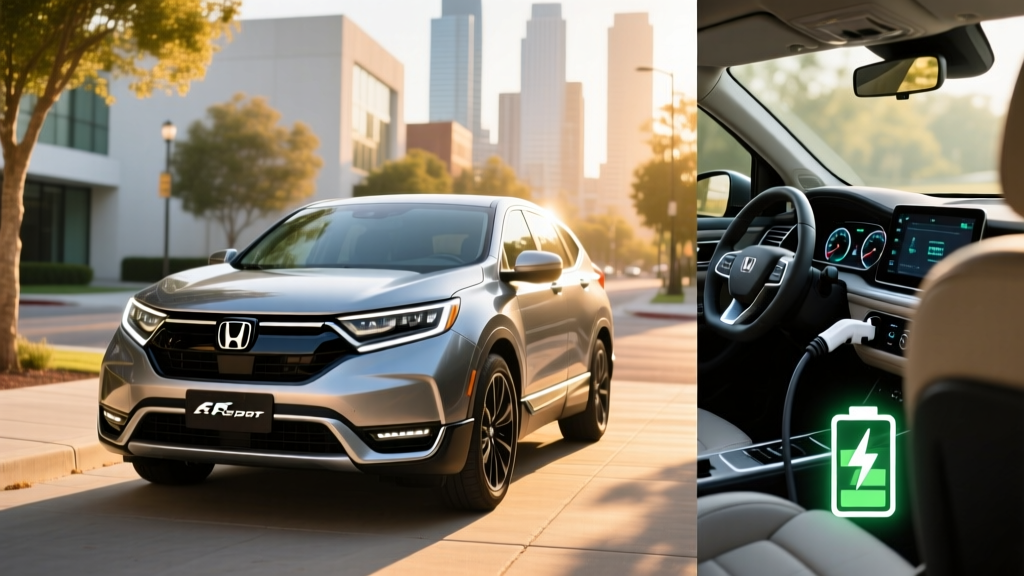
The 2026 Honda CR-V Sport Touring Hybrid sits at the top of Honda's compact SUV hybrid lineup, bundling the brand's two-motor hybrid powertrain with premium features like a 9-inch touchscreen, wireless Apple CarPlay and Android Auto, Bose premium audio, a heated steering wheel, and Honda Sensing driver-assistance tech. It isn't a plug-in hybrid — there's no EV-only mode to manage — but its EPA-rated 40 MPG combined delivers real cost savings over gas-only competitors without requiring any change to your fueling habits.
For buyers cross-shopping between a conventional hybrid, a PHEV like the Toyota RAV4 Prime, and a full battery-electric vehicle, the CR-V Sport Touring Hybrid occupies a specific niche: maximum convenience with meaningful efficiency gains. Here's exactly what you're getting.
CR-V Sport Touring Hybrid: Full Spec Sheet
| Specification | 2026 CR-V Sport Touring Hybrid |
|---|---|
| Powertrain Type | Conventional Hybrid (HEV) — no plug-in |
| Engine | 2.0L Atkinson-cycle 4-cylinder + dual-motor hybrid system |
| Combined Horsepower | 204 hp |
| Combined Torque | 247 lb-ft (electric motor) |
| Drivetrain | AWD standard (Sport Touring trim) |
| Transmission | e-CVT (direct-drive, no traditional gears) |
| EPA Fuel Economy (City/Hwy/Combined) | 40 / 34 / 37 MPG |
| Fuel Tank Capacity | 14.0 gallons |
| Total Driving Range | ~518 miles (EPA combined estimate) |
| 0–60 mph | ~7.6 seconds (est.) |
| Cargo Volume (rear seats up/down) | 36.3 / 76.5 cu ft |
| Towing Capacity | 1,000 lbs |
| Base MSRP (Sport Touring Hybrid AWD) | ~$41,345 (incl. destination) |
| Federal §30D Tax Credit | Not eligible (HEV, not PHEV or BEV) |
| Hybrid Battery Warranty | 8 years / 100,000 miles (10 yr/150k mi in CARB states) |
Sources: EPA fueleconomy.gov, Honda CR-V Hybrid official specs. MSRP reflects estimated 2026 pricing; confirm with dealer.
Fuel Economy: EPA Ratings vs. Real-World MPG
The EPA rates the 2026 CR-V Sport Touring Hybrid AWD at 40 MPG city, 34 MPG highway, and 37 MPG combined. Note that Honda's hybrid system, like Toyota's, is optimized for city driving — the electric motor handles low-speed propulsion while the gas engine primarily acts as a generator. This is why the city number exceeds the highway number, the opposite of a conventional gas car.
| Driving Scenario | EPA Rating | Real-World Expectation |
|---|---|---|
| City / Stop-and-Go | 40 MPG | 38–43 MPG (regenerative braking thrives here) |
| Highway (70+ mph) | 34 MPG | 30–34 MPG (aero drag + engine-direct mode) |
| Combined Mixed Driving | 37 MPG | 34–39 MPG |
| Cold Weather (below 30°F) | — | 30–34 MPG (engine runs more for cabin heat) |
In real-world mixed driving, most owners report landing between 34 and 39 MPG combined. City-heavy commuters often beat the EPA city estimate thanks to frequent regenerative braking opportunities. Highway road trips at sustained speeds above 75 mph will drop you closer to 30–32 MPG, particularly with roof cargo or in headwinds. Cold weather reduces efficiency as the engine runs longer to provide cabin heat and warm up the catalytic converter — expect a 10–15% hit in winter conditions.
Hybrid vs. PHEV vs. EV: Which CR-V Powertrain Fits You?
The CR-V lineup now spans three powertrains: gas-only, conventional hybrid (HEV), and — depending on your market — competitors offer plug-in hybrid alternatives. Here's how to think about the decision.
HEV vs. PHEV vs. BEV at a Glance
| Factor | HEV (CR-V Hybrid) | PHEV (e.g., RAV4 Prime) | BEV (e.g., Ioniq 5) |
|---|---|---|---|
| Plug-in Required? | No | Yes (for EV mode) | Yes (always) |
| Electric-Only Range | None (EV assist only at low speed) | 30–42 mi typical | 250–350+ mi |
| Home Charging Needed? | No | Recommended (120V or 240V) | Essential (240V Level 2) |
| Fuel/Energy Cost per Mile | ~$0.10–0.12 (gas) | ~$0.04 (electric) / $0.11 (gas) | ~$0.04–0.06 (electric) |
| Federal Tax Credit (§30D) | Not eligible | Up to $7,500 (if eligible) | Up to $7,500 (if eligible) |
| Best For | No home charging, simplicity | Short commutes + road trips | Home charging access, low running costs |
Choose the CR-V Sport Touring Hybrid (HEV) if: You don't have access to home or workplace charging, you want zero behavior change from a gas car, and you value the simplicity of filling up at any gas station while still cutting fuel consumption by roughly 35% compared to the gas-only CR-V (28 MPG combined).
Consider a PHEV alternative if: You have a garage or driveway where you can install a Level 2 charger, your daily commute is under 40 miles round-trip, and you want to drive mostly on electricity while keeping a gas engine for longer trips. The Toyota RAV4 Prime (42 miles EV range) or the Hyundai Tucson PHEV (33 miles EV range) are strong competitors here, and both may qualify for the federal §30D tax credit depending on battery sourcing, your income, and MSRP caps.
Consider a full BEV if: You have reliable Level 2 home charging, your daily driving is predictable, and you want the lowest per-mile energy cost and minimal maintenance. Models like the Hyundai Ioniq 5, Tesla Model Y, or Honda Prologue offer 250–320 miles of EPA range and qualify for federal credits.
Powertrain Deep Dive: How Honda's Two-Motor Hybrid Works
The CR-V Sport Touring Hybrid uses Honda's fourth-generation two-motor hybrid system paired with a 2.0-liter Atkinson-cycle four-cylinder engine. The combined system output is 204 horsepower and 247 lb-ft of torque from the electric drive motor. All-wheel drive is standard on the Sport Touring trim, with a rear-mounted electric motor providing torque to the rear axle when needed.
Unlike a traditional transmission, the e-CVT uses a direct-drive arrangement. At low speeds, the vehicle operates primarily on electric power drawn from a small lithium-ion battery pack (approximately 1.1 kWh usable — note this is a conventional hybrid battery, not a large PHEV pack). The gas engine acts mainly as a generator to recharge the battery. At highway speeds, a lock-up clutch connects the engine directly to the wheels for efficiency.
The result is smooth, linear acceleration from a stop — the electric motor's instant torque makes the CR-V Hybrid feel more responsive than its gas-only counterpart in city driving. The 0–60 mph time of roughly 7.6 seconds is adequate for merging and passing, though it won't win any drag races.
Pricing, Tax Credits, and Total Cost of Ownership
The 2026 Honda CR-V Sport Touring Hybrid AWD carries an estimated MSRP of $41,345 including destination charges. This positions it roughly $5,500 above the gas-only Sport Touring trim and about $7,000 above the base hybrid (Sport Hybrid AWD, ~$34,345).
Federal Tax Credit Status
The CR-V Hybrid is a conventional hybrid (HEV), not a plug-in hybrid or battery-electric vehicle. Under current IRS §30D rules, the federal clean vehicle credit applies only to PHEVs and BEVs that meet battery-component and critical-mineral sourcing requirements, MSRP caps ($80,000 for SUVs), and buyer income limits. The CR-V Hybrid does not qualify for the $7,500 federal tax credit.
Some states offer their own hybrid incentives or rebates — check your state's energy office or DMV for current programs. However, these are less common for HEVs than for PHEVs and BEVs.
5-Year Cost Comparison: Hybrid vs. Gas CR-V
| Cost Factor (5 years / 75,000 mi) | CR-V Gas AWD (28 MPG) | CR-V Sport Touring Hybrid (37 MPG) |
|---|---|---|
| Fuel Cost (@ $3.50/gal avg) | ~$9,375 | ~$7,095 |
| Fuel Savings (Hybrid) | — | ~$2,280 saved |
| Estimated Maintenance | ~$3,200 | ~$2,900 (regenerative braking saves brake wear) |
| Insurance (avg) | ~$7,500 | ~$7,800 (slightly higher for hybrid) |
| Price Premium for Hybrid Trim | — | ~$1,200 (vs. equivalent gas Sport Touring) |
Over five years, the hybrid's fuel savings of roughly $2,280 more than offset the modest price premium over the gas Sport Touring. The payback period against the gas-only base trim is longer due to the higher starting price, but the Sport Touring Hybrid buyer is also paying for premium features (Bose audio, heated steering wheel, wireless charging pad, hands-free power tailgate) that aren't purely efficiency-driven.
Battery Longevity, Warranty, and Replacement Cost
Hybrid Battery Warranty
Honda covers the CR-V Hybrid's lithium-ion battery pack for 8 years or 100,000 miles (whichever comes first) under its standard hybrid battery warranty. In California Air Resources Board (CARB) states — which include CA, CO, CT, ME, MD, MA, NJ, NY, OR, RI, VT, and WA — the warranty extends to 10 years or 150,000 miles.
The warranty covers battery capacity loss below a specified threshold (typically 60–70% of original capacity) and defects. It is fully transferable to subsequent owners.
Real-World Battery Degradation
Honda's hybrid battery packs are small (~1.1 kWh usable) and operate within a narrow state-of-charge window — the system never fully charges or fully depletes the battery, which dramatically reduces degradation stress. Based on long-term data from Honda and Toyota hybrid owners, meaningful battery capacity loss is uncommon before 150,000–200,000 miles. Many first-generation Honda Insight and Civic Hybrid batteries lasted well beyond 10 years.
Battery Replacement Cost
If the hybrid battery does fail outside of warranty, expect a replacement cost between $2,000 and $4,000 including parts and labor at a Honda dealership. Independent hybrid-specialist shops may offer refurbished battery packs for $1,500–$2,500. This is significantly less than a full BEV battery replacement ($8,000–$20,000+) because the CR-V Hybrid's pack is small and simpler.
What the Sport Touring Trim Adds Over Lower Hybrids
The Sport Touring Hybrid sits at the top of the CR-V hybrid lineup. Here's what justifies the premium over the Sport Hybrid and Sport-L Hybrid trims:
- Bose 12-speaker premium audio system
- 9-inch HD touchscreen with wireless Apple CarPlay and Android Auto
- Wireless phone charging pad
- Heated steering wheel
- Heated rear outboard seats
- Hands-free power tailgate with walk-away close
- Rain-sensing windshield wipers
- Low-speed braking control and traffic sign recognition
- 19-inch alloy wheels (Sport-specific styling)
- Honda Sensing suite: adaptive cruise control, lane-keeping assist, collision mitigation braking, road departure mitigation
Note that Honda Sensing is standard across all CR-V trims — it's a Level 2 driver-assistance system per SAE classification, meaning the driver must remain fully engaged and attentive at all times. It is not a self-driving system.
Pros and Cons
Pros
- 40 MPG city EPA — excellent for stop-and-go commuters
- No plug-in charging required; zero behavior change from gas
- AWD standard on Sport Touring Hybrid
- Premium features justify the trim price
- Honda Sensing standard; strong IIHS safety ratings
- Proven hybrid system with 8–10 year battery warranty
- Spacious cargo area (36.3 cu ft behind rear seats)
Cons
- No federal tax credit eligibility (HEV, not PHEV/BEV)
- Highway MPG drops to 34 — less advantage on road trips
- ~$41,345 MSRP is steep for a compact SUV
- 1,000-lb towing capacity (below some competitors)
- Engine drone under hard acceleration (e-CVT characteristic)
- No spare tire — tire inflation kit only
Frequently Asked Questions
How many MPG does the CR-V Sport Touring Hybrid get?
The EPA rates it at 40 MPG city, 34 MPG highway, and 37 MPG combined. Real-world mixed driving typically yields 34–39 MPG combined, with city-heavy commuters often exceeding the EPA city estimate. Cold weather and sustained highway speeds above 75 mph reduce efficiency.
Does the CR-V Hybrid need to be plugged in?
No. The CR-V Sport Touring Hybrid is a conventional hybrid (HEV), not a plug-in hybrid. It recharges its small battery through regenerative braking and the gas engine. You fuel it exactly like any gas car — just less often.
Does the CR-V Hybrid qualify for any tax credit?
It does not qualify for the federal §30D clean vehicle credit, which applies only to plug-in hybrids (PHEVs) and battery-electric vehicles (BEVs). Some states may offer modest hybrid incentives — check your state energy office. If tax credits are a priority, consider a PHEV like the RAV4 Prime or a BEV like the Ioniq 5.
Is the CR-V Hybrid reliable, and what does battery replacement cost?
Honda's hybrid system is one of the most proven in the industry, with decades of real-world data from the Insight, Accord Hybrid, and CR-V Hybrid. The hybrid battery is warrantied for 8 years/100,000 miles (10 years/150,000 miles in CARB states). Out-of-warranty replacement runs $2,000–$4,000. Overall CR-V reliability ratings from IIHS and owner surveys are strong.
How does the CR-V Hybrid compare to the Toyota RAV4 Hybrid?
The 2026 RAV4 Hybrid (Woodland Edition, AWD) is rated at 39 MPG combined — nearly identical to the CR-V Hybrid's 37 MPG combined. The RAV4 Hybrid starts lower in price and offers a PHEV variant (RAV4 Prime, 42 miles EV range, eligible for federal credits). The CR-V Sport Touring Hybrid counters with a more premium interior at the top trim, slightly more rear-seat legroom, and Honda Sensing. Both are excellent choices; the decision often comes down to brand loyalty, dealer experience, and whether you want the PHEV option.
Should I buy the CR-V Hybrid or wait for a full EV?
If you lack home charging access, regularly drive more than 300 miles between stops, or live in an area with sparse public charging infrastructure, the CR-V Hybrid is the pragmatic choice. If you have a garage with a 240V outlet and your daily driving is under 250 miles, a BEV will deliver lower fuel costs (~$0.04–0.06/mile vs. $0.10–0.12/mile for the hybrid) and less maintenance over time. The CR-V Hybrid is the right bridge for buyers who want efficiency now without infrastructure dependency.