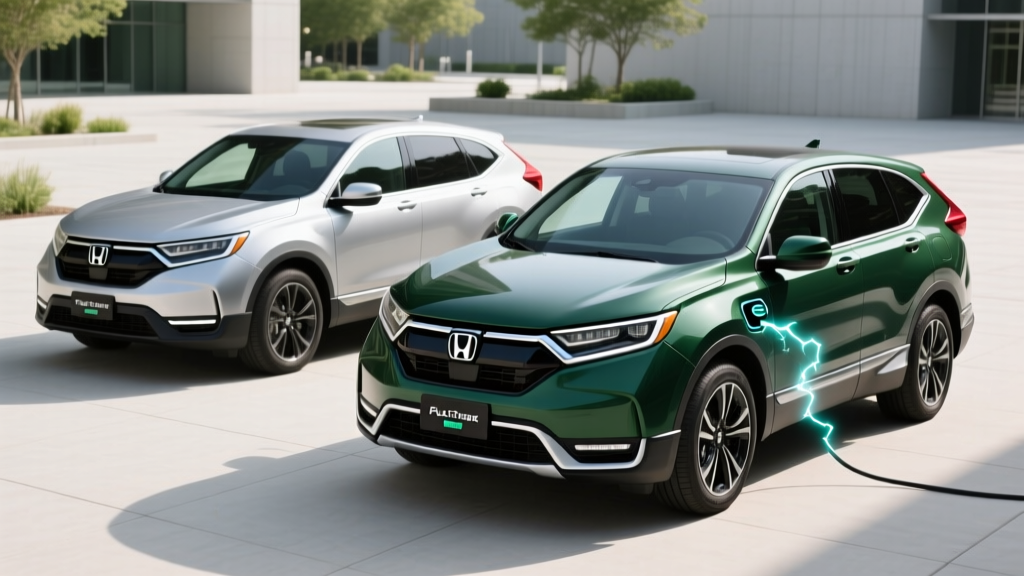
Search for "Honda CR-V hybrid plug in" and you'll find forums, dealership queries, and buyers wondering if Honda offers a plug-in version of its best-selling compact SUV. The short answer for 2026: Honda does not sell a CR-V plug-in hybrid (PHEV) in the United States. What Honda does offer is the CR-V Hybrid, a conventional gas-electric hybrid (HEV) that requires no plug, delivers an EPA-estimated 40 MPG combined, and competes directly with the Toyota RAV4 Hybrid and Hyundai Tucson Hybrid.
But the confusion is understandable. Toyota sells the RAV4 Prime (a PHEV with 42 miles of electric range), Hyundai offers the Tucson PHEV, and Mitsubishi has the Outlander PHEV. Honda's own Clarity Plug-In was discontinued after 2021. So where does the CR-V fit, and is the conventional hybrid enough — or should you look elsewhere for plug-in capability?
This guide breaks down the 2026 Honda CR-V Hybrid's real-world fuel economy, powertrain engineering, battery longevity, pricing, and tax-credit eligibility. We'll also clarify exactly when a conventional HEV, a PHEV, or a full battery-electric vehicle (BEV) makes the most sense for your driving pattern.
2026 Honda CR-V Hybrid: EPA Fuel Economy and Real-World MPG
The 2026 Honda CR-V Hybrid uses the same fourth-generation two-motor hybrid system introduced with the current CR-V generation. Front-wheel drive (FWD) and all-wheel drive (AWD) trims carry slightly different EPA ratings.
| Drivetrain | City MPG | Highway MPG | Combined MPG |
|---|---|---|---|
| FWD (Sport, Sport Touring) | 43 | 36 | 40 |
| AWD (Sport, Sport Touring) | 40 | 34 | 37 |
Source: fueleconomy.gov — EPA estimates. Your results will vary.
Real-World MPG: What Owners Actually Report
Conventional hybrids like the CR-V Hybrid often exceed their EPA city estimates in stop-and-go driving, where regenerative braking recaptures the most energy. Owner forums and aggregated fuel-tracking data (Fuelly, Spritmonitor) show many CR-V Hybrid drivers averaging 38–44 MPG combined in mixed suburban and city use.
However, sustained highway driving at 75+ MPH tends to pull figures down to 32–35 MPG, because the 2.0-liter Atkinson-cycle engine operates less efficiently at high continuous loads and aerodynamic drag dominates. Cold-weather short-trip driving (sub-30°F, trips under 5 miles) can temporarily drop observed economy to 28–32 MPG as the engine runs more frequently to heat the cabin and warm the catalytic converter.
How the CR-V Hybrid Powertrain Works (HEV, Not PHEV)
Understanding the distinction matters for your purchase decision, your charging expectations, and your fuel budget.
| Feature | Conventional Hybrid (HEV) | Plug-In Hybrid (PHEV) |
|---|---|---|
| Plug required? | No — self-charging via engine + regen | Yes — plug in for electric-only range |
| Battery size | ~1.0–1.8 kWh | ~13–20 kWh |
| Electric-only range | Less than 1 mile at low speed | 20–45 miles typical |
| Gas engine | Primary power + battery charging | Kicks in after battery depletes |
| Federal tax credit | Not eligible (§30D requires plug-in) | Up to $7,500 if criteria met |
| Example | Honda CR-V Hybrid | Toyota RAV4 Prime, Tucson PHEV |
The CR-V Hybrid's two-motor system pairs a 2.0-liter Atkinson-cycle inline-4 with two electric motors and a lithium-ion battery pack. Combined system output is 204 horsepower and 247 lb-ft of torque. The larger of the two electric motors serves as the primary drive motor at low and moderate speeds; the gas engine either generates electricity for the drive motor (series-hybrid mode) or directly drives the wheels via a lock-up clutch at steady highway speeds (parallel-hybrid mode).
The battery pack in the CR-V Hybrid is approximately 1.06 kWh (usable). This is intentionally small — it buffers regenerative braking energy and assists acceleration but cannot propel the vehicle for meaningful distances on electricity alone. There is no charge port, no Level 1 or Level 2 charging capability, and no DC fast-charge hardware. You simply fuel it with gasoline.
Powertrain Specs and Driving Impressions
| Specification | Value |
|---|---|
| Engine | 2.0L Atkinson-cycle DOHC inline-4 |
| Combined system horsepower | 204 hp |
| Combined system torque | 247 lb-ft |
| Electric drive motor output | 181 hp / 247 lb-ft |
| Transmission | Direct-drive (no traditional gearbox) |
| Drivetrain options | FWD or AWD (torque-vectoring rear motor) |
| 0–60 mph (est.) | ~7.6 seconds |
| Towing capacity | 1,000 lbs |
| Battery chemistry | Lithium-ion |
| Battery capacity (usable) | ~1.06 kWh |
| Charge port | None (HEV — no plug-in) |
The CR-V Hybrid's electric-first launch gives it a responsive, torque-rich feel around town that the non-hybrid 1.5L turbo CR-V can't match at low speeds. The AWD system uses a rear-mounted electric motor rather than a mechanical driveshaft, enabling precise torque vectoring in corners and on low-traction surfaces. At highway speeds, the transition to direct engine drive is nearly imperceptible — Honda's hybrid control software has matured considerably since the early Clarity days.
One limitation: at 1,000 lbs towing capacity, the CR-V Hybrid is not a towing vehicle. If you need to pull a small trailer or boat, the non-hybrid CR-V (1,500 lbs) or a body-on-frame SUV is a better fit.
Pricing, Trims, and Tax Credit Eligibility
For the 2026 model year, the CR-V Hybrid is available exclusively in Sport and Sport Touring trims with either FWD or AWD.
| Trim | Drivetrain | MSRP (approx.) |
|---|---|---|
| Sport | FWD | $36,395 |
| Sport | AWD | $37,895 |
| Sport Touring | AWD (standard) | $41,895 |
Prices include destination. Verify with your local dealer for current MSRP and incentives.
Federal Tax Credit: Not Eligible
Because the CR-V Hybrid is a conventional HEV (no plug, battery under 4 kWh), it does not qualify for the IRS §30D Clean Vehicle Credit. That credit — up to $7,500 — applies only to plug-in vehicles (PHEVs and BEVs) meeting battery capacity, critical-mineral sourcing, MSRP caps, and buyer income limits. See the IRS §30D page for current eligibility rules.
Some states and utilities offer separate rebates for conventional hybrids, but these vary widely by jurisdiction. Check your state energy office or utility provider for local programs.
Battery Warranty, Reliability, and Replacement Cost
Hybrid battery longevity is consistently the top concern for first-time hybrid buyers. Honda addresses this with robust warranty coverage.
Honda Hybrid Battery Warranty
- Hybrid battery: 8 years / 100,000 miles (10 years / 150,000 miles in CARB states including CA, NY, MA, and others adopting California emissions standards)
- Hybrid system components: 8 years / 100,000 miles
- Powertrain warranty: 5 years / 60,000 miles
- Limited vehicle warranty: 3 years / 36,000 miles
Honda's hybrid battery is a relatively small, conservatively managed lithium-ion pack. Unlike large BEV batteries subjected to deep daily cycles and DC fast-charging heat, the CR-V Hybrid's battery operates in a narrow state-of-charge window (roughly 40–80% SoC), which dramatically reduces degradation stress. Real-world data from Honda's hybrid fleet — including the Accord Hybrid and CR-V Hybrid — shows very few battery failures within the warranty period, and many first-generation Honda hybrid batteries (Insight, early Civic Hybrid) lasted 150,000+ miles before notable capacity loss.
If replacement is needed out of warranty, a new OEM CR-V Hybrid battery pack currently costs approximately $2,000–$3,500 including labor at a Honda dealer. Third-party reconditioned packs are available for $1,200–$2,000. This is far less expensive than a BEV battery replacement ($8,000–$20,000+) because the pack is small.
The CR-V Hybrid earned the IIHS Top Safety Pick designation (verify current year status at iihs.org), and Honda's hybrid powertrain has consistently scored above average in Consumer Reports reliability surveys.
CR-V Hybrid vs PHEV Competitors: Which Fits Your Life?
If you searched for a "Honda CR-V hybrid plug in," you're likely weighing whether a plug-in hybrid might better suit your commute. Here's how the CR-V Hybrid stacks up against PHEV alternatives in the compact SUV segment.
| Model | Type | Combined MPG / MPGe | Electric Range | MSRP (base) | Federal Credit |
|---|---|---|---|---|---|
| Honda CR-V Hybrid AWD | HEV | 37 MPG | None | ~$37,895 | None |
| Toyota RAV4 Prime SE | PHEV | 94 MPGe / 38 MPG gas | 42 mi | ~$44,500 | Up to $7,500* |
| Hyundai Tucson PHEV | PHEV | 80 MPGe / 35 MPG gas | 33 mi | ~$39,500 | Up to $7,500* |
| Mitsubishi Outlander PHEV | PHEV | 74 MPGe / 26 MPG gas | 38 mi | ~$41,000 | Up to $7,500* |
*§30D credit eligibility depends on MSRP caps, buyer AGI, battery sourcing, and point-of-sale transfer rules. Verify at irs.gov.
The RAV4 Prime's $7,500 credit (if you qualify) effectively narrows the price gap with the CR-V Hybrid to near zero — but only if you can charge at home and your commute fits within 42 electric miles. If you lack home charging access, a PHEV's electric range goes largely unused, and you're carrying 500+ lbs of extra battery weight that reduces gas-only efficiency.
Who Should Buy the CR-V Hybrid — and Who Should Look Elsewhere
Choose the Honda CR-V Hybrid (HEV) If:
- You cannot charge at home (apartment, street parking, no garage outlet)
- You want zero behavior change — just fuel it and drive
- Your driving is a mix of city and highway with no single commute pattern
- You value Honda's reliability record and dealer network
- You want AWD capability with strong fuel economy (37 MPG AWD)
- Your budget is $36,000–$42,000 and you don't qualify for or want to navigate EV tax credits
Consider a PHEV (RAV4 Prime, Tucson PHEV) If:
- You can charge at home (Level 1 outlet or Level 2 charger)
- Your daily round-trip commute is under 35–40 miles (covers most errands on electricity)
- You qualify for the full $7,500 federal tax credit (income and sourcing rules apply)
- You want near-EV daily driving with a gas engine for road trips
- You're willing to pay a higher MSRP upfront, offset by the credit and fuel savings
Consider a Full EV (BEV) If:
- You have reliable home Level 2 charging
- Your daily driving is under 200 miles (covers most Americans)
- You want the lowest per-mile fuel cost (~$0.04–$0.06/mile on home electricity vs ~$0.12–$0.15/mile for a 37 MPG hybrid)
- You want zero tailpipe emissions and minimal drivetrain maintenance
- Models to compare: Hyundai Ioniq 5, Tesla Model Y, Ford Mustang Mach-E, Honda Prologue
Frequently Asked Questions
Does Honda make a CR-V plug-in hybrid?
No. As of the 2026 model year, Honda does not offer a CR-V plug-in hybrid (PHEV) in the U.S. market. The CR-V Hybrid is a conventional HEV that charges its small battery through regenerative braking and the gas engine — no plug is needed or available. Honda previously sold the Clarity Plug-In Hybrid (discontinued after 2021) and currently sells the all-electric Prologue SUV.
How many MPG does the Honda CR-V Hybrid get?
The EPA rates the 2026 CR-V Hybrid FWD at 43 city / 36 highway / 40 combined MPG. The AWD version is rated at 40 city / 34 highway / 37 combined. Real-world results typically range from 34 MPG (highway-heavy, cold climate) to 44 MPG (city-dominant, moderate climate).
Can I convert the CR-V Hybrid to a plug-in?
No. There is no factory or aftermarket plug-in conversion for the CR-V Hybrid. The battery, power electronics, and control software are designed exclusively for self-charging HEV operation. Any modification would void the hybrid system warranty.
Is the CR-V Hybrid battery expensive to replace?
Out-of-warranty replacement runs approximately $2,000–$3,500 at a Honda dealer. However, Honda's hybrid battery warranty covers 8 years / 100,000 miles (10 years / 150,000 miles in CARB states), and real-world failure rates within that period are very low. The small battery size makes replacement far cheaper than a BEV battery swap.
Does the CR-V Hybrid qualify for any tax credit?
No. The federal §30D Clean Vehicle Credit applies only to plug-in electric vehicles (PHEVs and BEVs) with battery packs of at least 7 kWh. The CR-V Hybrid's ~1 kWh pack does not qualify. Some states offer hybrid-specific rebates — check your state energy office for current programs.
How does the CR-V Hybrid compare to the non-hybrid CR-V?
The non-hybrid CR-V uses a 1.5L turbocharged engine rated at 190 hp and achieves 28 city / 34 highway / 30 combined MPG (FWD). The Hybrid costs roughly $3,000–$4,000 more but delivers 204 hp, significantly more low-end torque, and roughly 23–33% better fuel economy depending on the trim and drivetrain. At current gas prices (~$3.30/gallon national average), the hybrid's fuel savings pay back the price premium in approximately 5–7 years for a driver covering 12,000 miles annually.
What Honda SUV does offer plug-in capability?
None in Honda's current U.S. lineup. Honda's electrified SUV options are the CR-V Hybrid (HEV, no plug) and the Prologue (full BEV, no gas engine). If plug-in hybrid capability is a priority, you'll need to look at competitors like the Toyota RAV4 Prime, Hyundai Tucson PHEV, or Mitsubishi Outlander PHEV.