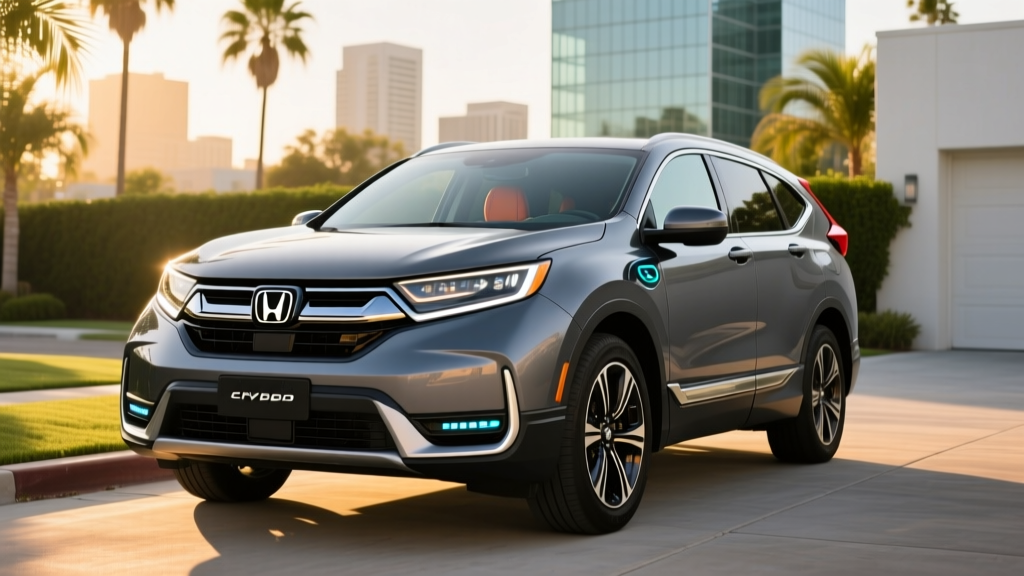
The Honda CR-V has long been one of America's best-selling compact SUVs, and the hybrid variant has quietly become the smart-money pick in the lineup. For the 2026 model year, the CR-V Hybrid continues with Honda's two-motor hybrid system, delivering strong city fuel economy, practical cargo space, and no plug-in hassle. If you've been searching for a CR-V Hybrid to understand what you're actually getting — real MPG, powertrain details, battery longevity, and whether it qualifies for any tax credit — this guide covers every number that matters.
HEV vs PHEV: What the CR-V Hybrid Actually Is
Before we get into the specs, let's clear up a common point of confusion. The Honda CR-V Hybrid is a conventional hybrid electric vehicle (HEV). It does not plug in. There is currently no plug-in hybrid (PHEV) version of the CR-V sold in the United States.
| Feature | Conventional Hybrid (HEV) | Plug-In Hybrid (PHEV) |
|---|---|---|
| Plug-in charging? | No — refuels with gasoline only | Yes — plugs into Level 1 or Level 2 outlet |
| Battery size | Small (~1–2 kWh) | Larger (typically 12–25 kWh) |
| Electric-only driving | Very limited (low-speed creep, assist only) | 20–50 miles on battery alone |
| Primary fuel | Gasoline (electric motor assists engine) | Electricity first, gasoline for longer trips |
| Federal tax credit | Not eligible under §30D | May qualify (up to $7,500, subject to rules) |
| Best for | Drivers who want better MPG without changing habits | Drivers with home charging who want some EV miles |
The CR-V Hybrid captures energy through regenerative braking and the gasoline engine to charge its small lithium-ion battery. You drive it exactly like a standard gas car — fill up at any station — but the electric motors handle low-speed driving and assist during acceleration, which is where hybrids shine most.
Fuel Economy: EPA Ratings and Real-World MPG
Fuel economy is the headline reason buyers choose the CR-V Hybrid over the turbocharged gas-only CR-V. Here's what the EPA rates the 2026 CR-V Hybrid at:
| Drivetrain | City MPG | Highway MPG | Combined MPG |
|---|---|---|---|
| FWD (Sport Hybrid) | 43 | 36 | 40 |
| AWD (Sport Hybrid / Sport-L / Sport Touring) | 40 | 34 | 37 |
For comparison, the gas-only 2026 CR-V with the 1.5L turbo and AWD returns 28 city / 34 highway / 30 combined. The hybrid's advantage is substantial in stop-and-go driving, where the electric motors do the heavy lifting and the engine shuts off at stops.
Real-World MPG: What Owners Actually See
Hybrids routinely exceed their EPA city estimates in real-world driving because city conditions maximize regenerative braking and electric-motor use. Many CR-V Hybrid owners report 42–45 MPG in mixed city driving during mild weather. Highway fuel economy tends to run closer to or slightly below the EPA estimate — expect 33–35 MPG at 70–75 mph on the interstate with AWD.
Cold weather reduces hybrid efficiency, just as it does with EVs, though the effect is smaller. In sub-freezing temperatures, expect a 5–10% drop in combined MPG due to increased engine idling for cabin heat and reduced battery efficiency. That still puts you in the low-to-mid 30s combined — well ahead of the gas-only model.
Powertrain Specs: Horsepower, Engine, and Motors
| Engine | 2.0L Atkinson-cycle 4-cylinder |
| Engine output | 145 hp @ 6,100 rpm / 138 lb-ft torque |
| Electric motors | Dual-motor system (one drive, one generator) |
| Drive motor output | 181 hp / 247 lb-ft torque |
| Combined system output | 204 hp |
| Transmission | e-CVT (no traditional gears) |
| Drivetrain options | FWD or Real Time AWD™ |
| 0–60 mph (est.) | ~7.5 seconds (AWD) |
| Towing capacity | 1,000 lbs (hybrid trims) |
Honda's two-motor hybrid system operates primarily in electric-drive mode at low and moderate speeds, with the gasoline engine acting as a generator. At highway speeds, a lock-up clutch connects the engine directly to the front wheels for efficiency. The result is smooth, quiet acceleration with immediate torque from the electric motor — no turbo lag, no gear hunting.
The 204 combined horsepower is competitive within the segment. The Toyota RAV4 Hybrid produces 219 hp, while the Hyundai Tucson Hybrid delivers 226 hp, but the CR-V Hybrid's tuning prioritizes refinement and fuel efficiency over outright power.
Battery, Warranty, and Long-Term Reliability
Hybrid battery longevity is consistently one of the top concerns for first-time hybrid buyers. Here's what you need to know about the CR-V Hybrid's battery system:
Battery & Hybrid System Warranty
- Hybrid battery warranty: 8 years / 100,000 miles (10 years / 150,000 miles in CARB states including CA, NY, MA, and others)
- Hybrid system components: 8 years / 100,000 miles
- Capacity retention threshold: Honda warrants the battery against defects and abnormal degradation; gradual capacity loss is normal and expected
- Replacement cost (out of warranty): Approximately $2,000–$4,000 for the hybrid battery pack, based on current parts pricing and labor
The CR-V Hybrid uses a relatively small lithium-ion battery pack (approximately 1.1 kWh gross capacity). Because it's small and the system manages charge/discharge cycles conservatively — never fully depleting or fully charging the pack — degradation is minimal. Honda's hybrid batteries in the Accord and CR-V have demonstrated strong longevity, with many units lasting well beyond 150,000 miles without significant issues.
For context, IIHS has consistently rated the CR-V highly for safety, and Honda's hybrid powertrain has a strong track record across the Accord Hybrid and Insight before it. The hybrid system is mechanically simpler than a traditional automatic transmission — the e-CVT has no belts, pulleys, or gear sets to wear out.
Pricing, Trims, and Tax Credit Eligibility
The 2026 CR-V Hybrid is available in four trims, all featuring the hybrid powertrain:
| Trim | Drivetrain | MSRP (approx.) |
|---|---|---|
| Sport Hybrid | FWD | $35,395 |
| Sport Hybrid | AWD | $36,895 |
| Sport-L Hybrid | AWD | $39,195 |
| Sport Touring Hybrid | AWD | $42,695 |
Federal Tax Credit: Does the CR-V Hybrid Qualify?
No. The IRS §30D Clean Vehicle Credit applies only to plug-in electric vehicles (BEVs and PHEVs) that meet battery capacity, critical mineral sourcing, and MSRP requirements. Because the CR-V Hybrid is a conventional HEV with no plug-in capability, it does not qualify for the federal EV tax credit.
However, some states and utilities offer rebates or incentives for hybrid purchases. Check with your state energy office and local utility for current programs, as these vary widely by jurisdiction and change frequently.
Total Cost of Ownership vs. Gas-Only CR-V
The hybrid carries a premium of roughly $1,500–$2,500 over equivalent gas-only CR-V trims, but the fuel savings offset that quickly. At 15,000 miles per year and $3.50/gallon regular unleaded:
- Gas-only CR-V AWD (30 combined MPG): ~$1,750/year in fuel
- CR-V Hybrid AWD (37 combined MPG): ~$1,419/year in fuel
- Annual savings: ~$331/year
- 5-year savings: ~$1,655
With higher gas prices or more city-heavy driving (where the hybrid's advantage widens), the payback period shortens considerably. At $4.00/gallon with mostly city driving, a hybrid owner could save $500+ annually.
CR-V Hybrid vs. RAV4 Hybrid vs. Tucson Hybrid
The compact hybrid SUV segment is competitive. Here's how the CR-V Hybrid stacks up against its two main rivals on the numbers that matter:
| Spec | Honda CR-V Hybrid AWD | Toyota RAV4 Hybrid AWD | Hyundai Tucson Hybrid AWD |
|---|---|---|---|
| Combined MPG (EPA) | 37 | 39 | 38 |
| City MPG | 40 | 41 | 38 |
| Combined HP | 204 | 219 | 226 |
| Cargo (behind rear seats) | 36.3 cu ft | 37.6 cu ft | 38.7 cu ft |
| Starting MSRP (AWD) | ~$36,895 | ~$35,075 | ~$37,490 |
| Hybrid battery warranty | 8 yr / 100k mi | 10 yr / 150k mi | 10 yr / 100k mi |
The RAV4 Hybrid leads on fuel economy and starting price. The Tucson Hybrid offers the most power and cargo space. The CR-V Hybrid's advantages are interior refinement, driving dynamics, and Honda's strong resale value. None of these three qualify for the federal EV tax credit — they're all conventional hybrids.
Who Should Buy the CR-V Hybrid — And Who Shouldn't
Reasons to Choose the CR-V Hybrid
- You want 37–40 MPG combined without plugging in or changing your routine
- Most of your driving is city or suburban (where hybrids excel)
- You want a refined, quiet cabin with strong build quality
- You value Honda's resale value and dealer network
- You don't have access to home or workplace charging
Reasons to Look Elsewhere
- You want electric-only driving miles (consider a PHEV like the RAV4 Prime or a full BEV)
- You want the maximum federal tax credit (only BEVs and qualifying PHEVs get §30D)
- You tow more than 1,000 lbs regularly
- Pure highway commuting dominates your driving (the hybrid advantage narrows at steady speed)
- You need the lowest possible starting price (RAV4 Hybrid undercuts by ~$1,800)
Hybrid vs. PHEV vs. Full EV — Which Fits You?
Choose the CR-V Hybrid (HEV) if: You want better fuel economy with zero lifestyle change. No charging, no range planning, no plug — just fill up with gas and go. Ideal if you live in an apartment, lack home charging, or take frequent long road trips.
Choose a PHEV (like the Toyota RAV4 Prime) if: You have reliable home charging and a commute under 40 miles. You'll drive on electricity most days and use gas only for longer trips. You may also qualify for a partial federal tax credit.
Choose a full EV (like the Hyundai Ioniq 5 or Tesla Model Y) if: You have home Level 2 charging, want zero tailpipe emissions, want the lowest per-mile fuel cost, and your typical trips fall within 250–300 miles. You'll qualify for up to $7,500 in federal tax credits on eligible models (subject to MSRP caps, income limits, and battery sourcing rules under current IRS §30D guidelines).
Frequently Asked Questions
How many MPG does the 2026 CR-V Hybrid get?
The EPA rates the FWD CR-V Hybrid at 43 city / 36 highway / 40 combined MPG. The AWD version is rated at 40 city / 34 highway / 37 combined. Real-world city driving often exceeds these estimates, while steady highway driving at higher speeds may return slightly less.
Does the CR-V Hybrid need to be plugged in?
No. The CR-V Hybrid is a conventional hybrid (HEV). It charges its battery through regenerative braking and the gasoline engine. You refuel it with regular unleaded gasoline at any gas station, just like a standard car.
Is there a plug-in hybrid (PHEV) version of the CR-V?
Not in the United States. Honda does not currently offer a CR-V PHEV in the U.S. market. If you want a plug-in hybrid compact SUV, look at the Toyota RAV4 Prime (42 miles electric-only range) or the Hyundai Tucson PHEV (33 miles electric-only).
How long will the CR-V Hybrid battery last?
Honda's hybrid batteries are designed to last the life of the vehicle under normal use. The battery is warranted for 8 years / 100,000 miles (10 years / 150,000 miles in CARB states). Real-world data from Honda's hybrid lineup shows most batteries lasting 150,000+ miles without requiring replacement. If replacement is needed out of warranty, expect $2,000–$4,000.
Does the CR-V Hybrid qualify for any tax credit?
The CR-V Hybrid does not qualify for the federal §30D Clean Vehicle Credit, which is limited to plug-in vehicles (BEVs and PHEVs). Some states and utilities may offer separate incentives for hybrid purchases — check your local programs.
Is the CR-V Hybrid reliable?
Honda's two-motor hybrid system has a strong reliability record, refined over years of use in the Accord Hybrid and other models. The e-CVT design has fewer moving parts than a conventional automatic transmission. The CR-V consistently earns top safety ratings from IIHS and NHTSA, and Honda's dealer network provides broad service coverage nationwide.
How much does it cost to fill up the CR-V Hybrid vs. the gas model?
With a 14.0-gallon fuel tank and regular unleaded at $3.50/gallon, a full tank costs about $49. At 37 combined MPG (AWD), that gives you roughly 518 miles of range per tank. The gas-only AWD CR-V at 30 combined MPG gets about 420 miles on the same tank — meaning the hybrid saves you roughly one fill-up every five tanks.