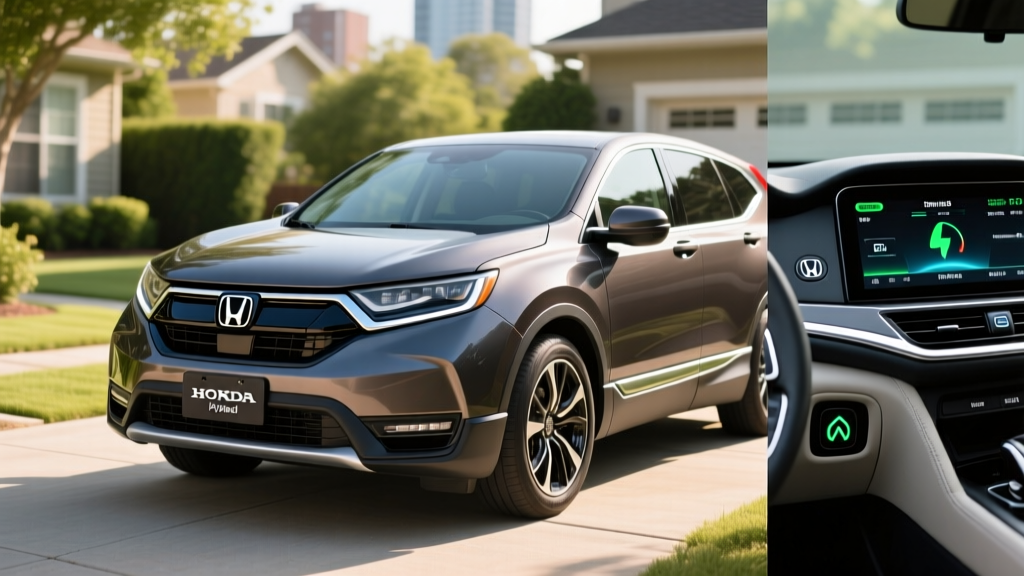
The Honda CR-V has long been one of America's best-selling compact SUVs, and its hybrid variants now account for a significant share of that volume. If you're researching Honda CR-V hybrid models for 2026, you're looking at a conventional hybrid (HEV) lineup — not a plug-in — that prioritizes fuel efficiency without requiring any change to your refueling habits. This guide breaks down every CR-V Hybrid trim, real-world MPG expectations, the powertrain underneath, battery longevity, and how it stacks up against both full EVs and plug-in competitors.
2026 Honda CR-V Hybrid Lineup at a Glance
For the 2026 model year, Honda continues to offer the CR-V Hybrid across multiple trims, all built around the same two-motor hybrid system paired with a 2.0-liter Atkinson-cycle four-cylinder engine. Unlike the Toyota RAV4 Prime, the CR-V Hybrid is not a plug-in hybrid (PHEV) — it generates and recovers all its own electricity and refuels exclusively at the gas pump.
| Trim | Drivetrain | EPA Combined MPG | MSRP (est.) |
|---|---|---|---|
| Sport Hybrid | FWD | 40 MPG | ~$36,350 |
| Sport Hybrid | AWD | 39 MPG | ~$37,850 |
| Sport-L Hybrid | AWD | 39 MPG | ~$40,350 |
| Sport Touring Hybrid | AWD | 37 MPG | ~$42,850 |
Source: fueleconomy.gov and Honda Newsroom. Pricing is approximate MSRP including destination; confirm with your dealer.
HEV vs PHEV: Why the CR-V Hybrid Doesn't Plug In
A common point of confusion among shoppers comparing hybrid SUVs is the difference between a conventional hybrid (HEV) and a plug-in hybrid (PHEV). Here's how they differ and why it matters for the CR-V:
HEV vs PHEV — What's the Difference?
Conventional Hybrid (HEV) — Honda CR-V Hybrid: Uses a small battery (typically ~1.1 kWh) charged entirely by the gasoline engine and regenerative braking. No plug, no charging cable. You simply fill up at the gas station. The electric motor assists the engine and enables brief low-speed electric-only driving, but the system is designed to optimize fuel economy across all conditions without driver intervention.
Plug-in Hybrid (PHEV) — e.g., Toyota RAV4 Prime: Carries a larger battery (typically 14–18 kWh) that you plug in to charge. Offers 30–42 miles of electric-only driving before the gas engine engages. Requires access to a home outlet or Level 2 charger to realize its full efficiency benefit.
The CR-V Hybrid falls firmly in the HEV camp. Honda does not currently offer a PHEV version of the CR-V in the U.S. market. If plug-in capability is a dealbreaker, you'll need to look at competitors like the Toyota RAV4 Prime (42 miles EV range) or the Hyundai Tucson PHEV (33 miles EV range).
Fuel Economy: EPA Ratings and Real-World MPG
Fuel economy is the primary reason buyers choose the CR-V Hybrid over the standard turbocharged gas model. Here's the full EPA breakdown:
| Drivetrain | City MPG | Highway MPG | Combined MPG |
|---|---|---|---|
| FWD | 43 | 36 | 40 |
| AWD | 40 | 34–35 | 37–39 |
Data via fueleconomy.gov.
Real-World MPG: What Owners Actually See
Honda's two-motor hybrid system excels in stop-and-go city driving, where the electric motor handles low-speed propulsion and regenerative braking recaptures energy that would otherwise be lost. This is why the city MPG rating (43 FWD) exceeds the highway figure (36 FWD) — the opposite of most gas-only vehicles.
In real-world driving, CR-V Hybrid owners frequently report exceeding the EPA city estimate in warm-weather urban commuting, with some seeing 44–47 MPG on flat, low-speed routes. Highway driving at 70–80 MPH, however, tends to fall slightly below the EPA highway number — expect 33–35 MPG on sustained interstate trips. Cold weather (below 35°F) reduces efficiency by roughly 8–12% due to increased engine runtime for cabin heat and reduced battery efficiency.
Powertrain Specs: Two-Motor Hybrid System
The CR-V Hybrid uses Honda's fourth-generation two-motor hybrid system. Here's exactly what's under the hood:
| Specification | Detail |
|---|---|
| Engine | 2.0L Atkinson-cycle DOHC 4-cylinder |
| Engine Power | 145 hp @ 6,100 rpm |
| Electric Motors | Dual-motor system (one drive, one generator) |
| Drive Motor Torque | 247 lb-ft |
| Combined System Output | 204 hp |
| Transmission | Direct-drive (no conventional transmission) |
| 0–60 MPH | ~7.6 seconds (est.) |
| Towing Capacity | 1,000 lbs |
The combined 204 horsepower represents a meaningful upgrade over the non-hybrid CR-V's 190-hp turbocharged 1.5L engine. More importantly, the hybrid's 247 lb-ft of electric motor torque is available from near-zero RPM, giving it noticeably stronger off-the-line acceleration than the gas model, which produces only 179 lb-ft. The trade-off is the 1,000-lb towing limit — if you need to tow more than a small utility trailer, the gas CR-V (1,500 lbs) or a body-on-frame SUV is a better fit.
Battery Warranty, Lifespan, and Replacement Cost
Hybrid battery longevity is consistently one of the top concerns for buyers switching from a conventional gas vehicle. Here's what Honda provides:
Honda Hybrid Battery Warranty
- Coverage: 8 years / 100,000 miles (10 years / 150,000 miles in CARB states including CA, NY, MA, and others)
- What's covered: Defects in materials/workmanship and capacity loss below functional thresholds
- Battery type: Lithium-ion, approximately 1.1 kWh total capacity
Confirm exact terms at Honda's official warranty page.
How Long Do CR-V Hybrid Batteries Actually Last?
Honda's hybrid system uses a relatively small lithium-ion battery that operates within a narrow state-of-charge window — typically between 40% and 80% SoC. This shallow cycling dramatically reduces degradation compared to full EV batteries that routinely cycle from 10% to 90%. Based on historical data from Honda's hybrid lineup (Insight, Accord Hybrid, previous-gen CR-V Hybrid), most hybrid batteries retain functional capacity well beyond 150,000 miles without requiring replacement.
If replacement is needed out of warranty, expect a cost between $2,000 and $4,000 for the battery pack itself, plus labor. Third-party refurbishers and independent hybrid specialists often offer replacement at the lower end of that range. For context, that's a fraction of a full EV battery replacement ($8,000–$20,000+), because the CR-V Hybrid's pack is roughly 1/60th the size of a typical EV battery.
Tax Credits and Incentives: What You Can Claim
This is where the distinction between HEV and PHEV matters most for your wallet:
- Federal §30D Clean Vehicle Credit ($7,500): The CR-V Hybrid does NOT qualify. The IRS §30D credit applies only to plug-in electric vehicles (BEVs and PHEVs) with a minimum battery capacity of 7 kWh. The CR-V Hybrid's ~1.1 kWh pack falls well below this threshold.
- Federal Used Hybrid Credit: No specific federal credit exists for used conventional hybrids.
- State/Local Incentives: Some states offer modest rebates or HOV lane access for hybrids, but these vary widely and change frequently. Check your state's energy office or the Alternative Fuels Data Center for current programs.
If a federal tax credit is a deciding factor in your purchase, you would need to look at a PHEV (like the RAV4 Prime, which may qualify depending on sourcing and income limits) or a full BEV. The CR-V Hybrid's value proposition rests entirely on fuel savings, lower purchase price than a PHEV, and zero charging hassle.
CR-V Hybrid vs Gas CR-V vs Full EV: Which Fits You?
Choosing between a hybrid, gas, and fully electric compact SUV depends on your driving patterns, charging access, and budget. Here's a decision framework:
Decision Framework
Choose the CR-V Hybrid if:
- You want 37–40 MPG without changing your refueling routine
- You lack access to home or workplace charging
- You take frequent road trips and don't want to plan around charging stations
- You want a lower purchase price than a PHEV or EV ($36K–$43K vs $45K–$55K)
- You live in a region with extreme cold where EV range loss is a concern
Choose a PHEV (RAV4 Prime, Tucson PHEV) if:
- You can charge at home (Level 1 or Level 2) and your daily commute is under 35 miles
- You want to drive mostly on electricity but still need gas flexibility for road trips
- You want potential federal tax credit eligibility (income and sourcing rules apply)
Choose a full EV (Tesla Model Y, Hyundai Ioniq 5) if:
- You have reliable home Level 2 charging
- Your daily driving is under 250 miles and you can plan road-trip charging
- You want the lowest per-mile fuel cost and zero tailpipe emissions
- You qualify for the full $7,500 federal credit (or point-of-sale transfer)
Pros, Cons, and the Bottom Line
Pros
- 40 MPG combined (FWD) with no plug required
- 204 hp with strong low-end electric torque
- 500+ mile real-world range per tank
- 8-year/100K-mile hybrid battery warranty
- Available AWD across all hybrid trims
- Lower starting price than PHEV/EV competitors
Cons
- No PHEV variant available (no electric-only commute mode)
- No federal tax credit eligibility
- Towing limited to 1,000 lbs
- Highway MPG drops below EPA at sustained 75+ MPH
- AWD Sport Touring trim loses ~3 MPG vs FWD Sport
- Regenerative braking feel takes adjustment for some drivers
Frequently Asked Questions
How many MPG does the Honda CR-V Hybrid get?
The 2026 CR-V Hybrid FWD achieves an EPA-estimated 43 city / 36 highway / 40 combined MPG. AWD trims rate at 40 city / 34–35 highway / 37–39 combined. Real-world city driving often exceeds the EPA city number, while sustained highway driving at high speeds may fall 2–3 MPG below the sticker.
Does the Honda CR-V Hybrid plug in?
No. The CR-V Hybrid is a conventional hybrid (HEV), not a plug-in hybrid. It charges its small battery through regenerative braking and the gasoline engine. You refuel it exclusively at the gas station — no charging cable, no outlet required.
Is there a plug-in hybrid version of the CR-V?
As of the 2026 model year, Honda does not offer a PHEV version of the CR-V in the United States. If plug-in hybrid capability is essential, the closest competitors are the Toyota RAV4 Prime (42 miles EV range) and Hyundai Tucson PHEV (33 miles EV range).
How long will the CR-V Hybrid battery last?
Honda covers the hybrid battery with an 8-year/100,000-mile warranty (10 years/150,000 miles in CARB states). Based on historical data from Honda's hybrid vehicles, most batteries remain functional well past 150,000 miles. The system's shallow charge cycling (operating between ~40–80% SoC) significantly reduces long-term degradation compared to full EV batteries.
What does it cost to replace the CR-V Hybrid battery?
Out-of-warranty replacement typically costs between $2,000 and $4,000, including parts and labor. This is substantially less than a full EV battery replacement because the CR-V Hybrid's battery pack is approximately 1.1 kWh — roughly 60 times smaller than a typical EV battery.
Does the CR-V Hybrid qualify for a federal tax credit?
No. The federal §30D Clean Vehicle Credit requires a minimum 7 kWh battery capacity and plug-in capability. The CR-V Hybrid's ~1.1 kWh battery does not meet these requirements. Check the IRS Clean Vehicle Credit page for current eligibility rules.
Is the CR-V Hybrid faster than the gas CR-V?
Marginally, yes. The hybrid produces 204 combined horsepower versus the gas model's 190 hp. More noticeably, the hybrid delivers 247 lb-ft of torque from near-zero RPM via its electric drive motor, compared to the gas turbo's 179 lb-ft. This gives the hybrid stronger initial acceleration in city driving, though 0–60 MPH times are similar (approximately 7.6 seconds hybrid vs ~8.0 seconds gas).
Can I tow with the CR-V Hybrid?
Yes, but with a 1,000-pound limit — suitable for a small utility trailer or a couple of dirt bikes, but not a boat or camper. The non-hybrid gas CR-V tows up to 1,500 pounds. If towing is a priority, neither the hybrid nor the gas CR-V is ideal; consider a midsize SUV like the Honda Passport (5,000 lbs).