Honda CR-V Hybrid Cargo Space: What You Actually Get
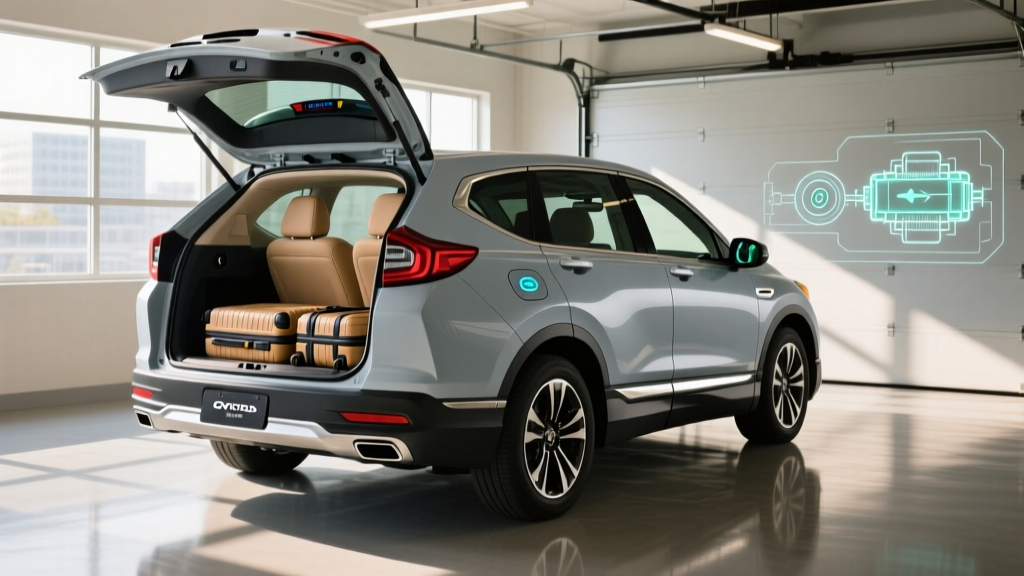
The 2026 Honda CR-V Hybrid remains one of the most practical compact SUVs on the market, and cargo capacity is a big reason why. Behind the second row, you get 36.3 cubic feet of usable cargo space — nearly identical to the non-hybrid CR-V's 36.3 cu ft. Fold the 60/40 split rear seats flat, and total volume expands to 76.5 cubic feet. The hybrid powertrain's battery pack is packaged under the rear floor and beneath the front seats, so Honda avoids the cargo-space penalty that plagues some rival hybrids.
For context, the Toyota RAV4 Hybrid offers 37.6 cu ft behind the rear seats and 69.8 cu ft total. The Hyundai Tucson Hybrid delivers 38.7 cu ft and 80.3 cu ft. The CR-V Hybrid sits in the middle of the pack on raw numbers but stands out for its low, flat load floor and wide opening, which makes loading bulky items like strollers or dog crates straightforward. A hands-free power liftgate is standard on Sport Touring Hybrid trims.
| Measurement | CR-V Hybrid | CR-V Gas |
|---|---|---|
| Cargo (behind 2nd row) | 36.3 cu ft | 36.3 cu ft |
| Cargo (seats folded) | 76.5 cu ft | 76.5 cu ft |
| Load floor height | ~27.5 in | ~27.5 in |
| Max towing capacity | 1,000 lbs | 1,500 lbs |
One trade-off worth noting: the CR-V Hybrid's towing capacity is limited to 1,000 lbs across all trims, compared to 1,500 lbs for the turbocharged gas model. If you need to tow a small trailer, the hybrid isn't the right fit.
EPA Fuel Economy and Real-World MPG
The 2026 CR-V Hybrid uses Honda's fourth-generation two-motor hybrid system paired with a 2.0-liter Atkinson-cycle four-cylinder engine. The EPA rates it as follows:
| Drivetrain | City | Highway | Combined |
|---|---|---|---|
| FWD (Sport, Sport-L Hybrid) | 43 MPG | 36 MPG | 40 MPG |
| AWD (Sport Touring Hybrid) | 40 MPG | 34 MPG | 37 MPG |
Source: fueleconomy.gov
Real-world expectation: Honda's two-motor system excels in city driving, where the electric motor handles most low-speed propulsion and regenerative braking recaptures energy frequently. Owners consistently report 41–44 MPG in mixed suburban and city driving. On sustained highway trips at 70+ mph, expect the AWD model to settle around 32–34 MPG — the engine takes over more at higher speeds, and aerodynamic drag reduces the hybrid system's advantage. In cold weather (below 30°F), expect a 3–5 MPG drop due to cabin heating demands and reduced battery efficiency. These figures are tracked by EPA user reports on fueleconomy.gov.
HEV vs PHEV vs EV: Which Powertrain Fits You?
The CR-V Hybrid is a conventional hybrid (HEV) — it does not plug in. Honda does not currently offer a plug-in hybrid (PHEV) version of the CR-V in the U.S. market for 2026. Here's how to think about which electrified powertrain makes sense:
| Factor | HEV (CR-V Hybrid) | PHEV (e.g., Tucson PHEV) | BEV (e.g., Ioniq 5) |
|---|---|---|---|
| Plugs in? | No | Yes (Level 1/2) | Yes (Level 1/2/DC) |
| Electric-only range | N/A | 30–33 mi | 250–310 mi |
| Home charging needed? | No | Recommended | Essential |
| Best for | No garage/outlet access | Short commute + road trips | Home charging + daily driving |
| Federal tax credit | Not eligible | Up to $7,500* | Up to $7,500* |
| Upfront cost premium | +$1,500–$2,500 vs gas | +$5,000–$8,000 vs gas | +$5,000–$15,000 vs gas |
*Federal §30D tax credit eligibility depends on MSRP caps, buyer income limits, and battery component/critical mineral sourcing. See the tax credit section below for details.
The CR-V Hybrid is the right call if you want better fuel economy without changing your habits — no charging, no range planning, just fill up with gas less often. If you have a garage with a 240V outlet and a short commute, a PHEV like the Hyundai Tucson PHEV or Toyota RAV4 Prime (if available) lets you drive 30+ miles on electricity alone before the gas engine kicks in. A full BEV makes sense only if you have reliable home charging and your daily driving is under 200 miles.
Powertrain Specs: Engine, Motors, and Horsepower
The 2026 CR-V Hybrid pairs a 2.0-liter Atkinson-cycle inline-four with two electric motors driving through an e-CVT (no traditional gearbox). Here are the exact numbers:
- Engine output: 145 hp @ 6,100 rpm / 134 lb-ft torque
- Drive motor output: 184 hp / 247 lb-ft torque
- Combined system output: 204 hp / 247 lb-ft torque
- 0–60 mph: ~7.8 seconds (FWD), ~8.0 seconds (AWD)
- Hybrid battery: ~1.06 kWh lithium-ion (not plug-in)
- Drivetrain: FWD standard; Real Time AWD available (Sport Touring Hybrid)
The two-motor system operates primarily in EV mode at low speeds, switches to hybrid mode (engine generates electricity for the motor) at moderate speeds, and engages direct engine drive at highway cruising. This is seamless in practice — you'll notice the engine starting and stopping frequently in city driving, but it's well-insulated from the cabin.
Hybrid Battery Warranty and Longevity
| Hybrid battery warranty | 8 years / 100,000 miles (10 yr / 150,000 mi in CARB states*) |
| Hybrid system warranty | 8 years / 100,000 miles |
| Powertrain warranty | 5 years / 60,000 miles |
| Basic warranty | 3 years / 36,000 miles |
*CARB states include CA, CO, CT, DE, ME, MD, MA, NJ, NY, OR, RI, VT, WA, and others that have adopted California emissions standards. Check your state's status.
Is the CR-V Hybrid reliable? Honda's hybrid system has matured significantly since the early Insight and Accord Hybrid days. The fourth-generation two-motor system has been in the Accord Hybrid and CR-V Hybrid since 2023 with few reported issues. The hybrid battery pack is small (~1.06 kWh) and operates in a shallow state-of-charge window (roughly 40–60% SoC most of the time), which minimizes degradation. Based on historical Honda hybrid data, owners can expect the battery to last well beyond 150,000 miles with minimal capacity loss.
Battery replacement cost: If the hybrid battery does fail outside warranty, expect a replacement cost between $2,500 and $4,000 including labor at a Honda dealer. Third-party hybrid battery refurbishers offer remanufactured packs for $1,500–$2,500. This is significantly cheaper than a full EV battery replacement, which can exceed $10,000, because the CR-V Hybrid's battery is small and relatively simple.
Pricing and Tax Credit Eligibility
The 2026 Honda CR-V Hybrid is available in three trims:
| Trim | Drivetrain | MSRP (incl. destination) |
|---|---|---|
| Sport Hybrid | FWD | $36,395 |
| Sport-L Hybrid | FWD | $38,695 |
| Sport Touring Hybrid | AWD | $42,295 |
Federal tax credit: The conventional CR-V Hybrid does not qualify for the IRS §30D federal clean vehicle tax credit. That credit applies only to plug-in electric vehicles (PHEVs and BEVs) with battery capacities of at least 7 kWh and specific critical mineral/battery component sourcing requirements. Since the CR-V Hybrid's battery is approximately 1.06 kWh and the vehicle cannot be plugged in, it is ineligible.
Some states and local utilities offer rebates for conventional hybrids, but these are uncommon and vary widely. Check your state energy office or utility provider for any current programs. For PHEV and BEV credit rules, see the IRS §30D guidance.
Real-World Ownership: What to Expect
Beyond cargo space and MPG, here are the practical ownership details that matter day-to-day:
- Fuel cost savings: At 40 MPG combined vs. the gas CR-V's 30 MPG combined, you'll save approximately $400–$550 per year on fuel (assuming 12,000 miles/year and $3.50/gallon). The hybrid premium pays for itself in roughly 4–6 years depending on trim and driving habits.
- Insurance: CR-V Hybrid insurance rates are typically 3–8% higher than the gas CR-V, reflecting the higher MSRP and hybrid system repair costs. Average annual premium: $1,600–$2,100 depending on state and driving record.
- Maintenance: Hybrid maintenance costs are similar to or slightly lower than the gas CR-V. Regenerative braking extends brake pad life (expect 60,000–80,000 miles before replacement). There's no traditional transmission fluid to change. Oil changes are still required at the same intervals (every 7,500–10,000 miles with synthetic).
- Resale value: According to Kelley Blue Book and industry data, the CR-V Hybrid retains approximately 55–60% of its value after 5 years, slightly above the gas model, driven by strong demand for fuel-efficient SUVs.
Pros
- Cargo space unaffected by hybrid battery (36.3 / 76.5 cu ft)
- 40 MPG combined FWD — among the best in the class
- Smooth, quiet hybrid operation in city driving
- Strong standard safety suite (Honda Sensing)
- 8-year/100,000-mile hybrid battery warranty
Cons
- AWD drops combined MPG to 37
- Towing limited to 1,000 lbs (gas model: 1,500 lbs)
- No PHEV option for electric-only commuting
- Engine noise noticeable under hard acceleration
- Not eligible for federal §30D tax credit
Frequently Asked Questions
How many MPG does the Honda CR-V Hybrid get?
The 2026 CR-V Hybrid FWD is EPA-rated at 43 city / 36 highway / 40 combined MPG. The AWD Sport Touring Hybrid is rated at 40 city / 34 highway / 37 combined. Real-world city driving often exceeds the EPA city figure, while sustained highway driving at 70+ mph typically returns 32–34 MPG.
Does the Honda CR-V Hybrid need to be plugged in?
No. The CR-V Hybrid is a conventional hybrid (HEV). It charges its small battery pack through regenerative braking and the gasoline engine. You never plug it in — just fill up with gas as you would with any other vehicle.
Is there a plug-in hybrid (PHEV) Honda CR-V?
As of 2026, Honda does not sell a PHEV version of the CR-V in the United States. If you want a compact SUV PHEV with electric-only range, consider the Hyundai Tucson PHEV (33 mi electric), Kia Sportage PHEV (34 mi), or Toyota RAV4 Prime (42 mi, if available).
How much cargo space does the CR-V Hybrid have compared to the gas model?
Identical. Both the hybrid and gas CR-V offer 36.3 cubic feet behind the second row and 76.5 cubic feet with the rear seats folded. Honda packages the hybrid battery under the floor, preserving the full cargo area.
Is the CR-V Hybrid reliable and what does a battery replacement cost?
Honda's fourth-generation hybrid system has proven reliable since its 2023 introduction. The hybrid battery is covered for 8 years/100,000 miles (10 years/150,000 miles in CARB states). Out-of-warranty replacement runs $2,500–$4,000 at a dealer, or $1,500–$2,500 through a third-party refurbisher. Based on historical data, most hybrid batteries last well past 150,000 miles.
Does the Honda CR-V Hybrid qualify for any tax credit?
No. The CR-V Hybrid is not eligible for the federal §30D clean vehicle tax credit because it is a conventional hybrid (not plug-in) with a battery capacity below the 7 kWh minimum. Some states or utilities may offer small hybrid incentives — check your local programs.
How does the CR-V Hybrid compare to the RAV4 Hybrid on cargo space?
The Toyota RAV4 Hybrid offers slightly more cargo space behind the rear seats (37.6 cu ft vs. 36.3 cu ft) but less total volume with seats folded (69.8 cu ft vs. 76.5 cu ft). The CR-V Hybrid wins on maximum cargo capacity; the RAV4 Hybrid wins on behind-seat space. Both are strong choices in this segment.