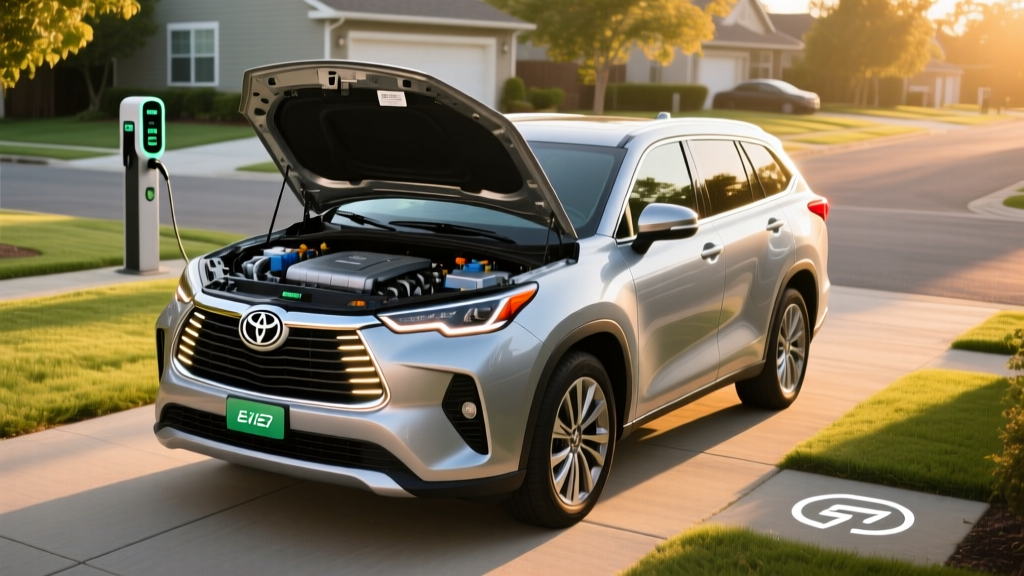
The Toyota Highlander Hybrid remains one of the few three-row SUVs that delivers genuine fuel savings without requiring a plug. For 2026, Toyota continues its proven hybrid synergy powertrain in the Highlander, targeting buyers who want family-hauler practicality without the fuel bills of a conventional V6 SUV. But what does Highlander Hybrid fuel economy actually look like once you leave the dealership? We break down the EPA numbers, real-world expectations, powertrain details, battery longevity, and whether this HEV is the right bridge for your household — or if a PHEV or full EV fits better.
Highlander Hybrid Fuel Economy: EPA Numbers vs. Real-World MPG
The 2026 Toyota Highlander Hybrid carries over the powertrain architecture that has defined this model since its hybrid debut. Here is the official EPA fuel economy breakdown by drivetrain configuration:
| Drivetrain | City MPG | Highway MPG | Combined MPG |
|---|---|---|---|
| FWD (LE, XLE) | 36 | 35 | 36 |
| AWD (LE, XLE, Limited, Platinum) | 35 | 34 | 35 |
Source: EPA Fuel Economy Guide
Compared to the gas-only Highlander's 24 MPG combined (AWD), the hybrid saves roughly 2.5 gallons per 100 miles. At $3.50/gallon and 15,000 miles per year, that translates to approximately $1,312 in annual fuel savings for the average driver.
Powertrain Deep Dive: How the Hybrid System Works
The 2026 Highlander Hybrid pairs a 2.5-liter inline-4 Atkinson-cycle gasoline engine with two front-mounted electric motor-generators (and a third on AWD models driving the rear axle). This is a conventional hybrid electric vehicle (HEV) — it does not plug in. The battery recharges through regenerative braking and engine-driven generation.
| Specification | Detail |
|---|---|
| Engine | 2.5L inline-4 Atkinson-cycle |
| Net System Horsepower | 243 hp combined |
| Electric Motors (FWD) | 2 front motor-generators |
| Electric Motors (AWD) | 2 front + 1 rear (eAWD) |
| Hybrid Battery | ~1.9 kWh nickel-metal hydride (NiMH) |
| Transmission | eCVT (planetary gearset, no belt) |
| 0-60 MPH (est.) | ~7.8 seconds |
| Towing Capacity | 3,500 lbs |
| Curb Weight | ~4,500 lbs |
| Plug-In Required? | No — self-charging HEV |
The Highlander Hybrid uses a relatively small battery pack compared to a PHEV or full BEV. That 1.9 kWh (approximate usable capacity) is not designed for electric-only driving. Instead, it serves as a buffer: capturing braking energy, assisting the gas engine during acceleration, and enabling brief low-speed electric-only operation in parking lots and stop-and-go traffic. The eCVT is not a traditional belt-driven continuously variable transmission — Toyota's planetary gearset design has proven exceptionally durable, with no belts to wear or slip.
HEV vs. PHEV vs. Full EV: Which Three-Row SUV Fits You?
The Highlander is offered only as a conventional hybrid (HEV). Toyota does not currently sell a Highlander PHEV in the United States. If you want plug-in capability in a Toyota three-row SUV, the closest option is the Grand Highlander Hybrid (also HEV only) or stepping to a different brand entirely. Here is how the three electrified powertrain types compare for a family SUV buyer:
Conventional Hybrid (HEV)
Example: Highlander Hybrid
- No plug needed
- 35-36 MPG combined
- No electric-only range
- Small battery (~1.9 kWh)
- No federal tax credit
- Lowest upfront cost
Plug-In Hybrid (PHEV)
Example: Kia Sorento PHEV
- Plug in for 30-32 mi electric
- 34 MPG combined (gas mode)
- Larger battery (~13.8 kWh)
- Level 2 charging (~3.5 hrs)
- May qualify for §30D credit
- Higher upfront cost
Full Electric (BEV)
Example: Kia EV9
- Plug in for 240-300 mi range
- Zero gasoline use
- Large battery (77-100 kWh)
- DC fast charging capable
- $7,500 federal credit (if eligible)
- Highest upfront, lowest fuel cost
Decision Framework: Which Powertrain Is Right for Your Household?
Choose the Highlander Hybrid (HEV) if: You lack home charging access (apartment, street parking, no garage), you frequently tow (3,500 lbs), you take long road trips into charging-desert regions, or you want the lowest purchase price and simplest ownership experience with no charging logistics.
Choose a PHEV (e.g., Sorento PHEV) if: You have a garage or dedicated parking with a 120V or 240V outlet, your daily commute is under 30 miles (covering most days on electricity alone), and you still want the gas engine for road trips without range planning.
Choose a full BEV (e.g., EV9) if: You have reliable Level 2 home charging, your daily driving is predictable, you want to eliminate gasoline entirely, and you qualify for the full federal tax credit to offset the higher MSRP.
Pricing, Trims, and Tax Credit Eligibility
The 2026 Toyota Highlander Hybrid starts at an MSRP of approximately $41,070 for the LE FWD trim and climbs to roughly $53,000 for the Platinum AWD. Here is the approximate trim breakdown:
| Trim | Drivetrain | MSRP (approx.) |
|---|---|---|
| LE | FWD | $41,070 |
| LE | AWD | $42,470 |
| XLE | AWD | $45,570 |
| Limited | AWD | $49,570 |
| Platinum | AWD | $53,070 |
Battery Longevity, Warranty, and Replacement Cost
Hybrid battery anxiety is the single most common concern among first-time hybrid buyers. Here are the facts based on Toyota's track record and warranty coverage:
Hybrid Battery Warranty & Lifespan
- Warranty: 10 years / 150,000 miles (whichever comes first) on hybrid battery and all hybrid-system components, per Toyota's warranty guide.
- Chemistry: Nickel-metal hydride (NiMH) — a mature, well-understood technology with decades of real-world data from the Prius, Camry Hybrid, and Highlander Hybrid lineages.
- Expected Lifespan: Most Toyota NiMH hybrid batteries last 150,000-200,000+ miles with normal use. Failures within the warranty period are rare but covered.
- Out-of-Warranty Replacement Cost: $3,000-$5,000 for a new OEM battery pack from a Toyota dealer. Refurbished/reconditioned packs from independent hybrid specialists run $1,500-$2,500.
- Degradation Behavior: Unlike BEV batteries, the small HEV battery operates in a narrow state-of-charge window (roughly 40-80%), which dramatically reduces stress and extends cycle life. You will not notice meaningful capacity loss in normal driving.
The Highlander Hybrid's NiMH pack is far less expensive to replace than a full EV's NMC or LFP traction battery ($10,000-$20,000+). And because Toyota has been building hybrid Synergy Drive systems since 1997 (Prius), independent hybrid repair shops are widely available in most metro areas, keeping out-of-warranty costs competitive.
Reliability and Safety Ratings
Toyota's hybrid powertrain has earned a reputation as one of the most reliable in the industry. The eCVT planetary gearset eliminates the complexity of a traditional multi-speed automatic — there are no clutch packs, torque converters, or shift solenoids to fail. The 2.5L Atkinson-cycle engine is under-stressed, running at lower RPMs than a conventional engine, which contributes to longevity.
The 2026 Highlander carries a 5-star overall safety rating from NHTSA and is an IIHS Top Safety Pick. Toyota Safety Sense 3.0 is standard across all trims, including pre-collision braking, lane departure alert, dynamic radar cruise control, and lane tracing assist — all SAE Level 1-2 driver-assistance features that require continuous driver engagement.
Pros and Cons at a Glance
✓ Pros
- 35-36 MPG combined in a 3-row, 7-seat SUV
- No plug-in charging required — zero infrastructure hassle
- Proven, durable hybrid powertrain with 10yr/150k-mi warranty
- 3,500-lb towing capacity (rare for hybrids)
- Standard AWD available across all trims
- Strong resale value (Toyota hybrid demand remains high)
- Fuel savings of ~$1,300/year vs gas-only Highlander
✗ Cons
- No electric-only driving range — always burns some gasoline
- No federal tax credit (HEV exclusion from §30D)
- Highway MPG drops to 30-32 at sustained 75+ MPH speeds
- Modest 243 hp — adequate but not quick for a 4,500-lb SUV
- Third-row space tight for adults on long trips
- Hybrid premium adds $2,000-$3,000 over gas-only model
- No DC fast charging capability (not applicable to HEV)
Frequently Asked Questions
How many MPG does the 2026 Toyota Highlander Hybrid get?
The EPA rates the Highlander Hybrid at 36 MPG combined (FWD) or 35 MPG combined (AWD), with city MPG equal to or slightly higher than highway thanks to regenerative braking. In real-world suburban commuting, many owners see 33-38 MPG depending on driving style, terrain, and climate.
Does the Highlander Hybrid need to be plugged in?
No. The Highlander Hybrid is a conventional HEV (hybrid electric vehicle). It charges its small battery through regenerative braking and the gasoline engine. There is no plug, no charging cable, and no electric-only driving range. You fuel it like any other vehicle at a gas station.
Is there a Highlander PHEV (plug-in hybrid) available?
As of 2026, Toyota does not offer a Highlander PHEV in the U.S. market. If you want plug-in hybrid capability with three rows, competitors include the Kia Sorento PHEV (32 miles electric-only, ~$51,000 MSRP) and the Mazda CX-90 PHEV (26 miles electric-only, ~$51,000 MSRP). Both qualify for partial or full federal tax credits depending on sourcing and eligibility.
What is the Highlander Hybrid battery replacement cost?
An OEM replacement hybrid battery from a Toyota dealer costs approximately $3,000-$5,000 including labor. Refurbished packs from independent hybrid specialists run $1,500-$2,500. However, Toyota's NiMH hybrid batteries are designed to last 150,000-200,000+ miles, and the 10-year/150,000-mile warranty covers most owners through the vehicle's primary ownership period.
Does the Highlander Hybrid qualify for any tax credit?
The Highlander Hybrid does not qualify for the federal §30D Clean Vehicle Credit, which is limited to plug-in vehicles (PHEVs and BEVs). Some states offer hybrid-specific rebates or HOV lane access — check your state's energy office. The hybrid's fuel savings (~$1,300/year over the gas Highlander) typically offset the purchase premium within 2-3 years without any incentive.
How does the Highlander Hybrid compare to a full EV like the Kia EV9?
The Kia EV9 offers 240-300 miles of electric range, qualifies for the $7,500 federal credit (subject to income and sourcing rules), and has near-zero fuel costs if you charge at home. However, the EV9 starts around $55,000, requires home Level 2 charging infrastructure ($500-$2,000 installation), and demands route planning on road trips beyond its range. The Highlander Hybrid costs less upfront, requires no charging infrastructure, tows 3,500 lbs, and eliminates range anxiety entirely — at the cost of ongoing fuel expenses and no electric-only operation.
Is the Highlander Hybrid reliable long-term?
Toyota's hybrid Synergy Drive system has been in production since 1997 and is widely regarded as one of the most reliable powertrains in the automotive industry. The eCVT has no belts, clutches, or torque converter to fail. Independent reliability surveys from Consumer Reports and J.D. Power consistently rank Toyota hybrids at or near the top of their segments. The 10-year/150,000-mile hybrid component warranty provides additional peace of mind.