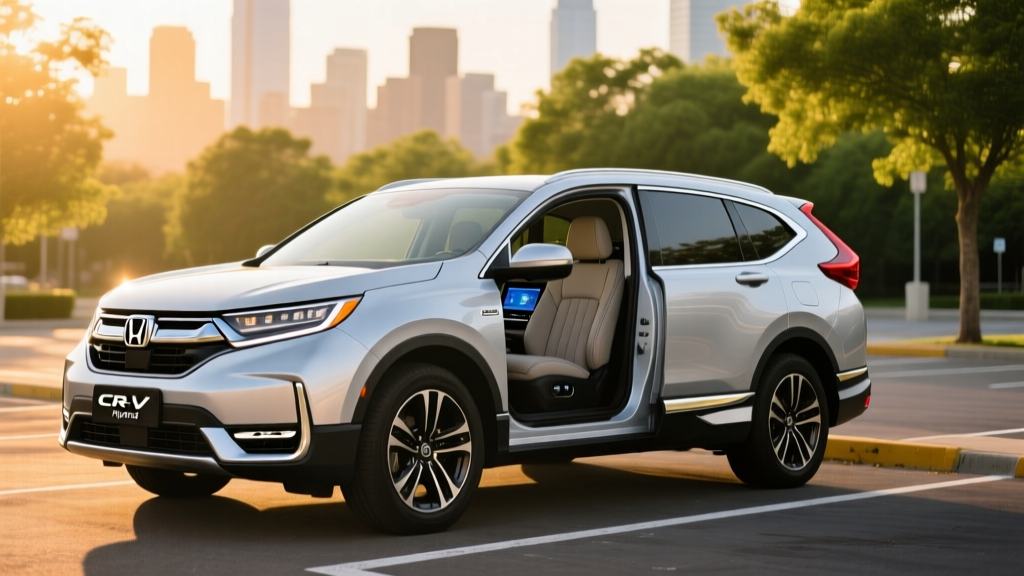
The Honda CR-V Hybrid has become one of the best-selling electrified SUVs in America, and for good reason: it offers near-EV efficiency in city driving without requiring a plug, a charger, or any change in daily habits. But with four hybrid trims, a wide price spread, and an increasingly competitive segment, understanding the Honda CR-V Hybrid 2025 price structure — and what you actually get at each tier — is essential before you visit a dealer.
This guide covers every trim's MSRP, the EPA-verified fuel economy numbers, the two-motor hybrid powertrain, real-world MPG expectations, battery longevity, and how the CR-V Hybrid stacks up against plug-in hybrid (PHEV) and battery-electric (BEV) alternatives in 2025.
Honda CR-V Hybrid 2025 Price by Trim Level
Honda offers the CR-V Hybrid across four trims for the 2025 model year. The hybrid powertrain is no longer confined to the top of the lineup — it's available from the mid-tier Sport trim all the way up to the Sport Touring Hybrid. Here is the complete MSRP breakdown, including the mandatory destination charge:
| Trim | Drivetrain | MSRP (incl. destination) |
|---|---|---|
| Sport Hybrid | FWD | $36,395 |
| Sport Hybrid | AWD | $37,895 |
| Sport-L Hybrid | FWD | $38,795 |
| Sport-L Hybrid | AWD | $40,295 |
| Sport Touring Hybrid | AWD (standard) | $42,895 |
Key pricing note: Honda's hybrid trims carry roughly a $1,500–$2,500 premium over their equivalent gas-only counterparts. The fuel savings typically recoup that premium within 3–5 years depending on annual mileage and local gas prices. All-wheel drive adds $1,500 across Sport and Sport-L trims; it comes standard on the Sport Touring Hybrid.
Fuel Economy: EPA MPG and Real-World Expectations
The CR-V Hybrid uses Honda's fourth-generation two-motor hybrid system, which is optimized for low-speed electric propulsion and seamlessly blends in the gasoline engine at higher loads. Here are the official EPA fuel economy figures:
| Drivetrain | City MPG | Highway MPG | Combined MPG |
|---|---|---|---|
| FWD Hybrid | 43 | 36 | 40 |
| AWD Hybrid | 40 | 34 | 37 |
Real-world MPG reality check: Honda's two-motor system excels in stop-and-go city traffic, where the electric motors handle most low-speed propulsion. Many owners report exceeding the EPA city estimate — 44–47 MPG is achievable in warm-weather urban driving with moderate acceleration. Highway fuel economy is the hybrid's relative weak point: at sustained 75–80 mph speeds, expect 31–34 MPG for AWD models, slightly below the EPA sticker. In cold weather (below 30°F), overall MPG can dip 5–10% as the engine runs more frequently to provide cabin heat and maintain battery temperature.
Powertrain Specs: How Honda's Two-Motor Hybrid Works
The 2025 CR-V Hybrid pairs a 2.0-liter Atkinson-cycle four-cylinder engine with Honda's e-CVT two-motor hybrid system. Unlike a traditional transmission, this setup uses one motor primarily as a generator and the second as the drive motor, creating a smooth, stepless power delivery that feels more like an EV than a conventional hybrid.
| Specification | Detail |
|---|---|
| Engine | 2.0L Atkinson-cycle 4-cylinder |
| Combined System Horsepower | 204 hp |
| Combined System Torque | 247 lb-ft (drive motor) |
| Transmission Type | e-CVT (two-motor hybrid) |
| 0–60 mph (est.) | ~7.6 seconds |
| Towing Capacity | 1,000 lbs |
| Fuel Tank | 15.3 gallons |
| Total Driving Range (AWD) | ~566 miles |
The 247 lb-ft of electric motor torque is available from near-zero RPM, giving the CR-V Hybrid strong off-the-line acceleration that feels noticeably punchier than the 190-hp turbocharged gas model at city speeds. The AWD system uses a dedicated rear-mounted electric motor rather than a mechanical driveshaft, which improves packaging and allows precise torque distribution to the rear wheels when traction demands it.
HEV vs PHEV vs EV: Which Electrified SUV Fits You?
One of the most common questions from CR-V shoppers: should I get the standard hybrid (HEV), a plug-in hybrid (PHEV), or go fully electric? Honda does not currently offer a CR-V PHEV in the United States, so the comparison extends to segment rivals. Here is how these three electrified approaches differ:
Conventional Hybrid (HEV) — Honda CR-V Hybrid
No plug required. The small battery recharges through regenerative braking and the gasoline engine. You simply fill up at a gas station as usual. Best for: drivers without home charging access, apartment dwellers, and those who want maximum simplicity with meaningful fuel savings.
Plug-In Hybrid (PHEV) — e.g., Toyota RAV4 Prime
Plug in for 25–42 miles of electric-only range, then the gas engine takes over. Requires access to a Level 1 (120V) or Level 2 (240V) outlet for meaningful benefit. Best for: drivers with short commutes who can charge at home and want EV-like daily driving with gas backup for road trips.
Battery Electric (BEV) — e.g., Hyundai Ioniq 5, Tesla Model Y
No gasoline at all. 250–320+ miles of EPA range, requires reliable home or workplace charging. Best for: drivers with consistent charging access who want the lowest per-mile energy cost and zero tailpipe emissions.
The decision framework: If you cannot charge at home or work, the CR-V Hybrid (HEV) is your best choice — it requires zero infrastructure and still delivers 37–40 MPG combined. If you can install a Level 2 charger and your daily commute is under 35 miles, a PHEV like the RAV4 Prime offers the best of both worlds but at a significantly higher starting price (~$44,500). If your commute is short, you have reliable home charging, and you want to eliminate gas entirely, a BEV delivers the lowest operating cost but demands the biggest upfront investment and lifestyle adjustment.
Battery Warranty, Longevity, and Replacement Cost
Hybrid battery anxiety is the number one concern we hear from first-time hybrid buyers. Here are the facts on the CR-V Hybrid's battery pack:
The CR-V Hybrid's battery pack is relatively small — approximately 1.06 kWh of usable capacity — because it only needs to store energy for brief electric-only bursts and regenerative braking capture, not sustained electric driving. This small size actually works in favor of longevity: the battery operates within a narrow, well-managed state-of-charge window (roughly 40–80%), which dramatically reduces degradation compared to a BEV or PHEV battery that cycles through deeper charge ranges.
Real-world lifespan data: Honda's hybrid systems have proven highly durable. Third-generation CR-V Hybrids (2020–2022 models) and high-mileage Accord Hybrids routinely surpass 150,000–200,000 miles on the original battery pack. Complete hybrid battery replacement, should it be needed out of warranty, typically costs between $2,000 and $4,000 including labor at a Honda dealership. Independent hybrid specialists may offer refurbished packs for $1,500–$2,500. Given the proven track record, most owners will never face this expense.
Does the CR-V Hybrid Qualify for a Federal Tax Credit?
This is where the distinction between HEV and PHEV matters enormously:
- The Honda CR-V Hybrid (HEV) does NOT qualify for the federal §30D clean vehicle tax credit. Under current IRS rules, the §30D credit of up to $7,500 is reserved for plug-in electric vehicles — battery-electric vehicles (BEVs) and plug-in hybrids (PHEVs) with a minimum battery capacity of 7 kWh. Conventional hybrids that cannot be plugged in are excluded entirely.
- No federal tax credit exists for conventional hybrids. The hybrid-specific tax incentives that existed prior to 2011 have long since expired.
- Some state and local incentives may apply. A handful of states and municipalities offer modest rebates or HOV lane access for hybrid vehicles, but these vary widely. Check your state energy office or Alternative Fuels Data Center for current local programs.
If the $7,500 federal tax credit is a priority in your purchase decision, you would need to look at a PHEV (like the Toyota RAV4 Prime, if it meets battery sourcing requirements) or a BEV — not a conventional hybrid. However, the CR-V Hybrid's lower purchase price and absence of charging infrastructure requirements often make its total cost of ownership competitive with or better than a PHEV once you factor in the full financial picture.
5-Year Total Cost of Ownership Snapshot
| Cost Factor | CR-V Hybrid AWD (Sport) | CR-V Gas AWD (EX) |
|---|---|---|
| MSRP | $37,895 | $35,695 |
| Federal Tax Credit | $0 | $0 |
| Fuel (5 yr / 75K mi) | ~$6,900 | ~$8,800 |
| Estimated Maintenance (5 yr) | ~$2,800 | ~$3,100 |
| Estimated Insurance (5 yr) | ~$7,500 | ~$7,200 |
| 5-Year Total (before depreciation) | ~$55,095 | ~$54,795 |
The hybrid's fuel savings of roughly $1,900 over five years nearly offsets its $2,200 higher MSRP. Factor in slightly lower maintenance costs (regenerative braking reduces brake pad wear significantly) and the hybrid reaches cost parity around year four. Beyond year five, the hybrid pulls ahead in savings. Depreciation for CR-V Hybrids has been strong — Honda's brand reputation and the growing consumer preference for electrified vehicles support robust resale values, as tracked by IIHS safety ratings and industry resale data.
Who Should Buy the CR-V Hybrid — And Who Shouldn't
✓ Choose the CR-V Hybrid If
- You want 37–40 MPG without plugging in or changing your routine
- You live in an apartment or lack access to home/work charging
- You take frequent road trips and don't want to plan around chargers
- You want Honda's reliability reputation and strong resale value
- Your budget is $36K–$43K and you want a well-equipped compact SUV
- You prioritize low-speed torque and smooth acceleration
✗ Look Elsewhere If
- You want electric-only daily driving (consider a PHEV or BEV)
- The $7,500 federal tax credit is essential to your budget
- You need more than 1,000 lbs of towing capacity
- You primarily drive highway miles (the hybrid advantage shrinks)
- You want a third row (the CR-V is strictly a two-row SUV)
Frequently Asked Questions
How many MPG does the 2025 Honda CR-V Hybrid actually get?
The EPA rates the FWD CR-V Hybrid at 43 city / 36 highway / 40 combined MPG, and the AWD model at 40 city / 34 highway / 37 combined MPG. In real-world city driving, many owners report 44–47 MPG in warm weather. Highway driving at 75+ mph typically yields 31–34 MPG for AWD models. Cold weather reduces efficiency by roughly 5–10%.
Is the CR-V Hybrid a plug-in? Do I need a charger?
No. The CR-V Hybrid is a conventional hybrid (HEV), not a plug-in hybrid (PHEV). You never plug it in. The battery charges automatically through regenerative braking and the gasoline engine. You simply refuel at any gas station as you would with a conventional vehicle.
How long will the hybrid battery last, and what does replacement cost?
Honda covers the hybrid battery for 8 years/100,000 miles (10 years/150,000 miles in CARB states). Real-world data from earlier Honda hybrid models shows battery packs routinely lasting 150,000–200,000+ miles. If replacement is needed out of warranty, expect to pay $2,000–$4,000 at a dealership or $1,500–$2,500 from an independent hybrid specialist.
Does the 2025 CR-V Hybrid qualify for any tax credit?
No. The federal §30D clean vehicle tax credit (up to $7,500) is only available for plug-in vehicles — BEVs and PHEVs with at least 7 kWh of battery capacity. The CR-V Hybrid is a conventional HEV and does not qualify. Some state or local incentive programs may offer modest hybrid rebates, but these vary by jurisdiction.
How does the CR-V Hybrid compare to the Toyota RAV4 Hybrid?
The RAV4 Hybrid is the CR-V Hybrid's closest rival. The RAV4 Hybrid is rated at 41 city / 38 highway / 39 combined MPG (slightly better highway, slightly worse city). The RAV4 Hybrid starts around $33,500, roughly $2,900 less than the CR-V Hybrid. However, the CR-V Hybrid offers more standard horsepower (204 vs. 219 combined for the RAV4 — though the RAV4's figure is higher, its driving feel differs), a more refined interior on upper trims, and Honda's Honda Sensing suite. Both are strong choices; the decision often comes down to dealer pricing, brand preference, and which interior layout you prefer.
Is the CR-V Hybrid reliable?
Honda's hybrid powertrain has a strong reliability track record. The e-CVT two-motor system has fewer moving parts than a traditional automatic transmission (no gear sets, torque converter, or clutch packs to wear). Combined with Honda's historical durability data and strong NHTSA safety ratings, the CR-V Hybrid is among the lowest-risk choices in the electrified compact SUV segment.