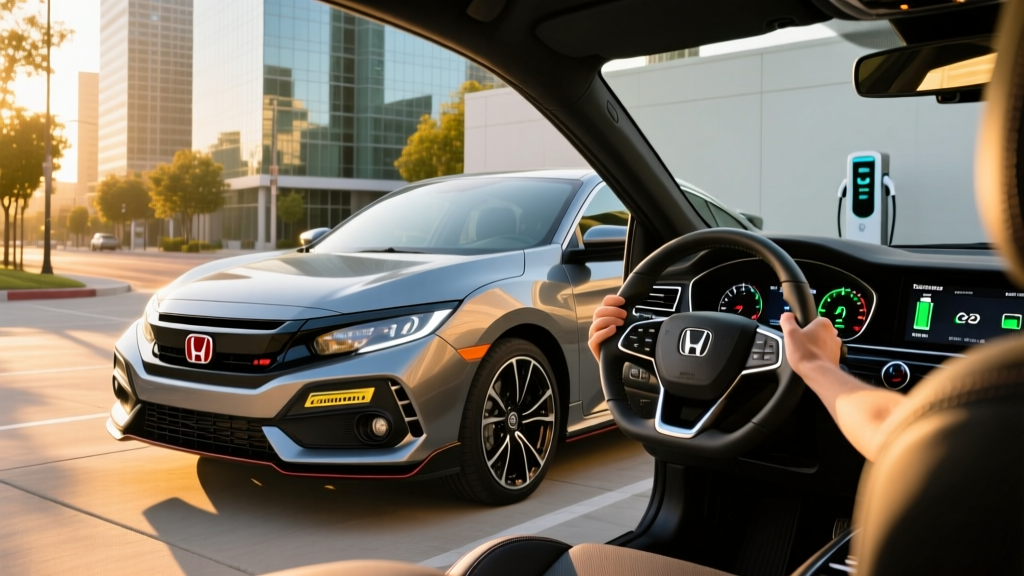
The 2026 Honda Civic Sport Hybrid Hatchback occupies a narrow but important lane: a five-door compact that sips fuel without asking you to plug in, worry about range, or compromise on cargo space. With an EPA-estimated 49 MPG combined and a two-motor hybrid powertrain producing 194 horsepower, it targets buyers who want electrified efficiency on a conventional fueling routine. This guide breaks down the real numbers — fuel economy, powertrain specs, battery longevity, pricing, and tax-credit eligibility — so you can decide if the Civic Sport Hybrid Hatchback fits your daily driving better than a plug-in hybrid or a full battery-electric vehicle.
Quick Verdict: Who the Civic Sport Hybrid Hatchback Is For
Buy this if: You want 45+ MPG in real-world mixed driving, need hatchback cargo versatility (up to 45.2 cu ft with seats folded), don't have reliable home-charging access for a PHEV or EV, and prefer a proven hybrid system backed by an 8-year/100,000-mile battery warranty.
Look elsewhere if: You have a short commute and home Level 2 charging — a PHEV like the Toyota Prius Prime would let you drive 40+ miles on electricity alone. Or if you're ready to eliminate gasoline entirely, a BEV like the Chevrolet Equinox EV offers 315+ miles of EPA range.
Fuel Economy: EPA Numbers vs. Real-World MPG
The Civic Sport Hybrid Hatchback pairs a 2.0-liter Atkinson-cycle four-cylinder engine with Honda's two-motor hybrid system. The EPA rates it at 50 MPG city / 47 MPG highway / 49 MPG combined for the front-wheel-drive Sport Hybrid trim. These figures come from fueleconomy.gov and apply to the 2025 model year; 2026 EPA certifications typically carry over when the powertrain is unchanged.
| Metric | EPA Estimate | Real-World Expectation |
|---|---|---|
| City MPG | 50 | 50–54 (hybrids excel in stop-and-go) |
| Highway MPG | 47 | 42–46 (sustained 75+ mph reduces regen benefit) |
| Combined MPG | 49 | 46–52 |
| Fuel Tank Capacity | 10.6 gal | ~480–550 mi total range |
Why real-world MPG can beat the EPA in the city: Honda's hybrid system runs the gasoline engine primarily as a generator at low speeds, with the electric traction motor handling acceleration. Every stop recharges the small lithium-ion battery through regenerative braking. Owners with heavy urban commutes routinely report 52–55 MPG on the trip computer.
Why highway MPG dips: Above roughly 55 mph, the engine clutches directly to the wheels for efficiency, but you lose the regenerative braking advantage. At sustained 80 mph on the interstate, expect closer to 42–44 MPG, especially with headwinds or hill climbs. Cold weather (below 30°F) can reduce combined MPG by 3–5 points due to cabin heating load and denser air.
HEV vs. PHEV vs. EV: Where This Civic Fits
The Civic Sport Hybrid Hatchback is a conventional hybrid (HEV) — it has no plug and no electric-only driving mode of meaningful distance. This is a critical distinction that trips up many shoppers. Here's how the three electrified categories compare:
| Feature | HEV (This Civic) | PHEV (e.g., Prius Prime) | BEV (e.g., Equinox EV) |
|---|---|---|---|
| Plugs in? | No | Yes (Level 1/2) | Yes (Level 1/2/DC) |
| Electric-only range | ~1 mi (low-speed creep) | 25–45 mi | 250–350+ mi |
| Gasoline needed? | Yes, always | Yes, for trips beyond EV range | No |
| Home charging required? | No | Recommended for full benefit | Essential |
| Federal tax credit (§30D) | Not eligible | Up to $7,500 (if eligible) | Up to $7,500 (if eligible) |
| Best for | No home charger, mixed driving | Short commute + road trips | Home charging + daily driving |
The Civic Hybrid is the lowest-friction electrified choice. You fuel it like any gas car and let the hybrid system optimize efficiency in the background. There is no charging cable, no preconditioning, no range planning. If your apartment building lacks chargers or your home electrical panel can't support a Level 2 installation without a costly upgrade, an HEV delivers 40–50% better fuel economy than a conventional gas Civic without any infrastructure changes.
Powertrain Specs: Two-Motor Hybrid System
| Specification | Value |
|---|---|
| Engine | 2.0L Atkinson-cycle DOHC 4-cylinder |
| Engine output | 146 hp / 134 lb-ft torque |
| Traction motor output | 184 hp / 232 lb-ft torque |
| Combined system horsepower | 194 hp |
| Combined system torque | 232 lb-ft (motor-driven) |
| Transmission | e-CVT (single-speed direct drive with engine clutch) |
| Drivetrain | Front-wheel drive |
| 0–60 mph (est.) | ~7.5 seconds |
| Hybrid battery type | Lithium-ion (approx. 1.0 kWh usable) |
| Driving modes | ECON, Normal, Sport, Individual |
Honda's e:HEV two-motor system is fundamentally different from the planetary-gear hybrid setups used by Toyota. In the Civic, the gasoline engine is mechanically disconnected from the wheels at low speeds — it acts purely as a generator feeding the traction motor. Only at highway cruising speeds does a lock-up clutch engage the engine directly to the axle, avoiding the efficiency loss of double energy conversion. The result is seamless, EV-like acceleration off the line (the motor's 232 lb-ft is available from zero RPM) with efficient highway operation.
In Sport mode, the system holds higher engine RPM and sharpens throttle response. It won't transform the Civic into a performance car, but the instant torque fills the gap that traditional CVTs leave during highway merges.
Pricing, Trims, and Tax Credit Eligibility
The 2026 Honda Civic Sport Hybrid Hatchback carries a starting MSRP of approximately $29,950 (including destination charge), based on Honda's pricing structure for the current generation. Key standard equipment includes a 7-inch touchscreen with wireless Apple CarPlay and Android Auto, Honda Sensing safety suite (adaptive cruise control, lane-keeping assist, automatic emergency braking), and 18-inch alloy wheels.
Federal Tax Credit (§30D) Status: The Civic Sport Hybrid Hatchback is a conventional hybrid (HEV). It does not qualify for the IRS §30D Clean Vehicle Credit, which applies only to plug-in electric vehicles (PHEVs and BEVs) with a minimum battery capacity of 7 kWh and external charging capability. There is currently no federal tax credit for conventional hybrids. Some states may offer rebates or HOV-lane access for hybrids — check your state energy office or the Alternative Fuels Data Center for local incentives.
The absence of a tax credit is a real cost consideration. A PHEV competitor like the Toyota Prius Prime SE starts around $33,000 but may qualify for up to $3,750 in federal credit (subject to IRS battery-sourcing and income-cap rules — see irs.gov for current eligibility), narrowing the price gap. However, the PHEV only delivers its efficiency advantage if you plug it in regularly. If you won't charge, the Civic Hybrid's lower purchase price and strong MPG make it the more economical choice.
Battery Warranty, Longevity, and Replacement Cost
Honda Hybrid Battery Warranty: 8 years / 100,000 miles (10 years / 150,000 miles in CARB states including California, New York, Massachusetts, and others adopting California emissions standards). Coverage applies to capacity loss below a defined threshold and defects.
The Civic Hybrid's lithium-ion battery pack is small (~1.0 kWh usable) and operates within a narrow state-of-charge window — typically between 20% and 80%. Honda's battery-management system never fully charges or fully depletes the pack, which dramatically reduces degradation compared to a BEV battery that cycles through wider ranges daily.
Real-world longevity data: Honda's two-motor hybrid system has been in production since the 2014 Accord Hybrid. Fleet data and owner reports indicate that Honda hybrid batteries routinely last 150,000–200,000+ miles before notable capacity loss. Unlike early-generation hybrids from the 2000s, modern lithium-ion packs with active thermal management rarely fail catastrophically within the warranty period.
Out-of-warranty replacement cost: If the hybrid battery does need replacement after the warranty expires, expect to pay between $2,000 and $4,000 for a new OEM pack installed at a Honda dealer, based on current parts pricing for the Civic/Accord hybrid family. Refurbished or aftermarket packs may be available for $1,200–$2,000. This is a fraction of BEV battery replacement costs ($8,000–$20,000+), reflecting the much smaller capacity.
Cargo, Practicality, and Ownership Costs
The hatchback body style is a major differentiator versus the Civic Hybrid Sedan. Behind the rear seats, you get 26.2 cubic feet of cargo space — roughly double the sedan's trunk. Fold the 60/40 split rear seats and the floor opens to 45.2 cubic feet, enough for a full sheet of plywood laid flat or several large suitcases. The load floor sits slightly higher than the non-hybrid hatchback due to the battery placement beneath the rear cargo area, but the impact is minimal in daily use.
Estimated annual fuel cost: At 49 MPG combined, 12,000 miles per year, and $3.40/gallon regular unleaded, the Civic Sport Hybrid Hatchback costs approximately $833/year in fuel. A comparable gas-only Civic Hatchback (33 MPG combined) would cost roughly $1,236/year — a savings of about $400 annually with the hybrid. Over a 5-year ownership cycle, fuel savings total roughly $2,000, partially offsetting the hybrid's higher MSRP.
Insurance and maintenance: Hybrid Civic insurance premiums run roughly 5–10% higher than gas Civic premiums, reflecting the higher replacement cost of hybrid components. Maintenance is essentially identical to a gas Civic — the hybrid system adds no routine service items. There is no transmission fluid to change (the e-CVT has no belts or pulleys), and regenerative braking extends pad and rotor life significantly; many hybrid owners report original brake pads lasting 80,000+ miles.
Pros, Cons, and Alternatives
Pros
- 49 MPG EPA combined; routinely exceeds 50 MPG in city driving
- 194 hp with instant electric torque — responsive for a compact hybrid
- Hatchback cargo (26.2 / 45.2 cu ft) beats sedan significantly
- No plug-in required — zero infrastructure cost or behavioral change
- 8-yr/100k-mi hybrid battery warranty (10/150k in CARB states)
- Honda Sensing ADAS suite standard on all trims
Cons
- No federal tax credit (HEV ineligible for §30D)
- Highway MPG drops to low 40s at sustained 75+ mph
- No AWD option (Sport Touring Hybrid also FWD only)
- Cabin noise under hard acceleration (engine drones at high RPM)
- ~$3,500 premium over gas Civic Sport Hatchback — payback takes ~4 years at 12k mi/yr
- Infotainment lags competitors in responsiveness (7-inch screen on Sport trim)
Key alternatives to cross-shop:
- Toyota Prius (HEV): 57 MPG combined, but liftback only — less cargo height than the Civic hatchback. Slightly less power (196 hp combined on AWD, 194 hp FWD).
- Toyota Prius Prime (PHEV): 44 miles EV-only, then 48 MPG combined as a hybrid. Eligible for partial federal credit. Best if you can charge at home.
- Hyundai Elantra Hybrid: 54 MPG combined, but sedan only — no hatchback option.
- Kia Niro HEV: 53 MPG combined, crossover ride height, but smaller overall and less engaging to drive.
Frequently Asked Questions
How many MPG does the Honda Civic Sport Hybrid Hatchback actually get?
The EPA rates it at 50 city / 47 highway / 49 combined MPG. In real-world driving, expect 50–54 MPG in city-heavy commutes where regenerative braking maximizes efficiency, and 42–46 MPG on sustained highway trips above 70 mph. Cold weather below freezing can reduce combined MPG by 3–5 points. Owner-reported averages on fuel-tracking apps typically cluster between 46 and 52 MPG combined.
Does the Civic Hybrid need to be plugged in?
No. The Civic Sport Hybrid Hatchback is a conventional hybrid (HEV), not a plug-in hybrid. It charges its small lithium-ion battery entirely through regenerative braking and the gasoline engine. You fuel it at any gas station with regular 87-octane unleaded. There is no charging port, no cable, and no electric-only driving mode beyond very low-speed parking-lot creep.
Hybrid vs. PHEV vs. EV — which should I choose?
Choose the Civic Hybrid (HEV) if you lack reliable home or workplace charging and want maximum MPG with zero behavioral change. Choose a PHEV (like the Prius Prime) if you have a short commute (under 40 miles round-trip), can install a Level 2 charger at home, and still want gas-engine flexibility for road trips — plus potential federal tax credits. Choose a BEV (like the Chevrolet Equinox EV or Hyundai Ioniq 5) if you have home charging, want to eliminate gasoline entirely, and your typical trips fall within 250+ miles. The Civic Hybrid is the lowest-risk, lowest-infrastructure option.
Is the Honda Civic Hybrid reliable, and what does battery replacement cost?
Honda's two-motor hybrid system has been in continuous production since 2014 and is among the most proven on the market. The hybrid battery is warranted for 8 years/100,000 miles (10 years/150,000 miles in CARB states). Real-world data shows these packs routinely lasting 150,000–200,000+ miles. Out-of-warranty replacement costs $2,000–$4,000 for an OEM pack — far less than a BEV battery. The IIHS has awarded the Civic Hatchback top safety ratings, and Honda Sensing comes standard.
Does the Civic Hybrid Hatchback qualify for any tax credit?
No federal tax credit applies. The IRS §30D Clean Vehicle Credit requires a plug-in vehicle with at least 7 kWh of battery capacity — the Civic Hybrid's ~1.0 kWh pack does not qualify. Some states or municipalities may offer hybrid-specific rebates, HOV-lane stickers, or reduced registration fees. Check the Alternative Fuels Data Center for state-level incentives. If a federal tax credit is a priority, you'll need to look at a PHEV or BEV.
How does the Sport Hybrid compare to the Sport Touring Hybrid?
The Sport Touring Hybrid Hatchback adds leather-trimmed seats, a 9-inch touchscreen with wireless CarPlay, Bose premium audio, heated rear seats, and a power liftgate, starting around $33,000. The powertrain is identical — 194 hp, same fuel economy. Choose the Sport Touring if you want premium features; the Sport Hybrid is the value pick with the same efficiency and performance.