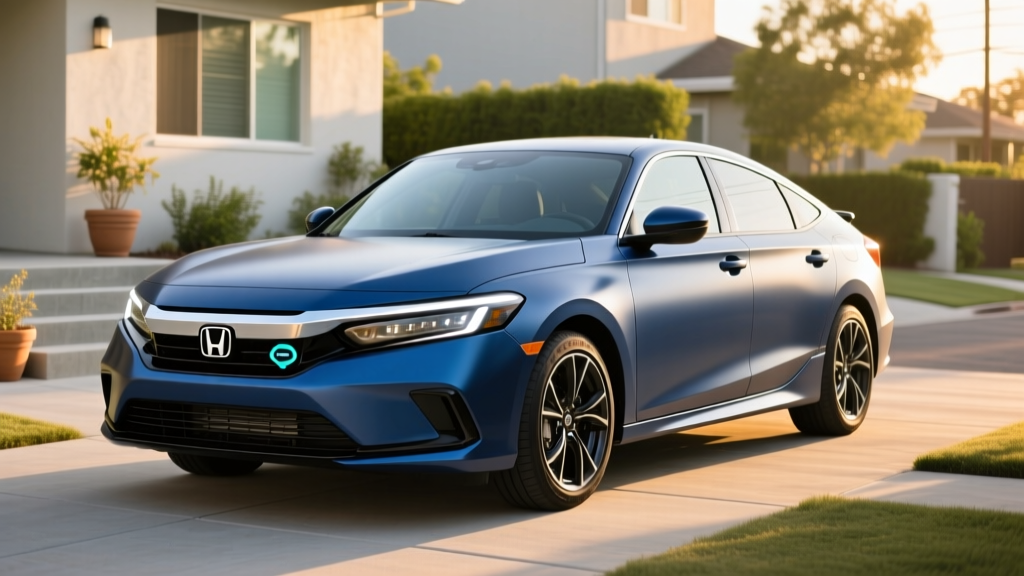
The Honda Civic Hybrid returns for 2026 with a compelling formula: 50 MPG combined from a two-motor system producing 200 horsepower, wrapped in a compact sedan or hatchback body that costs thousands less than a comparable EV. If you've been searching for detailed Honda Civic Hybrid specs to see whether this powertrain fits your commute, budget, and charging situation, this guide covers every number that matters—from EPA fuel economy to battery warranty to real-world efficiency.
Let's get one thing clear up front: the 2026 Civic is a conventional hybrid (HEV), not a plug-in hybrid. You never plug it in. It charges its small lithium-ion battery through regenerative braking and the gasoline engine. This distinction matters because buyers often confuse HEVs with PHEVs, and the ownership experience is fundamentally different. No home charger needed, no electric-only range to manage, and no federal tax credit under IRS §30D.
HEV vs PHEV: What's the Difference?
| Feature | Civic Hybrid (HEV) | Plug-In Hybrid (PHEV) |
|---|---|---|
| Plug in to charge? | No | Yes (Level 1 or Level 2) |
| Electric-only range | ~1 mile at low speed | 20–50 miles typical |
| Battery size | ~1.0 kWh (small buffer) | 12–25 kWh usable |
| DC fast charging | Not applicable | Some models (50–80 kW) |
| Federal tax credit | No | Up to $7,500 (if eligible) |
| Best for | No home charging access | Home charging + short commute |
2026 Honda Civic Hybrid MPG and Fuel Economy
The headline number for the 2026 Civic Hybrid is its EPA-estimated fuel economy. Honda's two-motor hybrid system pairs a 2.0-liter Atkinson-cycle four-cylinder engine with dual electric motors for class-leading efficiency in the compact segment.
| Trim / Body | City | Highway | Combined |
|---|---|---|---|
| Sport Sedan | 50 MPG | 47 MPG | 49 MPG |
| Sport Touring Sedan | 50 MPG | 47 MPG | 49 MPG |
| Sport Hatchback | 50 MPG | 45 MPG | 48 MPG |
| Sport Touring Hatchback | 50 MPG | 45 MPG | 48 MPG |
Source: EPA fueleconomy.gov
Real-World MPG vs EPA Sticker
Hybrids like the Civic typically exceed their EPA city rating in stop-and-go traffic because regenerative braking recovers energy that a gas car wastes as heat. In our experience and owner reports, the Civic Hybrid delivers 52–55 MPG in urban driving. Highway efficiency is more variable: at sustained 75–80 MPH, expect 42–45 MPG as the gasoline engine does most of the work without regen assistance. Cold weather (below 35°F) reduces efficiency by roughly 8–12% due to increased engine runtime for cabin heating and reduced battery efficiency.
Powertrain Specs: Engine, Motors, and Horsepower
The 2026 Civic Hybrid uses Honda's fourth-generation two-motor hybrid system. Unlike Toyota's planetary-gear power-split design, Honda's system operates primarily in series-hybrid mode at low and moderate speeds—the engine generates electricity that powers the drive motor—then switches to direct engine drive via a lock-up clutch at highway cruising speeds.
| Specification | |
|---|---|
| Engine | 2.0L Atkinson-cycle DOHC 4-cylinder |
| Engine output | 146 hp @ 6,000 rpm / 134 lb-ft @ 4,500 rpm |
| Drive motor | 184 hp / 232 lb-ft torque |
| Combined system output | 200 hp / 232 lb-ft |
| Transmission | e-CVT (single-speed direct drive + lock-up clutch) |
| Drivetrain | Front-wheel drive |
| 0–60 MPH | ~7.2 seconds (est.) |
| Hybrid battery | ~1.0 kWh lithium-ion |
| Fuel tank | 10.6 gallons |
| Total range | ~520 miles (combined) |
The 200-horsepower combined output puts the Civic Hybrid ahead of the non-hybrid 2.0L Civic (158 hp) and close to the 1.5T turbo (180 hp), while delivering more than double the fuel economy. The instant electric torque (232 lb-ft available from near zero RPM) gives the Civic Hybrid strong off-the-line acceleration that feels quicker than its 0–60 time suggests.
Pricing and Tax Credit Eligibility
The 2026 Honda Civic Hybrid is available in Sport and Sport Touring trims for both sedan and hatchback body styles.
| Trim | Body | MSRP |
|---|---|---|
| Sport | Sedan | $29,845 |
| Sport Touring | Sedan | $32,845 |
| Sport | Hatchback | $30,845 |
| Sport Touring | Hatchback | $33,845 |
Prices include destination charge. Source: Honda.com
Does the Civic Hybrid Qualify for a Federal Tax Credit?
No. The IRS §30D Clean Vehicle Credit applies only to plug-in electric vehicles (BEVs and PHEVs) with battery capacities of at least 7 kWh and the ability to charge from an external power source. The Civic Hybrid's ~1.0 kWh battery charges only from its engine and regenerative braking—it has no plug. It does not qualify for the federal EV tax credit, and there is no comparable federal credit for conventional hybrids in 2026.
Some states offer rebates for high-efficiency vehicles, but these vary by jurisdiction and change frequently. Check your state's energy office or the Alternative Fuels Data Center for current local incentives.
Battery Warranty, Lifespan, and Replacement Cost
Battery longevity is the number-one concern for hybrid buyers, and Honda addresses this with strong warranty coverage.
2026 Civic Hybrid Battery Warranty
- Hybrid battery: 8 years / 100,000 miles (10 years / 150,000 miles in CARB states including CA, CT, ME, MA, NJ, NY, OR, RI, VT, WA)
- Hybrid system components: 8 years / 100,000 miles
- Powertrain warranty: 5 years / 60,000 miles
- Limited vehicle warranty: 3 years / 36,000 miles
The warranty covers capacity loss below a functional threshold—Honda does not publish a specific percentage, but industry standard is replacement if capacity drops below 60–70% of original.
Real-World Battery Lifespan
Honda's hybrid systems have proven durable. The earlier-generation Insight and Accord Hybrid batteries commonly last 150,000–200,000+ miles before significant degradation. The Civic Hybrid's small ~1.0 kWh battery undergoes shallow charge cycles (it rarely drops below 40% or above 80% state of charge), which dramatically extends cell life compared to a full EV battery that cycles through deeper ranges.
Battery Replacement Cost
If the hybrid battery does need replacement outside warranty, expect to pay $2,500–$4,000 for a new OEM battery pack including labor at a Honda dealer. Third-party refurbished batteries are available for $1,500–$2,500. This is far less than EV battery replacements ($8,000–$20,000) because the hybrid battery is small and simpler to service.
Reliability and Safety Ratings
Honda's hybrid powertrain has a strong reliability track record. The two-motor system has fewer moving parts than a traditional automatic transmission—no torque converter, no multi-speed gear sets, no conventional starter motor. The e-CVT is a direct-drive unit with a lock-up clutch, reducing mechanical complexity.
For the 2026 model year, the Civic Hybrid includes Honda Sensing as standard equipment across all trims:
- Adaptive Cruise Control (ACC) with Low-Speed Follow
- Collision Mitigation Braking System (CMBS)
- Lane Keeping Assist System (LKAS)
- Road Departure Mitigation (RDM)
- Traffic Sign Recognition
Note: Honda Sensing is an SAE Level 2 driver-assistance system. It provides steering and acceleration/braking support but requires the driver to remain fully engaged with hands on the wheel and eyes on the road at all times. It is not autonomous or self-driving.
The Civic earned a TOP SAFETY PICK rating from IIHS in prior model years with good ratings across crashworthiness tests. NHTSA has historically given the Civic 5 stars overall.
Hybrid vs PHEV vs EV: Which Should You Choose?
The Civic Hybrid occupies a specific niche in the electrification spectrum. Here's a practical decision framework based on real ownership scenarios:
Choose the Civic Hybrid (HEV) if:
- You don't have access to home or workplace charging (apartment, street parking, condo without EV infrastructure)
- You want maximum fuel economy with zero behavior change—just fill up with gas
- Your budget is under $35,000 and you want proven reliability
- You regularly take long road trips where EV charging infrastructure is sparse
- You want 500+ miles of total range without planning stops
Choose a PHEV (like the Toyota Prius Prime or Hyundai Tucson PHEV) if:
- You can install a Level 2 charger at home
- Your daily commute is under 40 miles round-trip (covering most days on electricity alone)
- You want to reduce gasoline consumption by 70–90% while keeping gas for road trips
- You may qualify for the $7,500 federal tax credit (check IRS §30D eligibility for income caps, MSRP limits, and battery sourcing rules)
Choose a full EV (like the Chevy Equinox EV or Hyundai Ioniq 5) if:
- You have reliable home Level 2 charging
- You want zero tailpipe emissions and minimal maintenance (no oil changes, no spark plugs)
- You qualify for the federal tax credit and/or state EV rebates
- Your daily driving is under 250 miles and you're comfortable with DC fast charging for road trips
What It's Like to Drive and Live With
The Civic Hybrid's two-motor system is one of the smoothest hybrid powertrains on the market. Because the drive motor handles most propulsion duties below ~50 MPH, acceleration feels linear and electric—no rubber-band CVT drone, no gear hunting. The engine only engages directly at highway cruising speeds through the lock-up clutch, and the transition is nearly imperceptible.
Honda includes selectable drive modes (ECON, Normal, Sport) and individual regen paddle shifters behind the steering wheel that let you adjust regenerative braking intensity from light coasting to strong one-pedal-style deceleration. In practice, the strongest regen setting slows the car significantly but doesn't bring it to a complete stop—you'll still use the brake pedal for final stopping.
The Sport Touring trim adds a Bose 12-speaker audio system, wireless Apple CarPlay/Android Auto, a 10.2-inch digital instrument cluster, heated rear seats, and a wireless phone charger. Cargo volume is 14.8 cu ft in the sedan and 24.4 cu ft behind the rear seats in the hatchback (per Honda specifications).
Pros
- 50 MPG combined—among the best in any compact car
- 200 hp provides confident acceleration
- No plug-in required—zero lifestyle change from a gas car
- Strong 8-year/100,000-mile hybrid battery warranty
- Honda Sensing safety suite standard on all trims
- Refined, quiet cabin with premium tech in Sport Touring
Cons
- No federal tax credit (HEV, not a PHEV or EV)
- FWD only—no all-wheel-drive option
- Hybrid only available in Sport and Sport Touring trims (higher starting price)
- Highway MPG drops to 45–47 (engine-dominant at sustained speed)
- No spare tire—tire repair kit only
- Cabin noise increases under hard acceleration (engine RPM rises)
Frequently Asked Questions
How many MPG does the 2026 Honda Civic Hybrid get?
The EPA rates the Civic Hybrid sedan at 50 city / 47 highway / 49 combined MPG. The hatchback is rated 50 / 45 / 48. In real-world city driving with frequent stops, many owners report 52–55 MPG thanks to aggressive regenerative braking. Highway driving at 75+ MPH typically yields 42–45 MPG.
Does the Civic Hybrid need to be plugged in?
No. The Civic Hybrid is a conventional HEV. Its small lithium-ion battery charges exclusively through regenerative braking and the gasoline engine. There is no plug, no charging cable, and no electric-only driving range to manage.
How far can the Civic Hybrid go on electric only?
Essentially zero miles in practical terms. The hybrid battery can propel the car at very low speeds (under 20 MPH) for brief distances—such as creeping through a parking lot—but the engine starts almost immediately under any meaningful acceleration. This is normal for conventional hybrids and is not a limitation; the system uses electric assist to optimize the engine's efficiency, not to replace it.
Is the Civic Hybrid reliable, and what does battery replacement cost?
Honda's hybrid systems have a strong long-term reliability record, with many owners exceeding 200,000 miles on the original hybrid battery. The battery is covered by an 8-year/100,000-mile warranty (10 years/150,000 miles in CARB states). If replacement is needed out of warranty, expect $2,500–$4,000 for an OEM battery at a dealer, or $1,500–$2,500 for a refurbished unit.
Does the 2026 Civic Hybrid qualify for any tax credit?
Not at the federal level. The IRS §30D Clean Vehicle Credit requires a plug-in vehicle with at least 7 kWh of battery capacity. The Civic Hybrid has a ~1.0 kWh battery and no plug. Some states may offer efficiency or clean-air rebates—check your state energy office or the Alternative Fuels Data Center for current programs.
How does the Civic Hybrid compare to the Toyota Prius?
The Prius (57 MPG combined, 196 hp) edges out the Civic Hybrid on fuel economy by about 8 MPG combined, but the Civic offers a more premium interior, stronger acceleration feel from its 232 lb-ft of electric torque, and a more conventional driving experience. The Prius also has an available AWD-e option and a PHEV variant (Prius Prime) that the Civic lineup lacks. If maximum MPG is your priority, the Prius wins. If you want a sportier compact car that happens to get 50 MPG, the Civic Hybrid is the stronger choice.
What is the total driving range of the Civic Hybrid?
With a 10.6-gallon fuel tank and 49 MPG combined, the Civic Hybrid sedan can travel approximately 520 miles between fill-ups. That's comparable to or better than most compact EVs on a single charge and eliminates range anxiety entirely—gas stations are everywhere.