Quick Verdict: The Civic Hatchback Sport Hybrid at a Glance
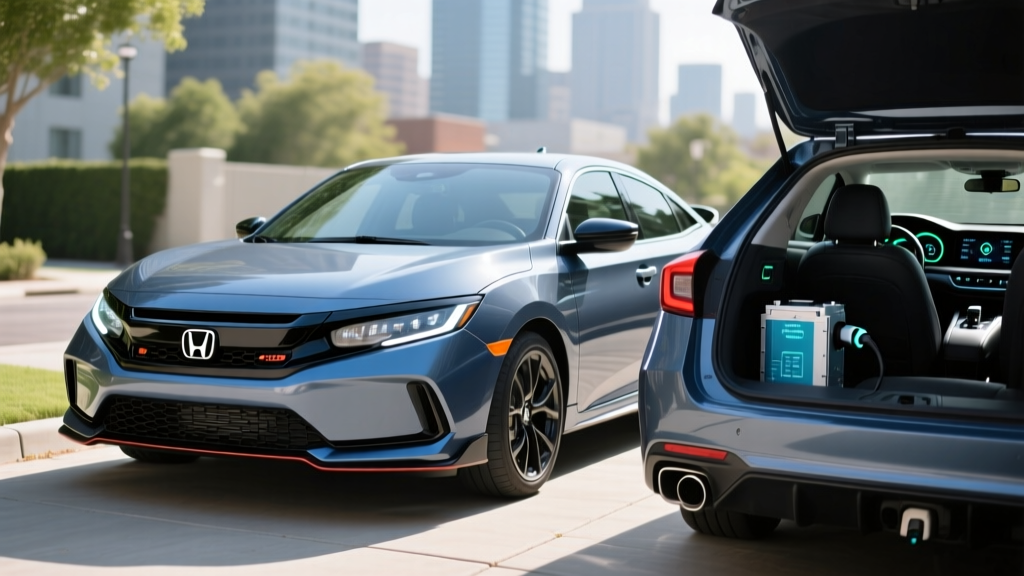
The 2026 Honda Civic Hatchback Sport Hybrid occupies a specific niche: buyers who want hatchback cargo versatility and excellent fuel economy without plugging in. This is a conventional hybrid (HEV), not a plug-in hybrid (PHEV) — meaning you never need to charge it. The two-motor hybrid system recaptures energy through regenerative braking and the gasoline engine, delivering an EPA-estimated 50 MPG combined. With a starting MSRP around $30,950 (including destination), it undercuts most plug-in hybrids and full EVs while still cutting fuel costs significantly versus a gas-only Civic.
| Spec | Value |
|---|---|
| Powertrain | 2.0L 4-cylinder Atkinson-cycle + two-motor hybrid system |
| Combined Horsepower | 200 hp |
| Combined Torque | 232 lb-ft (electric motor peak) |
| EPA MPG (City / Hwy / Combined) | 50 / 45 / 48 MPG |
| Fuel Tank Capacity | 10.6 gallons |
| Total Driving Range | ~508 miles (EPA est.) |
| Cargo Volume (rear seats up / folded) | 24.3 / 46.2 cu ft |
| 0–60 mph (est.) | ~7.5 seconds |
| Starting MSRP (Sport Hybrid) | ~$30,950 |
| Hybrid Battery Warranty | 8 years / 100,000 miles (10 yr/150k in CARB states) |
HEV vs PHEV: Understanding What the Civic Hatchback Sport Hybrid Is
A common point of confusion in the electrified-vehicle space is the difference between a conventional hybrid (HEV) and a plug-in hybrid (PHEV). The 2026 Honda Civic Hatchback Sport Hybrid is an HEV. Here is what that means in practical terms:
| Feature | HEV (Civic Sport Hybrid) | PHEV (e.g., Toyota Prius Prime) | Full EV (BEV) |
|---|---|---|---|
| Plug in to charge? | No — self-charging via regen + engine | Yes — plug in for electric-only miles | Yes — must plug in |
| Electric-only range | ~1 mile at low speeds | 25–44 miles (typical) | 200–400+ miles |
| Uses gasoline? | Yes — always | Yes — after battery depletes | No |
| Federal tax credit (§30D)? | No | Up to $7,500 (if eligible) | Up to $7,500 (if eligible) |
| Home charging needed? | No | Recommended (120V or 240V) | Essential |
| Maintenance | Oil changes, standard ICE service | Oil changes + battery system | Minimal — no oil, fewer fluids |
The Civic Hatchback Sport Hybrid's two-motor system operates primarily in EV mode at low speeds and in hybrid mode at higher speeds, with the engine sometimes driving the wheels directly through a lock-up clutch at highway cruising speeds. You will never need to find a charger or worry about electric-only range — it simply gets better mileage than its gas-only counterpart.
Fuel Economy: EPA Ratings and Real-World MPG
According to fueleconomy.gov, the 2026 Honda Civic Hatchback Sport Hybrid carries EPA ratings of 50 MPG city, 45 MPG highway, and 48 MPG combined. (Note: exact figures may vary slightly by final EPA certification; the related Civic Sedan Hybrid rates 50/47/49.)
| Driving Condition | EPA MPG | Real-World Expectation |
|---|---|---|
| City | 50 MPG | 48–54 MPG (hybrids often exceed EPA in stop-and-go) |
| Highway | 45 MPG | 42–46 MPG (sustained 75+ mph reduces hybrid advantage) |
| Combined | 48 MPG | 46–50 MPG |
| Cold Weather (below 32°F) | N/A | 40–44 MPG (engine runs more for cabin heat) |
Why real-world MPG can exceed EPA in the city: Honda's hybrid system uses the electric motor as the primary drive source at low and moderate speeds, with the engine acting mainly as a generator. Stop-and-go traffic triggers frequent regenerative braking, recapturing kinetic energy that a gas car would waste as heat. Owners who do predominantly city driving often report 50–54 MPG on enthusiast forums — a rare case where the sticker number is conservative.
Where you lose efficiency: Sustained highway driving above 75 MPH, cold weather (the engine runs more often to provide cabin heat), and steep mountain grades all reduce the hybrid advantage. In sub-freezing winter testing, expect a 10–15% drop from the combined rating, landing around 40–44 MPG. This is still substantially better than the gas-only Civic Hatchback Sport's 33 MPG combined.
Powertrain Deep Dive: 200 HP From a Two-Motor System
The Civic Hatchback Sport Hybrid uses Honda's fourth-generation two-motor hybrid system paired with a 2.0-liter Atkinson-cycle four-cylinder engine. Here is how the components break down:
- Gasoline engine: 2.0L DOHC 4-cylinder, producing approximately 146 hp and 134 lb-ft of torque on its own
- Drive motor: Permanent-magnet electric motor producing up to 184 hp and 232 lb-ft of torque
- Generator motor: Second electric motor that acts as a generator, starter, and engine-speed smoother
- Combined system output: 200 hp (Honda rates combined output lower than peak motor output due to engine/motor power-band overlap)
- Transmission: No traditional gearbox — the system uses an e-CVT (single-speed direct drive with engine lock-up clutch at highway speeds)
The result is a 0–60 mph time of approximately 7.5 seconds — roughly a full second quicker than the gas-only Civic Hatchback Sport (which uses a 2.0L non-hybrid engine rated at 158 hp). The electric motor's instant torque delivery makes the Sport Hybrid feel notably punchier in city acceleration and passing maneuvers, even though the peak horsepower number is modest.
Honda's hybrid system also features selectable drive modes: Normal, Econ (reduces throttle response and A/C load), Sport (sharper throttle, enhanced engine sound), and Individual (customizable). An EV button allows short-distance electric-only driving at low speeds — useful for creeping through a parking garage or residential street — but the battery is too small for meaningful electric-only range.
Pricing, Trims, and Tax Credit Eligibility
The 2026 Honda Civic Hatchback Sport Hybrid is offered in two trims:
- Sport Hybrid: ~$30,950 MSRP (incl. destination)
- Sport Touring Hybrid: ~$34,350 MSRP (incl. destination) — adds Bose audio, wireless charging, navigation, leather-trimmed seats, and Honda Sensing with expanded features
Federal tax credit status: The Civic Hatchback Sport Hybrid does not qualify for the IRS §30D Clean Vehicle Credit. That credit applies only to plug-in electric vehicles (PHEVs and BEVs) with sufficient battery capacity. As a conventional hybrid, the Civic Sport Hybrid is ineligible for the federal $7,500 credit or the $4,000 used-EV credit.
State incentives: Some states offer rebates or HOV-lane access for conventional hybrids, but these vary widely and change frequently. Check your state's energy or DMV website for current programs. States like California, Colorado, and Maryland have historically offered hybrid incentives, but many have shifted focus to PHEVs and BEVs.
Despite the lack of a federal tax credit, the Civic Hatchback Sport Hybrid's fuel savings are meaningful. At $3.50/gallon and 12,000 miles/year, the Sport Hybrid (48 MPG combined) costs approximately $875/year in fuel versus $1,273/year for the gas-only Civic Hatchback Sport (33 MPG combined) — a savings of roughly $398 per year, or about $1,990 over five years.
Hybrid Battery Longevity, Warranty, and Replacement Cost
Honda Hybrid Battery Warranty:
- Standard coverage: 8 years / 100,000 miles (whichever comes first)
- CARB states (CA, CT, ME, MD, MA, NJ, NY, OR, RI, VT, WA, and others adopting California emissions standards): 10 years / 150,000 miles
- Coverage applies to capacity loss below a defined threshold and any manufacturing defects
The Civic Sport Hybrid uses a lithium-ion hybrid battery pack positioned under the rear seats. Unlike a full EV battery (typically 60–100 kWh), the Civic's hybrid battery is small — approximately 1.0 kWh of total capacity — because it only needs to buffer energy for short bursts of electric driving and regenerative capture, not sustained electric-only range.
How long do Honda hybrid batteries last? Based on long-term data from the Accord Hybrid, CR-V Hybrid, and prior Civic Hybrid models, Honda's lithium-ion hybrid packs routinely last 150,000–200,000+ miles before significant degradation. Because the battery is small and the system never fully depletes or fully charges it (maintaining a ~40–80% state-of-charge window), stress on the cells is minimal. Failures within the warranty period are uncommon.
Replacement cost if out of warranty: A replacement hybrid battery pack for the Civic Hybrid runs approximately $2,000–$3,500 (parts and labor) based on current Honda dealer pricing and aftermarket options. This is far less than a full EV battery replacement ($8,000–$20,000+), because the pack is small and straightforward to swap. Independent hybrid-battery specialists also offer refurbished packs for $1,200–$2,000.
Who Should Choose the Civic Hatchback Sport Hybrid?
Pros
- 48 MPG combined — among the best in the compact hatchback segment
- No charging required — ideal for apartment dwellers and those without garage access
- 24.3 cu ft cargo space (46.2 with seats folded) — more versatile than the sedan
- 200 hp hybrid system is noticeably quicker than the gas-only model
- Strong reliability track record; hybrid battery warranty up to 10 yr/150k mi
- Honda Sensing ADAS suite standard on all trims
Cons
- No federal tax credit (HEV ineligible for §30D)
- Electric-only capability limited to ~1 mile at low speeds
- Highway MPG advantage narrows vs. efficient gas cars at sustained 75+ mph
- ~$2,500 price premium over the gas-only Civic Hatchback Sport
- No AWD option (available on the CR-V Hybrid but not the Civic)
Choose the Civic Hatchback Sport Hybrid if:
- You want excellent fuel economy without any lifestyle change (no plugging in, no range planning)
- You drive mostly city and suburban miles where the hybrid system shines
- You need hatchback cargo space for gear, pets, or gear but don't want an SUV
- You plan to own the car 8+ years and want proven Honda hybrid reliability
Consider a PHEV or full EV instead if:
- You have home charging access and want electric-only daily commuting (look at the Toyota Prius Prime or Hyundai Ioniq PHEV)
- You want to qualify for the $7,500 federal tax credit (requires a PHEV or BEV)
- Your daily commute is under 40 miles round-trip and you want to eliminate gasoline use entirely
Frequently Asked Questions
How many MPG does the Honda Civic Hatchback Sport Hybrid get?
The EPA rates the 2026 Civic Hatchback Sport Hybrid at 50 MPG city, 45 MPG highway, and 48 MPG combined. In real-world driving, city-heavy commuters often see 50–54 MPG, while sustained highway driving at 75+ mph typically yields 42–46 MPG. Cold weather can reduce combined economy to approximately 40–44 MPG.
Is the Civic Hatchback Sport Hybrid a plug-in hybrid?
No. It is a conventional hybrid (HEV). You never plug it in. The hybrid battery charges through regenerative braking and the gasoline engine. If you want a plug-in Honda, the Clarity Plug-In Hybrid was discontinued — Honda currently does not offer a Civic PHEV in the US market.
Does the Honda Civic Hatchback Sport Hybrid qualify for any tax credit?
It does not qualify for the federal IRS §30D Clean Vehicle Credit, which is reserved for plug-in vehicles (PHEVs and BEVs). Some state or local utility programs may offer small rebates for hybrids, but these vary by jurisdiction. Check your state energy office or utility provider for current programs.
How long will the hybrid battery last, and what does replacement cost?
Honda warranties the hybrid battery for 8 years/100,000 miles (10 years/150,000 miles in CARB states). Real-world data from Honda's hybrid lineup suggests these packs routinely last 150,000–200,000+ miles. Out-of-warranty replacement costs approximately $2,000–$3,500 at a dealer, or $1,200–$2,000 for a refurbished pack from an independent specialist.
Hybrid vs PHEV vs EV — which is right for me?
Choose the Civic Hatchback Sport Hybrid (HEV) if you cannot charge at home, want zero lifestyle adjustment, and drive a mix of city and highway miles. Choose a PHEV (like the Toyota Prius Prime) if you have home charging and want 25–44 miles of electric-only commuting with a gas backup. Choose a full EV (like the Hyundai Ioniq 5 or Chevy Equinox EV) if you want to eliminate gasoline entirely, have reliable home charging, and want the lowest per-mile fuel cost and maintenance burden.
Is the Sport Hybrid faster than the gas Civic Hatchback?
Yes. The Sport Hybrid's 200 combined horsepower and 232 lb-ft of electric motor torque deliver a 0–60 mph time of approximately 7.5 seconds, compared to roughly 8.5 seconds for the gas-only Civic Hatchback Sport (158 hp). The difference is most noticeable in city acceleration and highway passing, where electric torque fills in before the engine revs up.
Does the Civic Hatchback Sport Hybrid have all-wheel drive?
No. The Civic Hatchback Sport Hybrid is front-wheel drive only. If AWD is a priority in a Honda hybrid, the CR-V Hybrid offers standard AWD across all trims.