Quick Verdict: The Accord Sport L Hybrid Earns Its Spot
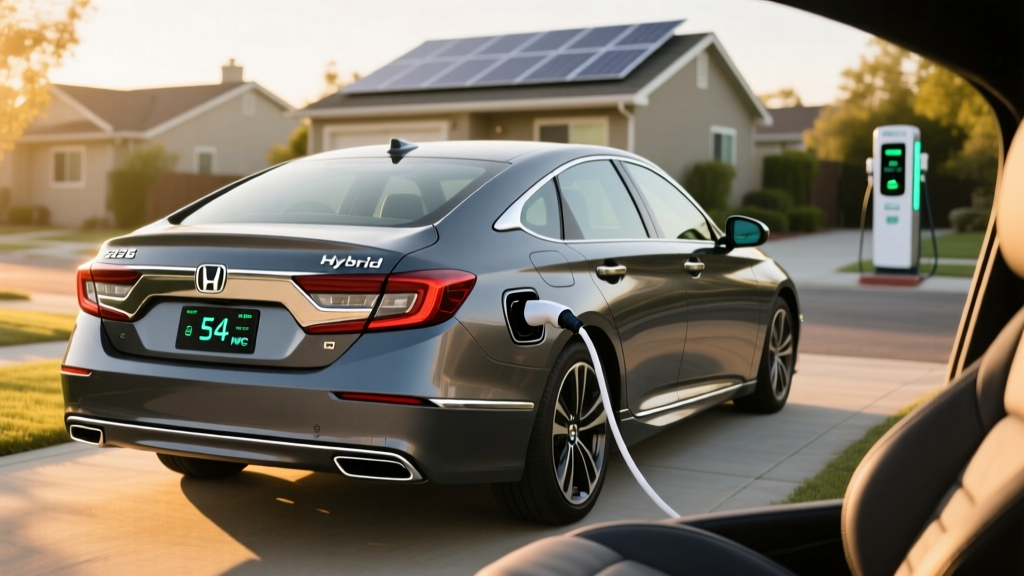
The 2026 Honda Accord Sport L Hybrid sits in the sweet spot of Honda's midsize sedan lineup. It pairs the proven two-motor hybrid system with the Sport L's upgraded interior and tech package, delivering 48 MPG combined without ever needing a plug. If you want near-EV efficiency in stop-and-go traffic without charging infrastructure concerns, this powertrain remains one of the most compelling choices in the segment.
The Sport L trim adds leather-trimmed seats, a 12.3-inch infotainment display with wireless Apple CarPlay and Android Auto, heated front seats, and Honda's full Honda Sensing suite. It's positioned above the Sport Hybrid but below the Touring Hybrid, giving buyers premium features without the top-trim premium. For 2026, Honda continues the Accord Hybrid with its 2.0-liter Atkinson-cycle four-cylinder paired with a dual-motor system — a setup that has proven remarkably durable across hundreds of thousands of real-world miles.
EPA Fuel Economy and Real-World MPG
| Driving Condition | EPA Estimate | Real-World Expectation |
|---|---|---|
| City | 51 MPG | 50–55 MPG (hybrids often exceed EPA in city) |
| Highway | 44 MPG | 40–44 MPG (sustained 75+ mph reduces regen benefit) |
| Combined | 48 MPG | 45–50 MPG depending on driving mix |
The Accord Hybrid's city-dominant EPA rating reflects how the two-motor system works: at low speeds, the electric drive motor handles most propulsion while the gasoline engine acts primarily as a generator. This means the harder you drive in traffic, the more the hybrid system recovers energy through regenerative braking. On the highway, the engine takes over direct drive duties above roughly 45 mph, which is why highway MPG drops — the electric motor's advantage diminishes at sustained speed.
In mixed driving with moderate temperatures (60–80°F), owners consistently report 46–50 MPG on the combined cycle. Cold weather (below 40°F) can reduce efficiency by 5–10% as the engine runs more frequently to maintain cabin heat and battery temperature. If your commute is heavily city-oriented, expect to push past the EPA city estimate; heavy highway commuters should budget closer to 42–44 MPG.
Powertrain Specs: How the Two-Motor System Works
| Specification | 2026 Accord Sport L Hybrid |
|---|---|
| Engine | 2.0L Atkinson-cycle 4-cylinder |
| Engine Output | 146 hp / 134 lb-ft torque |
| Drive Motor Output | 181 hp / 247 lb-ft torque |
| Combined System Output | 204 hp (152 kW) |
| Transmission | Single-speed direct drive (e-CVT) |
| 0–60 mph | ~7.2 seconds (est.) |
| Drivetrain | Front-wheel drive |
| Drive Modes | Normal, ECON, Sport, Individual |
Honda's two-motor hybrid system operates in three modes without driver intervention. In EV Drive, the battery powers the drive motor alone — typically at low speeds or gentle acceleration for short bursts. In Hybrid Drive, the gasoline engine spins a generator motor that feeds electricity to the drive motor, which propels the wheels. In Engine Drive, a lock-up clutch connects the engine directly to the wheels for efficient highway cruising.
The result is seamless power delivery that feels more like an EV than a traditional hybrid. There are no simulated gear shifts or rubber-band CVT sensations. The 247 lb-ft of torque from the electric drive motor gives strong low-end punch — useful for merging and passing. Sport mode sharpens throttle response and increases regenerative braking aggressiveness, though the difference is subtle compared to the Normal setting.
HEV vs. PHEV vs. Full EV: Which Fits Your Situation?
The Accord is offered exclusively as a conventional hybrid (HEV) — it does not plug in. This is a deliberate distinction worth understanding before cross-shopping:
| Feature | HEV (Accord Hybrid) | PHEV (e.g., Toyota Prius Prime) | Full EV (e.g., Tesla Model 3) |
|---|---|---|---|
| Plugs In? | No — refuels at gas station only | Yes — Level 1/Level 2 charging | Yes — Level 1/2/DC fast charging |
| Electric-Only Range | Minimal (low-speed creeping only) | 25–45 miles typical | 250–360+ miles typical |
| Total Range | ~614 miles | ~550–640 miles (electric + gas) | 250–360+ miles |
| Home Charging Needed? | No | Recommended (Level 2) | Essential (Level 2) |
| Federal Tax Credit (§30D) | Not eligible | Up to $7,500 (if eligible) | Up to $7,500 (if eligible) |
| Best For | No home charging access; long highway commutes | Short daily commute + home charging; road trips | Home charging access; daily commute under range |
Choose the Accord Hybrid if: You don't have access to home or workplace charging, your commute involves significant highway miles, or you want maximum simplicity with no charging logistics. The Accord Hybrid rewards city-heavy driving with exceptional MPG and requires zero behavioral change from a conventional gas car.
Consider a PHEV if: Your daily round-trip commute is under 40 miles, you can install a Level 2 charger at home, and you still want gas-engine backup for road trips. A PHEV lets you drive electrically on weekdays and take gas-powered road trips on weekends.
Go full EV if: You have reliable home Level 2 charging, your daily driving stays well within the vehicle's range, and you want to eliminate gasoline costs and tailpipe emissions entirely. Federal tax credits of up to $7,500 can narrow the price gap significantly for eligible buyers and vehicles.
Pricing, Trims, and Tax Credit Eligibility
| Accord Hybrid Trim | 2026 MSRP (est.) |
|---|---|
| Sport Hybrid | ~$32,695 |
| Sport L Hybrid | ~$34,695 |
| EX-L Hybrid | ~$36,195 |
| Touring Hybrid | ~$39,495 |
The Sport L Hybrid adds roughly $2,000 over the Sport Hybrid for leather-trimmed seating, a heated leather-wrapped steering wheel, the upgraded 12.3-inch touchscreen, wireless phone charging, and rear USB-C ports. It's the value-oriented luxury choice in the Accord Hybrid range.
- The Accord Hybrid is a conventional HEV and does NOT qualify for the §30D Clean Vehicle Credit (up to $7,500).
- The §30D credit applies only to plug-in electric vehicles (BEVs and PHEVs) meeting battery capacity, critical mineral sourcing, and battery component requirements.
- No federal income tax credit is available for conventional hybrids as of 2026.
- Some states offer separate hybrid incentives — check your state's energy or DMV website for current programs.
- Source: IRS Clean Vehicle Tax Credits
While the lack of a federal tax credit is a disadvantage versus plug-in competitors, the Accord Hybrid's lower base price, exceptional fuel economy, and zero charging requirements often result in a lower total cost of ownership over five years compared to PHEVs and EVs for drivers without home charging access.
Battery Warranty, Reliability, and Replacement Costs
- Coverage: 8 years / 100,000 miles (10 years / 150,000 miles in CARB states including CA, CT, ME, MA, NJ, NY, OR, RI, VT, WA)
- What's covered: Hybrid battery pack (IPU), DC-DC converter, hybrid control unit, and related components
- Capacity threshold: Honda warrants against defects and abnormal degradation — there is no published minimum capacity retention percentage, unlike EV warranties that guarantee 70% SoH
The Accord Hybrid uses a relatively small 1.34 kWh lithium-ion battery pack (Intelligent Power Unit, or IPU). This is fundamentally different from a PHEV or BEV battery — it's designed for rapid charge/discharge cycles rather than sustained energy storage. The battery cycles shallowly and frequently, which is gentler on cell chemistry than deep discharge cycles.
Real-world data from Honda's hybrid fleet (Accord, CR-V, Civic hybrids) shows these battery packs routinely lasting 150,000–200,000+ miles before significant degradation. Failure before 100,000 miles is uncommon. The battery is located under the rear seats, which helps with thermal management but makes trunk space identical to the gas-only Accord (16.7 cu ft).
If replacement becomes necessary out of warranty, expect to pay $2,000–$4,000 for a new OEM hybrid IPU, including labor. Refurbished units from authorized recyclers can reduce this to $1,200–$2,000. Given the pack's small size and proven longevity, battery replacement cost is a fraction of what a full EV battery swap would require.
Honda's hybrid system has earned strong reliability marks across model years. The two-motor design eliminates the conventional transmission entirely — there's no CVT belt, no planetary gearset, and no traditional transmission fluid to service. The e-CVT is essentially a pair of electric motors with a single gear reduction, making it one of the most mechanically simple and durable drivetrain configurations available.
Driving Impressions and Daily Ownership
The Sport L Hybrid drives with the quiet composure Honda has refined over successive Accord generations. Electric motor propulsion at low speeds makes for near-silent departure from stops. The transition from electric to engine power is well-masked — you'll notice the engine engage primarily under harder acceleration or above 45 mph on the highway.
The Sport L's suspension tuning is comfort-oriented with controlled body motion. It's not a sports sedan, but the 204-hp system output and instant electric torque make it responsive enough for confident highway merging. Steering weight is light but communicative. Road noise is well-managed at moderate speeds, though tire noise becomes noticeable on coarse pavement above 65 mph.
The Honda Sensing suite comes standard across all Accord trims and includes adaptive cruise control with low-speed follow, lane keeping assist, road departure mitigation, collision mitigation braking, and traffic sign recognition. This is an SAE Level 2 driver-assistance system — it requires your hands on the wheel and eyes on the road at all times. It is not autonomous driving.
Daily ownership is straightforward: fill up at any gas station, follow standard maintenance intervals (oil changes every 7,500–10,000 miles with 0W-20 synthetic), and drive. There is no plug to manage, no charging app to configure, and no range planning required for road trips. The 614-mile total range means most drivers will visit the gas station once every two to three weeks.
- 48 MPG combined — among the best in the midsize sedan class
- No plug-in charging required — zero infrastructure dependency
- 614-mile total range per tank
- Proven hybrid system with strong reliability record
- Generous 8yr/100k mi battery warranty (10yr/150k in CARB states)
- Smooth, EV-like low-speed driving feel
- Full Honda Sensing ADAS suite standard
- Spacious cabin and 16.7 cu ft trunk (no battery intrusion)
- No federal tax credit eligibility (HEV, not PHEV/BEV)
- FWD only — no AWD option unlike the CR-V Hybrid
- Highway MPG drops to 44 (less benefit on long highway commutes)
- Modest 204 hp — adequate but not quick
- Engine noise noticeable under hard acceleration
- No electric-only driving mode for meaningful distances
Frequently Asked Questions
How many MPG does the Honda Accord Sport L Hybrid get?
The 2026 Accord Sport L Hybrid is EPA-rated at 51 MPG city, 44 MPG highway, and 48 MPG combined. Real-world results typically fall between 45–50 MPG combined, with city-heavy drivers often exceeding the EPA city estimate thanks to regenerative braking.
Does the Accord Hybrid need to be plugged in?
No. The Accord Hybrid is a conventional hybrid (HEV). It charges its 1.34 kWh battery internally through regenerative braking and the gasoline engine. You refuel exclusively at gas stations — no plug, no charger, no charging app required.
How far can the Accord Hybrid drive on electric only?
The Accord Hybrid can operate in EV mode for very short distances (typically under 1 mile) at low speeds (under 30 mph). This is not a meaningful electric-only range — it's a system feature for silent, emission-free creeping in parking lots and residential streets. If you need 25–40 miles of electric-only driving, you need a PHEV, not an HEV.
Is the Accord Hybrid reliable?
Honda's two-motor hybrid system has demonstrated strong reliability across multiple model years and hundreds of thousands of fleet miles. The system eliminates the conventional transmission, reducing mechanical complexity. The hybrid battery (IPU) typically lasts 150,000–200,000+ miles and is covered by an 8-year/100,000-mile warranty (10yr/150k in CARB states).
What does it cost to replace the Accord Hybrid battery?
A new OEM hybrid IPU replacement runs approximately $2,000–$4,000 including labor. Refurbished units can reduce costs to $1,200–$2,000. Given the pack's small 1.34 kWh size and shallow cycling design, replacement is rarely needed before 150,000 miles.
Does the Accord Hybrid qualify for any tax credits?
The Accord Hybrid does not qualify for the federal §30D Clean Vehicle Credit, which is reserved for plug-in vehicles (BEVs and PHEVs). Some states may offer separate incentives for hybrid purchases — check your state energy office or DMV for current programs. Always consult a tax professional for personal eligibility. Source: IRS Clean Vehicle Tax Credits.
How does the Accord Hybrid compare to the Accord gas model?
The hybrid delivers approximately 48 MPG combined versus the gas 1.5T Accord's roughly 33 MPG combined — a 45% improvement in fuel economy. The hybrid also provides stronger low-end torque (247 lb-ft from the electric motor vs. 192 lb-ft from the turbo). The trade-off is a higher starting price (roughly $2,500–$3,000 premium) and no federal tax credit to offset it.
Should I get the Accord Hybrid or a PHEV instead?
If you have home Level 2 charging and a daily commute under 40 miles, a PHEV (like the Toyota Prius Prime) lets you drive mostly on electricity during the week while retaining gas flexibility for road trips. If you lack home charging, drive significant highway miles, or want zero charging logistics, the Accord Hybrid is the simpler and often more cost-effective choice.
Sources: EPA Fuel Economy, Honda Accord Hybrid Specifications, IRS Clean Vehicle Tax Credits