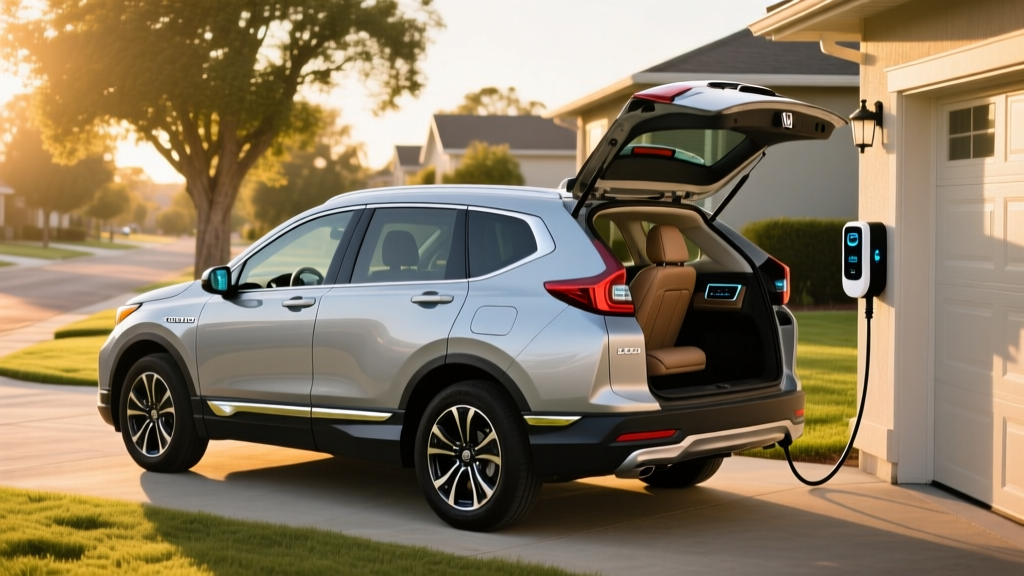
Quick Verdict: The 2022 Honda CR-V Hybrid Touring in 2026
If you're shopping for a compact hybrid SUV on the used market in 2026, the 2022 Honda CR-V Hybrid Touring remains one of the most rational choices available. It delivers an EPA-estimated 40 MPG combined without ever needing a plug, offers standard all-wheel drive, and comes packed with the Touring trim's full suite of premium features. Honda's two-motor hybrid system is proven, the battery carries a robust warranty, and real-world fuel economy often beats the EPA sticker in city driving.
However, this is a conventional hybrid (HEV), not a plug-in hybrid (PHEV). That means zero electric-only range — but also zero charging infrastructure anxiety. Let's break down exactly what you're getting, what it costs to own, and whether a hybrid, PHEV, or full EV better fits your driving life.
HEV vs PHEV vs EV: Where Does the CR-V Hybrid Fit?
Before diving into specs, it's critical to understand what the 2022 CR-V Hybrid is — and what it isn't.
| Feature | HEV (This CR-V) | PHEV (e.g., Toyota RAV4 Prime) | BEV (e.g., Tesla Model Y) |
|---|---|---|---|
| Plugs in? | No | Yes | Yes |
| Electric-only range | 0 miles | 25–42 miles typical | 250–330+ miles |
| Battery size | ~1.3 kWh (small buffer) | 18.1 kWh usable | 60–82 kWh usable |
| Fuel/energy source | Gasoline only | Gasoline + grid electricity | Grid electricity only |
| Tax credit (new) | None | Up to $7,500 (§30D) | Up to $7,500 (§30D) |
| Home charging needed? | No | Recommended | Essential |
The 2022 CR-V Hybrid is a conventional hybrid electric vehicle (HEV). Its small lithium-ion battery recharges exclusively through regenerative braking and the gasoline engine. You never plug it in. You simply fuel it with regular unleaded and drive.
This matters because many shoppers conflate "hybrid" with "plug-in hybrid." Honda did not offer a plug-in CR-V in the US market for the 2022 model year. If you need electric-only commuting capability, you'd need to look at PHEVs like the Toyota RAV4 Prime or a full battery-electric vehicle.
Fuel Economy: EPA Ratings and Real-World MPG
The headline number for the 2022 Honda CR-V Hybrid Touring is its EPA-estimated fuel economy, which applies across all Hybrid trims (EX, EX-L, Touring):
| Driving Cycle | EPA Estimate | Real-World Expectation |
|---|---|---|
| City | 40 MPG | 38–45 MPG (hybrids excel in stop-and-go) |
| Highway | 35 MPG | 31–36 MPG (aero drag limits hybrid advantage) |
| Combined | 38 MPG | 35–40 MPG depending on driving mix |
Source: EPA Fuel Economy
Several real-world factors shape these numbers:
- City driving advantage: Honda's two-motor hybrid system allows the electric motor to handle low-speed propulsion while the 2.0L Atkinson-cycle engine acts primarily as a generator. In stop-and-go traffic, regenerative braking recaptures energy that a gas car would waste as heat. Many owners report exceeding the 40 MPG city EPA figure on urban commutes.
- Highway limitation: At sustained speeds above 65 mph, aerodynamic drag dominates, and the hybrid system's regenerative advantage diminishes. Expect highway fuel economy to settle closer to 33–35 MPG on flat terrain at 70–75 mph, dropping further in hilly terrain or headwinds.
- Cold-weather impact: In freezing temperatures, expect a 5–10% fuel economy reduction. The engine runs more frequently to provide cabin heat and maintain battery temperature, reducing the electric motor's share of propulsion.
- All-wheel drive standard: The 2022 CR-V Hybrid comes exclusively with AWD, which carries a slight efficiency penalty versus a FWD-only competitor but provides year-round traction confidence.
Powertrain Specs: Two-Motor Hybrid System
| Specification | Value |
|---|---|
| Engine | 2.0L Atkinson-cycle inline-4 |
| Engine output | 143 hp / 129 lb-ft torque |
| Electric motors | Two-motor system (propulsion + generator) |
| Propulsion motor output | 181 hp / 232 lb-ft torque |
| Combined system output | 212 hp |
| Battery type | Lithium-ion (approx. 1.3 kWh total capacity) |
| Drivetrain | Real Time AWD (standard) |
| Transmission | Electronic CVT (e-CVT, no traditional gears) |
| 0–60 mph | ~7.8 seconds (estimated) |
| Towing capacity | 1,000 lbs |
Honda's hybrid powertrain operates in three modes seamlessly and without driver input:
- EV Drive: The battery powers the propulsion motor alone at low speeds and light loads — typically under 25 mph for short distances (roughly 0.5–1 mile). This is not meaningful electric-only range; it's a brief efficiency assist.
- Hybrid Drive: The gasoline engine spins the generator motor, which sends electricity to the propulsion motor. The engine is mechanically disconnected from the wheels in this mode, allowing it to operate at its most efficient RPM.
- Engine Drive: At highway cruising speeds, a lock-up clutch mechanically connects the engine directly to the front wheels for maximum efficiency — bypassing the electric motor entirely.
The result is a powertrain that feels smooth and responsive around town (electric motor torque is instant) while remaining efficient at highway speeds (direct mechanical drive). The e-CVT produces none of the rubber-band sensation associated with older Toyota hybrid CVTs.
2022 CR-V Hybrid Touring: Features and Pricing
The Touring sits at the top of the 2022 CR-V Hybrid lineup. Here's what the original MSRP looked like and what you can expect on the used market in 2026:
| Trim | 2022 MSRP (new) | 2026 Used Market Range (est.) |
|---|---|---|
| Hybrid EX | $31,895 | $21,000–$25,000 |
| Hybrid EX-L | $34,495 | $23,000–$27,500 |
| Hybrid Touring | $37,595 | $26,000–$31,000 |
Used pricing varies significantly by mileage, condition, and region. Source for MSRP: Honda
The Touring trim adds significant content over lower trims:
- Navigation system with 7-inch touchscreen
- Wireless Apple CarPlay and Android Auto
- Wireless phone charging pad
- Hands-free power tailgate
- Heated rear seats
- Heated steering wheel
- Rain-sensing wipers
- Low-speed braking control and front/rear parking sensors
- 9-speaker premium audio system
- Honda Sensing suite (adaptive cruise, lane keeping, collision mitigation, road departure mitigation)
Tax Credit Eligibility
The 2022 Honda CR-V Hybrid does not qualify for the federal §30D new clean vehicle tax credit (up to $7,500), because it is a conventional hybrid — not a plug-in hybrid or battery-electric vehicle. The §30D credit applies only to PHEVs and BEVs that meet battery-sourcing and critical-mineral requirements, MSRP caps, and buyer income limits per IRS guidelines.
On the used market in 2026, the CR-V Hybrid also does not qualify for the §25E used clean vehicle credit (up to $4,000), which similarly requires a plug-in electric or fuel-cell vehicle.
Bottom line: No federal tax incentives apply to conventional hybrids. Some states offer minor hybrid incentives or HOV lane access — check your local DMV for specifics.
Battery Warranty, Reliability, and Replacement Cost
Honda Hybrid Battery Warranty
- Hybrid battery warranty: 8 years / 100,000 miles (10 years / 150,000 miles in CARB states including CA, CT, MA, ME, NJ, NY, OR, RI, VT, WA)
- Powertrain warranty: 5 years / 60,000 miles
- Limited vehicle warranty: 3 years / 36,000 miles
For a 2022 model, the hybrid battery warranty extends through at least 2030 or 100,000 miles (whichever comes first). In CARB states, coverage extends to 2032 or 150,000 miles.
Long-Term Reliability
Honda's two-motor hybrid system, introduced with the 2014 Accord Hybrid and refined across multiple models, has demonstrated strong reliability in the field. Unlike early hybrid systems that relied on complex planetary gearsets, Honda's design uses a relatively simple clutch-based architecture with fewer moving parts.
The lithium-ion hybrid battery in the 2022 CR-V Hybrid is small (~1.3 kWh) and operates within a narrow state-of-charge window — typically between 20% and 80% SoC. Honda's battery management system never allows full charging or full depletion, which significantly reduces degradation stress. This shallow-cycling strategy is the same principle that extends longevity in full EVs.
Based on data from earlier Honda hybrid models (Accord Hybrid, Insight), hybrid battery failure before 150,000 miles is uncommon. When failures do occur, they are often covered under warranty.
Battery Replacement Cost
If the hybrid battery fails out of warranty, replacement costs for Honda's compact hybrid batteries typically range from $2,000 to $4,000 (parts and labor) at a dealership. Independent hybrid specialists may offer refurbished battery packs for $1,500–$2,500. This is dramatically less expensive than a full EV battery replacement ($10,000–$20,000+), reflecting the CR-V Hybrid's much smaller battery capacity.
It's worth noting that the CR-V Hybrid's conventional powertrain components (the 2.0L engine, e-CVT) are also relatively simple and inexpensive to service compared to turbocharged or multi-speed automatic alternatives.
Who Should Choose the 2022 CR-V Hybrid Touring?
Pros
- 40 MPG city without plugging in — zero lifestyle change required
- Standard AWD for all-weather confidence
- Touring trim includes premium features at a used-market discount
- Proven hybrid system with strong warranty coverage remaining
- Smooth, quiet powertrain with instant electric torque at low speeds
- No charging infrastructure dependency
- Honda Sensing ADAS suite included
Cons
- Highway MPG (35 EPA) is less impressive than city (40 EPA)
- No electric-only driving range — still burns gas in traffic
- No federal tax credit eligibility (new or used)
- 1,000-lb towing capacity limits utility
- Infotainment screen (7-inch) feels dated vs. 2026 competitors
- Touring MSRP premium may not justify over EX-L for budget buyers
Choose the 2022 CR-V Hybrid Touring If:
- You drive 15,000+ miles/year and want to reduce fuel costs without changing your routine
- Your commute is primarily city/suburban with frequent stops (where hybrids shine)
- You lack access to home or workplace charging (apartment, street parking, no garage)
- You want AWD and a proven nameplate with strong resale value
- You're buying used and want a vehicle with remaining hybrid battery warranty
Consider a PHEV Instead If:
- You have home charging access and a commute under 30 miles (a PHEV like the RAV4 Prime could eliminate most gas use)
- You want to qualify for federal or state EV incentives on a new purchase
- You want the experience of electric-only driving with a gas backup
Consider a Full EV Instead If:
- You have reliable home Level 2 charging
- Your daily driving is under 250 miles and you take road trips infrequently (or are willing to plan DC fast-charging stops)
- You want to eliminate gasoline costs entirely and minimize maintenance
- You want the latest in tech, performance, and available tax credits on a new purchase
Ownership Economics: CR-V Hybrid vs Gas vs EV
To put the fuel savings in perspective, here's an annual cost comparison assuming 15,000 miles/year, $3.40/gallon regular unleaded, and the EPA combined MPG for each vehicle type:
| Vehicle | Combined MPG / MPGe | Annual Fuel Cost (est.) |
|---|---|---|
| 2022 CR-V Hybrid (38 MPG combined) | 38 MPG | ~$1,342 |
| 2022 CR-V Gas AWD (30 MPG combined) | 30 MPG | ~$1,700 |
| Annual savings (Hybrid vs Gas) | — | ~$358/year |
| 2026 Tesla Model Y LR (home charging) | 122 MPGe | ~$550 (electricity) |
The hybrid saves roughly $350–$400 per year versus the gas CR-V. Over five years of ownership, that's approximately $1,800 in fuel savings — meaningful but not transformative. The real value proposition is that you get these savings with zero behavioral change: no charging, no route planning, no app management.
A full EV charged primarily at home will save substantially more ($800–$1,000/year vs the hybrid), but requires charging access and a higher upfront purchase price (partially offset by tax credits on new EVs).
Frequently Asked Questions
How many MPG does the 2022 Honda CR-V Hybrid get?
The EPA rates the 2022 CR-V Hybrid at 40 MPG city, 35 MPG highway, and 38 MPG combined. In real-world driving, city MPG often exceeds 40 in stop-and-go traffic thanks to regenerative braking, while sustained highway driving at 70+ mph may return 31–34 MPG.
Does the 2022 CR-V Hybrid need to be plugged in?
No. The 2022 CR-V Hybrid is a conventional hybrid (HEV), not a plug-in hybrid. It charges its small battery through regenerative braking and the gasoline engine. You never plug it in — just fill up with regular unleaded.
How far can the CR-V Hybrid drive on electric power alone?
Effectively zero miles of meaningful electric-only range. The hybrid system can propel the vehicle on electric power alone for roughly 0.5–1 mile at very low speeds (under 25 mph), but this is a brief efficiency assist, not usable electric-only driving. If you want electric-only commuting range, you need a PHEV or BEV.
Is the 2022 CR-V Hybrid reliable?
Honda's two-motor hybrid system has a strong reliability track record since its introduction in 2014. The hybrid battery is warrantied for 8 years/100,000 miles (10 years/150,000 miles in CARB states), and the battery management system's shallow-cycling strategy promotes longevity. Early battery failures are uncommon based on data from Honda's other hybrid models.
What does it cost to replace the CR-V Hybrid battery?
Out-of-warranty hybrid battery replacement typically costs $2,000–$4,000 at a dealership, or $1,500–$2,500 through an independent hybrid specialist using refurbished packs. This is far less than a full EV battery replacement. For a 2022 model, factory hybrid battery coverage extends through at least 2030 or 100,000 miles.
Does the 2022 CR-V Hybrid qualify for any tax credit?
No. Federal tax credits under §30D (new vehicle) and §25E (used vehicle) apply only to plug-in electric vehicles (PHEVs and BEVs) and fuel-cell vehicles. Conventional hybrids like the CR-V Hybrid do not qualify for any federal purchase incentive. Some states may offer minor hybrid incentives — check your state's energy or DMV website.
How does the CR-V Hybrid compare to the Toyota RAV4 Hybrid?
The 2022 Toyota RAV4 Hybrid is rated at 41 MPG city / 38 MPG highway / 40 MPG combined — slightly higher than the CR-V Hybrid's 40/35/38. The RAV4 Hybrid also offers a PHEV variant (RAV4 Prime with 42 miles of electric range). However, the CR-V Hybrid Touring offers more premium standard features at its price point and a more refined e-CVT driving experience. Both are strong choices; the RAV4 edges out on pure fuel economy, while the CR-V Touring edges out on features and refinement.
What is the towing capacity of the 2022 CR-V Hybrid?
The 2022 CR-V Hybrid is rated for 1,000 lbs of towing capacity — suitable for a small utility trailer or a pair of dirt bikes, but not for boat or camper towing. If you need higher towing capacity, the gas-only CR-V AWD is rated for 1,500 lbs, and competitors like the Toyota RAV4 Hybrid are rated for 1,750 lbs.