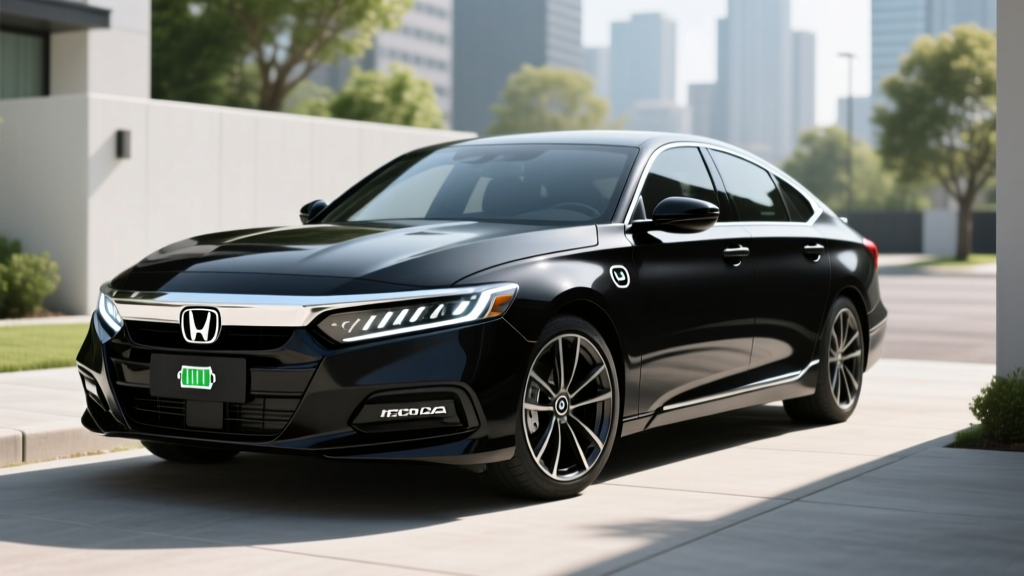
If you've been searching for a Honda Accord Hybrid in black, you're looking at one of the most fuel-efficient midsize sedans on the market — and arguably the best-looking one when dressed in Honda's Crystal Black Pearl or Meteorite Gray Metallic finishes. The 2026 Accord Hybrid carries forward the two-motor e-CVT powertrain that made its predecessor a segment benchmark, delivering EPA-rated efficiency that rivals compact cars while offering full-size interior space.
This guide covers everything a research-heavy buyer needs: exact EPA MPG figures, real-world fuel economy expectations, the hybrid powertrain breakdown, battery warranty details, pricing across trims, and how the Accord Hybrid stacks up against plug-in hybrids and full EVs. Whether you want the stealthy look of a blacked-out Accord Sport Hybrid or the premium feel of a black Touring model, the numbers below will help you decide.
HEV vs PHEV: Where the Accord Hybrid Fits
Before diving into specs, it's essential to understand what the Accord Hybrid is — and what it isn't.
Conventional Hybrid (HEV) — Honda Accord Hybrid
- No plug required. The battery recharges through regenerative braking and the gasoline engine.
- No electric-only driving range beyond very low-speed, short-distance EV mode (typically under 1 mile).
- Advantage: Zero behavior change from a gas car. Fill up at any station and go.
- Trade-off: You always use some gasoline; no ability to commute on electricity alone.
Plug-In Hybrid (PHEV) — e.g., Toyota Prius Prime, Hyundai Tucson PHEV
- Plugs in to a standard 120V outlet or Level 2 (240V) charger.
- Electric-only range: typically 25–45 miles on battery before the gas engine kicks in.
- Advantage: Daily commutes can be emission-free if you charge regularly.
- Trade-off: Requires charging access; higher purchase price; smaller gas tank means less total range when battery is depleted.
The 2026 Honda Accord Hybrid is strictly a conventional HEV. Honda does not currently offer a plug-in Accord in the U.S. market. If your goal is electric-only commuting, you'll need to look at PHEV alternatives or a full battery-electric vehicle (BEV). But if you want maximum MPG with zero lifestyle adjustment — no home charger installation, no route planning around charging stations — the Accord Hybrid is purpose-built for that.
Fuel Economy: EPA Ratings and Real-World MPG
The Accord Hybrid's two-motor system excels in city driving, where the electric motor handles most low-speed propulsion and the 2.0-liter Atkinson-cycle engine acts primarily as a generator. Here's what the EPA says, and what you should actually expect.
| Trim | City MPG | Highway MPG | Combined MPG | Fuel Tank (gal) | Est. Total Range |
|---|---|---|---|---|---|
| Sport Hybrid | 51 | 44 | 48 | 12.8 | ~614 mi |
| Sport-L Hybrid | 51 | 44 | 48 | 12.8 | ~614 mi |
| EX-L Hybrid | 51 | 44 | 48 | 12.8 | ~614 mi |
| Touring Hybrid | 46 | 41 | 44 | 12.8 | ~563 mi |
Source: EPA / fueleconomy.gov
Real-World MPG Expectations
EPA Combined: 48 MPG (Sport/Sport-L/EX-L) | 44 MPG (Touring)
What to actually expect:
- City driving: The Accord Hybrid routinely exceeds its EPA city rating. Many owners report 52–56 MPG in stop-and-go traffic, where regenerative braking and electric-motor propulsion dominate. This is a key advantage of Honda's two-motor system.
- Highway cruising (70–80 mph): Expect 40–44 MPG. At sustained highway speeds, the engine drives the wheels directly through a lock-up clutch, and aerodynamic drag reduces efficiency. The Touring trim's larger 19-inch wheels and additional weight drop highway MPG by ~3 MPG versus lower trims.
- Cold weather (below 32°F): Plan for a 5–10% reduction, bringing combined MPG to roughly 41–45. The engine runs more frequently to provide cabin heat, reducing electric-motor utilization.
- Mixed real-world average: Most owners report 45–50 MPG combined over thousands of miles, as tracked on Fuelly and owner forums.
The key insight: hybrids reward city driving. If your commute involves frequent stops, school drop-offs, or urban errands, the Accord Hybrid will deliver its best numbers exactly where gas-only cars are least efficient. Highway-heavy drivers will still see excellent MPG, but the advantage over a turbo-gas Accord narrows.
Powertrain Specs: How the Two-Motor System Works
| Specification | Detail |
|---|---|
| Engine | 2.0L DOHC Atkinson-cycle inline-4 |
| Engine HP / Torque | 146 hp @ 6,100 rpm / 134 lb-ft @ 4,500 rpm |
| Drive Motor | AC synchronous permanent-magnet |
| Drive Motor HP / Torque | 184 hp / 247 lb-ft |
| Combined System Output | 204 hp / 247 lb-ft |
| Transmission | Electronic Continuously Variable (e-CVT) |
| Drivetrain | Front-wheel drive |
| 0–60 mph (est.) | ~7.0 seconds |
| Hybrid Battery | Lithium-ion, ~1.1 kWh (under rear seat) |
| Driving Modes |
Honda's hybrid system operates in three modes, switching seamlessly based on speed and load:
- EV Drive: At low speeds and light loads, the battery powers the drive motor alone. The engine stays off. Range is very short (typically under a mile), but this mode handles parking-lot maneuvers, creep traffic, and initial acceleration from stops.
- Hybrid Drive: The engine spins a generator motor that produces electricity for the drive motor. The engine is not mechanically connected to the wheels. This is the dominant mode for city and suburban driving, and it's where the Accord Hybrid achieves its best efficiency.
- Engine Drive: At steady highway speeds, a lock-up clutch connects the engine directly to the front wheels via a single fixed gear ratio. This avoids the energy-conversion losses of Hybrid Drive and is more efficient at constant cruising speeds.
The result is a sedan that accelerates with the immediacy of an electric motor (247 lb-ft of torque is available from 0 rpm) while achieving fuel economy that shames cars half its size. The 204 combined horsepower is adequate for confident highway merging, though this is a comfort-oriented sedan, not a sport sedan. The e-CVT is smooth and avoids the rubber-band feeling that plagues some competitors' CVTs.
Black Exterior Options and Trim Pricing
For buyers specifically seeking a black Honda Accord Hybrid, Honda offers Crystal Black Pearl across all hybrid trims. Here's the 2026 pricing breakdown:
| Trim | MSRP | Key Features |
|---|---|---|
| Sport Hybrid | $34,995 | 19-inch alloy wheels, black rear spoiler, heated front seats, wireless Apple CarPlay/Android Auto, Honda Sensing suite |
| Sport-L Hybrid | $36,695 | Sport content + leather-trimmed seats, wireless phone charger, heated rear seats, power moonroof |
| EX-L Hybrid | $37,395 | Leather interior, 12-speaker Bose audio, front ventilated seats, rear USB-C ports, low-profile roof rails |
| Touring Hybrid | $40,895 | Google built-in, 12.3-inch infotainment, head-up display, heated steering wheel, front cross-traffic alert, low-speed braking control |
Source: Honda Automobiles
The Sport and Sport-L trims in Crystal Black Pearl deliver the most aggressive visual presence: black-accented wheels, a gloss-black rear lip spoiler, and dark-chrome grille surrounds. The Touring trim's 19-inch wheels in machine-finish contrast strikingly against the black paint. Honda's black paint quality is generally excellent, though like all dark finishes, it shows swirl marks and dust more readily than silver or white — budget for a quality ceramic coating or paint-protection film if appearance longevity matters to you.
Battery Warranty, Reliability, and Replacement Costs
Hybrid battery longevity is the single most common concern among first-time hybrid buyers. Here's what Honda covers and what the data shows.
Honda Accord Hybrid Battery Warranty
- Hybrid battery (IMA/lithium-ion): 8 years / 100,000 miles (10 years / 150,000 miles in CARB states including CA, CT, ME, MA, NJ, NY, OR, RI, VT, WA)
- Hybrid system components (inverter, DC-DC converter, drive motor): 8 years / 100,000 miles
- Powertrain warranty: 5 years / 60,000 miles
- New-vehicle limited warranty: 3 years / 36,000 miles
Real-world reliability data: Honda's two-motor hybrid system, introduced with the 2014 Accord Hybrid and refined for the current generation, has proven exceptionally durable. The lithium-ion battery pack is small (~1.1 kWh) and operates within a narrow state-of-charge window (roughly 40–60%), which minimizes degradation stress. Unlike a full EV battery that cycles through 80–90% of its capacity daily, the Accord Hybrid's battery is baby-sitted by aggressive thermal and charge management.
Failures of the hybrid battery in the current-generation Accord Hybrid are rare. Third-party data from Consumer Reports and J.D. Power consistently rate the Accord Hybrid at or above average for reliability in the midsize car segment.
Out-of-warranty replacement cost: If the hybrid battery does require replacement after the warranty period, expect to pay approximately $2,000–$4,000 for a new OEM battery pack plus installation at a Honda dealer. Independent hybrid specialists may offer refurbished packs for $1,500–$2,500. Given the small battery size and conservative charge management, most Accord Hybrids will never need a battery replacement within a typical ownership cycle of 10–15 years.
Tax Credits and Incentives: What Applies
This is where the distinction between HEV and PHEV matters for your wallet.
Federal §30D Tax Credit Eligibility — 2026 Rules
The Honda Accord Hybrid does NOT qualify for the federal §30D EV tax credit.
The IRS §30D Clean Vehicle Credit (up to $7,500) applies only to plug-in electric vehicles — battery-electric vehicles (BEVs) and plug-in hybrids (PHEVs) with a minimum battery capacity of 7 kWh. The Accord Hybrid's ~1.1 kWh battery and lack of plug-in capability make it ineligible.
Key §30D requirements for qualifying vehicles:
- Must be a BEV or PHEV with ≥7 kWh battery
- MSRP cap: $55,000 (sedans) / $80,000 (SUVs, trucks, vans)
- Buyer income cap: $150,000 (single) / $300,000 (joint)
- Critical-mineral and battery-component sourcing requirements
- Point-of-sale transfer available at participating dealers
Source: IRS.gov — Clean Vehicle Credits
State and local incentives: Some states offer rebates or tax incentives for conventional hybrids, though these are less common and typically smaller than EV incentives. Check your state's energy office or department of environmental quality for current programs. A few utility companies offer reduced electricity rates for hybrid owners who also have solar, though this varies by jurisdiction.
The economic case without a tax credit: Even at full MSRP, the Accord Hybrid's fuel savings are substantial. At 48 MPG combined versus the gas-only Accord's 33 MPG combined, and assuming $3.50/gallon gasoline with 12,000 miles driven annually:
| Metric | Accord Hybrid (48 MPG) | Gas Accord (33 MPG) |
|---|---|---|
| Annual fuel consumption | 250 gallons | 364 gallons |
| Annual fuel cost ($3.50/gal) | $875 | $1,274 |
| 5-year fuel cost | $4,375 | $6,370 |
| 5-year savings with Hybrid | ~$1,995 | |
At higher gas prices or more annual miles, the savings grow proportionally. The hybrid's premium over a comparably equipped gas Accord (roughly $1,200–$1,500 depending on trim) typically pays for itself within 3–4 years through fuel savings alone, before factoring in the hybrid's stronger resale value.
Accord Hybrid vs. PHEV vs. Full EV: Which Fits You?
The decision between a conventional hybrid, a plug-in hybrid, and a battery-electric vehicle depends on your driving patterns, charging access, and budget.
Choose the Accord Hybrid (HEV) if:
- You lack reliable home or workplace charging access (apartment, street parking, no garage).
- You take frequent long road trips and don't want to plan around DC fast-charging stops.
- You want maximum MPG with zero behavioral change — just fill up at any gas station.
- Your budget is under $40,000 and you want a full-size sedan.
- You drive a mix of city and highway and want proven reliability with minimal maintenance.
Choose a PHEV (e.g., Toyota Prius Prime, Hyundai Sonata PHEV) if:
- You have home charging (even a standard 120V outlet works for overnight PHEV charging).
- Your daily commute is under 30–40 miles round-trip and you want to drive mostly on electricity.
- You want the §30D federal tax credit (up to $7,500, income and sourcing permitting).
- You still want a gas engine for long road trips without range anxiety.
Choose a Full EV (e.g., Tesla Model 3, Hyundai Ioniq 6) if:
- You have Level 2 home charging and your daily driving is within the vehicle's range.
- You want the lowest per-mile fuel cost (electricity at $0.12–$0.18/kWh beats gas at any price).
- You want maximum federal and state incentives.
- You're willing to plan longer road trips around DC fast-charging infrastructure.
- You want the lowest maintenance costs (no oil changes, fewer moving parts).
Pros and Cons at a Glance
Pros
- 48 MPG combined (Sport trims) — among the best of any midsize sedan
- 247 lb-ft of electric torque delivers responsive acceleration from stops
- No charging infrastructure needed — zero lifestyle adjustment
- 614-mile total range eliminates fuel stops on most road trips
- Spacious interior with 16.7 cu-ft trunk (battery under rear seat, not in trunk)
- Honda Sensing ADAS suite standard on all trims (adaptive cruise, lane-keeping, AEB)
- Strong resale value; Accord Hybrid retains ~55–60% of value at 5 years
- Crystal Black Pearl available across all trims
Cons
- No federal tax credit eligibility (HEV, not PHEV/BEV)
- Touring trim drops to 44 MPG combined due to weight and 19-inch wheels
- No all-wheel-drive option (FWD only; a disadvantage in snow-belt states)
- Modest 204 hp — adequate but not quick; 0–60 in ~7.0 seconds
- Road noise on coarse pavement is noticeable at highway speeds
- Infotainment is functional but not class-leading; no native navigation below Touring trim
- Black paint requires more maintenance to keep swirl-free
Frequently Asked Questions
How many MPG does the Honda Accord Hybrid get?
The 2026 Accord Hybrid Sport, Sport-L, and EX-L trims achieve an EPA-rated 51 city / 44 highway / 48 combined MPG. The Touring trim, with its larger wheels and additional equipment, rates at 46 city / 41 highway / 44 combined. In real-world city driving, many owners exceed the EPA city rating, seeing 52–56 MPG thanks to the two-motor system's regenerative efficiency.
Does the Honda Accord Hybrid need to be plugged in?
No. The Accord Hybrid is a conventional hybrid (HEV). Its small lithium-ion battery recharges automatically through regenerative braking and the gasoline engine. You never plug it in. You simply refuel at any gas station as you would with a conventional car.
How far can the Accord Hybrid go on electric only?
Less than one mile in most conditions. The EV Drive mode activates at low speeds and light loads (parking lots, stop-and-go traffic below ~25 mph), but the ~1.1 kWh battery cannot sustain electric-only driving for meaningful distances. This is by design — the system prioritizes continuous hybrid efficiency over electric-only range. If you want 25+ miles of electric-only driving, you need a PHEV or BEV.
Is the Honda Accord Hybrid reliable?
Yes. The Accord Hybrid's two-motor system has been in production since 2014 and is one of the most proven hybrid powertrains on the market. Consumer Reports and J.D. Power rate the current-generation Accord Hybrid at or above the segment average for reliability. The hybrid battery is warrantied for 8 years/100,000 miles (10 years/150,000 miles in CARB states), and real-world battery failures are rare due to the conservative charge-management strategy.
What does it cost to replace the hybrid battery?
Out-of-warranty replacement of the Accord Hybrid's lithium-ion battery pack costs approximately $2,000–$4,000 at a Honda dealership, including parts and labor. Independent hybrid specialists may offer refurbished units for $1,500–$2,500. Given the battery's small size and conservative operating window, most Accord Hybrids will not require a battery replacement during a typical 10–15 year ownership period.
Does the Honda Accord Hybrid qualify for any tax credit?
The Accord Hybrid does not qualify for the federal §30D Clean Vehicle Credit, which is reserved for plug-in vehicles (BEVs and PHEVs) with battery packs of at least 7 kWh. Some states or utilities may offer small incentives for hybrids, but these vary by jurisdiction. Check your state energy office for current programs.
Is the Accord Hybrid good in snow?
The Accord Hybrid is front-wheel drive only, with no AWD option. In light snow and rain, the traction control and stability systems are competent, and the hybrid motor's smooth torque delivery helps avoid wheel-spin. However, for heavy snow or icy conditions, dedicated winter tires are strongly recommended. If AWD is a priority, consider the Toyota Camry Hybrid (AWD available) or a crossover like the Honda CR-V Hybrid.
How does the black paint hold up?
Honda's Crystal Black Pearl is a single-stage metallic that looks excellent when clean but shows dust, water spots, and swirl marks more readily than lighter colors. Owners who prioritize a showroom finish should budget $800–$1,500 for a ceramic coating at delivery, or commit to regular hand-washing with a two-bucket method and microfiber drying. Paint protection film (PPF) on the hood, fenders, and mirrors ($1,500–$2,500) will prevent rock chips that are especially visible on black.
The 2026 Honda Accord Hybrid in black is a compelling choice for drivers who want sedan efficiency without the infrastructure demands of a plug-in vehicle. At 48 MPG combined, with a 614-mile range and Honda's proven hybrid reliability, it's a rational, data-backed purchase that pays for its modest price premium within a few years of fuel savings. If you need electric-only commuting or want the federal tax credit, look to a PHEV or BEV. If you want to drive more and fuel less — with no changes to your routine — the Accord Hybrid is hard to beat.