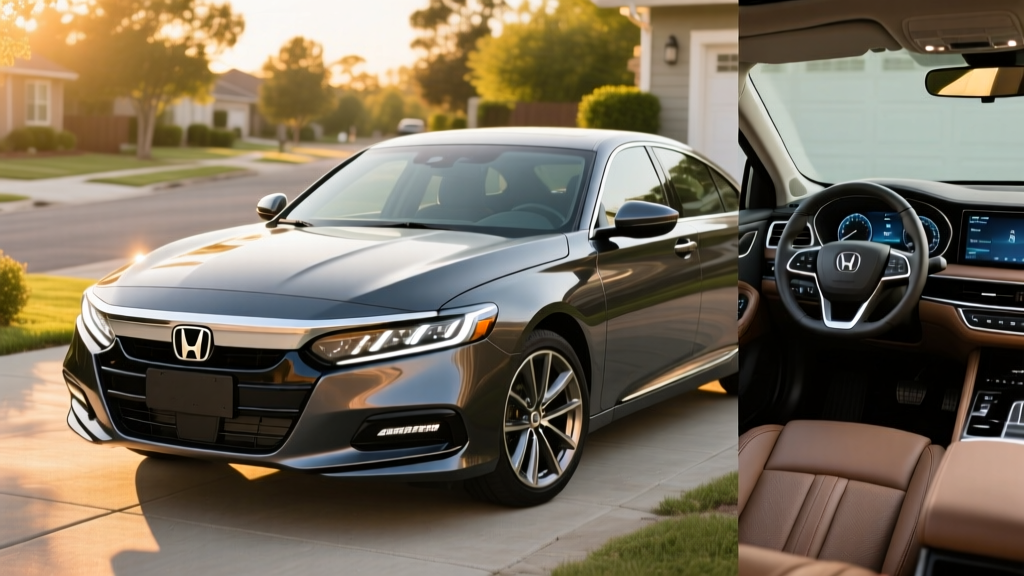
The midsize hybrid sedan segment rewards patience. While crossover buyers chase the latest EV tax credits and 300-kW charging speeds, the Honda Accord EX-L Hybrid quietly delivers one of the most compelling efficiency-to-comfort ratios on the market — without ever needing to be plugged in. For 2026, Honda continues the Accord's two-motor hybrid powertrain on the EX-L trim, pairing a 2.0-liter Atkinson-cycle four-cylinder with dual electric motors and a lithium-ion battery pack. The result: a spacious, leather-trimmed sedan that achieves up to 51 MPG city and 44 MPG highway on the EPA cycle, with a combined rating of 48 MPG.
This guide breaks down everything a prospective buyer needs to know about the 2026 Accord EX-L Hybrid — from its real-world fuel economy behavior and powertrain architecture to battery longevity, warranty coverage, and whether it makes more financial sense than a plug-in hybrid or full battery-electric vehicle.
Accord EX-L Hybrid Powertrain: How the Two-Motor System Works
The 2026 Accord Hybrid uses Honda's fourth-generation two-motor hybrid system, which operates fundamentally differently from the planetary-gear setups found in some competitors. Here's the architecture:
- Engine: 2.0L Atkinson-cycle inline-4, producing approximately 146 hp and 134 lb-ft of torque on its own
- Propulsion Motor: AC permanent-magnet synchronous motor, 181 hp and 247 lb-ft of torque
- Generator Motor: Functions as a starter, generator, and regenerative braking unit
- Combined System Output: 204 hp (192 hp net) and 247 lb-ft of torque
- Transmission: e-CVT (no traditional belts or pulleys — the system uses a fixed-ratio gear for engine-direct drive at highway speeds)
- Battery: ~1.0 kWh lithium-ion pack (not plug-in — recharged exclusively through regenerative braking and the gasoline engine)
Because this is a conventional hybrid electric vehicle (HEV), the Accord EX-L Hybrid never needs to be plugged in. The small battery pack buffers energy recovered during braking and deceleration, then deploys it to assist acceleration or enable brief electric-only driving at low speeds. This is a critical distinction from plug-in hybrids (PHEVs), which carry larger batteries (typically 12–20 kWh) and can be charged from an external source for 25–50 miles of electric-only range.
HEV vs. PHEV: Where the Accord Fits
| Feature | Accord EX-L Hybrid (HEV) | Typical Midsize PHEV |
|---|---|---|
| Plug-in Charging Required? | No | Yes (Level 1 or Level 2) |
| Battery Capacity | ~1.0 kWh | 12–20 kWh |
| Electric-Only Range | ~1–2 miles at low speed | 25–50 miles |
| Federal Tax Credit (§30D) | Not eligible | Up to $7,500 (if qualified) |
| Best For | Drivers without home charging access | Drivers with home/workplace charging |
Fuel Economy: EPA Ratings and Real-World MPG
The EPA rates the 2026 Honda Accord Hybrid (including the EX-L trim) at 51 MPG city / 44 MPG highway / 48 MPG combined. These figures are among the highest in the midsize sedan class and reflect the two-motor system's strength in stop-and-go urban driving, where regenerative braking recaptures the most energy.
| Driving Condition | EPA Rating | Real-World Expectation |
|---|---|---|
| City | 51 MPG | 48–55 MPG (hybrids often beat EPA city) |
| Highway (70–80 mph) | 44 MPG | 38–43 MPG (aerodynamic drag dominates) |
| Combined | 48 MPG | 43–50 MPG (depends on driving mix) |
| Cold Weather (below 32°F) | N/A | 38–44 MPG (engine runs more for cabin heat) |
Why real-world highway MPG falls short: Unlike full EVs, which lose range primarily to cold and high speed, hybrids lose efficiency on the highway because the gasoline engine must operate continuously at higher loads. The Accord's engine-direct-drive clutch engages at roughly 45–50 mph and above, meaning the motor no longer assists and you're running a 2.0L four-cylinder pushing a 3,300-lb sedan through the air. Expect 38–43 MPG on flat interstate at 75 mph; mountain passes will pull that lower.
Why city MPG can exceed the EPA sticker: Hybrid systems shine in urban driving. Every stop becomes a regeneration event, feeding energy back into the battery for the next acceleration pulse. Owners who drive predominantly in city traffic with frequent stops consistently report 50–55 MPG on forums and fueleconomy.gov user data.
Pricing, Trims, and Tax Credit Eligibility
The 2026 Honda Accord Hybrid is available across multiple trims. The EX-L Hybrid sits in the upper-middle of the lineup, adding leather-trimmed seats, a power-adjustable front passenger seat, heated rear outboard seats, and wireless phone charging over the Sport Hybrid.
| Spec | Accord EX-L Hybrid |
|---|---|
| Base MSRP (2026) | ~$36,300 (incl. destination) |
| Combined System HP | 204 hp (192 net) |
| Torque | 247 lb-ft |
| 0–60 mph (est.) | ~7.0 seconds |
| EPA Combined MPG | 48 MPG |
| Fuel Tank | 12.8 gal |
| Total Driving Range | ~614 miles |
| Cargo Volume | 16.7 cu ft |
| Federal §30D Tax Credit | Not eligible (HEV, not PHEV/BEV) |
Federal tax credit status: The Accord EX-L Hybrid is a conventional hybrid (HEV), not a plug-in hybrid or battery-electric vehicle. Under IRS §30D rules, only vehicles with plug-in capability and a minimum battery capacity of 7 kWh qualify for the federal clean vehicle credit. The Accord Hybrid's ~1.0 kWh pack and lack of a charge port make it ineligible. Some states may offer modest hybrid incentives — check your state energy office or dealer for current programs.
Battery Longevity, Warranty, and Replacement Cost
Hybrid battery anxiety remains one of the top concerns for first-time hybrid buyers. Here's what the data shows for the Accord's lithium-ion pack:
Battery Warranty Coverage
- Federal emissions warranty: 8 years / 80,000 miles (mandatory minimum for all hybrid battery systems under EPA rules)
- CARB-state extended warranty: 10 years / 150,000 miles in California and states that follow California Air Resources Board standards (including NY, MA, WA, OR, CO, and others)
- Capacity threshold: Honda warrants the hybrid battery against failure and excessive capacity loss — typically defined as dropping below ~60–70% of original capacity
Real-world longevity data: Honda's hybrid systems have accumulated over a decade of field data across the Accord, CR-V, and Insight nameplates. The lithium-ion packs in the current-generation Accord Hybrid are smaller and experience shallower charge/discharge cycles than EV batteries, which significantly reduces degradation stress. Many Accord Hybrid owners report 150,000–200,000+ miles on the original battery pack with no issues.
Replacement cost if out of warranty: A new OEM hybrid battery pack for the Accord Hybrid typically costs between $2,000 and $4,000 installed at a Honda dealership, depending on labor rates. Independent hybrid specialists and refurbished/reconditioned packs can bring that cost down to $1,200–$2,500. This is dramatically less than a full EV battery replacement ($8,000–$20,000+) because the pack is roughly 1/60th the size.
How the Accord EX-L Hybrid Drives: Performance and Refinement
The two-motor system gives the Accord Hybrid a driving character that feels more like an EV than a traditional hybrid in normal conditions. At low to moderate speeds, the propulsion motor handles all acceleration while the engine either stays off or spins a generator to feed electricity to the motor. Only at sustained highway speeds does the engine clutch engage for direct mechanical drive.
This means:
- Off the line: Instant electric torque (247 lb-ft available from 0 rpm) gives brisk, smooth acceleration from stops
- City driving: Frequent transitions between electric and engine power are nearly imperceptible — no gear hunting, no CVT drone
- Highway passing: Adequate but not thrilling — the system downshifts and the engine revs noticeably when you floor it at 70 mph
- Refinement: The EX-L's additional sound insulation and leather interior keep cabin noise competitive with entry-level luxury sedans
Honda Sensing (the brand's ADAS suite) is standard on all trims, including adaptive cruise control with low-speed follow, lane-keeping assist, and collision mitigation braking. This is an SAE Level 1–2 driver-assist system — the driver must remain fully engaged at all times.
Hybrid vs. PHEV vs. Full EV: Which Powertrain Fits You?
Choosing between a conventional hybrid like the Accord EX-L, a plug-in hybrid (like the Hyundai Sonata PHEV or Toyota RAV4 Prime), and a full battery-electric vehicle (like the Tesla Model 3 or Hyundai Ioniq 6) depends on your charging access, driving patterns, and budget.
Decision Framework
Choose the Accord EX-L Hybrid (HEV) if:
- You don't have access to home or workplace charging
- You want maximum simplicity — no plugs, no charging apps, no range planning
- Your daily commute is under 40 miles with mixed city/highway driving
- You want a premium interior at a mid-$30K price point without the EV premium
Choose a PHEV if:
- You have Level 1 or Level 2 home charging and a commute under 30–40 miles
- You want electric-only daily driving but gas flexibility for road trips
- You want to qualify for the §30D federal tax credit (up to $7,500, subject to income and sourcing rules)
Choose a full EV if:
- You have reliable home Level 2 charging
- Your daily driving is under 250 miles and you road-trip infrequently
- You want the lowest per-mile fuel cost and minimal drivetrain maintenance
- You want to maximize federal and state incentives
Annual Fuel Cost and Ownership Economics
At 48 MPG combined and a national average of $3.20/gallon for regular unleaded, the Accord EX-L Hybrid costs approximately $960 per year in fuel for a driver covering 14,400 miles annually. Compare that to a non-hybrid midsize sedan averaging 30 MPG combined ($1,536/year) — the hybrid saves roughly $576 per year in fuel alone.
Against a full EV averaging 3.5 miles/kWh and electricity at $0.15/kWh, the EV's annual fuel cost drops to about $617 — but that comparison only holds if you charge primarily at home. Public DC fast charging at $0.40–$0.50/kWh erases much of the EV cost advantage.
The Accord Hybrid also benefits from:
- Lower insurance premiums than comparable EVs (no expensive battery to total in a collision)
- No home charger installation cost ($500–$2,000 for Level 2)
- Standard maintenance intervals (oil changes every 7,500–10,000 miles, but the engine runs less in hybrid mode, so some owners stretch intervals)
- Strong resale value — Honda Accord hybrids historically hold value well in the used market
Pros
- 48 MPG combined EPA — class-leading for a midsize sedan
- No plug-in charging required — works anywhere gas is sold
- EV-like smooth acceleration in city driving
- Premium EX-L interior with leather, heated seats, wireless charging
- Proven hybrid system with strong reliability history
- 614-mile total range — fewer fill-ups than gas-only competitors
- Standard Honda Sensing ADAS suite
Cons
- Not eligible for the federal §30D tax credit
- Highway MPG drops to 38–43 real-world at 75+ mph
- Engine noise noticeable under hard acceleration
- No AWD option (FWD only)
- Cargo space slightly reduced vs. non-hybrid Accord (~16.7 vs. ~16.7 cu ft — minimal difference)
- Higher MSRP than non-hybrid EX-L (~$1,500 premium)
Frequently Asked Questions
How many MPG does the 2026 Honda Accord EX-L Hybrid get?
The EPA rates it at 51 MPG city / 44 MPG highway / 48 MPG combined. In real-world driving, expect 43–50 MPG combined depending on your driving mix. City-heavy routes with frequent stops often yield 50–55 MPG, while sustained highway driving at 75+ mph drops to 38–43 MPG.
Does the Accord EX-L Hybrid need to be plugged in?
No. The Accord EX-L Hybrid is a conventional hybrid (HEV). Its ~1.0 kWh battery recharges through regenerative braking and the gasoline engine. You simply fill up at a gas station as you would with any other car.
Does the Accord Hybrid qualify for any federal tax credit?
No. The IRS §30D clean vehicle credit applies only to plug-in electric vehicles (PHEVs and BEVs) with a minimum battery capacity of 7 kWh. The Accord Hybrid's ~1.0 kWh pack and lack of a charge port make it ineligible. Check your state energy office for any local hybrid incentives.
Is the Accord Hybrid battery reliable and how much does replacement cost?
Honda's hybrid batteries are covered by an 8-year/80,000-mile federal emissions warranty (10 years/150,000 miles in CARB states). Real-world data shows these packs routinely last 150,000–200,000+ miles. If replacement is needed out of warranty, expect $2,000–$4,000 at a dealer, or $1,200–$2,500 through an independent hybrid specialist.
How far can the Accord Hybrid go on electric-only power?
Approximately 1–2 miles at very low speeds (under 25 mph) on a fully charged battery. This is not a plug-in hybrid — electric-only mode is used for low-speed maneuvering, not commuting. For meaningful electric-only range (25–50 miles), you would need a PHEV like the Toyota RAV4 Prime or a full EV.
Accord Hybrid vs. a full EV like the Tesla Model 3 — which is cheaper to own?
Over 5 years, the comparison is close and depends heavily on your electricity and gas prices, insurance costs, and whether you charge at home. The Accord Hybrid has a lower purchase price (~$36,300 vs. ~$40,000+ for a Model 3) and no charger installation cost, but higher fuel costs. The Model 3 qualifies for the $7,500 federal credit (if eligible), which can narrow the gap significantly. For buyers without home charging, the Accord Hybrid is the more practical choice.
Is the Accord EX-L Hybrid good in cold weather?
Cold weather reduces hybrid efficiency because the gasoline engine must run more frequently to provide cabin heat (unlike EVs with heat pumps). Expect 38–44 MPG combined in sustained sub-freezing temperatures — a 10–15% reduction from the EPA combined rating. The engine also runs longer during warm-up cycles. Traction is FWD-only; there is no AWD option on the Accord Hybrid.
Sources: EPA fuel economy data via fueleconomy.gov, IRS §30D credit rules via irs.gov, Honda specifications. Pricing and specifications reflect 2026 model year and are subject to change. Consult a tax professional for credit eligibility.