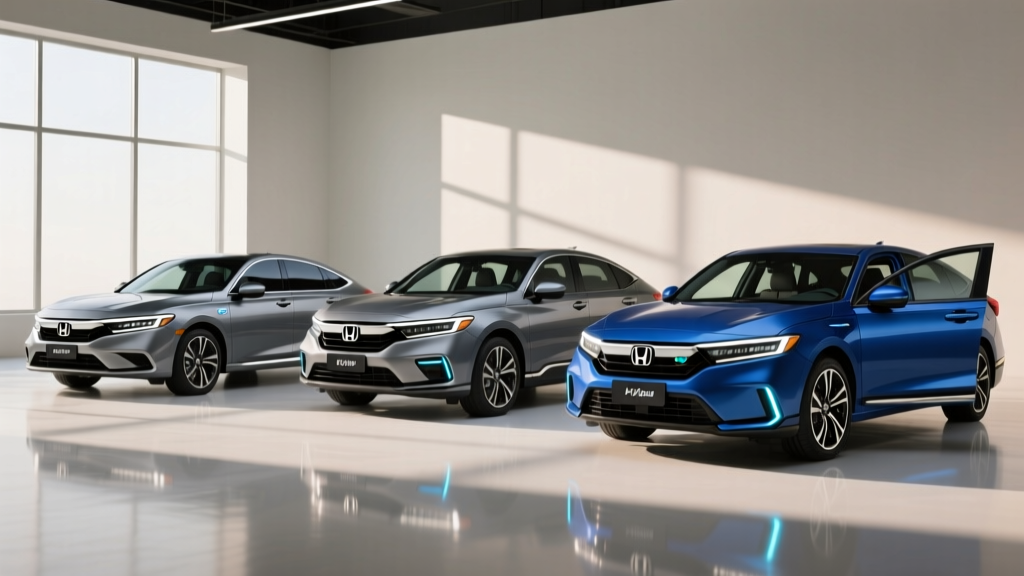
Honda's 2026 hybrid lineup spans three core models — the CR-V Hybrid, Accord Hybrid, and Civic Hybrid — plus one plug-in hybrid variant sold in select markets. Unlike full battery-electric vehicles, Honda's conventional hybrids (HEVs) require no plug and no lifestyle change. You fuel them like a normal gas car; the hybrid system simply recaptures energy that would otherwise be wasted, translating directly into better MPG. This guide covers every 2026 Honda hybrid with exact EPA figures, real-world expectations, battery warranty details, and whether any qualify for federal tax credits.
Honda's 2026 Hybrid Lineup at a Glance
For 2026, Honda offers its two-motor hybrid system across its highest-volume nameplates. The architecture pairs a 2.0-liter Atkinson-cycle inline-four engine with two electric motors and a lithium-ion battery pack. One motor primarily drives the wheels; the second acts as a generator. At highway speeds, the engine can mechanically connect to the drivetrain via a lock-up clutch for improved efficiency. This is Honda's fourth-generation hybrid system, and it is markedly smoother and more responsive than the earlier single-motor IMA setups from the 2010s.
| Model | Type | Combined HP | EPA Combined MPG | Starting MSRP |
|---|---|---|---|---|
| CR-V Hybrid (Sport/Sport Touring) | HEV | 204 hp | 40 MPG | $37,695 |
| Accord Hybrid (Sport, EX-L, Sport-L, Touring) | HEV | 204 hp | 44–48 MPG | $33,995 |
| Civic Hybrid (Sport, Sport Touring) | HEV | 200 hp | 49–50 MPG | $29,845 |
All three models are conventional hybrids (HEVs). Honda does not currently sell a plug-in hybrid (PHEV) in the US market for the 2026 model year. The Clarity PHEV was discontinued after 2021, and Honda has not announced a US-market PHEV replacement as of early 2026.
HEV vs. PHEV: What Honda Buyers Need to Know
Conventional Hybrid (HEV): Charges its own small battery (~1–2 kWh) through regenerative braking and the engine. You never plug it in. Fuel economy improves 30–50% over a gas-only equivalent. Honda's 2026 CR-V, Accord, and Civic hybrids are all HEVs.
Plug-in Hybrid (PHEV): Carries a larger battery (typically 12–20 kWh) that you charge via a plug, giving 25–45 miles of electric-only driving before the gas engine engages. Honda does not currently offer a PHEV in the US for 2026. Competitors in this space include the Toyota RAV4 Prime (42 mi EV range) and Hyundai Tucson PHEV (33 mi EV range).
If you want electric-only commuting with a gas backup for road trips, a PHEV is ideal — but you will need to look outside Honda's current US lineup. If you want significantly improved fuel economy with zero change to your fueling routine, Honda's 2026 HEVs deliver that directly.
Fuel Economy: EPA Ratings and Real-World MPG
Honda's hybrid system excels in city driving, where the electric motor handles low-speed propulsion and regenerative braking recaptures energy at every stop. Highway MPG is lower because the engine must sustain higher RPMs at cruising speed, though the lock-up clutch helps.
| Model / Trim | City MPG | Highway MPG | Combined MPG |
|---|---|---|---|
| CR-V Hybrid Sport (FWD) | 43 | 36 | 40 |
| CR-V Hybrid Sport Touring (AWD) | 40 | 34 | 37 |
| Accord Hybrid Sport (FWD) | 46 | 41 | 44 |
| Accord Hybrid EX-L (FWD) | 51 | 44 | 48 |
| Civic Hybrid Sport (FWD) | 50 | 47 | 49 |
| Civic Hybrid Sport Touring (FWD) | 50 | 47 | 49 |
Source: fueleconomy.gov (EPA estimates). Actual mileage will vary based on driving conditions, climate, and habits.
In mixed suburban and city driving, Honda's hybrids frequently exceed their EPA city ratings — the Civic Hybrid regularly returns 52–55 MPG in stop-and-go traffic where regenerative braking is maximized. Highway driving is a different story: at sustained 75–80 mph, expect the Accord Hybrid to deliver 38–42 MPG (below its 41–44 EPA highway rating) and the CR-V Hybrid AWD to return 30–33 MPG. Cold weather (below 35°F) typically reduces hybrid fuel economy by 5–10% due to increased engine warm-up time and reduced battery efficiency.
Powertrain Details: Honda's Two-Motor Hybrid System
All 2026 Honda hybrids use a variant of the same two-motor architecture, though tuning and output differ by model.
| Specification | CR-V Hybrid | Accord Hybrid | Civic Hybrid |
|---|---|---|---|
| Engine | 2.0L DOHC I-4 | 2.0L DOHC I-4 | 2.0L DOHC I-4 |
| Engine HP | 146 hp | 146 hp | 146 hp |
| Drive Motor Output | 181 hp / 247 lb-ft | 181 hp / 247 lb-ft | 174 hp / 232 lb-ft |
| Combined System HP | 204 hp | 204 hp | 200 hp |
| Transmission | e-CVT (direct drive) | e-CVT (direct drive) | e-CVT (direct drive) |
| Drivetrain | FWD or AWD | FWD only | FWD only |
| 0–60 mph (est.) | ~7.6 sec | ~7.0 sec | ~7.2 sec |
| Battery Type | Lithium-ion | Lithium-ion | Lithium-ion |
| Battery Capacity | ~1.1 kWh (usable) | ~1.1 kWh (usable) | ~1.1 kWh (usable) |
The e-CVT here is not a traditional belt-and-pulley CVT. Honda's system uses a fixed-ratio direct drive with the electric motor handling most propulsion duties at low and moderate speeds. The engine primarily acts as a generator until highway speeds, where the lock-up clutch engages for a direct mechanical connection. The result is smooth, linear acceleration with none of the "rubber band" drone associated with older CVTs.
The CR-V Hybrid's available AWD system uses a rear-mounted electric motor rather than a mechanical driveshaft. This provides responsive torque vectoring to the rear wheels when traction is needed, without the parasitic loss of a full-time mechanical AWD system.
Pricing and Tax Credit Eligibility
| Model / Trim | MSRP (incl. destination) |
|---|---|
| Civic Hybrid Sport | $29,845 |
| Civic Hybrid Sport Touring | $32,045 |
| Accord Hybrid Sport | $33,995 |
| Accord Hybrid EX-L | $35,295 |
| Accord Hybrid Sport-L | $36,395 |
| Accord Hybrid Touring | $39,995 |
| CR-V Hybrid Sport | $37,695 |
| CR-V Hybrid Sport Touring | $41,995 |
Honda's 2026 conventional hybrids (CR-V, Accord, Civic) do not qualify for the federal §30D Clean Vehicle Credit. That credit applies only to battery-electric vehicles (BEVs) and plug-in hybrids (PHEVs) meeting specific battery sourcing, MSRP, and buyer income requirements — details available at irs.gov. Since Honda's 2026 hybrids are HEVs with no plug-in capability, they are ineligible.
Some states and utilities offer rebates or reduced registration fees for hybrids. Check your state's energy office or utility provider for current programs — these vary widely by jurisdiction and change frequently.
Battery Warranty, Reliability, and Replacement Costs
Hybrid battery longevity remains one of the most common concerns among buyers transitioning from conventional gas vehicles. Honda addresses this with a comprehensive warranty.
- Hybrid battery: 8 years / 100,000 miles (10 years / 150,000 miles in CARB states including CA, CT, ME, MA, NJ, NY, OR, VT, WA)
- Hybrid system components (inverter, motor, control unit): 8 years / 100,000 miles
- Powertrain warranty: 5 years / 60,000 miles
- Capacity retention threshold: Honda covers the hybrid battery if it fails to hold sufficient charge to operate the hybrid system — unlike BEVs, there is no specific percentage degradation threshold, since the small HEV battery is managed in a narrow state-of-charge window to maximize lifespan
Honda's hybrid batteries are small (~1.1 kWh usable) and operate in a tightly managed state-of-charge window — typically between 40% and 80%. This shallow cycling dramatically reduces degradation compared to a BEV battery that regularly cycles from 10% to 90%. In real-world data from previous-generation Honda hybrids (2014–2022 Accord Hybrid, 2020+ CR-V Hybrid), battery failures before 150,000 miles are uncommon. Most Honda hybrid owners will never need a battery replacement.
Replacement cost if out of warranty: A Honda hybrid battery replacement typically runs between $2,000 and $4,000 including labor, depending on the model. This is far less than a BEV battery replacement ($10,000–$20,000+) because the HEV battery is physically small and uses less expensive chemistry. Third-party refurbishment options exist for $1,200–$2,000 for older models.
Honda's overall reliability ratings remain strong. The brand consistently scores well in J.D. Power dependability studies and Consumer States reliability surveys. The two-motor hybrid system has fewer wear components than a traditional automatic transmission — there are no friction clutches, torque converters, or belt-driven accessories to replace.
Who Should Buy a Honda Hybrid vs. a Full EV or Gas Car
Choose a Honda Hybrid If:
- You want 40–50 MPG without changing your fueling routine
- You lack access to home or workplace charging (apartment, street parking)
- You frequently drive long road trips and don't want to plan around charging stops
- You live in an extreme climate (very cold or very hot) where BEV range loss is a concern
- Your budget is $30,000–$42,000 and you want maximum fuel savings within that range
- You want strong resale value and proven long-term reliability
Consider a Full BEV Instead If:
- You have reliable Level 2 home charging (garage or dedicated outlet)
- Your daily commute is under 80 miles round-trip
- You want to qualify for the $7,500 federal tax credit (§30D, subject to income and sourcing rules)
- You want to eliminate gasoline costs entirely
- You prefer instant electric torque and one-pedal regenerative driving
- You want zero tailpipe emissions for local air quality
Honda Hybrid Pros
- Class-leading city MPG (Civic Hybrid: 50 city)
- No plug-in required — zero lifestyle change
- Strong 8yr/100k-mi hybrid battery warranty
- Smooth two-motor e-CVT with no belt-driven CVT drone
- CR-V Hybrid offers AWD with electric rear motor
- Low battery replacement cost ($2k–$4k) if ever needed
- Honda's strong resale value and reliability record
Honda Hybrid Cons
- No PHEV option in Honda's 2026 US lineup
- No federal tax credit eligibility (HEV only)
- Accord Hybrid is FWD only — no AWD option
- Highway MPG drops noticeably at 75+ mph
- Hybrid trims cost $1,500–$3,000 more than gas equivalents
- Cold weather reduces MPG by 5–10%
- No electric-only driving mode for zero-emission zones
Ownership Cost: Honda Hybrid vs. Gas Equivalent
To quantify the savings, consider the 2026 Accord Hybrid EX-L ($35,295) versus the gas-only Accord EX-L 1.5T (~$34,000, EPA combined 32 MPG). At 15,000 miles per year and $3.40/gallon average fuel:
| Metric | Accord Hybrid EX-L (48 MPG) | Accord Gas EX-L (32 MPG) |
|---|---|---|
| Annual fuel consumption | 312.5 gallons | 468.8 gallons |
| Annual fuel cost | $1,063 | $1,594 |
| 5-year fuel cost | $5,313 | $7,969 |
| 5-year fuel savings (Hybrid) | $2,656 | |
The hybrid premium on the Accord is roughly $1,300 at comparable trim. The fuel savings pay back that premium in approximately 2.5 years — after that, you are saving roughly $530 per year in fuel. Over a typical 7-year ownership cycle, total fuel savings approach $3,700, yielding a net savings of ~$2,400 after accounting for the higher purchase price. The Civic Hybrid's payback is even faster due to its lower starting price and higher combined MPG.
Frequently Asked Questions
How many MPG does the 2026 Honda Civic Hybrid get?
The 2026 Civic Hybrid is EPA-rated at 50 city / 47 highway / 49 combined MPG. In real-world city driving with frequent stops, owners commonly report 52–55 MPG thanks to aggressive regenerative braking. Sustained highway driving at 75+ mph reduces this to approximately 43–46 MPG.
Does Honda offer a plug-in hybrid (PHEV) for 2026?
No. Honda discontinued the Clarity PHEV after the 2021 model year and has not introduced a replacement PHEV in the US market for 2026. If you need plug-in electric-only range, competitors like the Toyota RAV4 Prime (42 miles EV), Toyota Prius Prime (44 miles EV), or Hyundai Tucson PHEV (33 miles EV) are current alternatives.
Do Honda hybrids need to be plugged in?
No. Honda's 2026 CR-V, Accord, and Civic hybrids are conventional hybrids (HEVs). The battery recharges itself through regenerative braking and the gasoline engine. You fuel them exactly like a standard gas car — at a gas station, with no plug, no charging cable, and no home charger installation required.
Is the 2026 Honda CR-V Hybrid available with AWD?
Yes. The CR-V Hybrid Sport Touring comes standard with AWD, and the Sport trim offers AWD as an option. The system uses an electric motor at the rear axle rather than a mechanical driveshaft, providing responsive all-wheel traction with minimal efficiency penalty — the AWD model is rated at 37 MPG combined versus 40 MPG for FWD.
How long will a Honda hybrid battery last and what does replacement cost?
Honda's hybrid batteries are warrantied for 8 years/100,000 miles (10 years/150,000 miles in CARB states). In practice, Honda's small HEV batteries experience minimal degradation because they operate in a narrow 40–80% state-of-charge window. Failures before 150,000 miles are rare. If replacement is needed out of warranty, expect $2,000–$4,000 including labor — significantly less than a full EV battery replacement.
Does any 2026 Honda qualify for the federal EV tax credit?
Honda's 2026 conventional hybrids do not qualify for the §30D federal Clean Vehicle Credit, which is limited to BEVs and PHEVs. The Honda Prologue (BEV SUV) may qualify depending on current-year battery sourcing and MSRP rules — check fueleconomy.gov for the latest eligibility list. Always consult a tax professional before relying on credit eligibility for purchase decisions.
How does Honda's hybrid system compare to Toyota's?
Both Honda and Toyota use two-motor hybrid architectures, but they operate differently. Toyota's Hybrid Synergy System uses a planetary gearset to continuously blend engine and motor power, while Honda's system operates primarily as a series hybrid (engine generates electricity, motor drives wheels) at low and moderate speeds, then switches to direct engine drive at highway speeds. The result: Honda's system tends to feel more like an EV in city driving with stronger electric motor torque, while Toyota's system is marginally more efficient in certain highway conditions. Both are highly reliable with proven track records exceeding 200,000 miles.
Specifications and pricing reflect 2026 model year information available as of publication. Confirm final pricing and availability with your local Honda dealer. Tax credit rules are subject to change — verify current eligibility at irs.gov before purchasing.