Quick Verdict: A Pioneer That Still Commutes
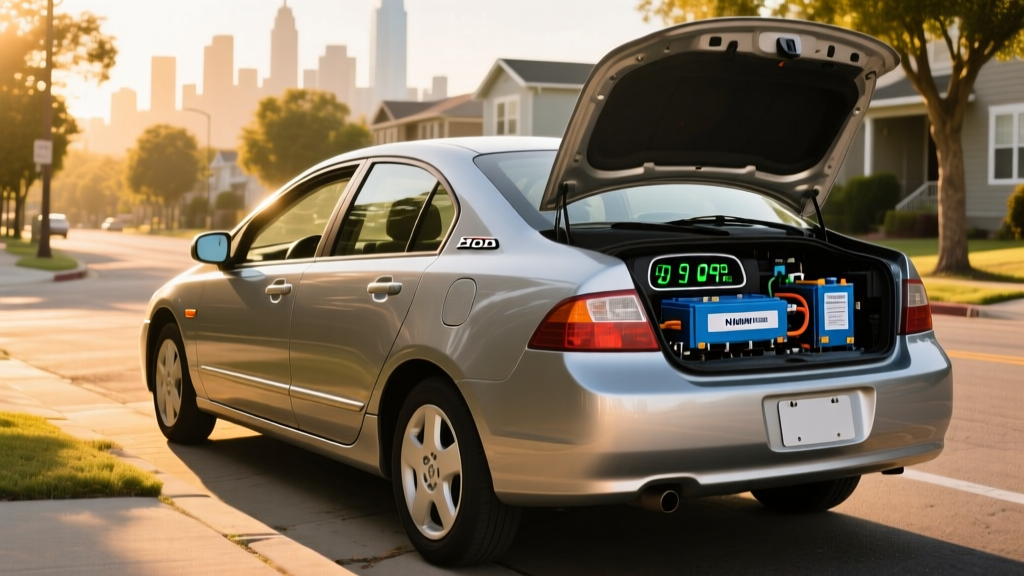
The 2005 Honda Civic Hybrid sedan was one of the first mainstream gasoline-electric hybrids sold in the United States, arriving at a time when the Toyota Prius dominated the conversation. Nearly two decades later, this compact sedan remains a data point worth studying — not because it competes with modern PHEVs and BEVs, but because it proves that early hybrid engineering can survive well past its warranty window if the battery is addressed. With an EPA-rated 48 MPG combined and a curb weight under 2,800 pounds, the 2005 Civic Hybrid still delivers real-world fuel economy that rivals many 2026 models.
However, buying one today means confronting a 20-year-old high-voltage battery, discontinued IMA (Integrated Motor Assist) components, and zero federal tax credit eligibility. This guide covers the exact specifications, real-world efficiency expectations, battery replacement economics, and the decision framework for whether this hybrid pioneer belongs in your driveway — or whether a modern PHEV or BEV is the smarter allocation of your budget.
EPA Fuel Economy vs. Real-World MPG
The 2005 Honda Civic Hybrid sedan carries EPA fuel economy ratings that were impressive at launch and remain competitive for a non-plug-in vehicle today. Honda equipped this generation with a continuously variable transmission (CVT) that keeps the 1.3-liter i-DSI engine in its most efficient RPM range.
| Metric | EPA Rating | Real-World Expectation |
|---|---|---|
| City MPG | 48 MPG | 44–50 MPG (city driving favors the electric assist) |
| Highway MPG | 47 MPG | 40–45 MPG (aerodynamic drag and lack of electric-only mode reduce highway gains) |
| Combined MPG | 48 MPG | 42–47 MPG (mixed driving, condition-dependent) |
Source: fueleconomy.gov (U.S. Department of Energy).
Hybrids typically exceed their EPA city rating in stop-and-go traffic because regenerative braking recovers kinetic energy that a conventional car wastes as heat. Highway driving tells a different story: the Civic Hybrid's small 1.3L engine must work harder at sustained speeds, and the IMA system provides minimal assist above 50 mph. Owners on Fuelly and similar tracking platforms report lifetime averages clustering between 42 and 47 MPG combined, with some hypermilers pushing past 50 MPG in warm climates with gentle acceleration.
Cold weather reduces MPG by roughly 10–15% due to richer fuel mixtures during warm-up, increased battery internal resistance, and cabin heater load. Expect 38–42 MPG combined in freezing conditions.
IMA Powertrain: How the 2005 Civic Hybrid Works
The 2005 Civic Hybrid uses Honda's first-generation Integrated Motor Assist (IMA) system — a parallel hybrid architecture fundamentally different from Toyota's series-parallel Hybrid Synergy Drive. Understanding this distinction matters for maintenance expectations and driving feel.
| Component | Specification |
|---|---|
| Gasoline Engine | 1.3L i-DSI inline-4, 8-valve, lean-burn capable |
| Engine Output | 85 hp @ 5,700 rpm / 87 lb-ft @ 3,300 rpm |
| Electric Motor | 15 kW (20 hp) brushless DC motor, sandwiched between engine and CVT |
| Combined System Output | 93 hp @ 5,700 rpm / 122 lb-ft @ 1,000 rpm |
| Transmission | Honda CVT (continuously variable) |
| High-Voltage Battery | NiMH (Nickel-Metal Hydride), ~6.0 Ah, nominal 158V (132 cells) |
| Battery Energy Capacity | Approximately 0.95 kWh (nominal) |
| 0–60 mph | ~11.5 seconds |
| Curb Weight | 2,732 lbs |
| Fuel Tank | 13.2 gallons |
| Total Driving Range | ~630 miles (at 48 MPG combined) |
The 2005 Civic Hybrid is a conventional hybrid (HEV). It cannot be plugged in, has no electric-only driving mode, and its ~0.95 kWh battery serves only to assist the gasoline engine during acceleration and capture energy during braking. A plug-in hybrid (PHEV) like the 2026 Toyota Prius Prime offers 40+ miles of electric-only range and a much larger battery (13.6 kWh) that charges via a wall outlet or DC fast charger. The Civic Hybrid's IMA system is simpler, lighter, and requires no charging infrastructure — but it also cannot drive a single mile on electricity alone.
The IMA motor sits directly on the crankshaft between the engine and transmission. It cannot propel the car independently; instead, it adds torque during acceleration (filling in the 1.3L engine's low-RPM torque gap) and acts as a generator during deceleration to recharge the NiMH pack. Honda's cylinder-deactivation system (VTEC-equipped variants shut down all four cylinders under light load) further reduces fuel consumption on gentle downhills and steady-speed cruising.
Battery Lifespan, Reliability, and Replacement Costs
The single largest ownership question for any 20-year-old hybrid is the high-voltage battery. The 2005 Civic Hybrid's NiMH pack was covered under Honda's original warranty for 8 years / 80,000 miles (10 years / 150,000 miles in CARB states like California, New York, and Massachusetts). That warranty expired no later than 2015 for most vehicles.
- Original warranty: 8 yr / 80,000 mi (10 yr / 150,000 mi in CARB states)
- Typical NiMH lifespan: 120,000–180,000 miles before significant capacity loss
- Common failure mode: Individual cell imbalance triggers IMA warning light, reduced regen/assist
- OEM replacement battery: Discontinued; refurbished packs cost $1,200–$2,200 installed
- Aftermarket/remanufactured: $800–$1,500 (parts only); add $300–$600 for labor
- Grid charger reconditioning: $50–$150 DIY; can extend life 1–3 years on marginal packs
NiMH chemistry degrades differently than the lithium-ion packs in modern EVs. Rather than a gradual, linear capacity fade, NiMH cells tend to develop voltage imbalances where weaker cells drag down the entire pack's usable capacity. Symptoms include the IMA warning light illuminating on the dash, reduced regenerative braking, lower assist during acceleration, and a noticeable drop in fuel economy (often 5–10 MPG below the EPA rating).
Replacement options in 2026 are limited. Honda no longer manufactures the OEM IMA battery for this generation. The aftermarket ecosystem offers remanufactured NiMH packs from vendors like Bumblebee Batteries and Hybrid Automotive, typically priced between $1,000 and $1,800 including core exchange. Installation requires a hybrid-certified technician familiar with Honda IMA systems — not every independent shop has this expertise. Labor adds $300–$600 depending on regional rates.
A cheaper stopgap is grid charging and deep-cycling the pack using an aftermarket balance charger (available for ~$100–$150). This can restore 60–80% of lost capacity on packs suffering from cell imbalance rather than outright cell death, buying 1–3 additional years of service. However, it is not a permanent fix.
Reliability Beyond the Battery
Outside the IMA battery, the 2005 Civic Hybrid's mechanical reliability is well-documented. The 1.3L i-DSI engine is under-stressed and routinely reaches 200,000+ miles with basic maintenance. The CVT transmission in this generation has a mixed record — Honda issued extended warranty coverage for certain CVT failures in 2003–2005 models, and some units have required replacement between 100,000 and 150,000 miles. A used example with a documented CVT fluid change history (Honda HMMF fluid, changed every 30,000 miles) is a significantly safer purchase.
Other known wear items include motor mounts (the additional torque from IMA accelerates mount degradation), 12V battery drain if the car sits unused for weeks, and the electric power steering rack, which can develop noise above 120,000 miles. None of these are deal-breakers, but they should factor into your pre-purchase inspection budget.
2026 Pricing and Tax Credit Reality
The 2005 Honda Civic Hybrid sedan originally carried an MSRP of approximately $20,140 (base, before destination). In the 2026 used-car market, examples range from $1,500 to $5,500 depending on mileage, condition, battery health, and regional demand. Low-mileage, well-maintained examples with a recently replaced IMA battery command the top of that range.
The 2005 Honda Civic Hybrid does not qualify for any federal EV or PHEV tax credit. The IRS §30D Clean Vehicle Credit applies only to new plug-in vehicles (BEVs and PHEVs) meeting battery-sourcing, MSRP, and buyer-income requirements. The federal used-EV credit (§25E) covers pre-owned BEVs and PHEVs priced under $25,000, but the Civic Hybrid is a conventional HEV with no plug — it has never been eligible for any federal electrification incentive.
Some states offered hybrid purchase rebates in 2005 (e.g., California's Clean Air Rebate of $1,500), but these expired long ago and do not transfer to subsequent owners. Check your state's current incentive programs at afdc.energy.gov, but expect no financial incentive for purchasing this vehicle today.
2005 Civic Hybrid vs. Modern HEV, PHEV, and BEV — Which Fits You?
The 2005 Civic Hybrid occupies a specific niche: ultra-low-cost transportation with strong fuel economy and no charging requirement. Here is how it stacks up against the alternatives a 2026 buyer is actually cross-shopping.
| Factor | 2005 Civic Hybrid (HEV) | 2026 Toyota Prius (HEV) | 2026 Toyota Prius Prime (PHEV) | 2026 Chevrolet Bolt EV (BEV) |
|---|---|---|---|---|
| Used/Purchase Price | $1,500–$5,500 | $28,550+ (new) | $33,450+ (new) | $28,000+ (new) |
| Combined MPG / MPGe | 48 MPG | 57 MPG | 52 MPG + 127 MPGe (EV mode) | 120 MPGe |
| Electric-Only Range | 0 miles | 0 miles | 44 miles | 259 miles |
| Plug-In Required? | No | No | Optional (best savings if plugged in) | Yes (mandatory) |
| Federal Tax Credit | None | None | Up to $3,750 (§30D, income/MSRP rules apply) | Up to $7,500 (§30D, income/MSRP rules apply) |
| Battery Replacement Risk | High (20-yr-old NiMH) | Low (warranty active) | Low (warranty active) | Low (8 yr/100k warranty) |
| Home Charging Needed? | No | No | Recommended for EV-mode savings | Yes (Level 2 strongly recommended) |
| Safety Tech (ADAS) | None (no ESC standard) | TSS 3.0 (AEB, LKA, ACC) | TSS 3.0 | Super Cruise available, AEB standard |
- Choose the 2005 Civic Hybrid if: Your budget is under $5,000, you need reliable A-to-B commuting at 45+ MPG, you have no home charging access, and you can verify IMA battery health (or budget $1,500 for replacement).
- Choose a modern HEV (2026 Prius) if: You want zero plug-in hassle, modern safety features, a full warranty, and 57 MPG combined — and can afford $28,000+.
- Choose a PHEV (Prius Prime) if: You have home Level 2 charging, a commute under 44 miles, and want to drive mostly on electricity while keeping gas for road trips. Check IRS §30D eligibility at irs.gov.
- Choose a BEV (Bolt EV) if: You have reliable home charging, want the lowest per-mile fuel cost (~$0.04/mile vs. $0.10/mile for the Civic Hybrid at $3.50/gal), qualify for the $7,500 credit, and don't regularly drive 300+ miles without stopping.
Pros and Cons of the 2005 Civic Hybrid in 2026
Pros
- 48 MPG EPA combined — still top-tier for a non-plug-in vehicle
- No charging infrastructure required; works anywhere gas is sold
- Low purchase price ($1,500–$5,500 used)
- Proven 1.3L engine longevity (200k+ miles common)
- Lightweight (2,732 lbs) = less tire and brake wear
- Simple IMA system — fewer failure points than full-hybrid systems
Cons
- 20-year-old NiMH battery likely at or past end-of-life
- OEM replacement battery discontinued; aftermarket supply limited
- No electric-only mode; IMA assist only supplements the gas engine
- CVT transmission failures documented in this generation
- No modern safety tech (no AEB, lane-keep, blind-spot monitoring)
- No federal or state tax credits available
- Performance is modest (93 hp combined, 11.5s 0–60)
Pre-Purchase Inspection Checklist
If you are seriously considering a 2005 Honda Civic Hybrid in 2026, a thorough pre-purchase inspection should specifically address the hybrid system:
- IMA battery health: Have a hybrid-certified technician read individual cell voltages via OBD-II. Any cell more than 0.2V below the pack average indicates imbalance.
- IMA warning light: If illuminated, the car may fail emissions inspection in some states and will operate in reduced-power "limp" mode.
- CVT condition: Test for shuddering during acceleration from a stop — a sign of degraded HMMF fluid or worn start clutch. Verify fluid change history.
- Motor mounts: Inspect for cracking or collapse, especially the rear mount which bears IMA torque loads.
- 12V battery: The IMA system relies on the 12V battery to boot the hybrid controller. A weak 12V can mimic IMA failure symptoms.
- Rust: Check subframe, rocker panels, and rear wheel arches — common corrosion points on 20-year-old Civics, especially in salt-belt states.
Frequently Asked Questions
How many MPG does the 2005 Honda Civic Hybrid get?
The EPA rates the 2005 Honda Civic Hybrid at 48 MPG city, 47 MPG highway, and 48 MPG combined. Real-world owners typically report 42–47 MPG combined, with city driving often exceeding the EPA estimate thanks to regenerative braking. Cold weather and aggressive driving can reduce this to 38–42 MPG.
Can the 2005 Civic Hybrid drive on electric power only?
No. The 2005 Civic Hybrid is a conventional hybrid (HEV), not a plug-in hybrid (PHEV). Its IMA system cannot propel the car without the gasoline engine running. The electric motor only assists during acceleration and captures energy during braking. For electric-only driving, you need a PHEV (like the Prius Prime, 44 miles EV range) or a BEV.
Is the 2005 Honda Civic Hybrid reliable?
The gasoline engine, suspension, and electronics are well-documented as reliable, with many examples exceeding 200,000 miles. The primary reliability concern is the IMA NiMH battery, which is now 20 years old and likely requires replacement or reconditioning. The CVT transmission also has a documented failure history in this generation. Budget $1,500–$2,500 for battery replacement if the current pack hasn't been changed.
How much does it cost to replace the hybrid battery?
A remanufactured NiMH IMA battery for the 2005 Civic Hybrid costs $800–$1,500 for parts, plus $300–$600 for professional installation, totaling $1,100–$2,100. Honda no longer sells the OEM battery. Grid charger reconditioning ($100–$150 DIY) can temporarily restore capacity on packs with cell imbalance but is not a permanent solution.
Does the 2005 Civic Hybrid qualify for any tax credit?
No. The 2005 Honda Civic Hybrid is a conventional hybrid (HEV) and has never qualified for the federal §30D Clean Vehicle Credit, which applies only to plug-in vehicles (BEVs and PHEVs). The used-EV credit (§25E) also excludes conventional hybrids. No current federal or state incentive applies to this vehicle.
Hybrid vs. PHEV vs. EV — which should I choose?
Choose a conventional hybrid (HEV) like the 2005 Civic Hybrid if your budget is tight, you lack home charging, and you want maximum MPG without plugging in. Choose a PHEV if you have home charging and a short commute — you'll drive mostly on electricity while retaining gas-engine range for longer trips. Choose a BEV if you want the lowest per-mile fuel cost, qualify for federal tax credits, and have reliable charging access. See the comparison table above for specifics.