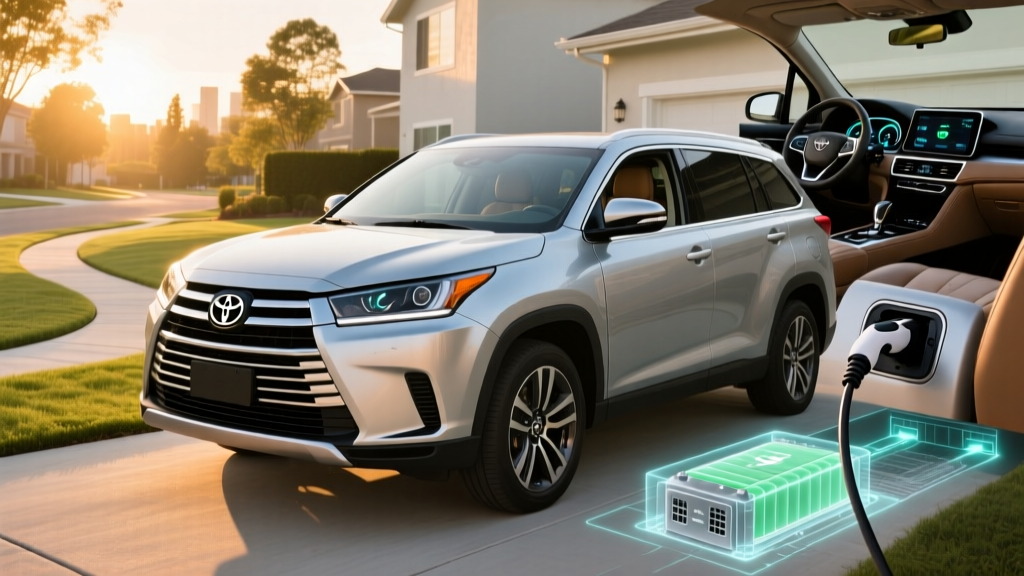
If you need three-row family hauling with all-weather capability but aren't ready to commit to a full battery-electric vehicle, the Toyota Highlander Hybrid AWD occupies a compelling middle ground. It pairs Toyota's proven hybrid synergy drive with electronic on-demand AWD, delivering EPA-estimated fuel economy that shames most midsize SUVs while requiring zero lifestyle changes — no plugs, no range calculations, no charging apps.
We've analyzed the current-generation Highlander Hybrid AWD across its trim lineup to give you the exact numbers that matter: real-world MPG, powertrain specs, battery longevity data, and total ownership economics. Here's what buyers actually need to know.
Highlander Hybrid AWD Powertrain: How It Works
The Highlander Hybrid AWD uses Toyota's fourth-generation hybrid system, combining a 2.5-liter inline-four Atkinson-cycle gasoline engine with three electric motors — two on the front axle and one dedicated to the rear wheels. This isn't a mechanical AWD system with a driveshaft; instead, the rear electric motor provides electronic on-demand all-wheel drive, activating automatically when the system detects front-wheel slip or when extra traction is needed.
| Specification | Highlander Hybrid AWD |
|---|---|
| Engine | 2.5L 4-cyl Atkinson-cycle |
| Combined System Horsepower | 243 hp |
| Front Motors | 2x permanent magnet AC synchronous |
| Rear Motor (AWD) | 1x permanent magnet AC synchronous (54 hp) |
| Hybrid Battery | 1.87 kWh nickel-metal hydride (NiMH) |
| Transmission | eCVT (electronically controlled) |
| 0-60 mph | ~7.8 seconds |
| Towing Capacity | 3,500 lbs |
| Drivetrain | Electronic on-demand AWD |
The 243 combined horsepower figure comes from the engine producing 186 hp and 175 lb-ft of torque, supplemented by the front electric motors' combined output. The rear AWD motor adds 54 hp and 89 lb-ft when engaged. Unlike some competitors that sacrifice power for efficiency, the Highlander Hybrid AWD maintains respectable acceleration while delivering class-leading fuel economy.
Fuel Economy: EPA Ratings vs. Real-World MPG
The EPA rates the Highlander Hybrid AWD identically across all trims (LE, XLE, Limited, Platinum) because the powertrain and curb weight differences are negligible for testing purposes.
| Driving Cycle | EPA Estimate | Real-World Expectation |
|---|---|---|
| City | 35 MPG | 33-37 MPG |
| Highway | 35 MPG | 30-34 MPG |
| Combined | 35 MPG | 32-36 MPG |
Real-world note: Toyota hybrids consistently achieve or exceed their EPA city estimates in actual stop-and-go driving because regenerative braking recovers energy that gas-only vehicles waste as heat. Highway driving tells a different story — at sustained 70-80 mph speeds, the gasoline engine does most of the work, and the Highlander's boxy three-row profile creates meaningful aerodynamic drag. Expect 30-32 MPG on extended highway trips, particularly in winter when cold air density increases drag and the engine runs more frequently for cabin heat.
According to fueleconomy.gov, the Highlander Hybrid AWD's 35 MPG combined translates to an estimated annual fuel cost of $1,750 based on 15,000 miles per year and $3.50/gallon regular unleaded — roughly $900 less per year than the non-hybrid Highlander AWD at 24 MPG combined.
HEV vs. PHEV vs. Full EV: Which Powertrain Fits You?
The Highlander Hybrid is a conventional hybrid electric vehicle (HEV), meaning it generates all its electricity internally through regenerative braking and the gasoline engine. You never plug it in. This is fundamentally different from a plug-in hybrid (PHEV) or a battery-electric vehicle (BEV).
| Factor | HEV (Highlander Hybrid) | PHEV (e.g., RAV4 Prime) | BEV (Full Electric) |
|---|---|---|---|
| Plug-in Required? | No | Yes (for EV range) | Yes (always) |
| Electric-Only Range | ~1 mile at low speed | 25-42 miles typical | 200-400+ miles |
| Home Charging Needed? | No | Recommended (Level 2) | Essential (Level 2) |
| Federal Tax Credit | No | Up to $7,500 (if eligible) | Up to $7,500 (if eligible) |
| Fuel Cost (per mile) | ~$0.10 | ~$0.04 electric / $0.10 gas | ~$0.04 |
| Range Anxiety | None (gas backup) | Minimal (gas backup) | Real for road trips |
| Upfront Price Premium | $1,500-$3,000 over gas | $5,000-$8,000 over gas | $8,000-$15,000+ |
Choose the Highlander Hybrid AWD (HEV) if: You want maximum simplicity, don't have access to home charging, take frequent road trips, or want three rows without the price premium of a PHEV or EV. The hybrid system pays for itself through fuel savings within 3-5 years for most drivers.
Consider a PHEV instead if: You have home charging, your daily commute is under 40 miles round-trip (so you'd drive mostly on electricity), and you still want gas-engine flexibility for longer trips. Note that Toyota does not currently offer the Highlander as a PHEV in the US market — the RAV4 Prime is Toyota's three-row-adjacent PHEV option, though it only seats five.
Consider a full EV if: You have reliable home Level 2 charging, want the lowest per-mile operating cost, value instant torque and quiet operation, and your typical trips fall within the vehicle's range. Three-row EVs like the Kia EV9 or Rivian R1S offer comparable space but at significantly higher starting prices ($55,000+).
Pricing, Trims, and Tax Credit Eligibility
The Highlander Hybrid AWD is available across four trims, with AWD standard on all hybrid configurations (front-wheel drive is not offered with the hybrid powertrain).
| Trim | MSRP (approx.) | Key Features |
|---|---|---|
| LE | $42,500 | 8-inch touchscreen, Toyota Safety Sense 3.0, 18-inch wheels |
| XLE | $46,000 | SofTex seats, sunroof, 20-inch wheels, wireless charging |
| Limited | $50,500 | Leather, 12.3-inch touchscreen, JBL audio, heated/ventilated front seats |
| Platinum | $54,000 | Panoramic roof, head-up display, 360-degree camera, panoramic view monitor |
Federal tax credit status: The conventional Highlander Hybrid (HEV) does not qualify for the federal §30D Clean Vehicle Credit. That credit applies only to plug-in vehicles (PHEVs and BEVs) meeting specific battery sourcing, MSRP caps, and buyer income requirements outlined by the IRS. Some states offer modest incentives for conventional hybrids — check your state's energy office or department of revenue for current programs, but do not count on them in your purchase budget.
The hybrid powertrain's fuel savings are the primary financial benefit. At 15,000 miles annually and $3.50/gallon fuel, the Highlander Hybrid AWD saves approximately $900 per year versus the gas-only AWD model, recouping the hybrid premium in roughly 3-4 years depending on trim selection.
Hybrid Battery Longevity: Warranty, Degradation, and Replacement
Toyota equips the Highlander Hybrid with a 1.87 kWh nickel-metal hydride (NiMH) traction battery. Unlike the larger lithium-ion packs in PHEVs and BEVs, this small battery is designed for frequent shallow charge-discharge cycles rather than deep cycling, which contributes to exceptional longevity.
Battery Warranty Coverage
- Hybrid Battery: 10 years / 150,000 miles (whichever comes first)
- Hybrid System Components: 8 years / 100,000 miles
- Capacity Retention Threshold: Toyota warrants the battery against abnormal capacity loss; no specific percentage threshold is published, but real-world data shows minimal degradation
Real-world reliability data: Toyota's hybrid systems are among the most proven in the automotive industry. The NiMH chemistry used in the Highlander Hybrid is inherently stable and tolerant of the shallow cycling pattern typical of HEV operation. Based on long-term data from the Prius and Camry Hybrid platforms using similar architectures, hybrid battery failures before 150,000 miles are rare. Many Toyota hybrids exceed 200,000 miles on the original battery pack.
Replacement cost if out of warranty: A new OEM hybrid battery for the Highlander Hybrid typically costs between $3,000 and $4,500 installed at a Toyota dealer. Independent hybrid specialists often offer refurbished or reconditioned packs for $1,500-$2,500 installed. Given the 10-year/150,000-mile warranty and the pack's demonstrated longevity, most original owners will never face this expense.
Toyota's hybrid battery uses a "battery buffer" strategy — the system never allows the pack to fully charge or fully discharge, keeping it in a 40-80% state of charge window that dramatically reduces chemical stress. This is why HEV batteries last far longer than their small kWh rating might suggest.
Driving Impressions: Performance, AWD Behavior, and Refinement
The Highlander Hybrid AWD delivers adequate rather than exciting performance. The 243 combined horsepower moves the 4,500-pound SUV competently, with the electric motors providing immediate low-end torque that makes city driving feel responsive. The eCVT eliminates traditional shift points, resulting in smooth, linear acceleration — though some drivers note a "rubber band" sensation during hard acceleration as the engine RPM rises ahead of vehicle speed.
The electronic AWD system is transparent in operation. Under normal dry-road driving, the Highlander operates primarily in front-wheel drive for maximum efficiency. When the system detects slip — in rain, snow, or during aggressive cornering — the rear motor engages within milliseconds, providing up to 54 hp and 89 lb-ft to the rear axle. This isn't a system designed for off-road crawling or deep snow; it's optimized for on-road safety and all-weather confidence.
At highway speeds, cabin noise is well-managed, though the four-cylinder engine becomes audible under hard acceleration. The transition between electric-only and engine-assisted driving is nearly imperceptible in normal driving — you'll only notice the engine starting at stoplights in cold weather when the system needs heat for the cabin.
Who Should Buy the Highlander Hybrid AWD?
Pros
- 35 MPG combined — best in the three-row midsize SUV segment
- Standard AWD with no plug-in requirement
- Proven hybrid reliability with 10-year battery warranty
- 3,500-lb towing capacity adequate for light trailers
- Toyota Safety Sense 3.0 standard across all trims
- Strong resale value — Toyota hybrids hold premium on the used market
Cons
- Third row is tight for adults; best suited for children
- No plug-in hybrid or EV variant available
- eCVT drone under hard acceleration
- Infotainment system lags behind competitors in responsiveness
- Cargo space behind third row (16.1 cu ft) is modest for the class
- No federal tax credit available (HEV, not PHEV/BEV)
The Highlander Hybrid AWD is ideal for: Families who need three rows and AWD for snow-belt commuting, drivers covering 12,000-20,000 miles annually who want to minimize fuel costs without changing their refueling habits, and buyers who prioritize long-term reliability and low cost of ownership over cutting-edge technology.
Look elsewhere if: You need genuine adult-sized third-row seating (consider the Mazda CX-90 PHEV or Kia EV9), you want electric-only commuting capability, or you prioritize sporty driving dynamics over efficiency (the Mazda CX-90 non-hybrid or BMW X5 xDrive50e may appeal more).
Frequently Asked Questions
How many MPG does the Highlander Hybrid AWD actually get?
The EPA rates it at 35 MPG city, 35 MPG highway, and 35 MPG combined. In real-world driving, expect 33-37 MPG in city conditions (hybrids often beat their EPA city estimate) and 30-34 MPG on extended highway trips. Cold weather and mountain driving will reduce these figures by 5-15%.
Does the Highlander Hybrid need to be plugged in?
No. The Highlander Hybrid is a conventional HEV — it generates all its electricity through regenerative braking and the gasoline engine. You fuel it exclusively at gas stations, just like a conventional vehicle. There is no plug, no charging port, and no electric-only range to manage.
How far can it drive on electric power alone?
Less than one mile, and only at very low speeds (under 25 mph) in stop-and-go traffic. The 1.87 kWh battery is too small to provide meaningful electric-only driving. If electric-only commuting is your goal, you need a PHEV like the Toyota RAV4 Prime (42 miles EV range) or a full BEV.
Is the hybrid battery reliable and what does replacement cost?
Toyota's hybrid batteries are among the most reliable components in modern vehicles. The NiMH pack is covered by a 10-year/150,000-mile warranty, and real-world data shows most packs last 200,000+ miles. Out-of-warranty replacement costs $3,000-$4,500 at a dealer, or $1,500-$2,500 through an independent hybrid specialist using a refurbished pack.
Does the Highlander Hybrid qualify for a tax credit?
The conventional Highlander Hybrid (HEV) does not qualify for the federal §30D Clean Vehicle Credit, which is limited to plug-in vehicles (PHEVs and BEVs). Some states may offer small incentives for conventional hybrids, but these vary by jurisdiction and change frequently — check your state's energy office for current programs.
How does the AWD system work?
The Highlander Hybrid uses electronic on-demand AWD. A dedicated electric motor powers the rear wheels when the system detects front-wheel slip or when additional traction is needed. Under normal dry-road conditions, it operates primarily as a front-wheel-drive vehicle for maximum efficiency. There is no mechanical connection (driveshaft) between the front and rear axles.
Can the Highlander Hybrid tow?
Yes — the Highlander Hybrid AWD is rated to tow up to 3,500 pounds when properly equipped, which is sufficient for a small boat, utility trailer, or lightweight travel trailer. This matches the gas-only Highlander's towing capacity.
Sources: EPA Fuel Economy, Toyota Highlander Hybrid Specifications, IRS Clean Vehicle Credits