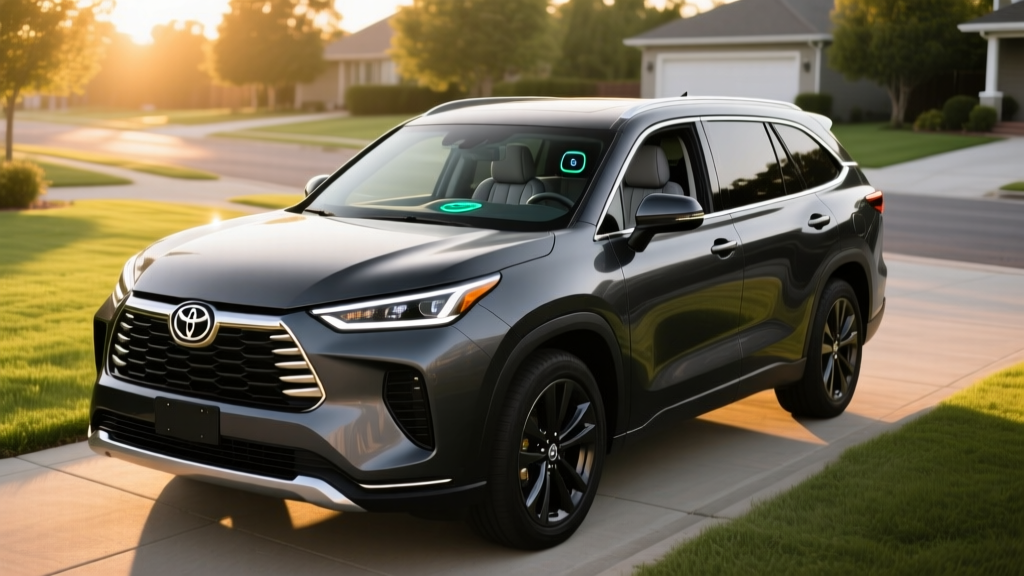
The Toyota Grand Highlander has quickly become one of the most popular three-row SUVs for families who want electrified efficiency without plugging in. For 2026, the Nightshade Edition brings a blacked-out aesthetic to Toyota's hybrid-only trim lineup, pairing monochromatic styling with the same proven hybrid powertrain that makes this SUV a fuel-sipping hauler. If you've been searching for the Grand Highlander Nightshade Hybrid and wondering whether its real-world MPG justifies the premium over a gas-only three-row SUV, this guide breaks down every number that matters.
What the Grand Highlander Nightshade Hybrid Actually Is
The Nightshade Edition is an appearance package layered onto the Grand Highlander's Hybrid powertrain. It replaces chrome exterior trim with gloss-black accents, adds 20-inch black alloy wheels, and includes black badging and mirror caps. Underneath the stealthy styling, it shares the same hybrid system found in the Grand Highlander Hybrid XLE and Limited trims.
The Grand Highlander Nightshade is a conventional hybrid (HEV). It does not plug in. Its small battery recharges through regenerative braking and the gasoline engine. Toyota does not currently offer a plug-in hybrid (PHEV) version of the Grand Highlander in the U.S. market. If you need electric-only driving for short commutes, you'd need to look at a PHEV like the Toyota RAV4 Prime or a full BEV. The HEV approach means zero behavior change — you fuel up at a gas station like any other car, but the hybrid system recaptures energy to boost MPG substantially over a conventional gas engine.
Hybrid Powertrain: Engine, Motors, and Horsepower
The Grand Highlander Nightshade Hybrid uses Toyota's fourth-generation hybrid system, pairing a 2.5-liter four-cylinder Atkinson-cycle engine with two electric motor-generators (front and rear) through an electronically controlled continuously variable transmission (eCVT).
| Specification | Value |
|---|---|
| Engine | 2.5L 4-cyl Atkinson-cycle |
| Electric Motors | Front + rear motor-generators |
| Combined Net Horsepower | 245 hp |
| Drivetrain | Electronic On-Demand AWD (eAWD) |
| Transmission | eCVT |
| Hybrid Battery | ~1.6 kWh NiMH (self-charging, no plug) |
| 0-60 mph | ~7.8 seconds (est.) |
| Towing Capacity | 3,500 lbs (hybrid AWD) |
| Seating | 7 or 8 passengers (trim dependent) |
The rear electric motor provides electronic on-demand all-wheel drive without a mechanical driveshaft. This means the rear wheels get torque only when the system detects slip or during hard acceleration — reducing parasitic losses and helping fuel economy compared to a traditional mechanical AWD system. The 245 combined horsepower is adequate for a three-row family hauler, though not sporty. Expect confident highway merging but no urgency off the line.
Fuel Economy: EPA MPG and Real-World Numbers
This is where the Grand Highlander Nightshade Hybrid earns its keep. For a three-row SUV that can seat up to eight and tow 3,500 pounds, the fuel economy numbers are genuinely impressive.
| Cycle | EPA Rating | Real-World Expectation |
|---|---|---|
| City | 36 MPG | 36-39 MPG (hybrids often beat EPA in city) |
| Highway | 32 MPG | 29-32 MPG (aero drag at 75+ mph hurts) |
| Combined | 34 MPG | 33-36 MPG (mixed driving) |
Source: fueleconomy.gov
Toyota hybrids consistently perform at or slightly above their EPA city rating in stop-and-go traffic because regenerative braking recaptures energy that a conventional vehicle wastes as heat. On highway-heavy road trips at sustained 75-80 mph, expect the number to dip toward 28-30 MPG due to the Grand Highlander's large frontal area and boxy profile. In cold weather (below 30°F), the engine runs more frequently to heat the cabin, which can temporarily drop city MPG by 3-5 points until the powertrain warms up.
Compared to the non-hybrid Grand Highlander with its turbocharged 2.4-liter engine (21 city / 27 highway / 23 combined for the AWD Turbo model), the hybrid saves roughly 3-4 gallons per 100 miles. At $3.50/gallon and 15,000 miles per year, that translates to approximately $525-$700 in annual fuel savings, depending on your driving mix.
Pricing and Tax Credit Eligibility
The Nightshade Edition slots between the XLE and Limited in the Grand Highlander Hybrid lineup, carrying a modest premium for its appearance upgrades.
| Trim | MSRP (est.) | Key Nightshade Additions |
|---|---|---|
| Hybrid XLE | ~$46,500 | Base hybrid trim |
| Hybrid Nightshade | ~$49,500 | Black 20" wheels, gloss-black trim, black badges |
| Hybrid Limited | ~$53,000 | Ventilated seats, premium audio, panoramic roof |
Note: Pricing reflects estimated 2026 model-year MSRP before destination charges. Confirm with your local Toyota dealer for exact figures.
The Grand Highlander Nightshade Hybrid is a conventional hybrid (HEV), not a plug-in vehicle. Under current IRS §30D Clean Vehicle Credit rules, only battery electric vehicles (BEVs) and plug-in hybrids (PHEVs) with sufficient battery capacity qualify for the federal tax credit. The Grand Highlander Hybrid does not qualify for the $7,500 federal credit. Some states may offer modest incentives for conventional hybrids — check your state energy office or department of revenue for local programs.
Battery Warranty, Reliability, and Replacement Cost
Hybrid battery longevity is consistently the top concern among first-time hybrid buyers. Here's what the data shows for Toyota's hybrid systems.
- Hybrid Battery: 10 years / 150,000 miles (whichever comes first)
- Hybrid System Components: 8 years / 100,000 miles
- Bumper-to-Bumper: 3 years / 36,000 miles
- Powertrain: 5 years / 60,000 miles
Toyota's hybrid battery track record is among the best in the industry. The Prius, which uses a similar NiMH-based hybrid system, routinely sees batteries lasting 150,000-200,000+ miles before significant degradation. The Grand Highlander's hybrid battery is relatively small (~1.6 kWh) and operates within a narrow state-of-charge window — typically between 40% and 80% — which dramatically reduces stress on the cells compared to a full EV battery that cycles through a wider range.
If replacement is eventually needed out of warranty, a Toyota hybrid battery replacement typically costs between $2,000 and $4,000 including labor, depending on whether you use a new OEM unit, a refurbished pack, or an independent hybrid specialist. Given the 10-year/150,000-mile warranty coverage, most original owners will never face this cost.
Toyota's reliability ratings from sources like Consumer Reports and J.D. Power consistently rank the brand at or near the top, and the Grand Highlander's hybrid powertrain uses well-established components from the Toyota Hybrid System family that have been refined over two decades.
Hybrid vs. PHEV vs. Full EV: Which Is Right for You?
Choosing between a conventional hybrid, a plug-in hybrid, and a full battery electric vehicle depends on your daily driving pattern, home charging access, and willingness to adapt your fueling routine.
| Factor | HEV (Grand Highlander Hybrid) | PHEV | Full EV (BEV) |
|---|---|---|---|
| Plug in? | No | Optional (but recommended) | Yes, required |
| Electric-only range | None (EV assist only) | 20-45 miles typical | 250-400 miles |
| Home charging needed | No | Recommended for value | Yes (Level 2 ideal) |
| Fuel cost per mile | ~$0.10/mi | ~$0.04-0.10/mi | ~$0.03-0.06/mi |
| Road trip ease | Gas station, no planning | Gas station, no planning | DC fast-charge stops needed |
| Federal tax credit | No | Up to $7,500 (if eligible) | Up to $7,500 (if eligible) |
- Choose the Grand Highlander Nightshade Hybrid (HEV) if: You want a three-row SUV with 34 MPG combined, you don't have reliable home charging access, you frequently take long road trips, and you want zero change to your fueling habits.
- Choose a PHEV three-row SUV if: You have home Level 2 charging, your daily commute is under 35 miles round-trip, and you want electric-only weekday driving with gas flexibility for weekend trips. (Note: PHEV three-row options remain limited — the Kia Sorento PHEV and Jeep Grand Cherokee 4xe are closest competitors.)
- Choose a full EV if: You have reliable home charging, your daily driving is under 250 miles, you're ready to plan road-trip charging stops, and you want the lowest per-mile fuel cost plus federal tax credit eligibility.
Nightshade Features and What You Get for the Premium
The Nightshade package typically adds $1,500-$2,500 over the equivalent XLE hybrid trim. Here's what's included beyond the standard hybrid equipment:
- 20-inch gloss-black alloy wheels (vs. 18-inch machine-finish on XLE)
- Black mirror caps, door handles, and window surround trim
- Black Toyota badging and Nightshade badge
- Dark-tinted rear privacy glass
- Black roof rails
- SofTex-trimmed seats with contrast stitching
The Nightshade does not add performance upgrades, additional horsepower, or different suspension tuning. It is strictly an appearance package. If you prioritize features over styling, the Limited trim adds ventilated front seats, a panoramic glass roof, a premium JBL audio system, and a 360-degree camera — all for a similar premium over the Nightshade.
- 34 MPG combined in a 3-row, 8-seat SUV
- Standard AWD with no fuel-economy penalty
- No plugging in — zero behavior change required
- 10-year/150,000-mile hybrid battery warranty
- Strong resale value (Toyota hybrid demand remains high)
- Distinctive Nightshade styling without a huge price jump
- No federal tax credit eligibility (HEV, not PHEV/BEV)
- 245 hp feels merely adequate for a 4,700-lb SUV
- Highway MPG drops at sustained 75+ mph speeds
- Nightshade is appearance-only — no performance upgrades
- Third row still tight for adults on long trips
- No DC fast charging or electric-only driving capability
Frequently Asked Questions
How many MPG does the Grand Highlander Nightshade Hybrid get?
The EPA rates the Grand Highlander Hybrid AWD at 36 city / 32 highway / 34 combined MPG. In real-world mixed driving, most owners report 33-36 MPG combined. City driving tends to match or slightly exceed the EPA rating thanks to regenerative braking, while sustained highway speeds above 75 mph can pull the number down to 28-30 MPG.
Can the Grand Highlander Nightshade Hybrid drive on electric power only?
Only for very short distances at low speeds (typically under 1 mile at under 25 mph). The hybrid battery is approximately 1.6 kWh — far too small for meaningful electric-only range. This is a conventional hybrid designed to assist the gas engine, not replace it. If electric-only commuting is a priority, you need a PHEV or BEV.
Does the Grand Highlander Hybrid qualify for any tax credit?
No. Under current IRS rules, the §30D Clean Vehicle Credit applies only to plug-in electric vehicles (BEVs and PHEVs) that meet battery sourcing, MSRP, and buyer income requirements. The Grand Highlander Hybrid is a conventional HEV and is not eligible for the federal $7,500 credit. Check your state's energy office for any local hybrid incentives.
Is the hybrid battery reliable and what does replacement cost?
Toyota's hybrid batteries have an excellent reliability record, frequently lasting 150,000-200,000+ miles. The Grand Highlander's hybrid battery is covered by a 10-year/150,000-mile warranty. If replacement is needed out of warranty, expect to pay $2,000-$4,000 for a new or refurbished pack including labor. Given the warranty terms and Toyota's track record, battery replacement is unlikely during typical first-owner use.
How does the Nightshade Hybrid compare to the Hybrid Max powertrain?
Toyota offers a more powerful Hybrid Max powertrain on the Grand Highlander (362 combined hp) in the Platinum and select trims. The Hybrid Max uses a turbocharged 2.4-liter engine with a more powerful electric motor and a 6-speed automatic instead of an eCVT. It's significantly quicker (0-60 in ~6.3 seconds) but sacrifices fuel economy — expect roughly 27-28 MPG combined. The Nightshade uses the standard 245-hp hybrid system for maximum efficiency. The Hybrid Max is not available with the Nightshade appearance package.
Should I get the Grand Highlander Nightshade Hybrid or wait for a PHEV version?
Toyota has not announced a plug-in hybrid variant of the Grand Highlander as of early 2026. If you need three rows and plug-in capability now, your options are limited to the Kia Sorento PHEV (32 miles electric-only, smaller third row) or the Jeep Grand Cherokee 4xe (25 miles electric-only, two rows only). If three-row space and maximum efficiency without plugging in are your priorities, the Grand Highlander Nightshade Hybrid is the strongest option currently available.
Sources: fueleconomy.gov (EPA ratings), Toyota.com (manufacturer specifications), IRS.gov (§30D tax credit rules). All specs reflect estimated 2026 model-year data; confirm with your dealer before purchasing.