Grand Highlander Hybrid MPG: The Quick Numbers
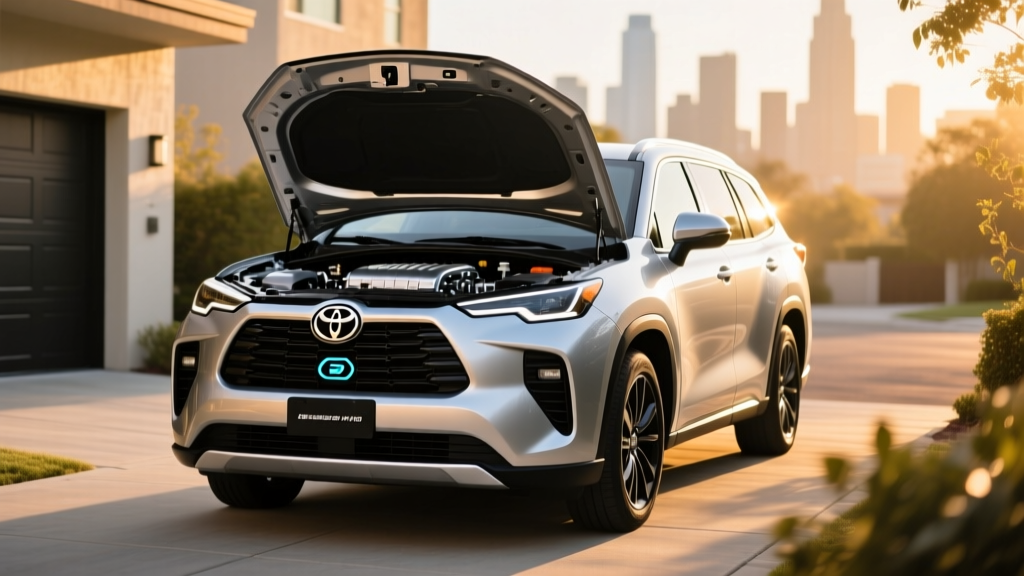
If you're researching Grand Highlander MPG hybrid efficiency, here's the essential data. The 2025-2026 Toyota Grand Highlander offers two distinct hybrid powertrains, and their fuel economy differs significantly:
| Powertrain | City MPG | Highway MPG | Combined MPG | Drivetrain |
|---|---|---|---|---|
| Hybrid (2.5L 4-cyl + motors) | 37 | 34 | 36 | AWD (electronic) |
| Hybrid MAX (2.4L turbo + motor) | 26 | 27 | 27 | AWD (torque-vectoring) |
The standard hybrid delivers mid-30s combined MPG in a three-row SUV weighing over 4,600 pounds — a figure that rivals many compact crossovers. The Hybrid MAX trades efficiency for 362 combined horsepower and a 5,000-pound towing capacity.
Source: EPA Fuel Economy
Real-World MPG vs. EPA Sticker
EPA Combined: 36 MPG (standard hybrid)
Real-world expectation: 33-38 MPG depending on conditions
Toyota's hybrid system excels in stop-and-go city driving, where regenerative braking and electric motor assist maximize efficiency. Many owners report 38-40 MPG in urban conditions. Highway cruising at 75+ mph typically yields 30-32 MPG. Cold weather reduces efficiency by 10-15% due to increased engine warm-up cycles and cabin heating demands.
HEV vs. PHEV: Understanding the Grand Highlander Hybrid
Important Clarification
The Toyota Grand Highlander hybrid is a conventional hybrid electric vehicle (HEV), not a plug-in hybrid (PHEV). This means:
- No plug required: The battery charges through regenerative braking and the gasoline engine
- No electric-only range: The electric motor assists the engine but cannot propel the vehicle alone for extended distances
- No home charging setup needed: You fuel it like any gas car, just less frequently
- No federal tax credit: The §30D credit applies only to plug-in vehicles with 4+ kWh batteries
If you're seeking plug-in capability with electric-only driving, the Grand Highlander doesn't currently offer a PHEV variant. Toyota's three-row PHEV option is the RAV4 Prime (42 miles electric-only, 94 MPGe), though it seats only five.
Powertrain Specs: Two Hybrid Systems, Different Priorities
| Specification | Standard Hybrid | Hybrid MAX |
|---|---|---|
| Engine | 2.5L 4-cylinder | 2.4L turbocharged 4-cylinder |
| Combined Horsepower | 245 hp | 362 hp |
| Combined Torque | 173 lb-ft (engine) | 400 lb-ft |
| Electric Motors | Front + rear (eAWD) | Front motor + rear (Direct AWD) |
| 0-60 mph | ~7.8 seconds | ~5.6 seconds |
| Towing Capacity | 3,500 lbs | 5,000 lbs |
| Combined MPG | 36 | 27 |
The standard hybrid prioritizes efficiency with Toyota's fourth-generation hybrid system. The 2.5-liter Atkinson-cycle engine pairs with front and rear electric motors, providing electronic all-wheel drive without a mechanical driveshaft. This setup reduces weight and parasitic losses.
Hybrid MAX uses a turbocharged 2.4-liter engine with a more powerful electric motor integrated into a six-speed automatic transmission (not the eCVT used in the standard hybrid). The result is a performance-oriented system with 400 lb-ft of torque and genuine towing capability, but at the cost of 9 MPG combined.
Who Should Choose the Grand Highlander Hybrid?
Choose the Standard Hybrid (36 MPG) If:
- You prioritize fuel economy over acceleration
- Most driving is suburban/urban with frequent stops
- Towing needs are light (under 3,500 lbs)
- You want three rows without the fuel cost penalty
Choose Hybrid MAX (27 MPG) If:
- You need 5,000-lb towing for boats or trailers
- Performance matters (5.6-second 0-60 in a three-row SUV)
- You frequently drive in mountainous terrain where torque helps
- You accept the efficiency trade-off for capability
Consider a Full EV Instead If:
- You have reliable home Level 2 charging
- Daily driving is under 250 miles (fits most EV ranges)
- You want to eliminate oil changes and engine maintenance
- Local electricity rates make charging significantly cheaper than gas
Hybrid vs. PHEV vs. EV: Which Powertrain Fits Your Life?
The Grand Highlander hybrid sits in a specific niche. Here's how it compares to alternatives:
| Factor | Grand Highlander HEV | Typical PHEV SUV | Three-Row EV (e.g., Kia EV9) |
|---|---|---|---|
| Fuel/energy cost per mile | ~$0.11 (at $3.50/gal) | ~$0.04-0.08 (electric + gas mix) | ~$0.04-0.06 (home charging) |
| Range anxiety | None (500+ mile range) | Minimal (30-40 mi electric, then gas) | Real concern on road trips |
| Home charging needed | No | Recommended for EV benefits | Essential |
| Maintenance complexity | Engine + hybrid system | Engine + larger battery + charging | Minimal (no engine) |
| Federal tax credit | None | Up to $7,500 (if eligible) | Up to $7,500 (if eligible) |
| Three-row seating | Yes | Limited options | Yes (EV9, etc.) |
For families needing three rows without charging infrastructure, the Grand Highlander hybrid offers the best balance of efficiency and convenience. If you have home charging and shorter commutes, a PHEV or EV delivers lower operating costs.
Pricing and Tax Credit Reality
The 2025-2026 Grand Highlander hybrid pricing (MSRP, before destination):
- XLE Hybrid: ~$46,000
- Limited Hybrid: ~$51,000
- Platinum Hybrid MAX: ~$58,000
Federal Tax Credit Eligibility
The Grand Highlander hybrid does NOT qualify for the federal §30D tax credit.
The IRS §30D credit requires plug-in electric vehicles with battery capacity of at least 4 kWh. Conventional hybrids like the Grand Highlander HEV don't meet this threshold — their batteries are typically 1-2 kWh and charge only through regenerative braking.
Source: IRS Clean Vehicle Credits
Some states offer separate hybrid incentives, but these are increasingly rare as programs shift focus to plug-in vehicles. Check your state's energy office for current programs.
Battery Warranty and Long-Term Reliability
Hybrid Battery Coverage
Warranty: 10 years / 150,000 miles (whichever comes first)
Coverage: Defects and capacity loss below specified threshold
Replacement cost (out of warranty): $3,000-$5,000
Toyota's hybrid battery warranty is among the industry's best. The nickel-metal hydride (NiMH) battery in the standard hybrid is proven technology — Toyota has used similar systems in the Prius and Highlander Hybrid for over two decades with strong reliability records.
Real-world data shows Toyota hybrid batteries typically last 150,000-200,000 miles before significant degradation. Many original Prius batteries from 2004-2009 are still in service. The Grand Highlander's hybrid system benefits from this institutional knowledge.
Hybrid MAX uses a lithium-ion battery pack, which may have different long-term characteristics, but carries the same 10/150,000 warranty.
Source: Toyota Warranty Guide
Ownership Costs: 5-Year Projection
| Cost Category | Grand Highlander Hybrid (36 MPG) | Gas-Only Three-Row SUV (22 MPG) |
|---|---|---|
| Fuel (75,000 miles @ $3.50/gal) | $7,292 | $11,932 |
| Maintenance (oil, filters, brakes) | $2,500 | $3,200 |
| Insurance (avg) | $9,000 | $8,500 |
| Depreciation (est.) | $18,000 | $16,000 |
| 5-Year Total | $36,792 | $39,632 |
The hybrid's fuel savings (~$4,600 over 5 years) offset its higher purchase price and slightly elevated insurance costs. Hybrids also benefit from reduced brake wear due to regenerative braking — many owners report 80,000+ miles on original brake pads.
Pros and Cons: Grand Highlander Hybrid
Pros
- 36 MPG combined in a true three-row SUV
- No charging infrastructure required
- 500+ mile total range (17.9-gallon tank)
- 10-year/150,000-mile hybrid battery warranty
- Proven Toyota hybrid reliability
- Smooth, quiet operation in EV-assist mode
Cons
- No federal tax credit (HEV, not PHEV)
- Hybrid MAX drops to 27 MPG for performance
- Higher MSRP than gas-only competitors
- No electric-only driving capability
- Limited third-row space vs. minivans
Frequently Asked Questions
How many MPG does the Grand Highlander hybrid get?
The standard hybrid achieves 37 city / 34 highway / 36 combined MPG. The Hybrid MAX performance variant gets 26 city / 27 highway / 27 combined. Real-world city driving often exceeds EPA estimates by 2-4 MPG due to regenerative braking efficiency.
Does the Grand Highlander hybrid need to be plugged in?
No. The Grand Highlander hybrid is a conventional HEV, not a plug-in hybrid. The battery charges through regenerative braking and the gasoline engine. You never plug it in — just fuel it at gas stations like any conventional vehicle.
How far can the Grand Highlander hybrid drive on electric only?
Not far — typically less than 1 mile at low speeds (under 25 mph) in optimal conditions. The electric motor primarily assists the gas engine during acceleration and enables engine-off coasting, but this isn't a PHEV with meaningful electric-only range.
Is the hybrid battery reliable and expensive to replace?
Toyota hybrid batteries have excellent longevity records, typically lasting 150,000-200,000 miles. The battery is warranted for 10 years/150,000 miles. Out-of-warranty replacement costs $3,000-$5,000, but most owners never need this service during typical ownership periods.
Does the Grand Highlander hybrid qualify for any tax credit?
No federal tax credit. The IRS §30D credit requires plug-in capability and 4+ kWh battery capacity. The Grand Highlander hybrid doesn't meet these criteria. Some states may offer separate hybrid incentives, but these are uncommon. Check your state energy office for current programs.
Hybrid vs. PHEV vs. EV — which should I choose?
Choose the Grand Highlander hybrid if you need three rows, lack home charging, or frequently take long road trips where charging infrastructure is uncertain. Consider a PHEV (like RAV4 Prime) if you want some electric-only range and have home charging. Choose a full EV (like Kia EV9) if you have reliable Level 2 charging, drive under 250 miles daily, and want minimal maintenance.
How does cold weather affect hybrid MPG?
Expect 10-15% MPG reduction in freezing temperatures. Cold weather increases engine warm-up time (reducing electric-assist availability), thickens fluids, and increases cabin heating demands. The Grand Highlander hybrid still outperforms gas-only SUVs in winter conditions, but plan for 30-32 MPG combined instead of 36.