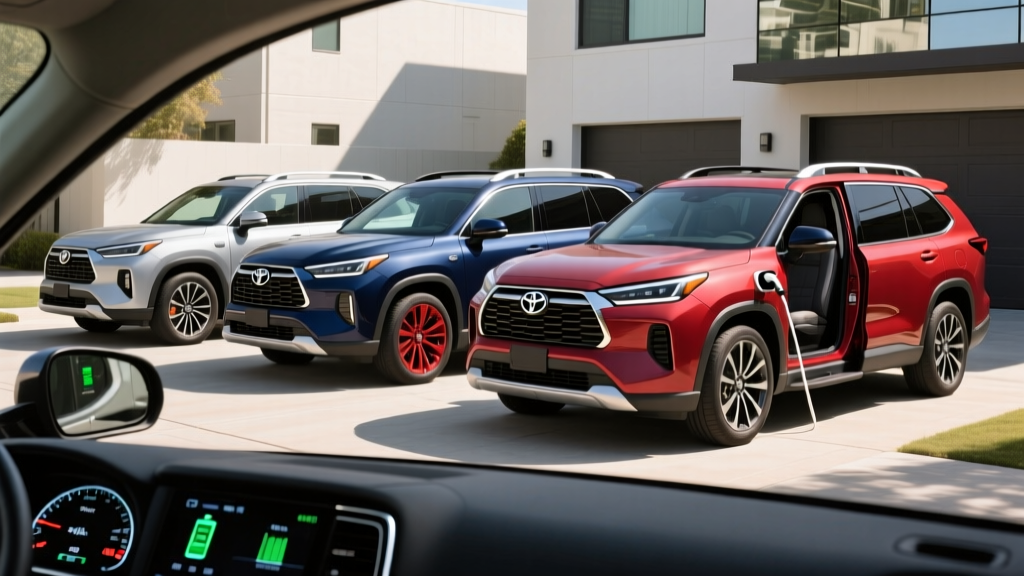
The three-row SUV segment is crowded, but few vehicles thread the needle between passenger space, cargo volume, and fuel economy like the Toyota Grand Highlander Hybrid. For 2026, Toyota continues to offer this midsize hauler with two distinct hybrid powertrains across four core trim levels — and choosing the right one depends on whether you prioritize maximum MPG, maximum power, or a balance of both.
This guide breaks down every 2026 Grand Highlander Hybrid trim level with exact EPA fuel economy figures, powertrain specifications, pricing, and real-world ownership considerations. Whether you're cross-shopping the Kia Sorento Hybrid, Hyundai Santa Fe Hybrid, or a full EV like the Kia EV9, you'll find the data you need here.
HEV vs PHEV: What the Grand Highlander Hybrid Actually Is
Conventional Hybrid (HEV): The Grand Highlander Hybrid is a self-charging hybrid. It uses a gasoline engine paired with electric motors and a small battery that recharges through regenerative braking and engine operation. You never plug it in. You simply fill up with gas and drive.
Plug-in Hybrid (PHEV): Toyota does not currently offer the Grand Highlander as a plug-in hybrid. If you need electric-only driving with a gas backup, you'd need to look at the Toyota RAV4 Prime (42 miles electric-only), the Kia Sorento PHEV (32 miles electric-only), or step up to a full BEV.
This distinction matters because some shoppers confuse "hybrid" with "plug-in." The Grand Highlander Hybrid operates exactly like a conventional gas vehicle at the pump — the hybrid system works invisibly in the background to reduce fuel consumption. There is no electric-only range to manage, no charging cable to deal with, and no range anxiety.
2026 Grand Highlander Hybrid Trim Levels at a Glance
Toyota offers the Grand Highlander Hybrid in two powertrain configurations for 2026: the standard Hybrid (focused on efficiency) and the Hybrid MAX (focused on performance). Here's how every trim stacks up:
| Trim | Powertrain | Combined HP | EPA City | EPA Hwy | EPA Combined | Drivetrain | MSRP (2026) |
|---|---|---|---|---|---|---|---|
| Hybrid LE | 2.5L 4-cyl Hybrid | 245 hp | 37 mpg | 34 mpg | 36 mpg | AWD (eAWD) | $42,190 |
| Hybrid XLE | 2.5L 4-cyl Hybrid | 245 hp | 37 mpg | 34 mpg | 36 mpg | AWD (eAWD) | $45,490 |
| Hybrid Limited | 2.5L 4-cyl Hybrid | 245 hp | 37 mpg | 34 mpg | 36 mpg | AWD (eAWD) | $49,870 |
| Hybrid MAX Limited | 2.4L Turbo Hybrid MAX | 362 hp | 27 mpg | 28 mpg | 27 mpg | AWD (Direct) | $54,990 |
Source: fueleconomy.gov and Toyota Motor Corporation 2026 model-year specifications. MSRP excludes destination charge (~$1,395).
Fuel Economy: EPA Numbers vs Real-World MPG
| Driving Scenario | Standard Hybrid (LE/XLE/Limited) | Hybrid MAX (Limited) |
|---|---|---|
| EPA City | 37 mpg | 27 mpg |
| EPA Highway | 34 mpg | 28 mpg |
| EPA Combined | 36 mpg | 27 mpg |
| Real-World City (observed) | 35–39 mpg | 25–28 mpg |
| Real-World Highway (70+ mph) | 30–33 mpg | 24–27 mpg |
| Cold Weather (below 30°F, short trips) | 28–32 mpg | 22–25 mpg |
The standard hybrid powertrain delivers its best efficiency in stop-and-go city driving, where the electric motors handle low-speed propulsion and regenerative braking recaptures energy. Toyota's hybrid system is particularly effective in urban conditions — many owners report matching or slightly exceeding the 37 mpg city EPA estimate on warm-weather commutes.
Highway driving is where the gap between EPA and real-world widens. At sustained 75–80 mph speeds, the 2.5-liter four-cylinder engine works harder, and aerodynamic drag on a vehicle this size takes a toll. Expect 30–33 mpg on long highway trips — still excellent for a three-row SUV, but a few ticks below the sticker.
The Hybrid MAX trades fuel economy for performance. Its turbocharged 2.4-liter engine and more powerful electric motors deliver V6-rivaling acceleration (0–60 mph in approximately 5.8 seconds) at the cost of roughly 9 mpg combined. If you tow frequently or want spirited acceleration, the tradeoff may be worth it. If maximum efficiency is the priority, the standard hybrid is the clear winner.
Powertrain Deep Dive: Standard Hybrid vs Hybrid MAX
Standard Hybrid (LE, XLE, Limited)
- Engine: 2.5-liter inline-4, Atkinson cycle
- Electric Motors: Front motor + rear motor (eAWD)
- Combined Output: 245 horsepower
- Transmission: eCVT (electronically controlled continuously variable)
- Drivetrain: Electronic on-demand AWD — the rear electric motor engages when slip is detected or under hard acceleration
- 0–60 mph: ~7.5 seconds
- Towing Capacity: Up to 3,500 lbs (when properly equipped)
Hybrid MAX (Limited only)
- Engine: 2.4-liter turbocharged inline-4
- Electric Motors: Front motor + rear motor (Direct AWD)
- Combined Output: 362 horsepower, 400 lb-ft torque
- Transmission: 6-speed automatic (not eCVT)
- Drivetrain: Direct AWD with mechanical rear driveshaft — more robust for towing and low-traction scenarios
- 0–60 mph: ~5.8 seconds
- Towing Capacity: Up to 5,000 lbs (when properly equipped)
The Hybrid MAX uses Toyota's i-FORCE MAX hybrid architecture, the same system found in the Tundra and Sequoia. It pairs a turbocharged engine with a sandwiched electric motor for torque-fill acceleration. The six-speed automatic provides more traditional shift feel compared to the eCVT's seamless but drone-prone character under hard throttle.
Pricing Breakdown: What Each Trim Costs
Here's what you'll actually pay for each 2026 Grand Highlander Hybrid trim, including destination:
- Hybrid LE: $43,585 (MSRP $42,190 + $1,395 destination)
- Hybrid XLE: $46,885 (MSRP $45,490 + $1,395 destination)
- Hybrid Limited: $51,265 (MSRP $49,870 + $1,395 destination)
- Hybrid MAX Limited: $56,385 (MSRP $54,990 + $1,395 destination)
Notable Trim Features by Level
Hybrid LE — Toyota Safety Sense 3.0 (pre-collision, lane departure, adaptive cruise, road sign assist), 12.3-inch touchscreen, wireless Apple CarPlay/Android Auto, tri-zone climate, Smart Key on front doors, 18-inch alloy wheels, heated front seats.
Hybrid XLE — Adds SofTex synthetic leather, power liftgate, 20-inch wheels, heated and ventilated front seats, wireless charging pad, auto-dimming rearview mirror, second-row sunshades.
Hybrid Limited — Adds genuine leather, panoramic roof, 11-speaker JBL audio, head-up display, 360-degree camera, heated second-row seats, digital rearview mirror, rain-sensing wipers.
Hybrid MAX Limited — All Limited features plus sport-tuned suspension, unique 20-inch wheels, quad exhaust tips, and the 362-hp i-FORCE MAX powertrain.
Tax Credit Eligibility
The Grand Highlander Hybrid does not qualify for the federal §30D Clean Vehicle Credit. Under current IRS rules, the credit is limited to plug-in electric vehicles (BEVs and PHEVs) with sufficient battery capacity. Conventional hybrids like the Grand Highlander Hybrid are excluded regardless of price or efficiency.
Some states offer their own incentives for hybrid vehicles, though these are less common than EV incentives. Check your state's energy or environmental agency website for current programs. Toyota also periodically offers manufacturer lease cash or financing incentives that can offset the price gap between hybrid and gas trims.
Battery Warranty, Reliability, and Replacement Costs
Hybrid Battery Warranty: Toyota covers the hybrid battery in the Grand Highlander Hybrid for 10 years or 150,000 miles (whichever comes first) from the date of first use. This applies to all 50 states. Prior to model year 2020, Toyota's hybrid battery warranty was 8 years/100,000 miles, but the automaker extended coverage for all subsequent model years.
Hybrid System Components: The hybrid control module, inverter, and related components carry the same 10-year/150,000-mile warranty.
Powertrain Warranty: The gasoline engine and transmission are covered under Toyota's 5-year/60,000-mile powertrain warranty.
How Long Will the Hybrid Battery Last?
Toyota's hybrid battery track record is among the best in the industry. The nickel-metal hydride (NiMH) battery pack in the standard hybrid and the lithium-ion pack in the Hybrid MAX are designed to last the life of the vehicle under normal use. Data from the Prius, Camry Hybrid, and Highlander Hybrid — all using similar architecture — shows most hybrid batteries exceed 150,000 miles before significant capacity loss.
Hybrid batteries experience far less stress than EV batteries. They operate in a narrow state-of-charge window (typically 40–80%), never fully charge or fully discharge, and are thermally managed. This shallow-cycling approach dramatically extends cell life compared to the deeper cycles a BEV battery endures.
Battery Replacement Cost
If the hybrid battery does fail outside of warranty, expect a replacement cost of approximately $3,000 to $5,000 including parts and labor at a Toyota dealer. Independent hybrid specialists can sometimes perform the replacement for $2,000–$3,500 using refurbished or aftermarket battery packs. This is significantly less than EV battery replacements, which can exceed $10,000–$20,000.
Some owners opt for individual module replacement rather than a full pack swap, which can reduce costs to under $1,500 if only a few cells have degraded.
Who Should Choose the Grand Highlander Hybrid?
Reasons to Choose It
- Best-in-class fuel economy for a three-row SUV (36 mpg combined)
- No charging infrastructure needed — works like a gas car
- Standard AWD across all trims at no extra cost
- Toyota's proven hybrid reliability and 10-year battery warranty
- Up to 97.5 cubic feet of cargo space with rows folded
- Third row fits adults on shorter trips (33.5 inches of legroom)
Reasons to Look Elsewhere
- No plug-in hybrid option for electric-only commuting
- Hybrid MAX trims sacrifice fuel economy for power
- No federal tax credit eligibility
- CVT drone under hard acceleration (standard hybrid)
- Limited off-road capability despite AWD
- Infotainment learning curve for first-time Toyota buyers
Grand Highlander Hybrid vs Full EV vs Gas — Which Fits You?
| Factor | Grand Highlander Hybrid | Full EV (e.g., Kia EV9) | Gas-Only SUV (e.g., Mazda CX-90) |
|---|---|---|---|
| Home Charging Required? | No | Yes (Level 2 strongly recommended) | No |
| Fuel Cost per Mile | ~$0.10–$0.13 | ~$0.04–$0.06 (home charging) | ~$0.15–$0.19 |
| Road Trip Convenience | Excellent — gas station stops only | Requires DC fast-charging planning | Excellent — gas station stops only |
| Federal Tax Credit | None | Up to $7,500 (if eligible) | None |
| Maintenance Costs | Low (no plug system, regenerative braking saves pads) | Lowest (fewest moving parts) | Higher (transmission, exhaust, more fluid changes) |
| Best For | Families who want max MPG without charging hassle | Homeowners with garage charging and predictable commutes | Buyers prioritizing lowest purchase price or towing-heavy use |
The Grand Highlander Hybrid occupies a specific sweet spot: families who want dramatically better fuel economy than a gas-only three-row SUV but aren't ready (or able) to install a home charger or plan road trips around DC fast-charging stations. If you have a garage where you can install a Level 2 charger, a mostly predictable daily commute under 40 miles, and a second vehicle for long trips, a PHEV or full EV may save you more money long-term. But if you need one vehicle to do everything — school runs, road trips, towing the occasional trailer — without any charging logistics, the Grand Highlander Hybrid is among the most efficient options available.
Frequently Asked Questions
How many MPG does the Grand Highlander Hybrid get?
The standard hybrid (LE, XLE, Limited) achieves an EPA-estimated 37 mpg city, 34 mpg highway, and 36 mpg combined. The Hybrid MAX Limited is rated at 27 mpg city, 28 mpg highway, and 27 mpg combined. In real-world driving, the standard hybrid typically delivers 35–39 mpg in city conditions and 30–33 mpg on the highway.
Does the Grand Highlander Hybrid need to be plugged in?
No. The Grand Highlander Hybrid is a conventional (self-charging) hybrid. The battery recharges through regenerative braking and the gasoline engine. You fuel it exactly like a conventional gas vehicle.
Is there a plug-in hybrid version of the Grand Highlander?
As of the 2026 model year, Toyota does not offer a plug-in hybrid (PHEV) version of the Grand Highlander. If you need electric-only commuting in a Toyota, the RAV4 Prime offers 42 miles of electric-only range, but it only seats five. The Prius Prime offers 44 miles of electric range but is a compact sedan.
Does the Grand Highlander Hybrid qualify for any tax credits?
The Grand Highlander Hybrid does not qualify for the federal §30D Clean Vehicle Credit, which is limited to plug-in vehicles (BEVs and PHEVs). Some states may offer hybrid-specific incentives, but these vary by jurisdiction and change frequently. Consult your state's energy office or a tax professional for current eligibility.
How reliable is the Grand Highlander Hybrid?
Toyota's hybrid powertrains have a strong reliability track record spanning over two decades (since the original Prius in 1997). The hybrid system has fewer wear components than a conventional powertrain — there's no traditional starter motor, alternator, or accessory belt, and regenerative braking extends brake pad life significantly. The hybrid battery carries a 10-year/150,000-mile warranty. According to IIHS and long-term owner data, Toyota hybrid systems routinely exceed 200,000 miles with proper maintenance.
What is the hybrid battery replacement cost?
Out-of-warranty hybrid battery replacement costs approximately $3,000–$5,000 at a Toyota dealer, including parts and labor. Independent hybrid specialists may offer lower prices using refurbished packs. Given the 10-year/150,000-mile warranty and Toyota's track record of battery longevity, most owners will never face this expense.
Which Grand Highlander Hybrid trim is the best value?
The Hybrid XLE offers the strongest balance of features and price. At approximately $46,885 with destination, it adds heated and ventilated front seats, SofTex upholstery, a power liftgate, 20-inch wheels, and second-row sunshades over the LE — all while maintaining the same 36 mpg combined rating. The LE is the efficiency-per-dollar champion if you can live with cloth seats and fewer comfort features.
Can the Grand Highlander Hybrid tow?
Yes. The standard hybrid (LE, XLE, Limited) is rated to tow up to 3,500 pounds when properly equipped. The Hybrid MAX Limited increases that to 5,000 pounds, making it suitable for small boats, utility trailers, and lightweight campers. Note that towing will significantly reduce fuel economy — expect 20–25 mpg in the standard hybrid and 17–20 mpg in the Hybrid MAX while towing.
Fuel economy data sourced from fueleconomy.gov. Tax credit information based on current IRS §30D guidelines. Specifications from Toyota Motor Corporation. Always verify current pricing and incentive eligibility with your local dealer and a qualified tax professional before purchasing.