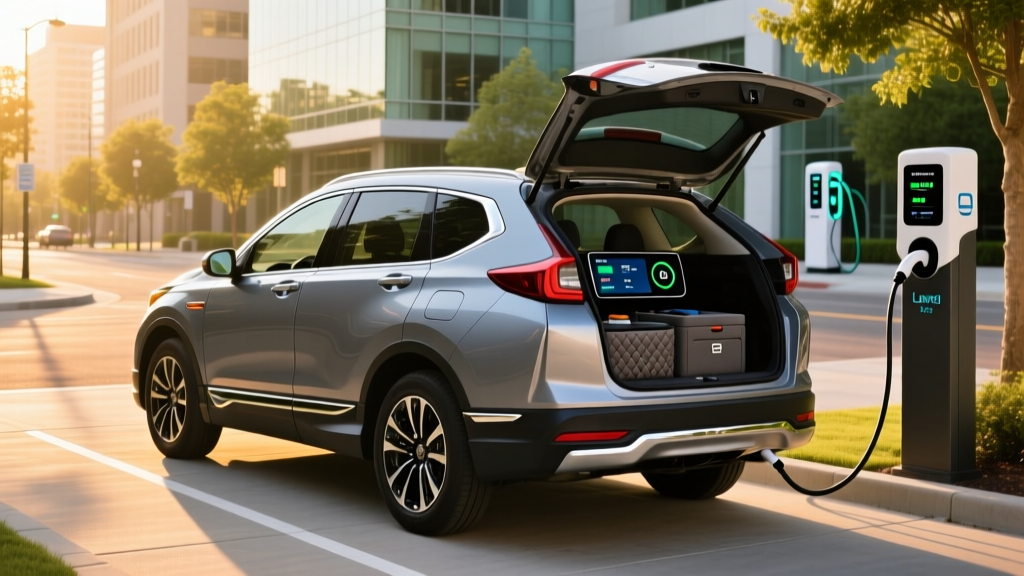
The 2025 Honda CR-V Hybrid Touring sits at the top of Honda's best-selling compact SUV lineup, pairing a 2.0-liter Atkinson-cycle engine with a two-motor hybrid system for an EPA-estimated 40 MPG combined. For buyers who want maximum fuel efficiency without plugging in, the Touring trim bundles every available feature — including a 9-inch touchscreen, wireless Apple CarPlay and Android Auto, heated rear seats, a hands-free power tailgate, and Honda Sensing 360 — into a package that starts at $40,850 (including destination). This guide breaks down the real-world fuel economy, powertrain behavior, long-term reliability outlook, and whether the CR-V Hybrid makes more financial sense than a plug-in hybrid or full battery-electric alternative.
2025 Honda CR-V Hybrid Touring: Key Specifications
| Powertrain | 2.0L DOHC 4-cyl + two-motor hybrid system |
| Combined Horsepower | 204 hp (146 hp engine + 181 hp drive motor) |
| Combined Torque | 247 lb-ft (drive motor) |
| Drivetrain | Real Time AWD (torque-vectoring rear axle) |
| EPA Fuel Economy (AWD) | 40 city / 34 highway / 37 combined MPG |
| EPA Fuel Economy (FWD) | 43 city / 36 highway / 40 combined MPG |
| Fuel Tank Capacity | 14.5 gallons |
| Total Driving Range (AWD est.) | ~536 miles |
| 0–60 mph (est.) | ~7.6 seconds |
| Cargo Volume (rear seats up / folded) | 36.3 / 76.5 cu ft |
| Towing Capacity | 1,000 lbs |
| Hybrid Battery Warranty | 8 years / 100,000 miles |
| MSRP (AWD Touring incl. destination) | $40,850 |
Source: EPA fueleconomy.gov and Honda official specs.
Fuel Economy: EPA Sticker vs. Real-World MPG
One of the most common questions about the CR-V Hybrid Touring is: How many MPG does this hybrid actually get? The answer depends heavily on your driving mix.
| Condition | City MPG | Highway MPG | Combined MPG |
|---|---|---|---|
| EPA Sticker (AWD) | 40 | 34 | 37 |
| EPA Sticker (FWD) | 43 | 36 | 40 |
| Real-World City (owner reports) | 38–44 | — | — |
| Real-World Highway (70–75 mph) | — | 30–34 | — |
| Real-World Combined (mixed driving) | — | — | 34–39 |
| Cold Weather (below 30°F, short trips) | — | — | 28–33 |
Honda's two-motor hybrid system excels in stop-and-go traffic, where the electric drive motor handles most low-speed propulsion and regenerative braking recaptures energy that a gas-only CR-V would waste as heat. Many owners report exceeding the EPA city number during warm-weather commutes, with 42–44 MPG achievable on flat suburban routes. Highway driving tells a different story: at sustained 70–75 mph speeds, the gasoline engine runs continuously and aerodynamic drag dominates, pulling fuel economy down to 30–34 MPG depending on terrain and wind.
Cold weather is the CR-V Hybrid's biggest efficiency penalty. Short trips in sub-freezing temperatures force the engine to run constantly for cabin heat (this is a conventional hybrid, not a PHEV with an electric heater), and the battery's charge/discharge efficiency drops. Expect 28–33 MPG combined in winter conditions with trips under 5 miles.
How the CR-V Hybrid Powertrain Works
Honda's fourth-generation two-motor hybrid system is fundamentally different from Toyota's planetary-gear hybrid setup. Here's what's under the hood:
- 2.0-liter Atkinson-cycle inline-4: Produces 146 hp and 134 lb-ft of torque. It runs on the efficient Atkinson cycle (delayed intake valve closing) and primarily acts as a generator at low speeds rather than directly driving the wheels.
- Drive motor: 181 hp / 247 lb-ft — this is what actually propels the vehicle most of the time. Instant torque delivery makes the CR-V Hybrid feel surprisingly quick off the line.
- Generator motor: Converts engine output to electricity and manages energy flow between the engine, battery, and drive motor.
- Lithium-ion battery pack: Approximately 1.06 kWh (usable). This is a small buffer — enough to capture regen energy and provide short electric-only bursts at low speed, but not designed for sustained electric driving.
- Real Time AWD: A mechanical rear driveshaft (not a separate rear electric motor) sends up to 50% of torque to the rear axle when slip is detected. This is simpler and lighter than the electric-AWD systems in some competitors.
The result is a system that behaves more like an extended-range electric vehicle at city speeds (engine generates electricity, motor drives wheels) and like a conventional car at highway speeds (engine connects directly to the wheels via a lock-up clutch for maximum efficiency). The transition between modes is mostly seamless, though you'll hear the engine drone during hard acceleration — Honda has added sound insulation for 2025, but it's still noticeable.
Hybrid vs. Plug-In Hybrid vs. Full EV: Which Is Right for You?
The CR-V Hybrid Touring is a conventional hybrid (HEV). It does not plug in, has no meaningful electric-only range, and requires no charging infrastructure. This distinction matters because buyers sometimes confuse HEVs with plug-in hybrids (PHEVs) or battery-electric vehicles (BEVs).
| Factor | HEV (CR-V Hybrid) | PHEV (e.g., Toyota RAV4 Prime) | BEV (e.g., Hyundai Ioniq 5) |
|---|---|---|---|
| Plug in required? | No | Yes (for EV range benefit) | Yes (always) |
| Electric-only range | ~1 mi (low-speed creep) | 35–42 mi | 250–320 mi |
| Combined efficiency | 37–40 MPG | 38 MPG + 94 MPGe (EV mode) | 110–132 MPGe |
| Federal tax credit (§30D) | Not eligible | Up to $7,500 (if eligible) | Up to $7,500 (if eligible) |
| Home charging needed? | No | Recommended (Level 2) | Essential (Level 2) |
| Upfront price premium | ~$1,500 over gas model | ~$5,000–$8,000 over gas | $5,000–$15,000 more |
| Best for | No charging access; long highway trips | Short commute + home charging; road trips | Home charging; mostly under 250 mi/day |
- You don't have access to home or workplace Level 2 charging.
- You regularly drive more than 300 miles between fuel stops (road trips, rural areas).
- You want better fuel economy without changing any habits — just fill up with gas and go.
- You want the fully loaded Touring trim without the $8,000+ premium of a PHEV equivalent.
- Your daily commute is under 40 miles round-trip AND you can install a Level 2 charger at home.
- You qualify for the $7,500 federal tax credit (income and sourcing rules apply — see below).
- You want near-EV efficiency on weekdays with gas-engine range for weekend trips.
- You have reliable home Level 2 charging and your daily driving stays under 200 miles.
- You want the lowest per-mile fuel cost (~$0.04/mile on home electricity vs. ~$0.10/mile for this hybrid at 37 MPG).
- You want to eliminate oil changes and engine maintenance entirely.
Pricing, Trims, and Tax Credit Eligibility
The 2025 Honda CR-V Hybrid is available in four trims. The Touring sits at the top:
| Trim | MSRP |
|---|---|
| Sport | $35,850 |
| Sport-L | $37,350 |
| Sport Touring | $40,850 |
Note: Honda consolidated the Hybrid lineup to Sport, Sport-L, and Sport Touring for 2025. The EX-L Hybrid from prior model years has been replaced by the Sport-L.
Does the CR-V Hybrid Qualify for a Federal Tax Credit?
No. The 2025 Honda CR-V Hybrid is a conventional hybrid (HEV), not a plug-in hybrid or battery-electric vehicle. It is not eligible for the IRS §30D Clean Vehicle Credit, which requires a minimum battery capacity of 7 kWh and plug-in capability. The CR-V Hybrid's ~1 kWh battery pack falls far below this threshold.
Some state-level programs offer small rebates for conventional hybrids (typically $250–$500), but these vary widely by jurisdiction. Check your state's energy office or DOE Alternative Fuels Data Center for current incentives in your area.
For comparison, the plug-in hybrid Toyota RAV4 Prime (42 miles EV range, ~$44,000 MSRP) may qualify for up to $7,500 under §30D, subject to the buyer's modified adjusted gross income ($150K single / $300K joint), the vehicle's MSRP cap ($80,000 for SUVs), and critical-mineral/battery-component sourcing requirements. Always verify current eligibility on IRS.gov before purchasing — these rules change frequently.
Reliability, Battery Warranty, and Long-Term Costs
Hybrid reliability is one of the top concerns for buyers considering their first electrified vehicle. Here's what the data shows for the CR-V Hybrid specifically:
Battery Replacement Cost
If the hybrid battery fails outside warranty, replacement at a Honda dealer currently runs $2,500–$4,000 (parts and labor). Independent hybrid-battery specialists can sometimes refurbish or replace individual cells for $1,500–$2,500. However, Honda's lithium-ion hybrid packs have proven durable — real-world data from the prior-generation CR-V Hybrid (2020–2022) shows very few battery-related failures under 150,000 miles. Unlike full EV batteries that degrade gradually (losing 10–15% capacity over 100K miles), the CR-V Hybrid's small battery is cycled shallowly and managed conservatively, which greatly extends its lifespan.
Overall Reliability
The 2025 CR-V Hybrid carries over the powertrain introduced in 2023, which is now in its third model year with incremental refinements. Honda Sensing 360 (standard on Touring) adds a front-facing camera, millimeter-wave radar, and corner radars for comprehensive ADAS coverage. The hybrid system itself has fewer wear items than a conventional gas powertrain: no traditional starter motor, no alternator, and regenerative braking significantly extends brake pad life (many owners report 80,000+ miles on original pads).
Common complaints on earlier CR-V Hybrid model years included infotainment lag and road noise. The 2025 Touring addresses both — the 9-inch touchscreen is responsive, and Honda added acoustic glass and additional sound deadening. The IIHS rates the CR-V as a Top Safety Pick+ for 2025, the highest designation available.
What the Touring Trim Gets That Lower Trims Don't
The Sport Touring commands a $3,500 premium over the Sport-L and adds:
- Heated rear outboard seats
- Heated steering wheel
- Hands-free power tailgate with walk-away close
- Wireless phone charger (Qi)
- Bose premium audio system (12 speakers)
- Low-speed braking control and traffic jam assist (part of Honda Sensing 360)
- Rear cross-traffic brake (auto-brake when reversing toward obstacles)
- 19-inch gloss-black alloy wheels
- Auto-dimming side mirrors with reverse-gear tilt
For buyers who want the safety and comfort features but can forgo the Bose audio and heated rear seats, the Sport-L at $37,350 represents a strong value — you're getting the same 204-hp hybrid powertrain and identical fuel economy.
5-Year Ownership Cost Estimate
| Category | Estimated Cost |
|---|---|
| Purchase price (MSRP, AWD Touring) | $40,850 |
| Estimated depreciation (5 yr) | –$16,000 |
| Fuel (75,000 mi ÷ 37 MPG × $3.40/gal avg) | $6,892 |
| Insurance (national avg, good driver) | $7,500 |
| Maintenance (oil, filters, tires, brakes) | $2,800 |
| Estimated repairs (out of warranty, years 4–5) | $600 |
| Total estimated 5-yr cost of ownership | ~$58,642 |
For comparison, a gas-only 2025 CR-V EX-L AWD (28 MPG combined, ~$37,500 MSRP) would cost approximately $10,040 in fuel over the same period — about $3,150 more in fuel alone. The hybrid premium (~$3,000 over an equivalently equipped gas model) pays for itself in fuel savings within roughly 4–5 years for a driver covering 15,000 miles annually.
Pros and Cons at a Glance
Pros
- 40 MPG combined (FWD) / 37 MPG (AWD) — class-leading for a compact hybrid SUV
- 204 hp with instant electric torque — peppy around town
- No plug-in charging required; zero behavior change from a gas car
- 76.5 cu ft cargo volume — identical to gas CR-V
- IIHS Top Safety Pick+ with Honda Sensing 360 standard on Touring
- 8-year/100,000-mile hybrid battery warranty (10 yr/150K in CARB states)
- Strong resale value — Honda CR-V consistently tops compact SUV depreciation charts
Cons
- No federal tax credit eligibility (conventional hybrid, not PHEV/BEV)
- Highway MPG drops to 30–34 at 75 mph — less impressive than city numbers
- Engine drone under hard acceleration (CVT-style behavior)
- 1,000-lb towing capacity — inadequate for any real trailer
- Touring trim pushes $41K — significant for a compact SUV
- No spare tire (tire-inflation kit only)
- Hybrid battery not designed for sustained electric-only driving
Frequently Asked Questions
How many MPG does the 2025 Honda CR-V Hybrid Touring actually get?
The EPA rates the AWD Touring at 40 city / 34 highway / 37 combined MPG. In real-world mixed driving, most owners see 34–39 MPG combined. City driving often exceeds the EPA estimate (38–44 MPG), while sustained highway speeds above 70 mph pull it down to 30–34 MPG. Cold weather and short trips can drop combined numbers to 28–33 MPG.
Can the CR-V Hybrid drive on electric power only?
Only in very limited circumstances — at low speeds (under ~25 mph) for short distances (roughly 0.5–1 mile) when the battery has sufficient charge. The ~1 kWh battery is far too small for meaningful electric-only driving. This is a conventional hybrid (HEV), not a plug-in hybrid (PHEV). If you want 30+ miles of electric-only range, you need a PHEV like the Toyota RAV4 Prime or a full BEV.
Does the 2025 CR-V Hybrid qualify for any tax credits?
No. The IRS §30D Clean Vehicle Credit requires a plug-in vehicle with at least 7 kWh of battery capacity. The CR-V Hybrid has approximately 1 kWh and does not plug in. It is not eligible for the federal EV tax credit. Some states offer small hybrid rebates ($250–$500), but these vary by location and change frequently.
Is the CR-V Hybrid reliable? What does a battery replacement cost?
Honda's hybrid system has proven highly reliable. The lithium-ion hybrid battery is warranted for 8 years / 100,000 miles (10 years / 150,000 miles in CARB states). Real-world data shows very few battery failures under 150,000 miles. If replacement is needed out of warranty, expect $2,500–$4,000 at a dealer, or $1,500–$2,500 at an independent hybrid specialist. The hybrid system also eliminates the starter motor and alternator, and regenerative braking extends brake pad life significantly.
Should I buy the CR-V Hybrid or wait for a plug-in version?
Honda has not announced a CR-V plug-in hybrid for the US market as of early 2026. If you need plug-in capability now, the Toyota RAV4 Prime (42 mi EV range, ~$44,000) is the closest competitor. If you can't charge at home, the CR-V Hybrid is the better choice — a PHEV driven without regular charging performs worse (lower MPG) than a conventional hybrid due to the added battery weight.
How does the CR-V Hybrid compare to the Toyota RAV4 Hybrid?
The RAV4 Hybrid (LE AWD) is EPA-rated at 41 city / 38 highway / 39 combined MPG — slightly better on the highway thanks to Toyota's series-parallel system and available rear electric motor (no mechanical driveshaft). The CR-V Hybrid offers more cargo space (76.5 vs. 69.8 cu ft), a more modern interior, and slightly quicker acceleration. The RAV4 Hybrid starts lower (~$33,000) but tops out lower on features. Both are excellent choices; the CR-V wins on interior quality and cargo, the RAV4 on highway MPG and price.
Does the hybrid battery affect cargo space?
No. Honda packages the hybrid battery beneath the rear seats, so cargo volume is identical to the gas-only CR-V: 36.3 cu ft behind the rear row and 76.5 cu ft with the rear seats folded. There is no frunk (front trunk) since the engine bay houses the hybrid powertrain.