Quick Verdict: What the Grand Highlander Hybrid Actually Tow
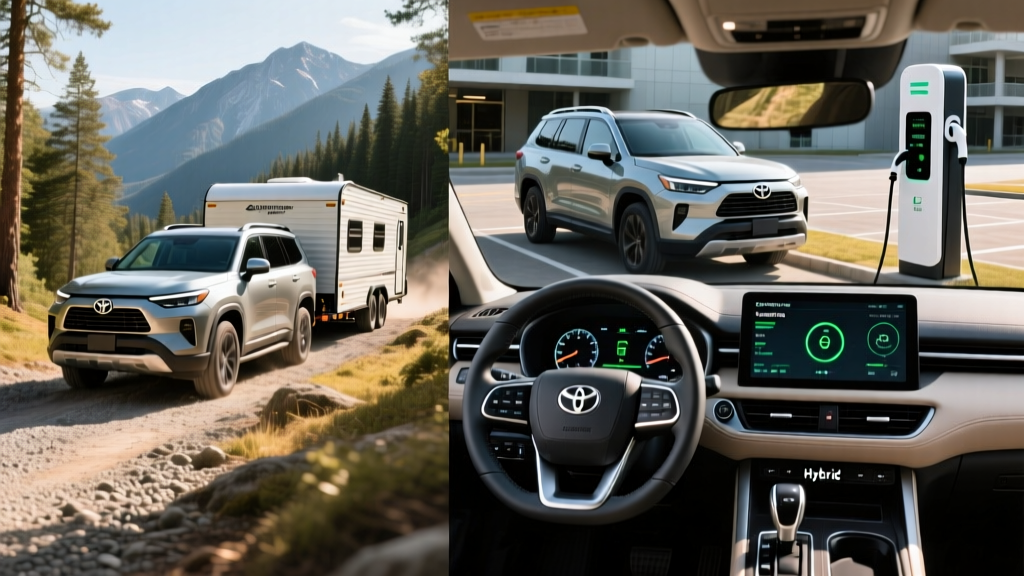
If you've searched for grand highlander hybrid towing capacity hoping for a five-ton hauler, recalibrate: the 2026 Toyota Grand Highlander Hybrid is rated to tow 3,500 pounds across all hybrid trims (LE, XLE, Limited, Platinum) when properly equipped with the factory tow package. That's enough for a small boat on a single-axle trailer, a pair of personal watercraft, a lightweight teardrop camper, or a utility trailer loaded with landscaping gear — but it falls well short of body-on-frame SUVs and even some competing three-row crossovers.
The Hybrid MAX powertrain (standard on Limited and Platinum, optional elsewhere) bumps output to 362 hp but does not increase the tow rating; Toyota keeps the limit at 3,500 lbs regardless of which hybrid setup you choose. For buyers who need 5,000+ lbs, Toyota steers you toward the non-hybrid turbo-four Grand Highlander or a 4Runner/Sequoia. For everyone else, the hybrid's value proposition is fuel economy during daily driving, not trailer-pulling prowess.
Powertrain Breakdown: Standard Hybrid vs. Hybrid MAX
The Grand Highlander offers two distinct hybrid configurations. Both are conventional self-charging hybrids (HEVs) — neither is a plug-in hybrid (PHEV), so there's no electric-only driving range and no charging port to plug into.
| Spec | Standard Hybrid (LE/XLE) | Hybrid MAX (Limited/Platinum) |
|---|---|---|
| Engine | 2.5L 4-cyl + 2 electric motors | 2.4L turbo 4-cyl + electric motor |
| Combined Horsepower | 245 hp | 362 hp |
| Drivetrain | AWD (e-motor rear axle) | AWD (e-motor rear axle) |
| Transmission | eCVT | 6-speed automatic |
| Towing Capacity | 3,500 lbs | 3,500 lbs |
| 0–60 mph (est.) | ~7.8 sec | ~6.3 sec |
| Hybrid Battery | ~1.6 kWh NiMH | ~1.6 kWh NiMH |
The standard hybrid pairs Toyota's proven 2.5-liter Atkinson-cycle four with front and rear electric motors for smooth, low-stress acceleration. Hybrid MAX swaps in a turbocharged 2.4-liter and a more powerful motor integrated with a conventional six-speed automatic — the result is noticeably punchier off the line and more confident when merging with a trailer, though it sacrifices a few MPG to get there.
MPG: EPA Ratings and Real-World Observations
| Powertrain | City | Highway | Combined |
|---|---|---|---|
| Standard Hybrid AWD | 36 MPG | 32 MPG | 34 MPG |
| Hybrid MAX AWD | 28 MPG | 29 MPG | 28 MPG |
According to fueleconomy.gov, the standard hybrid delivers 36/32/34 MPG city/highway/combined — impressive for a three-row SUV that weighs over 4,600 pounds. The Hybrid MAX drops to 28 MPG combined, which is still a meaningful improvement over the non-hybrid turbo-four Grand Highlander's roughly 23 MPG combined.
Real-world note: Toyota hybrids tend to beat their EPA city numbers in stop-and-go traffic where regenerative braking thrives, but fall short of EPA highway figures at sustained 75–80 mph speeds. Expect roughly 32–34 MPG combined in mixed driving with the standard hybrid, and closer to 26–27 MPG with the Hybrid MAX if your commute leans highway-heavy. Towing a loaded 3,500-lb trailer will cut economy sharply — plan on 16–20 MPG depending on terrain and wind, since the aerodynamic drag of a trailer dominates at highway speed.
HEV vs. PHEV vs. EV: Which Fits Your Three-Row Need?
The Grand Highlander is only available as a conventional hybrid (HEV). Toyota does not offer a plug-in hybrid variant. If you want a three-row PHEV with 30+ miles of electric-only range, look at the Kia Sorento PHEV (32 miles electric, ~1,650 lbs tow) or the Mazda CX-90 PHEV (26 miles electric, 3,500 lbs tow). For a full battery-electric three-row SUV, the Kia EV9 and Rivian R1S lead the segment, though both cost significantly more.
Choose the Grand Highlander HEV if: you want maximum range without plugging in, simple ownership, proven Toyota hybrid reliability, and a tow rating that covers light-duty trailers.
Choose a PHEV if: you have home charging and a short commute you want to run on electricity, while keeping gas-engine range for road trips and towing.
Choose a full EV if: you can charge at home, rarely tow, and want to eliminate gas and oil changes entirely.
Towing in Practice: What 3,500 Pounds Actually Means
Toyota's 3,500-lb rating assumes a properly equipped vehicle — that means the factory-installed tow hitch receiver, wiring harness, and often the integrated trailer brake controller available on higher trims. Here's what that capacity covers in real life:
- Small boat + single-axle trailer: a 16–18 ft aluminum fishing boat typically weighs 1,500–2,200 lbs with trailer, well within limits
- Teardrop or pop-up camper: most teardrops sit at 1,500–2,500 lbs loaded; pop-ups range 2,000–3,200 lbs
- Utility trailer: a 5×10 utility trailer with ATV, mulch, or furniture usually lands between 2,000–3,000 lbs
- Two personal watercraft: a double PWC trailer typically weighs 2,800–3,400 lbs loaded
What it won't handle: a 22+ ft travel trailer (typically 4,500–6,500 lbs), a horse trailer, a large enclosed cargo trailer, or a heavy boat on a tandem-axle trailer. For those, you need a vehicle rated for 5,000+ lbs — consider the non-hybrid Grand Highlander Turbo (rated 5,000 lbs), a Ford Explorer (5,600 lbs with the right package), or a body-on-frame SUV.
Towing tip: the Hybrid MAX's 362 hp and 400 lb-ft of torque make it the more comfortable choice when towing near the 3,500-lb limit, especially on highway on-ramps and mountain grades. The standard hybrid works fine for lighter loads but can feel strained at max capacity.
Battery Warranty, Reliability, and Replacement Cost
Toyota Hybrid Battery Warranty: 10 years / 150,000 miles (whichever comes first) on the hybrid battery and related components, per Toyota's current coverage for 2020+ model-year hybrids. This applies nationwide, regardless of state emissions rules.
Real-world longevity: Toyota's hybrid battery packs — particularly the NiMH chemistry used in the Grand Highlander — have a strong track record of lasting 150,000–200,000+ miles with minimal capacity loss. The hybrid system is fundamentally simpler than a full EV powertrain: there's no large liquid-cooled lithium pack to worry about, and the small NiMH battery operates in a narrow state-of-charge window that minimizes stress.
Replacement cost if out of warranty: a Toyota hybrid battery replacement typically runs $2,500–$4,500 at a dealership (parts + labor), with refurbished or aftermarket options sometimes available for $1,500–$2,500. Given the 10-year/150k-mile warranty and Toyota's hybrid reliability history, this is a low-probability expense for most original owners.
Toyota's hybrid system is one of the most field-proven electrified powertrains on the road, with over two decades of Prius, Camry Hybrid, and Highlander Hybrid data backing it. According to NHTSA and owner surveys, hybrid-specific failures are rare, and the eCVT transmission (on the standard hybrid) has no conventional clutch packs or bands to wear out.
Pricing, Trims, and Tax Credit Eligibility
| Trim | MSRP (2026 est.) | Powertrain | Tow Rating |
|---|---|---|---|
| LE Hybrid | ~$42,500 | 245 hp Standard Hybrid | 3,500 lbs |
| XLE Hybrid | ~$46,000 | 245 hp Standard Hybrid | 3,500 lbs |
| Limited Hybrid MAX | ~$52,000 | 362 hp Hybrid MAX | 3,500 lbs |
| Platinum Hybrid MAX | ~$56,500 | 362 hp Hybrid MAX | 3,500 lbs |
Federal tax credit: the Grand Highlander Hybrid does not qualify for the IRS §30D Clean Vehicle Credit. That credit applies only to plug-in electric vehicles (BEVs and PHEVs) meeting battery sourcing, MSRP cap, and buyer income requirements. Conventional hybrids like this one are ineligible for the $7,500 federal credit. Check IRS.gov for current rules, as legislation can shift.
Some states and utilities offer rebates for hybrids, though these are increasingly rare as incentive programs focus on plug-in vehicles. A few states with strong Toyota dealer networks occasionally run regional hybrid cash-back promotions — check your local dealer and state energy office for current offers.
Pros
- 34 MPG combined in a three-row SUV is class-leading
- 10-year/150k-mile hybrid battery warranty
- Proven, low-maintenance hybrid powertrain
- 3,500 lbs covers light-duty towing needs
- Hybrid MAX offers genuine performance (6.3-sec 0–60)
- No plug-in required — fuel and go
Cons
- 3,500-lb tow rating trails some competitors (Mazda CX-90: 3,500; Ford Explorer: 5,600)
- No PHEV option for electric-only commuting
- No federal tax credit eligibility
- Hybrid MAX fuel economy drops to 28 MPG combined
- High trims push past $55,000
Frequently Asked Questions
What is the 2026 Toyota Grand Highlander Hybrid towing capacity?
The Grand Highlander Hybrid is rated to tow 3,500 pounds when properly equipped, across all hybrid trims and both the standard hybrid and Hybrid MAX powertrains. This covers small boats, teardrop campers, utility trailers, and PWC trailers, but not larger travel trailers or horse trailers.
How many MPG does the Grand Highlander Hybrid get?
The standard hybrid AWD achieves an EPA-estimated 36 city / 32 highway / 34 combined MPG. The Hybrid MAX AWD rates 28 city / 29 highway / 28 combined. Real-world mixed driving typically yields 32–34 MPG for the standard hybrid and 26–27 MPG for the Hybrid MAX.
Is the Grand Highlander Hybrid a plug-in hybrid (PHEV)?
No. The Grand Highlander Hybrid is a conventional self-charging hybrid (HEV). It has no plug, no electric-only driving range, and no external charging capability. The small hybrid battery recharges through regenerative braking and the gas engine. If you need plug-in electric range in a three-row SUV, consider the Kia Sorento PHEV or Mazda CX-90 PHEV.
Does the Grand Highlander Hybrid qualify for a federal tax credit?
No. The IRS §30D Clean Vehicle Credit applies only to plug-in vehicles (BEVs and PHEVs) that meet battery sourcing, MSRP, and income requirements. Conventional hybrids are not eligible. Consult a tax professional and IRS.gov for current rules.
How long will the hybrid battery last and what does replacement cost?
Toyota covers the hybrid battery for 10 years / 150,000 miles. In practice, Toyota NiMH hybrid batteries routinely last 150,000–200,000+ miles. If replacement is needed out of warranty, expect to pay $2,500–$4,500 at a dealership, with refurbished options sometimes available for less.
Is the Hybrid MAX worth it for towing?
If you plan to tow regularly near the 3,500-lb limit, the Hybrid MAX's 362 hp and 400 lb-ft of torque make merging, climbing grades, and maintaining highway speed noticeably easier than the standard hybrid's 245 hp. The trade-off is roughly 6 MPG combined and a higher purchase price. For occasional light towing, the standard hybrid is adequate and far more efficient.
Can I tow more than 3,500 lbs if I install an aftermarket hitch?
No. The 3,500-lb rating is set by Toyota based on the vehicle's cooling capacity, suspension tuning, transmission limits, and braking system. An aftermarket hitch does not increase the manufacturer's rated capacity, and exceeding it can void warranty coverage and compromise safety.