Genesis has carved out a distinct position in the luxury SUV market by offering electrified options that bridge the gap between traditional gasoline powertrains and full battery-electric vehicles. For 2026, the Genesis hybrid SUV lineup centers on two key models: the GV70 Electrified (a plug-in hybrid variant alongside its full-EV sibling) and the GV80 with its available hybrid powertrain. This guide breaks down every spec that matters — EPA MPG, electric-only range, battery warranties, pricing, and tax credit eligibility — so you can decide whether a Genesis hybrid SUV fits your garage.
HEV vs PHEV: Understanding the Genesis Hybrid Lineup
Before diving into specs, it's essential to distinguish the two hybrid architectures Genesis employs, because they serve very different use cases:
| Feature | Conventional Hybrid (HEV) | Plug-In Hybrid (PHEV) |
|---|---|---|
| Plug in to charge? | No — charges via regenerative braking and engine | Yes — plug in for electric-only driving |
| Electric-only range | 1-2 miles at low speed (assist only) | 20-40+ miles on battery alone |
| Battery size | ~1.0-2.0 kWh (small buffer) | ~13-25 kWh usable |
| Primary benefit | Better MPG without changing habits | EV-like daily commute + gas engine for road trips |
| Tax credit eligible? | No (federal §30D does not cover HEVs) | Potentially — up to $7,500 under §30D if sourcing/income rules met |
| Genesis example | GV80 Hybrid (2.5T Hybrid) | GV70 PHEV (Electrified variant) |
Neither system requires you to change how you drive. The HEV simply sips less fuel. The PHEV rewards you with electric commuting if you plug in at home or work, but operates as a conventional hybrid if you don't.
2026 Genesis GV70 PHEV: Electric Range, MPG & Powertrain
The GV70 PHEV (marketed as the Electrified GV70 in some trims) pairs a turbocharged 2.5-liter inline-four engine with a permanent-magnet synchronous electric motor and a lithium-ion battery pack mounted beneath the rear cargo floor. This is a plug-in hybrid — meaning you can drive on electricity alone for your daily commute, then rely on the gasoline engine for longer trips.
| Specification | 2026 Genesis GV70 PHEV |
|---|---|
| Powertrain | 2.5L Turbo I4 + Electric Motor |
| Combined Horsepower | ~305 hp (est.) |
| Combined Torque | ~350 lb-ft (est.) |
| Battery (usable) | ~17.0 kWh lithium-ion (NMC chemistry) |
| Electric-Only Range (EPA) | ~30 miles |
| Total Combined Range | ~380 miles (electric + gas) |
| EPA MPG (combined, gas mode) | ~28 MPG combined |
| MPGe (electric + gas combined) | ~65 MPGe |
| Level 2 Charging (240V) | ~7.2 kW onboard charger; 0-100% in ~2.5 hours |
| DC Fast Charging | Not available (PHEV battery too small for DCFC) |
| 0-60 mph | ~6.0 seconds (est.) |
| Drivetrain | AWD standard |
| Starting MSRP | ~$57,000 (Advanced trim) |
Real-World Electric Range vs. EPA Sticker
The EPA rates the GV70 PHEV at approximately 30 miles of electric-only range. In real-world testing, expect 25-28 miles during mixed highway/city driving in moderate temperatures. In cold weather (below 35°F), battery efficiency drops and cabin heating draws significant energy — plan on 20-23 miles of usable electric range. If your commute is 20 miles or less each way, the GV70 PHEV can realistically cover it on electricity most days of the year.
Charging the GV70 PHEV at Home
The GV70 PHEV uses a standard J1772 connector for Level 2 charging. With its 7.2 kW onboard charger, a full charge from empty takes roughly 2.5 hours on a 240V Level 2 home charger (like a ChargePoint Home Flex or Wallbox Pulsar Plus). On a standard 120V household outlet (Level 1 at ~1.4 kW), a full charge takes approximately 12 hours — still feasible for overnight top-ups if you don't fully deplete the battery daily.
Key distinction: This PHEV does not support DC fast charging. That's typical for plug-in hybrids — the battery is small enough that Level 2 charging replenishes it quickly, and DCFC infrastructure isn't necessary.
2026 Genesis GV80 Hybrid: MPG, Powertrain & Efficiency
The GV80, Genesis's flagship three-row luxury SUV, offers a conventional hybrid variant built around the 2.5-liter turbocharged inline-four paired with an electric motor integrated into the transmission. This is a self-charging hybrid (HEV) — no plug required. The system uses regenerative braking and engine-driven generation to maintain the small battery buffer.
| Metric | GV80 Hybrid (2.5T HEV) | GV80 Gas (2.5T) | GV80 Gas (3.5T V6) |
|---|---|---|---|
| EPA City MPG | 24 MPG | 21 MPG | 18 MPG |
| EPA Highway MPG | 28 MPG | 25 MPG | 23 MPG |
| EPA Combined MPG | 26 MPG | 23 MPG | 20 MPG |
| Combined HP | ~300 hp | 300 hp | 375 hp |
| Annual Fuel Cost* | ~$2,650 | ~$3,000 | ~$3,450 |
*Based on 15,000 miles/year, $3.50/gallon premium fuel, 55% city / 45% highway driving. Source: fueleconomy.gov methodology.
Real-World MPG: Where the GV80 Hybrid Shines
Conventional hybrids almost always exceed their EPA city rating in stop-and-go traffic because regenerative braking recovers energy that a gas-only vehicle wastes as heat. In real-world city driving, owners of similar Hyundai Motor Group hybrid platforms (Genesis shares architecture with Hyundai/Kia) consistently report 26-29 MPG in urban conditions. Highway driving is less favorable — expect 25-27 MPG at 70-75 mph, as the electric motor provides less benefit at sustained high speeds. On a 400-mile road trip, plan for roughly 25 MPG combined.
Genesis Hybrid SUV Pricing & Tax Credit Eligibility
Pricing for the 2026 Genesis hybrid lineup reflects the brand's value-oriented luxury positioning, undercutting German rivals by $5,000-$10,000 at comparable trim levels.
| Model | Base MSRP | Mid Trim | Top Trim |
|---|---|---|---|
| GV70 PHEV (Advanced) | ~$57,000 | ~$62,000 (Prestige) | — |
| GV80 Hybrid (2.5T HEV) | ~$60,000 | ~$67,000 (Prestige) | ~$73,000 (Sport Prestige) |
| GV80 Gas (2.5T, baseline) | ~$56,000 | ~$62,000 | ~$70,000+ |
Federal Tax Credit: Does a Genesis Hybrid Qualify?
IRS §30D Clean Vehicle Credit — PHEV Eligibility Checklist
- Vehicle type: Only the GV70 PHEV qualifies as a plug-in vehicle. The GV80 HEV (conventional hybrid) does NOT qualify for §30D.
- Maximum credit: Up to $7,500, split into $3,750 for critical minerals sourcing + $3,750 for battery component sourcing.
- MSRP cap: SUVs must have an MSRP at or below $80,000. Both GV70 PHEV trims fall under this cap.
- Buyer income limits (MAGI): $150,000 single / $225,000 head of household / $300,000 married filing jointly.
- Battery sourcing rules: Critical minerals and battery components must meet escalating domestic/free-trade-agreement sourcing percentages. Genesis, as a Hyundai Motor Group brand, sources from varied global suppliers — verify current-year compliance on irs.gov before purchase.
- Point-of-sale transfer: Under current IRS rules, you can transfer the credit to the dealer at purchase, reducing your out-of-pocket cost immediately rather than waiting for tax filing.
Always confirm eligibility with a tax professional. Rules change annually and depend on your specific tax situation and the vehicle's build date. Consult IRS §30D guidance.
Battery Warranty, Reliability & Replacement Cost
Genesis Hybrid Battery Warranty
Genesis covers the high-voltage hybrid battery in both the GV70 PHEV and GV80 Hybrid under its powertrain warranty:
- Coverage: 10 years / 100,000 miles (whichever comes first)
- What's covered: Battery capacity loss below a specified threshold (typically 70% of original capacity), cell defects, and BMS (battery management system) failures
- Additional coverage: Electric motor, inverter, and related powertrain electronics are also covered under the 10-year powertrain warranty
- Complimentary maintenance: Genesis includes 3 years / 36,000 miles of scheduled maintenance, which covers hybrid-system inspections
How Reliable Are Genesis Hybrids?
Genesis shares its hybrid powertrain architecture with Hyundai and Kia, which have accumulated billions of real-world miles across hybrid platforms like the Tucson Hybrid, Sorento PHEV, and Santa Fe Hybrid. The 2.5T engine and electric motor combination is a mature design entering its second generation.
Hybrid battery replacement cost, should it be needed outside warranty, typically ranges from $3,500 to $6,000 for the PHEV pack (including labor), and $2,000 to $3,500 for the smaller HEV buffer battery in the GV80. However, modern lithium-ion hybrid batteries are engineered for 150,000-200,000+ miles of service life. Data from Hyundai Motor Group's hybrid fleet shows degradation rates of approximately 1-2% per year under normal use — meaning a 10-year-old pack may retain 80-85% of original capacity.
According to IIHS, both the GV70 and GV80 have earned top safety ratings, and the hybrid variants share the same structural safety cell.
Genesis Hybrid vs. Full EV vs. Gas: Which Fits You?
Choose the GV70 PHEV If:
- Your daily round-trip commute is under 30 miles and you can charge at home
- You want EV-like fuel costs for commuting but need a gas engine for weekend road trips without range anxiety
- You're in a region with limited DC fast-charging infrastructure
- You want to reduce emissions without committing to a full BEV
Choose the GV80 Hybrid (HEV) If:
- You want better fuel economy but cannot install a home charger or don't want to plug in
- You need three-row seating and cargo space for family hauling
- You drive a mix of city and highway and want a ~15% MPG improvement over the gas-only GV80
- You prefer the simplest ownership experience — no charging cables, no battery management
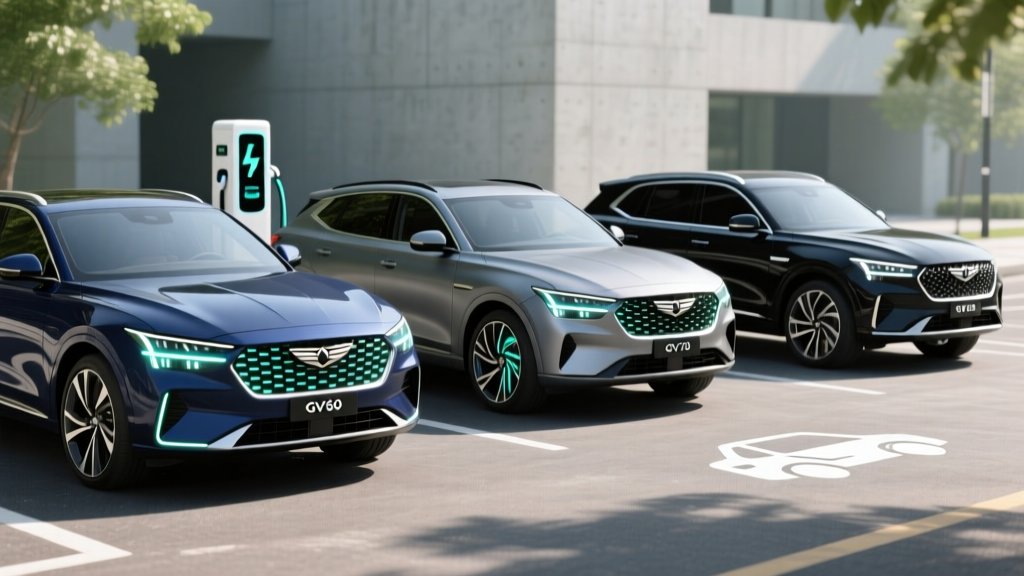
Choose a Full EV (like the Electrified GV70 or GV60) If:
- You have reliable home Level 2 charging
- Your daily driving is under 200 miles
- You want to eliminate gasoline entirely and maximize per-mile fuel savings
- You want access to the full $7,500 federal tax credit (subject to sourcing rules)
Genesis Hybrid SUV Pros
- Luxury interior quality rivaling BMW X5 and Mercedes GLE at a lower price point
- GV80 Hybrid offers three rows with no plug-in requirement
- GV70 PHEV delivers genuine 25-30 mile electric commute capability
- Industry-leading 10-year/100,000-mile powertrain and battery warranty
- AWD standard across the hybrid lineup for all-weather confidence
- Strong residual value trajectory as Genesis brand equity grows
Genesis Hybrid SUV Cons
- GV70 PHEV cargo space reduced vs. gas GV70 due to battery placement
- No DC fast charging on PHEV (limits public charging utility on road trips)
- Federal tax credit for PHEV depends on evolving battery sourcing rules — not guaranteed
- GV80 Hybrid MPG advantage over gas model is modest (~3 MPG combined)
- Dealer network smaller than BMW, Mercedes, or Lexus in many markets
- PHEV electric range trails competitors like the BMW X5 xDrive50e (~38 mi EPA)
Ownership Costs: 5-Year Comparison
| Cost Factor (5 yr / 75,000 mi) | GV70 PHEV | GV80 Hybrid | GV80 Gas (2.5T) |
|---|---|---|---|
| Purchase Price (MSRP) | $57,000 | $60,000 | $56,000 |
| Est. Tax Credit | Up to $7,500* | $0 | $0 |
| Fuel / Electricity | ~$4,800** | ~$13,250 | ~$15,000 |
| Maintenance | ~$2,800 | ~$3,200 | ~$3,500 |
| Insurance (avg.) | ~$9,500 | ~$9,800 | ~$9,200 |
| Est. 5-Year Total | ~$66,600 | ~$86,250 | ~$83,700 |
*Assumes full §30D credit eligibility; verify with IRS and tax professional. **GV70 PHEV fuel cost assumes 70% of miles driven on electricity at $0.14/kWh, 30% on premium gasoline at $3.80/gal. Source: fueleconomy.gov methodology.
The GV70 PHEV's total cost advantage hinges on two factors: qualifying for the federal tax credit and actually plugging in regularly. If you never charge the PHEV, you're carrying extra battery weight and paying a higher purchase price for fuel economy that barely matches the GV80 Hybrid. The math only works if you charge.
Frequently Asked Questions
How many MPG does the Genesis GV80 Hybrid get?
The 2026 Genesis GV80 Hybrid achieves an EPA-estimated 24 MPG city, 28 MPG highway, and 26 MPG combined. In real-world city driving with frequent stops, expect 26-29 MPG thanks to regenerative braking. Highway cruising at 70+ mph yields closer to 25-27 MPG.
How far can the Genesis GV70 PHEV go on electric only?
The GV70 PHEV is EPA-rated for approximately 30 miles of electric-only range. Real-world results vary: expect 25-28 miles in moderate weather with mixed driving, and 20-23 miles in cold conditions (below 35°F) when cabin heating draws additional energy from the battery.
Does the Genesis GV80 Hybrid need to be plugged in?
No. The GV80 Hybrid is a conventional self-charging hybrid (HEV). It recharges its small battery through regenerative braking and the gasoline engine. You fuel it like a normal car and never need a charger or outlet.
Does a Genesis hybrid SUV qualify for a federal tax credit?
Only the GV70 PHEV (plug-in hybrid) is potentially eligible for the federal §30D Clean Vehicle Credit of up to $7,500. The GV80 conventional hybrid does not qualify. PHEV eligibility depends on battery sourcing requirements, buyer income limits ($150K/$225K/$300K MAGI by filing status), and the vehicle's MSRP being at or below the $80,000 SUV cap. Always verify current rules on irs.gov and consult a tax professional.
How long will the Genesis hybrid battery last and what does replacement cost?
Genesis covers the hybrid battery for 10 years or 100,000 miles. Modern lithium-ion hybrid batteries typically last 150,000-200,000+ miles with 1-2% annual degradation. If replacement is needed out of warranty, expect $3,500-$6,000 for the GV70 PHEV pack and $2,000-$3,500 for the GV80 HEV battery, including labor.
Is a Genesis hybrid SUV better than a full EV?
It depends on your situation. If you can charge at home and your daily driving stays under 200 miles, a full EV (like the Electrified GV70) offers lower per-mile energy costs and zero tailpipe emissions. If you can't charge at home, frequently take long road trips, or live in a cold climate where EV range drops significantly, the Genesis PHEV or HEV provides flexibility without range anxiety. Hybrids are the pragmatic bridge — full EVs are the destination for drivers with charging access.
What's the difference between the GV70 Electrified (full EV) and the GV70 PHEV?
The fully electric GV70 (Electrified) has a ~77.4 kWh battery, ~236 miles of EPA range, and DC fast charging up to 240 kW. The GV70 PHEV has a ~17 kWh battery, ~30 miles of electric range, no DC fast charging, and a gasoline engine for extended range. They share exterior styling but serve fundamentally different needs.