The Ford Transit Hybrid Lineup: What's Actually Available?
Commercial van buyers searching for a hybrid Transit Ford model encounter a fragmented reality. Unlike Ford's passenger lineup — where the Escape Hybrid and Maverick Hybrid offer straightforward gasoline-electric powertrains — the Transit family's electrification story splits into two distinct chapters: the fully electric E-Transit (battery electric, zero tailpipe emissions) and the conventional gasoline Transit with mild-hybrid or no hybrid assist depending on market and model year.
As of the 2026 model year, Ford does not sell a traditional full-hybrid (HEV) or plug-in hybrid (PHEV) Transit in the United States. The E-Transit is the electrified option, while the standard Transit relies on Ford's 3.5L EcoBoost V6 or 3.5L PowerBoost hybrid V6 in limited configurations. International markets (notably Europe) have seen Transit Custom PHEV variants, but these are not part of the US lineup.
This guide breaks down exactly what US fleet and owner-operator buyers can get, the real-world efficiency numbers, and how to decide between the gas Transit, the E-Transit, or whether to wait for a potential hybrid variant.
HEV vs PHEV vs BEV: Understanding the Transit Options
Powertrain Types Explained
| Type | How It Works | Plug In? | Transit Availability (US, 2026) |
|---|---|---|---|
| HEV (Full Hybrid) | Gas engine + electric motor; battery recharges via regenerative braking and engine | No | Not offered in US Transit van (available in F-150 PowerBoost) |
| PHEV (Plug-in Hybrid) | Larger battery + gas engine; drives on electric-only for 20–40 mi, then switches to hybrid | Yes (Level 1/2) | Not offered in US Transit (Transit Custom PHEV sold in Europe) |
| BEV (Battery Electric) | Electric motor only, large traction battery, zero tailpipe emissions | Yes (Level 1/2/DC) | E-Transit: 126 mi EPA range, 266 HP |
The distinction matters enormously for fleet planning. A conventional hybrid (HEV) never needs plugging in — it generates electricity onboard through regenerative braking and engine-driven generation. A plug-in hybrid (PHEV) has a larger battery (typically 10–20 kWh) that charges from the grid and provides meaningful electric-only driving before the gas engine engages. A battery electric vehicle (BEV) like the E-Transit has no engine at all.
Ford's 3.5L PowerBoost hybrid V6 — a proven full-hybrid powertrain producing 430 hp and 570 lb-ft of torque — is available in the F-150 but has not been adapted to the Transit van platform for the US market. This is the closest analog to what a "hybrid Transit" would look like, and its absence from the van lineup is a notable gap for fleets wanting electric-assist efficiency without range limitations.
Ford E-Transit: The Electrified Option (2026 Specs)
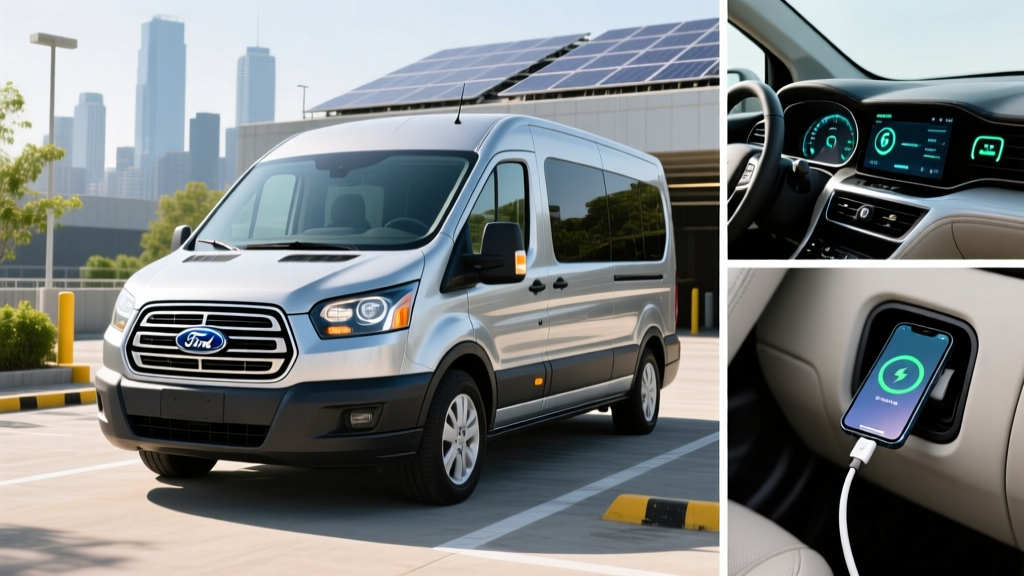
For buyers specifically seeking an electrified Ford Transit, the E-Transit is the current production offering. Here are the exact specifications:
| Specification | 2026 Ford E-Transit (Cutaway/Cargo Van) |
|---|---|
| EPA Range | 126 miles (cargo van, low roof); varies by body configuration |
| Real-World Range Expectation | ~95–115 mi highway/loaded; ~80–100 mi cold weather with HVAC |
| Battery Capacity | 68 kWh usable (NMC chemistry) |
| Motor Output | 266 hp (198 kW), 317 lb-ft torque |
| DC Fast Charge Peak | 115 kW (CCS1 connector) |
| 10–80% DC Charge Time | ~45 minutes at peak rate |
| Level 2 Charge Rate | 10.5 kW (240V, ~8 hours empty-to-full) |
| 0–60 mph | Not published; estimated ~8–9 sec (unloaded) |
| Payload Capacity | Up to 3,880 lbs (cargo van) |
| Starting MSRP | ~$55,000 (cargo van, before incentives) |
| Battery Warranty | 8 years / 100,000 miles (minimum 70% capacity retention) |
Real-World Range Reality Check
The E-Transit's 126-mile EPA estimate assumes mixed driving with moderate load and temperate conditions. Fleet operators running stop-and-go urban delivery routes with frequent regenerative braking opportunities may see 110–120 miles. However, highway driving at 70 mph with a full payload can reduce effective range to 85–95 miles. Cold-weather operation (below 30°F) with cabin heating active typically shaves 20–30% off the EPA figure, yielding 80–100 usable miles. The E-Transit does not currently offer a heat pump, which means resistive cabin heating draws directly from the traction battery.
Standard Gasoline Transit: Fuel Economy Baseline
For comparison, the conventional 2026 Ford Transit with the 3.5L EcoBoost V6 provides the efficiency baseline that a hybrid variant would need to beat:
| Configuration | City MPG | Highway MPG | Combined MPG |
|---|---|---|---|
| 3.5L EcoBoost V6 (RWD, low roof cargo) | 14 | 19 | 16 |
| 3.5L EcoBoost V6 (RWD, medium roof) | 14 | 18 | 15 |
| 3.5L EcoBoost V6 (AWD, cargo) | 13 | 17 | 14 |
Source: fueleconomy.gov, EPA estimates. Real-world MPG for loaded commercial vans typically runs 1–3 MPG below sticker depending on payload, route profile, and idle time.
At 14–16 MPG combined, the gas Transit's fuel costs are substantial for high-mileage fleet operations. A hybrid powertrain analogous to the F-150 PowerBoost could theoretically push combined figures into the 20–24 MPG range — a 40–50% improvement — based on how Ford's hybrid system performs in the truck. But that remains speculative until Ford announces a Transit HEV or PHEV for North America.
Transit Custom PHEV: The European Precedent
Ford has produced a plug-in hybrid Transit Custom for European markets, and its specifications reveal what a US-bound PHEV Transit might look like if Ford ever greenlights one:
- Battery: 13.6 kWh (NMC), liquid-cooled
- Electric-only range: ~23–27 miles (WLTP; expect ~18–22 mi EPA equivalent)
- Engine: 1.0L EcoBoost three-cylinder acting as a range extender (series hybrid architecture)
- Combined output: ~120 hp (electric motor primary drive)
- Charging: Level 2 AC only (~2.7 hours to full); no DC fast charging
- Total range: ~310 miles combined (electric + gasoline)
The European Transit Custom PHEV's series-hybrid architecture — where the gas engine generates electricity rather than directly driving the wheels — is well-suited to urban delivery cycles. The engine runs at its most efficient RPM to charge the battery, while the electric motor handles the stop-start demands of city driving. Whether Ford would bring this architecture or adapt the PowerBoost parallel-hybrid system to a US-spec Transit remains an open question.
Tax Credits and Incentives: What Applies to Electrified Transit Vans?
§30D Federal Tax Credit Rules (2026)
The IRS §30D clean vehicle credit applies to new EVs and PHEVs that meet strict criteria. Key requirements:
- Vehicle type: Must be a plug-in EV or PHEV with ≥7 kWh battery (conventional HEVs do not qualify)
- MSRP cap: Vans/cargo vehicles fall under the $80,000 MSRP cap (same as SUVs/pickups)
- Buyer income cap: AGI ≤ $150,000 (single) / $225,000 (head of household) / $300,000 (joint)
- Battery sourcing: Critical minerals and battery components must meet escalating domestic/FTA-country thresholds (phased in annually through 2029)
- Point-of-sale transfer: Eligible buyers can transfer the credit to the dealer for an upfront price reduction
- Commercial vehicle credit (§45W): Businesses may qualify for up to $7,500 under the commercial clean vehicle credit instead of §30D — consult a tax professional for which applies
What this means for Transit buyers: The E-Transit qualifies as a BEV and may be eligible for up to $7,500 under §30D (subject to battery-sourcing compliance and buyer income limits). Fleet buyers purchasing through a business entity should investigate the §45W commercial vehicle credit, which has different eligibility rules and may be more advantageous. A conventional hybrid Transit — if one existed — would not qualify for any federal plug-in credit, as HEVs lack the required battery capacity and plug-in capability.
State and local incentives vary widely. California's CVRP, Colorado's innovative motor vehicle credit, and various utility rebate programs may offer additional savings. Check your state energy office and local utility for current programs.
Battery Longevity, Warranty, and Replacement Costs
Ford Electrified Vehicle Battery Warranty
| Coverage | Term | Details |
|---|---|---|
| E-Transit High-Voltage Battery | 8 years / 100,000 miles | Minimum 70% capacity retention; covers defects and excessive degradation |
| Hybrid/PHEV Components (if offered) | 8 years / 100,000 miles | Ford's standard hybrid component warranty per federal emissions requirements |
| 12V Auxiliary Battery | 3 years / 36,000 miles | Standard bumper-to-bumper coverage |
For fleet operators concerned about long-term battery costs, the E-Transit's 68 kWh NMC pack carries a replacement cost estimated between $15,000–$22,000 out of warranty based on current NMC cell pricing and Ford's module-level service approach. However, Ford's 8-year/100,000-mile warranty with a 70% retention floor means that a battery dropping below 47.6 kWh usable capacity within the warranty period would trigger a covered repair or replacement.
NMC batteries in commercial cycle service (daily charge-discharge, moderate depths of discharge) typically retain 80–85% capacity at 150,000 miles based on fleet data from early E-Transit adopters. The key degradation accelerants to avoid are repeated DC fast charging above 80% SoC, prolonged storage at 100% SoC in hot climates, and frequent full-depth discharges.
If Ford were to introduce a Transit HEV, the hybrid battery would be significantly smaller (1.5–2.5 kWh) and experience shallower cycling, which historically translates to excellent longevity. Toyota and Ford hybrid batteries in passenger vehicles routinely exceed 150,000–200,000 miles without replacement. Replacement cost for a small HEV battery pack is typically $2,000–$4,000 — a fraction of a full BEV pack.
Who Should Choose What: Decision Framework
Transit Powertrain Decision Guide
Choose the E-Transit (BEV) if:
- Your daily routes are under 100 miles with predictable return-to-base charging
- You have depot Level 2 charging infrastructure (or can install it)
- Your fleet operates primarily in urban/suburban stop-and-go cycles where regenerative braking maximizes efficiency
- You want to eliminate fuel costs and reduce maintenance (no oil changes, fewer moving parts)
- Local emissions regulations or corporate sustainability mandates require zero-tailpipe vehicles
Choose the gas Transit (EcoBoost V6) if:
- Your routes exceed 200 miles daily or include unpredictable long-haul runs
- You lack charging infrastructure and cannot justify the capital investment
- You operate in extreme cold climates where BEV range loss is prohibitive
- You need maximum payload and towing (the gas Transit tows up to 6,900 lbs vs. the E-Transit's lower rating)
- Upfront budget is constrained and you cannot leverage tax credits
Wait for a Transit Hybrid (HEV/PHEV) if:
- You want 20+ MPG without range limitations or charging dependency
- Your fleet runs mixed urban/highway cycles where a hybrid's regenerative benefits shine without sacrificing long-distance capability
- You want lower fuel costs than the gas Transit but cannot commit to BEV infrastructure
Total Cost of Ownership: 5-Year Fleet Projection
| Cost Factor | E-Transit (BEV) | Gas Transit (EcoBoost V6) |
|---|---|---|
| Base MSRP | ~$55,000 | ~$46,000 |
| Federal Tax Credit (est.) | –$7,500 (if eligible) | $0 |
| Effective Purchase Price | ~$47,500 | ~$46,000 |
| Fuel/Energy (5 yr, 75,000 mi) | ~$4,500 (electricity at $0.14/kWh avg) | ~$17,800 (gas at $3.50/gal, 15 MPG) |
| Maintenance (5 yr) | ~$2,500 | ~$5,500 |
| Insurance (5 yr est.) | ~$9,000 | ~$7,500 |
| 5-Year Total Cost | ~$63,500 | ~$76,800 |
Estimates based on commercial fleet averages. Actual costs vary by region, electricity rate, gas price, driving profile, and insurance provider. Source: fleet TCO modeling using AFDC electricity cost data and EPA MPG figures.
The E-Transit's fuel and maintenance savings offset its higher purchase price within approximately 2.5–3 years for a fleet vehicle covering 15,000 miles annually. The breakeven point arrives faster in states with low commercial electricity rates and higher gas prices, and slower in regions where electricity costs exceed $0.20/kWh.
Pros and Cons at a Glance
E-Transit (BEV) Pros
- Zero tailpipe emissions; ideal for urban delivery and sustainability mandates
- Low operating cost: ~$0.06/mile energy vs. ~$0.24/mile fuel (gas)
- Reduced maintenance: no oil, spark plugs, transmission fluid, or exhaust system
- Quiet operation; beneficial for residential-area deliveries
- ProPass telematics integration for fleet route optimization
- Eligible for up to $7,500 federal tax credit + potential state/utility incentives
E-Transit (BEV) Cons
- 126-mile EPA range is limiting for anything beyond short-haul urban routes
- Cold-weather range loss of 20–30% is significant for winter-climate fleets
- No DC fast charging above 115 kW; 45-minute 10–80% time limits mid-day top-ups
- Higher upfront cost ($9,000+ premium over gas Transit before credits)
- Depot charging infrastructure investment required ($3,000–$15,000+ per stall)
- Lower payload and towing capacity than gas equivalent
Frequently Asked Questions
Does Ford make a hybrid Transit van in the US?
As of the 2026 model year, Ford does not sell a conventional hybrid (HEV) or plug-in hybrid (PHEV) Transit in the United States. The electrified option is the E-Transit, a fully battery-electric van with 126 miles of EPA range. Ford has sold a Transit Custom PHEV in Europe, but this model is not available in North America.
How many MPG does the gas Ford Transit get?
The 2026 Ford Transit with the 3.5L EcoBoost V6 achieves an EPA-estimated 14 city / 19 highway / 16 combined MPG in the low-roof cargo van RWD configuration. Real-world fuel economy for loaded commercial use typically falls 1–3 MPG below these figures depending on payload, route profile, and idle time.
What is the range of the Ford E-Transit?
The E-Transit's EPA-estimated range is 126 miles for the cargo van configuration. In real-world fleet operation, expect 95–115 miles on highway routes with payload, and 80–100 miles in cold weather with HVAC demand. This makes the E-Transit suited primarily to urban and suburban delivery routes under 100 miles daily.
Is the E-Transit battery reliable, and what does replacement cost?
Ford covers the E-Transit's high-voltage battery for 8 years or 100,000 miles with a minimum 70% capacity retention guarantee. Early fleet data suggests NMC batteries in commercial cycle service retain 80–85% capacity at 150,000 miles. Out-of-warranty replacement is estimated at $15,000–$22,000, though module-level repairs may reduce costs for partial degradation issues.
Does the E-Transit qualify for the federal tax credit?
The E-Transit is eligible for the IRS §30D clean vehicle credit of up to $7,500, subject to battery-sourcing compliance, buyer income limits ($150K single / $300K joint), and the $80,000 MSRP cap for vans. Commercial fleet buyers may alternatively qualify under the §45W commercial clean vehicle credit. Always verify current-year eligibility on irs.gov and consult a tax professional.
Can the E-Transit DC fast charge?
Yes. The E-Transit supports DC fast charging at up to 115 kW via a CCS1 connector, achieving a 10–80% charge in approximately 45 minutes. This is slower than many passenger EVs (which charge at 150–350 kW) but adequate for depot-based fleet operations where vehicles charge overnight on Level 2 and top up during scheduled breaks.
Hybrid vs PHEV vs EV — which Transit option fits my fleet?
Choose the E-Transit (BEV) if your routes are under 100 miles with return-to-base charging. Choose the gas Transit if you need long range, heavy payload, or lack charging infrastructure. A hybrid Transit would bridge these needs — offering 20+ MPG without range limits — but Ford has not announced one for the US market. Monitor Ford's commercial vehicle announcements for potential future HEV or PHEV Transit variants.
Will Ford release a hybrid Transit in the future?
Ford has not announced a hybrid Transit for the US market as of early 2026. The company's commercial vehicle strategy has focused on the E-Transit for electrification and the EcoBoost V6 for conventional power. However, Ford's proven PowerBoost hybrid V6 architecture (in the F-150) demonstrates the company's capability to hybridize commercial platforms. Fleet demand for a mid-efficiency, no-compromise-range Transit could drive a future HEV or PHEV variant, but no timeline has been confirmed.