Quick Verdict: Ford's Hybrid SUVs in 2026
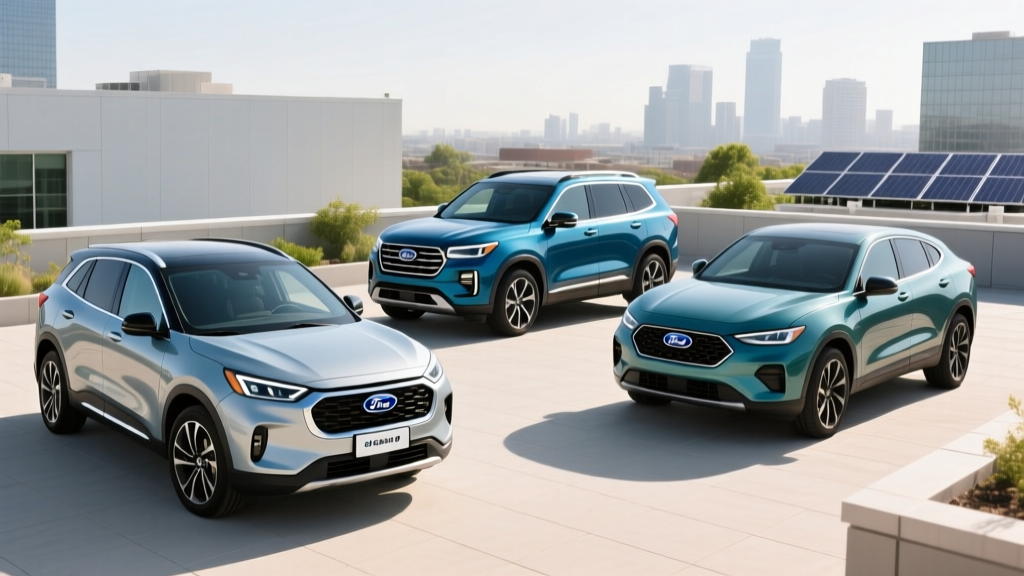
Ford's electrified SUV strategy in 2026 leans heavily on hybrids rather than full EVs, and for good reason. The Escape Hybrid delivers up to 42 MPG combined for commuters, the Explorer Hybrid brings three-row practicality at 23 MPG combined, and the Maverick hybrid — while technically a compact truck — competes directly with crossovers and achieves an impressive 42 MPG city. None of these require plugging in. All are conventional hybrids (HEVs), meaning they recharge their small batteries through regenerative braking and the gasoline engine.
This guide breaks down every Ford SUV hybrid currently on sale with exact EPA figures, real-world expectations, powertrain data, battery warranty coverage, and total cost context so you can decide which one fits your driving pattern — or whether a PHEV or full BEV makes more sense.
HEV vs PHEV vs EV: Which Ford Electrified SUV Fits You?
Before diving into specs, let's clarify the three electrification levels Ford offers across its lineup. This distinction drives everything from daily fuel cost to whether you need a home charger.
| Feature | HEV (Conventional Hybrid) | PHEV (Plug-In Hybrid) | BEV (Full Electric) |
|---|---|---|---|
| Plugs in? | No | Yes | Yes |
| Electric-only range | ~1 mile at low speed | 20–40 miles typical | 230–350+ miles |
| Gas engine? | Yes | Yes | No |
| Home charger needed? | No | Recommended (Level 2) | Essential (Level 2) |
| Federal tax credit (§30D)? | No | Up to $7,500 (if eligible) | Up to $7,500 (if eligible) |
| Best for | No garage/outlet access, road trips | Short commute + home charging | Home charging + mostly under 300 mi/day |
Key point for Ford SUV hybrid shoppers: Ford discontinued the Escape PHEV in the U.S. market after the 2024 model year. As of 2026, Ford's U.S. hybrid SUV lineup is exclusively conventional HEV. If you need plug-in electric range in a Ford, you'd need to look at the Lincoln Corsair Grand Touring PHEV or consider a competitor like the Toyota RAV4 Prime.
Ford Escape Hybrid: Specs, MPG, and Real-World Economy
| Spec | 2026 Escape Hybrid FWD | 2026 Escape Hybrid AWD |
|---|---|---|
| Powertrain | 2.5L I4 + electric motor | 2.5L I4 + electric motor |
| Combined HP | 198 hp | 198 hp |
| EPA City / Hwy / Combined | 42 / 36 / 39 MPG | 38 / 34 / 36 MPG |
| Fuel Tank | 14.2 gal | 14.2 gal |
| Total Range | ~554 miles | ~511 miles |
| 0–60 mph | ~7.7 sec | ~8.0 sec |
| Cargo (behind 2nd row) | 34.4 cu ft | 34.4 cu ft |
| Starting MSRP | ~$33,000 | ~$35,000 |
| Battery Warranty | 8 yr / 100,000 mi | 8 yr / 100,000 mi |
How Many MPG Does the Escape Hybrid Actually Get?
The EPA rates the FWD Escape Hybrid at 42 city / 36 highway / 39 combined. The AWD version drops to 38/34/36. According to fueleconomy.gov, real-world owner reports for the Escape Hybrid cluster around 37–41 MPG combined, with city-heavy drivers often beating the EPA estimate.
This is a characteristic advantage of conventional hybrids: regenerative braking recaptures energy in stop-and-go traffic, so city MPG often exceeds highway MPG — the opposite of a gas-only car. On a 200-mile highway road trip at 75 mph, expect closer to 33–35 MPG in the FWD model. In winter conditions with cold-starts and heater use, a 5–10% drop is typical.
Battery Longevity & Replacement Cost
Ford covers the Escape Hybrid's high-voltage battery (approximately 1.1 kWh usable, NiMH) for 8 years or 100,000 miles (10 years/150,000 miles in CARB states including California, New York, Massachusetts, and others). Out-of-warranty replacement runs approximately $2,500–$4,000 including labor at a dealership, though many hybrid batteries from this generation last 150,000+ miles before significant capacity loss. Individual cell module repair by a hybrid specialist can cost $500–$1,200.
Ford Explorer Hybrid: Three-Row Efficiency
| Spec | 2026 Explorer Hybrid RWD | 2026 Explorer Hybrid AWD |
|---|---|---|
| Powertrain | 3.3L V6 + electric motor | 3.3L V6 + electric motor |
| Combined HP | 318 hp | 318 hp |
| EPA City / Hwy / Combined | 24 / 28 / 25 MPG | 23 / 26 / 24 MPG |
| Fuel Tank | 18.0 gal | 18.0 gal |
| Total Range | ~450 miles | ~432 miles |
| 0–60 mph | ~6.4 sec | ~6.6 sec |
| Towing Capacity | 5,000 lbs | 5,000 lbs |
| Cargo (behind 3rd row) | 18.2 cu ft | 18.2 cu ft |
| Starting MSRP | ~$46,000 | ~$48,000 |
| Battery Warranty | 8 yr / 100,000 mi | 8 yr / 100,000 mi |
Is the Explorer Hybrid Worth the Premium?
The Explorer Hybrid pairs a 3.3-liter V6 with a 35 kW electric motor integrated into the 10-speed automatic transmission, yielding 318 combined horsepower. That's a meaningful bump over the base 2.3L EcoBoost (300 hp) with better low-end torque feel around town.
EPA figures of 24/28/25 MPG (RWD) represent roughly a 3–4 MPG combined improvement over the gas-only Explorer. Real-world mixed driving tends to land between 22–26 MPG combined. Heavy highway driving at 75+ mph narrows the hybrid advantage — expect 23–25 MPG on the interstate. Towing drops economy significantly, often into the 14–17 MPG range.
At roughly $3,000–$4,000 more than a comparably equipped gas Explorer, the hybrid premium pays back in approximately 5–7 years for a driver covering 15,000 miles annually at $3.40/gallon, according to our fuel-cost modeling. The faster 0–60 time and smoother low-speed behavior are bonuses that don't show up in a spreadsheet.
Ford Maverick Hybrid: The Truck That Drinks Like a Prius
While technically a compact pickup, the Maverick competes on price and footprint with compact SUVs, and many crossover shoppers cross-shop it. It deserves inclusion in any Ford SUV hybrid discussion.
| Spec | 2026 Maverick Hybrid FWD |
|---|---|
| Powertrain | 2.5L I4 + electric motor |
| Combined HP | 191 hp |
| EPA City / Hwy / Combined | 42 / 35 / 40 MPG |
| Fuel Tank | 13.8 gal |
| Total Range | ~552 miles |
| 0–60 mph | ~8.5 sec |
| Payload / Towing | 1,500 lbs / 2,000 lbs |
| Bed Length | 4.5 ft (48 cu ft volume) |
| Starting MSRP | ~$27,000 |
| Battery Warranty | 8 yr / 100,000 mi |
The Maverick hybrid's 42 city MPG is extraordinary for a vehicle with a truck bed. Real-world owners on fueleconomy.gov report averages of 37–44 MPG combined, with city-dominant drivers frequently exceeding the EPA sticker. Highway driving at 70+ mph brings it closer to 32–34 MPG. The trade-off versus the 2.0L EcoBoost Maverick (250 hp, AWD available, 4,000-lb towing with the tow package) is power and capability — the hybrid is FWD only and limited to 2,000 lbs towing.
Ford Hybrid SUV Tax Credits and Ownership Costs
Here's where the math diverges sharply from full EVs: conventional hybrids (HEVs) do not qualify for the federal §30D Clean Vehicle Credit. The IRS restricts the up-to-$7,500 credit to plug-in vehicles (PHEVs and BEVs) that meet battery sourcing, critical minerals, MSRP cap, and buyer income requirements. Since Ford's current U.S. SUV hybrid lineup is HEV-only, you will not receive a federal purchase incentive.
§30D Federal Credit Requirements (2026)
- Vehicle must be a plug-in (PHEV or BEV) — HEVs excluded
- MSRP cap: $80,000 for SUVs/pickups/vans; $55,000 for sedans
- Buyer AGI limits: $300K joint / $225K head of household / $150K single
- Battery critical minerals and component sourcing thresholds apply
- Credit can be transferred to dealer at point of sale as a price reduction
- Verify current rules at IRS.gov
Some states offer their own hybrid incentives. A handful of states provide rebates or HOV lane access for hybrids, though most state programs have shifted focus to plug-in vehicles. Check your state's energy office or DMV for current programs.
5-Year Ownership Cost Snapshot
Assuming 15,000 miles/year, $3.40/gallon gas, and standard maintenance:
- Escape Hybrid FWD: ~$1,820/year fuel = ~$9,100 over 5 years
- Escape gas (24 MPG combined): ~$2,125/year fuel = ~$10,625 over 5 years
- Fuel savings: ~$1,525 over 5 years for the hybrid
Insurance for Ford hybrids typically runs 5–10% higher than gas equivalents due to specialized repair training, though this varies by carrier and state. Always get a quote before purchasing.
Ford Hybrid Battery Reliability and Long-Term Costs
Ford's hybrid systems have been in production since the 2005 Escape Hybrid, giving the company over two decades of real-world data. The eCVT power-split transmission used in the Escape and Maverick has no traditional clutch packs or bands to wear — it's one of the most mechanically simple transmissions in the industry.
Pros
- 42 MPG city (Escape/Maverick) with no plug-in needed
- Proven eCVT design with minimal wear components
- 8-year/100,000-mile hybrid battery warranty standard
- Extended 10yr/150K coverage in CARB states
- No home charger installation required
- Strong regenerative braking reduces brake pad wear
Cons
- No federal tax credit for conventional hybrids
- AWD hybrid drops 3–4 MPG vs FWD
- Explorer Hybrid premium takes 5–7 years to recoup
- Escape PHEV discontinued — no plug-in Ford SUV option
- Highway MPG advantage narrows at 75+ mph
- Hybrid battery replacement: $2,500–$4,000 out of warranty
For battery longevity, Ford's hybrid battery management system keeps the NiMH pack in a narrow state-of-charge window (roughly 40–60%), which dramatically reduces degradation compared to full EVs that cycle from 10–90%. Many first-generation Escape Hybrids from 2005–2012 are still running on their original battery packs at 200,000+ miles. However, if you live in an extremely hot climate (Arizona, Texas), battery cooling is less robust than in a liquid-cooled BEV, and capacity loss may accelerate after year 10.
Who Should Buy a Ford SUV Hybrid — And Who Shouldn't?
Choose a Ford SUV Hybrid If:
- You don't have access to home or workplace charging (apartment, street parking)
- You drive 12,000–20,000 miles/year in mixed city/highway conditions
- You take road trips of 400+ miles and don't want to plan around chargers
- You want lower fuel costs without behavioral changes
- You need three rows (Explorer Hybrid) without the fuel penalty of a full-size SUV
Consider a Full EV or PHEV Instead If:
- You have Level 2 home charging and a commute under 40 miles (a PHEV runs mostly electric)
- You want the $7,500 federal tax credit (requires a plug-in vehicle)
- You drive under 8,000 miles/year (fuel savings won't offset the hybrid premium quickly)
- You want zero tailpipe emissions in daily driving
Frequently Asked Questions
How many MPG does a Ford SUV hybrid get?
The 2026 Ford Escape Hybrid FWD is EPA-rated at 42 city / 36 highway / 39 combined. The AWD version rates 38/34/36. The Explorer Hybrid rates 24/28/25 (RWD) or 23/26/24 (AWD). The Maverick Hybrid FWD achieves 42 city / 35 highway / 40 combined. City-heavy drivers often exceed EPA estimates thanks to regenerative braking.
Does the Ford Escape Hybrid need to be plugged in?
No. The Escape Hybrid is a conventional HEV. It recharges its battery through regenerative braking and the gasoline engine. You never plug it in. Ford discontinued the Escape PHEV after 2024, so there is no plug-in Escape in the 2026 lineup.
Is the Ford hybrid system reliable?
Ford's hybrid power-split eCVT has been in production since 2005 and is among the most reliable transmission designs in the industry due to its lack of traditional friction-based shifting components. The IIHS and owner surveys consistently rate the Escape Hybrid and Maverick Hybrid as average to above-average in long-term reliability.
What does a Ford hybrid battery replacement cost?
Out-of-warranty replacement for the Escape or Maverick hybrid battery typically costs $2,500–$4,000 at a dealership. The Explorer Hybrid battery replacement is higher, approximately $3,500–$5,500. However, many Ford hybrid batteries last 150,000–200,000+ miles. The warranty covers 8 years/100,000 miles (10 years/150,000 miles in CARB states).
Do Ford hybrid SUVs qualify for a tax credit?
No. The federal §30D Clean Vehicle Credit applies only to plug-in electric vehicles (PHEVs and BEVs). Conventional hybrids like the Escape Hybrid, Explorer Hybrid, and Maverick Hybrid are not eligible. Check with your state energy office for any state-level hybrid incentives, though most have shifted to plug-in vehicles.
How does a Ford hybrid compare to the Toyota RAV4 Hybrid?
The Toyota RAV4 Hybrid (39/35/39 MPG EPA, AWD standard, ~$34,000 starting) is the Escape Hybrid's closest rival. The Escape FWD slightly edges the RAV4 on city MPG; the RAV4 offers standard AWD and typically stronger resale value. Both use proven eCVT architectures. The RAV4 Prime PHEV (42 miles electric-only) fills the plug-in gap that Ford currently leaves open in this segment.
Can I tow with a Ford hybrid SUV?
Yes. The Explorer Hybrid tows up to 5,000 lbs with the factory tow package — identical to the gas V6 Explorer. The Escape Hybrid tows up to 1,500 lbs (FWD). The Maverick Hybrid is limited to 2,000 lbs. Note that towing dramatically reduces fuel economy, often cutting hybrid MPG by 30–50%.