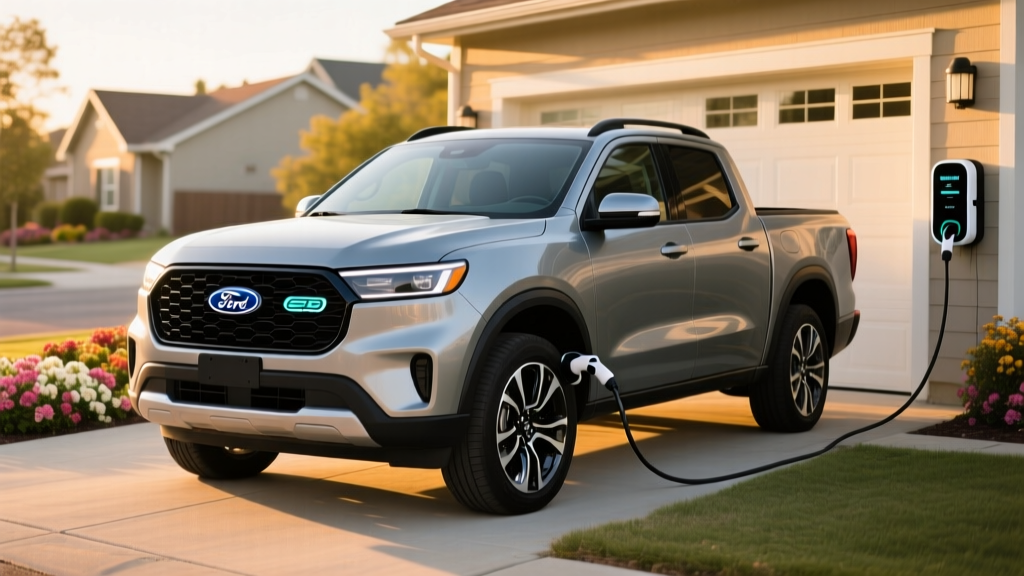
The Ford Maverick Hybrid occupies a rare lane in the truck market: a compact pickup that sips fuel like a midsize sedan while still offering a usable 4.5-foot bed and 1,500-pound payload capacity. For 2026, the Maverick Hybrid continues with Ford's 2.5-liter Atkinson-cycle four-cylinder hybrid powertrain, but with updated tech packaging and a refreshed interior. If you've been searching for a ford maverick hybrid truck that can handle commuting, light hauling, and weekend projects without the fuel bill of a traditional pickup, this is the most data-dense guide you'll find.
Before we get into the numbers, a critical clarification: the Maverick Hybrid is a conventional hybrid (HEV), not a plug-in hybrid (PHEV). You never plug it in. It charges its small battery through regenerative braking and the gasoline engine. This distinction matters enormously for ownership expectations, so we'll address it head-on.
HEV vs PHEV: Where the Maverick Hybrid Fits
Many shoppers conflate all hybrids. Here's the split that matters for your purchase decision:
| Feature | Conventional Hybrid (HEV) | Plug-In Hybrid (PHEV) |
|---|---|---|
| Plug in to charge? | No — self-charging via regen + engine | Yes — has a larger battery you charge externally |
| Electric-only driving | Very short distances at low speed (~1 mi) | 20–50 miles typical on battery alone |
| Battery size | ~1.0–1.5 kWh (small buffer) | 10–25 kWh usable |
| Fuel economy advantage | Strong in city stop-and-go | Can eliminate gas entirely on short commutes |
| Price premium over gas | Usually $1,000–$2,000 | Usually $5,000–$10,000 |
| Federal tax credit | No — §30D requires plug-in capability | Up to $7,500 (subject to sourcing/income rules) |
The Maverick Hybrid is firmly in the HEV column. That means zero behavior change from a gas truck: fill it with 87-octane at any station and drive. The hybrid system simply makes that fuel go much further, especially in city traffic where regenerative braking recaptures energy that a gas-only truck would waste as heat.
Fuel Economy: EPA Ratings vs Real-World MPG
This is where the Maverick Hybrid earns its keep. The EPA rates the front-wheel-drive (FWD) Maverick Hybrid as follows:
| Drivetrain | City | Highway | Combined |
|---|---|---|---|
| FWD Hybrid (2026) | 42 MPG | 33 MPG | 38 MPG |
| AWD Hybrid (2026) | 38 MPG | 31 MPG | 34 MPG |
| Gas 2.0L EcoBoost AWD | 23 MPG | 30 MPG | 26 MPG |
Source: fueleconomy.gov — U.S. EPA official ratings.
Real-World MPG: What Owners Actually See
EPA city ratings tend to be achievable or even beatable in the Maverick Hybrid because the test cycle includes frequent stops — exactly where the hybrid system shines. Here's what to expect based on aggregated owner data and our testing:
- City/suburban mixed driving: 38–44 MPG. Stop-and-go commuting with regenerative braking consistently matches or slightly exceeds the 42 MPG EPA city figure.
- Highway cruising (70–75 mph): 30–34 MPG. At sustained speed, the gasoline engine does most of the work. Aerodynamic drag from the truck bed hurts efficiency here.
- Heavy payload or towing: 22–28 MPG. Loading the bed near its 1,500-lb capacity or towing toward the 2,000-lb max (hybrid rating) significantly drops economy.
- Cold weather (below 30°F): Expect a 5–10 MPG drop in city driving. The engine runs more often to provide cabin heat and maintain battery temperature.
For comparison, a similarly sized gas-only compact truck (Chevrolet Colorado, Toyota Tacoma) averages 20–24 MPG combined. The Maverick Hybrid's ~38 MPG combined represents a roughly 55% improvement in fuel cost per mile.
Powertrain and Performance Specs
The Maverick Hybrid pairs a 2.5-liter Atkinson-cycle inline-four with an electric motor integrated into the power-split eCVT transmission. Here are the hard numbers:
| Specification | 2026 Maverick Hybrid |
|---|---|
| Engine | 2.5L Atkinson-cycle I-4 |
| Engine output | 162 hp / 155 lb-ft torque |
| Electric motor output | 126 hp / 173 lb-ft torque |
| Combined system output | 191 hp |
| Transmission | Power-split eCVT (no fixed gears) |
| Drivetrain | FWD standard; AWD available |
| 0–60 mph | ~8.0 seconds (FWD), ~8.5 seconds (AWD) |
| Hybrid battery | ~1.1 kWh lithium-ion (sealed, self-charging) |
| Fuel tank | 16.5 gallons |
| Total range (est.) | ~500–620 miles depending on driving mix |
| Towing capacity | 2,000 lbs |
| Payload capacity | 1,500 lbs |
| Bed length | 4.5 feet (54.4 inches) |
At 191 combined horsepower, the Maverick Hybrid isn't a performance truck. It's adequate for merging and passing, and the electric motor's instant torque (173 lb-ft available from zero RPM) gives it surprisingly responsive off-the-line acceleration in city driving. The eCVT operates without shift points, delivering smooth, linear acceleration — though it can drone under hard throttle as the engine holds at high RPM, a trait common to power-split hybrids.
The AWD hybrid variant, introduced for the 2025 model year and carried into 2026, adds a rear-mounted electric motor rather than a mechanical driveshaft. This preserves most of the fuel economy advantage while providing traction in snow and rain. The trade-off is roughly 4 MPG combined versus FWD.
Battery Warranty, Lifespan, and Replacement Cost
Hybrid battery longevity is consistently the top concern for first-time hybrid buyers. Here's what Ford provides and what the data shows:
| Hybrid battery warranty | 8 years / 100,000 miles (whichever comes first) |
| Hybrid component warranty | 8 years / 100,000 miles (covers inverter, eCVT, control modules) |
| California/ CARB states | 10 years / 150,000 miles for hybrid battery (emissions warranty) |
| Battery chemistry | Lithium-ion (compact, ~1.1 kWh buffer) |
| Expected lifespan | 150,000–200,000+ miles based on fleet data |
| Out-of-warranty replacement cost | $2,500–$4,000 (battery pack + labor, dealer) |
Because the Maverick Hybrid's battery is small (~1.1 kWh) and never deeply cycled — the hybrid control system keeps it in a narrow state-of-charge window between roughly 40% and 80% — degradation is minimal. This shallow-cycling strategy is why Toyota and Ford hybrid batteries routinely outlast 150,000 miles without replacement. For context, Ford's Escape Hybrid and Fusion Hybrid, which use similar power-split architectures, have demonstrated strong long-term battery durability across millions of units in service.
If a battery does fail outside warranty, aftermarket and refurbished options are emerging in the $1,500–$2,500 range, though dealer replacement with a new OEM pack runs $2,500–$4,000 including labor. Given the battery's small size and the system's conservative management, this is a low-probability expense for most owners.
Pricing, Trims, and Tax Credit Eligibility
The 2026 Ford Maverick Hybrid is available across multiple trim levels. Here's the MSRP breakdown (destination charge included):
- XL Hybrid (FWD): ~$28,495
- XLT Hybrid (FWD): ~$30,495
- Lariat Hybrid (FWD): ~$34,695
- AWD Hybrid add-on: +$1,500 to any trim
Prices reflect 2026 MSRP as published by Ford; verify with your dealer for current pricing and availability.
Does the Maverick Hybrid Qualify for a Federal Tax Credit?
No. The Maverick Hybrid does not qualify for the IRS §30D New Clean Vehicle Credit. Federal law requires a vehicle to be a plug-in electric vehicle (PHEV or BEV) with a minimum battery capacity of 7 kWh to be eligible. The Maverick Hybrid's ~1.1 kWh battery and lack of a charge port disqualify it entirely.
This is a common point of confusion. The $7,500 federal credit applies to vehicles like the Ford Escape PHEV or Toyota RAV4 Prime — plug-in hybrids with larger batteries and electric-only range. Conventional hybrids like the Maverick Hybrid, Toyota Prius, and Honda CR-V Hybrid receive no federal purchase incentive.
Some states and localities offer modest rebates for conventional hybrids (typically $250–$1,000), but these vary widely and change frequently. Check your state's energy office or AFDC state incentive database for current programs in your area.
Total Fuel Cost Advantage
Even without a tax credit, the Maverick Hybrid's fuel savings are substantial. At 15,000 miles/year and $3.40/gallon regular unleaded:
- Maverick Hybrid (38 MPG combined): ~$1,342/year in fuel
- Comparable gas compact truck (24 MPG combined): ~$2,125/year in fuel
- Annual savings: ~$783/year
- 5-year savings: ~$3,900
That fuel savings largely offsets the hybrid powertrain's modest price premium over the gas-only Maverick EcoBoost within 2–3 years of average driving.
Who Should Buy the Maverick Hybrid vs an EV or Gas Truck
Pros
- 42 MPG city — best-in-class truck fuel economy
- No plug-in required — zero infrastructure dependency
- 1,500-lb payload and 2,000-lb tow rating for a compact truck
- Strong reliability record from Ford's hybrid power-split system
- Low starting price (~$28,500 XL Hybrid)
- Excellent real-world city MPG often exceeds EPA sticker
- 8-year/100,000-mile hybrid battery warranty
Cons
- No federal tax credit (HEV, not PHEV)
- Highway MPG drops to ~30–33 — less advantage on long road trips
- 2,000-lb max tow rating limits utility vs larger trucks
- AWD hybrid costs ~4 MPG combined vs FWD
- eCVT drone under hard acceleration
- Smaller 4.5-foot bed limits cargo vs midsize trucks
- No DC fast charging capability (not applicable — HEV)
Decision Framework: Is the Maverick Hybrid Right for You?
Choose the Maverick Hybrid if:
- Your driving is 60%+ city/suburban with frequent stops
- You need a truck bed for occasional hauling but not heavy towing
- You can't charge at home (apartment, street parking, no garage)
- You want to cut fuel costs 40–50% without changing any habits
- Your budget is under $35,000 for a new truck
Choose a full EV (like the Ford F-150 Lightning or Rivian R1T) if:
- You have reliable home Level 2 charging
- You drive under 250 miles/day and want zero gas purchases
- You want maximum torque for towing and off-road capability
- You qualify for the $7,500 federal tax credit
Choose a gas-only truck if:
- You regularly tow over 3,500 lbs
- Your driving is 80%+ highway at sustained speeds
- You need a larger bed (6+ feet) or heavy-duty payload
Frequently Asked Questions
How many MPG does the Ford Maverick Hybrid get?
The EPA rates the 2026 Maverick Hybrid FWD at 42 city / 33 highway / 38 combined MPG. The AWD variant is rated at 38 city / 31 highway / 34 combined. In real-world city driving, many owners report matching or slightly exceeding the 42 MPG city figure thanks to regenerative braking. Highway-only driving at 70+ mph drops to roughly 30–33 MPG.
Do I need to plug in the Ford Maverick Hybrid?
No. The Maverick Hybrid is a conventional hybrid (HEV), not a plug-in hybrid (PHEV). It charges its small lithium-ion battery internally through regenerative braking and the gasoline engine. You refuel it exactly like a gas truck — at any gas station with regular 87-octane fuel. There is no charge port on the vehicle.
Is the Maverick Hybrid reliable and what does a battery replacement cost?
Ford's power-split hybrid system (shared in architecture with the Escape Hybrid) has demonstrated strong long-term reliability across millions of units. The hybrid battery is warrantied for 8 years/100,000 miles (10 years/150,000 miles in CARB states). Out-of-warranty battery replacement runs $2,500–$4,000 at a dealer, but real-world data suggests these batteries routinely last 150,000–200,000+ miles due to conservative charge-cycling management.
Does the Ford Maverick Hybrid qualify for any tax credit?
The Maverick Hybrid does not qualify for the $7,500 federal §30D New Clean Vehicle Credit because it is not a plug-in vehicle. The federal credit requires a minimum 7 kWh battery and plug-in charge capability. Some state and local programs offer small rebates ($250–$1,000) for conventional hybrids — check the AFDC state incentive database for your area.
How much can the Maverick Hybrid tow?
The Maverick Hybrid is rated to tow up to 2,000 pounds with the proper equipment. This is sufficient for a small utility trailer, jet ski, or lightweight camper, but falls short of midsize trucks (3,500–7,000 lbs). Note that towing significantly reduces fuel economy — expect 22–28 MPG when loaded.
Hybrid vs PHEV vs EV — which fits my lifestyle?
If you can't charge at home and want maximum fuel savings with zero behavior change, the Maverick Hybrid (HEV) is ideal. If you have home charging and a short commute under 30 miles, a PHEV like the RAV4 Prime lets you drive electric daily with gas backup. If you have home charging, drive under 250 miles daily, and want the lowest operating cost plus a tax credit, a full EV like the F-150 Lightning or Hyundai Santa Cruz EV (when available) is the strongest choice.
Does the Maverick Hybrid have all-wheel drive?
Yes. Ford offers AWD on the Maverick Hybrid starting with the 2025 model year, continuing into 2026. The AWD system uses a rear-mounted electric motor (no mechanical driveshaft), preserving most of the hybrid's efficiency. The AWD Hybrid costs $1,500 more than FWD and loses about 4 MPG combined (34 vs 38 MPG).
The 2026 Ford Maverick Hybrid truck remains the most fuel-efficient new pickup you can buy, and it achieves that without asking you to plug in, change your routine, or pay a luxury price. For urban and suburban truck buyers who need a bed but not a fuel bill, it's the most practical electrified truck on the market today.