The Ford Maverick Hybrid occupies a unique space in the truck market: a compact, unibody pickup that sips fuel like a sedan but still handles light-duty hauling. For buyers researching the Ford Maverick Hybrid towing capacity, the headline number is 2,000 pounds — but real-world towing involves trade-offs in fuel economy, drivetrain behavior, and long-term battery health that spec sheets rarely mention.
This guide breaks down exactly what the 2026 Maverick Hybrid can tow, how its fuel economy holds up under load, and whether a conventional hybrid (HEV) truck makes more sense for your needs than a plug-in hybrid or full electric alternative.
Ford Maverick Hybrid Towing Capacity: The Hard Numbers
The 2026 Ford Maverick Hybrid carries a maximum towing capacity of 2,000 pounds across all available trims when properly equipped. That figure applies to the front-wheel-drive hybrid powertrain, which pairs a 2.5-liter Atkinson-cycle four-cylinder engine with an electric motor integrated into the eCVT transaxle.
For context, here's how that compares to other configurations and competitors:
| Powertrain | Drivetrain | Max Towing | Max Payload |
|---|---|---|---|
| 2.5L Hybrid (HEV) | FWD | 2,000 lbs | 1,500 lbs |
| 2.0L EcoBoost Turbo | FWD | 2,000 lbs | 1,500 lbs |
| 2.0L EcoBoost Turbo | AWD | 4,000 lbs* | 1,500 lbs |
*4,000-lb towing requires the optional 4K Tow Package, available only on EcoBoost AWD models — not on the hybrid.
| Spec | Value |
|---|---|
| Powertrain | 2.5L I-4 Atkinson + electric motor (HEV) |
| Combined Horsepower | 191 hp |
| Drivetrain | Front-wheel drive |
| Transmission | eCVT (power-split) |
| Max Towing Capacity | 2,000 lbs |
| Max Payload | 1,500 lbs |
| Bed Length | 4.5 ft (54.4 in) |
| Hybrid Battery | ~1.1 kWh (NiMH), self-charging |
| EPA Fuel Economy (combined) | 37 MPG |
| Base MSRP (XL trim) | ~$27,995 |
What 2,000 Pounds Actually Looks Like
Two thousand pounds of towing capacity covers a meaningful range of light-duty scenarios but has firm boundaries. Here's what fits and what doesn't:
Within the 2,000-lb limit (typical weights):
- Small utility trailer loaded with landscaping supplies (~1,200–1,800 lbs)
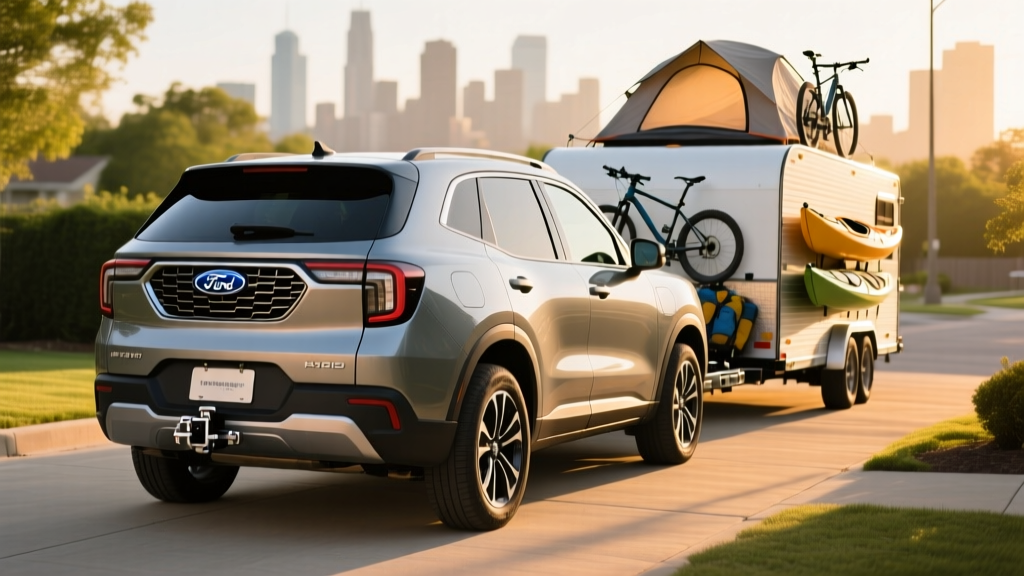
- Lightweight pop-up camper or teardrop trailer (~1,000–1,800 lbs)
- Single personal watercraft on a trailer (~1,200–1,600 lbs)
- Small aluminum boat with trailer (~1,500–1,900 lbs)
- ATV or side-by-side on a lightweight trailer (~1,000–1,800 lbs)
Exceeds the 2,000-lb limit:
- Most travel trailers (typically 3,000–5,000+ lbs)
- Standard 16–20 ft bass boats with trailer (~2,500–3,500 lbs)
- Horse trailer (even single-horse, ~2,500+ lbs empty)
- Enclosed cargo trailers loaded for moving (~3,000+ lbs)
- Car hauler with any vehicle on it (~4,500+ lbs)
If your typical towing needs fall in the second category, you'll need to step up to the EcoBoost AWD with the 4K Tow Package (4,000-lb max) or look at a midsize truck like the Ford Ranger or Toyota Tacoma.
Real-World MPG: On the Highway and Under Tow
The Maverick Hybrid's efficiency is its strongest selling point over the turbocharged EcoBoost models. The EPA rates the 2026 Maverick Hybrid at:
| Cycle | MPG |
|---|---|
| City | 40 MPG |
| Highway | 33 MPG |
| Combined | 37 MPG |
Real-world MPG observations: Hybrid trucks, like hybrid sedans, tend to exceed their EPA city rating in stop-and-go driving because regenerative braking recaptures energy that a conventional truck wastes as heat. Owners consistently report 40–45 MPG in urban and suburban driving. Highway fuel economy is more honest — expect 31–34 MPG at 70 mph, with the engine running more frequently since regenerative opportunities are limited.
MPG while towing: This is where reality bites. When towing near the 2,000-lb maximum, expect fuel economy to drop to roughly 18–24 MPG depending on trailer aerodynamics, terrain, and speed. A boxy enclosed trailer at highway speed will pull figures toward the low end; a flat-bed utility trailer at 55 mph on level ground will stay closer to the high end. The hybrid system's electric motor assists with initial acceleration, but sustained highway towing relies primarily on the 2.5L gas engine.
Hybrid Battery Warranty & Longevity
Ford covers the Maverick Hybrid's battery pack and hybrid-specific components under its hybrid/electric component warranty: 8 years or 100,000 miles (whichever comes first). In states that follow California Air Resources Board (CARB) standards — including California, New York, Massachusetts, and several others — that coverage extends to 10 years or 150,000 miles.
The Maverick uses a relatively small nickel-metal hydride (NiMH) battery pack (~1.1 kWh) rather than a large lithium-ion pack. NiMH chemistry in Toyota and Ford hybrid systems has an extensive track record of longevity, with many packs lasting 150,000–200,000+ miles before meaningful degradation. Out-of-warranty replacement costs, should they arise, typically range from $2,500 to $4,500 including labor — significantly less than a full EV battery replacement.
HEV vs PHEV vs EV: Which Truck Fits Your Life?
The Maverick Hybrid is a conventional hybrid (HEV), meaning it never needs to be plugged in. The gasoline engine and regenerative braking keep the small battery charged automatically. This is fundamentally different from a plug-in hybrid (PHEV) or a battery-electric vehicle (BEV).
| Factor | HEV (Maverick Hybrid) | PHEV (e.g., upcoming electric trucks with range extender) | BEV (e.g., Rivian R1T, Ford F-150 Lightning) |
|---|---|---|---|
| Plug-in required? | No | Yes, for electric-only miles | Yes, always |
| Electric-only range | None (motor assists only) | 25–50 mi typical | 250–400 mi |
| Total range | 500+ mi (gas tank) | 400–500+ mi combined | 250–400 mi |
| Towing capacity | 2,000 lbs | Varies (often reduced on EV mode) | 5,000–11,000 lbs |
| Home charging needed? | No | Recommended (Level 2) | Required (Level 2) |
| Federal tax credit (§30D) | Not eligible | Eligible if requirements met | Eligible if requirements met |
| Best for | No charging access, light towing, max MPG | Short commutes + longer road trips | Home charging, heavier towing, lowest running cost |
Who should choose the Maverick Hybrid: You don't have access to home or workplace charging, you tow occasionally but lightly (under 2,000 lbs), and you want truck utility with sedan-like fuel costs. The Maverick Hybrid is also ideal for urban and suburban drivers who spend most of their miles in stop-and-go traffic where hybrid efficiency peaks.
Who should look elsewhere: If you regularly tow over 2,000 lbs, need AWD for off-road or snow conditions (the hybrid is FWD-only), or want the lowest possible running costs and have reliable home charging access, a full-electric truck like the Ford F-150 Lightning or Rivian R1T will serve you better — though at a significantly higher purchase price.
Pricing, Trims, and Tax Credit Eligibility
The 2026 Ford Maverick Hybrid is available across multiple trims, with pricing starting under $28,000:
| Trim | Approximate MSRP | Hybrid Availability |
|---|---|---|
| XL | $27,995 | Optional ($1,000 add over EcoBoost) |
| XLT | $29,495 | Optional |
| Lariat | $33,995 | Standard |
| Lobo | $35,495 | Not available (EcoBoost only) |
| Tremor | $37,995 | Not available (EcoBoost AWD only) |
Prices reflect approximate base MSRP before destination charges and options. Verify current pricing at Ford's official Maverick page.
Federal tax credit status: The Maverick Hybrid is a conventional HEV, which means it does not qualify for the IRS §30D Clean Vehicle Credit. That credit — up to $7,500 — applies only to plug-in electric vehicles (BEVs and PHEVs) that meet battery sourcing, MSRP cap, and buyer income requirements. There is currently no federal tax credit for conventional hybrids.
Some states and local utilities offer rebates or incentives for hybrid vehicles, but these vary widely by jurisdiction. Check your state energy office or utility provider for current programs.
Powertrain Deep Dive: How the Hybrid System Tows
The Maverick Hybrid uses Ford's fourth-generation hybrid system, closely related to the powertrain in the Ford Escape Hybrid. Here's the mechanical breakdown:
- Engine: 2.5-liter inline-four, Atkinson-cycle, producing approximately 162 hp and 155 lb-ft of torque on its own
- Electric motor: Integrated into the eCVT transaxle, contributing additional torque for a combined system output of 191 hp
- Battery: ~1.1 kWh nickel-metal hydride (NiMH) pack, located under the rear seat
- Transmission: Electronic continuously variable transmission (eCVT) using a planetary gearset — not a belt-and-cone CVT
- Drivetrain: Front-wheel drive only (AWD is not available on the hybrid)
When towing, the electric motor provides immediate low-end torque to assist with getting a loaded trailer moving from a stop — the scenario where a small gas engine would otherwise struggle most. The eCVT eliminates shift shock and keeps the engine in its optimal power band during acceleration. However, on sustained highway grades with a loaded trailer, the gas engine carries the majority of the workload, which is where the fuel economy drops significantly.
One practical note: the hybrid's FWD-only layout means less traction when towing on wet or loose-surface boat ramps compared to the AWD EcoBoost models. If you frequently launch boats or tow on unpaved inclines, this is a meaningful limitation.
Reliability Track Record and Ownership Costs
The Maverick Hybrid's powertrain benefits from Ford's extensive hybrid experience, and the 2.5L hybrid system has been in production across multiple Ford models since 2020. Early reliability data and owner surveys have been generally favorable, with no widespread reports of hybrid-system failures.
Key ownership cost considerations:
- Maintenance: The hybrid requires the same routine maintenance as the EcoBoost (oil changes, tire rotations, brake fluid) but often sees longer brake pad life due to regenerative braking reducing friction-brake wear
- Fuel cost savings: At 37 MPG combined vs. the EcoBoost FWD's ~26 MPG combined, and assuming $3.40/gallon gas and 15,000 miles/year, the hybrid saves approximately $550–$650 per year in fuel costs
- Insurance: Hybrid premiums are typically comparable to or slightly above equivalent gas trims; get quotes before purchasing
- Resale value: The Maverick has held strong residual values due to high demand and limited supply since its 2022 launch
Pros
- 37 MPG combined is best-in-class for any pickup
- No plug-in charging needed — works with any lifestyle
- Low starting price (~$27,995 before hybrid option)
- Strong city MPG (40) benefits urban commuters
- Proven hybrid powertrain with 8-yr/100k-mi warranty
- Practical 4.5-ft bed with useful DIY storage features
Cons
- 2,000-lb tow limit rules out most travel trailers and boats
- FWD only — no AWD option on the hybrid
- No federal tax credit eligibility
- MPG drops to ~18–24 when towing near max capacity
- Hybrid not available on Tremor or Lobo performance trims
- High demand can mean limited dealer inventory and markups
Frequently Asked Questions
Can the Ford Maverick Hybrid tow a camper?
It can tow lightweight campers — specifically pop-up campers and teardrop trailers that weigh under 2,000 lbs loaded. Most hard-sided travel trailers, even the smallest models, exceed 2,000 lbs and are beyond the Maverick Hybrid's rating. Always check your specific trailer's GVWR (gross vehicle weight rating), not just its dry weight.
Does towing void the hybrid battery warranty?
No. Towing within the manufacturer's rated 2,000-lb capacity is a normal use case and does not affect the 8-year/100,000-mile hybrid component warranty (10 years/150,000 miles in CARB states). Exceeding the rated capacity could potentially be cited in a warranty dispute if drivetrain damage is linked to overloading.
How does the Maverick Hybrid's towing compare to the Hyundai Santa Cruz?
The Hyundai Santa Cruz with its standard 2.5L engine is rated for 3,500 lbs (turbo AWD), and up to 5,000 lbs with the turbocharged engine and AWD. However, the Santa Cruz does not offer a hybrid powertrain, and its fuel economy (23–27 MPG combined depending on powertrain) is significantly lower than the Maverick Hybrid's 37 MPG.
Is the Maverick Hybrid FWD a problem for towing?
For dry, paved roads and moderate grades, FWD is adequate for 2,000-lb loads. The main limitation is traction: on wet boat ramps, gravel inclines, or in snow, FWD with a trailer pushing from behind can lead to wheelspin. If your towing involves these conditions regularly, the EcoBoost AWD is a more capable choice.
What is the Maverick Hybrid's payload capacity, and does it affect towing?
The Maverick Hybrid has a maximum payload rating of approximately 1,500 lbs. Payload (passengers and cargo in the truck) and tongue weight (the downward force the trailer exerts on the hitch) both count against this figure. If your trailer has a 200-lb tongue weight and you have two passengers plus gear totaling 500 lbs, you're using 700 lbs of your 1,500-lb payload budget. Always calculate total payload before towing.
Will the Maverick Hybrid ever get AWD or a higher tow rating?
Ford has not announced an AWD hybrid Maverick as of early 2026. The current hybrid system is FWD-only. If Ford introduces an AWD hybrid variant in a future model year, it could potentially raise the tow rating, but no such model has been confirmed.
The Ford Maverick Hybrid makes a compelling case as the most fuel-efficient truck you can buy, and its 2,000-lb towing capacity covers genuine light-duty needs. For buyers whose towing stays within that boundary — a small utility trailer, a teardrop camper, a jet ski — the fuel savings and low purchase price are hard to beat. If your towing requirements exceed 2,000 lbs or you need all-wheel-drive traction, you'll need to explore the EcoBoost AWD Maverick or step up to a midsize truck, accepting the fuel-economy trade-off that comes with it.