Quick Verdict: The Three-Row Hybrid That Doesn't Ask You to Plug In
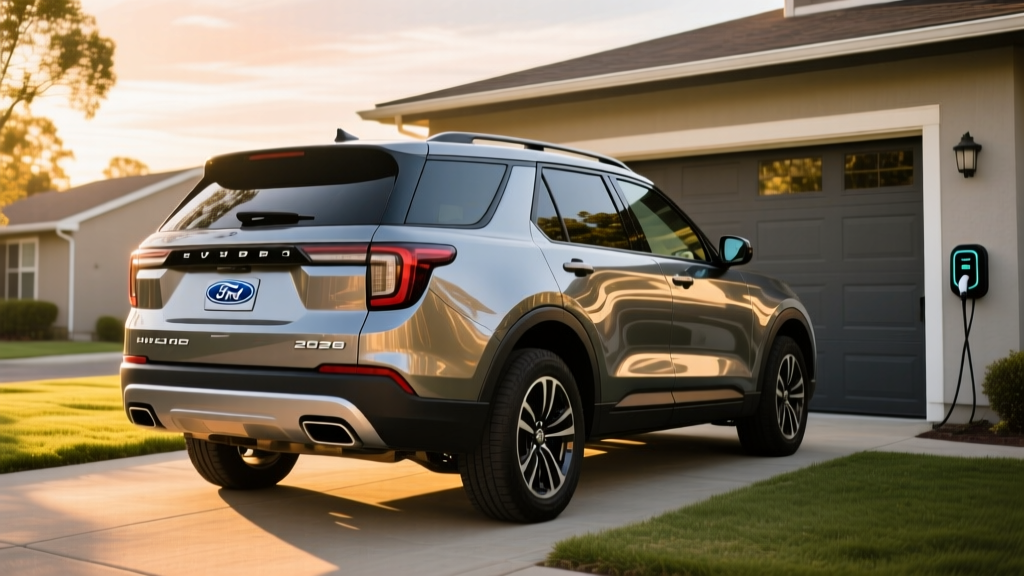
The 2026 Ford Explorer Hybrid occupies a narrow but valuable lane: a three-row, seven-passenger SUV that delivers meaningful fuel savings over its gas-only sibling without requiring a charging cable, a garage outlet, or any change in your daily routine. With an EPA-rated 28 MPG combined and 318 combined horsepower from its 3.3-liter V6 hybrid powertrain, it trades the turbocharged four-cylinder's peak thrust for smoother low-end torque and roughly 4–5 MPG better real-world economy in stop-and-go driving.
This is a conventional hybrid (HEV), not a plug-in hybrid (PHEV). Ford discontinued the Explorer Limited Hybrid for the 2024 model year and has not reintroduced a plug-in variant for 2026. If you're searching for a "ford hybrid explorer," what you'll find on dealer lots is the self-charging HEV model — no plug, no electric-only range, no federal §30D tax credit eligibility. That's a crucial distinction we'll unpack below.
HEV vs. PHEV vs. EV: Where the Explorer Hybrid Fits
Before diving into specs, it helps to map the three electrified powertrain types, because buyer confusion here is common and costly.
| Feature | HEV (Explorer Hybrid) | PHEV (e.g., Toyota RAV4 Prime) | BEV (e.g., Tesla Model Y) |
|---|---|---|---|
| Plug-in charging required? | No — regenerative braking charges battery | Yes — for electric-only range | Yes — sole energy source |
| Electric-only range | ~1 mile at low speed | 25–42 miles typical | 250–330+ miles EPA |
| Battery size | ~1.5 kWh (small buffer) | 15–20 kWh usable | 60–100+ kWh |
| Federal tax credit (§30D) | Not eligible | Up to $7,500 (if sourcing/income rules met) | Up to $7,500 (if sourcing/income rules met) |
| Home charging install needed? | No | Recommended (Level 2) | Essential (Level 2) |
| Best for | Drivers without charging access | Short commutes + road trips | Home chargers + daily driving |
The Explorer Hybrid is purpose-built for buyers who want lower fuel costs and smoother powertrain behavior but lack access to home or workplace charging. If you have a garage and a short commute, a PHEV like the Hyundai Tucson PHEV or a full BEV may save you more. If you tow frequently, haul seven passengers regularly, and fill up at gas stations, the Explorer HEV is the pragmatic middle ground.
Fuel Economy: EPA Ratings and Real-World MPG
The EPA rates the 2026 Ford Explorer Hybrid at 27 MPG city / 28 MPG highway / 28 MPG combined for front-wheel-drive trims, with all-wheel-drive models dropping slightly to 23 city / 26 highway / 24 combined per fueleconomy.gov. These numbers apply to the 3.3L V6 hybrid powertrain paired with the 10-speed modular hybrid transmission.
| Configuration | City MPG | Highway MPG | Combined MPG |
|---|---|---|---|
| FWD Hybrid (3.3L V6) | 27 | 28 | 28 |
| AWD Hybrid (3.3L V6) | 23 | 26 | 24 |
| FWD Gas (2.3L EcoBoost I4) | 21 | 28 | 24 |
| AWD Gas (2.3L EcoBoost I4) | 20 | 27 | 23 |
The hybrid's advantage over the 2.3L EcoBoost gas model is most pronounced in city driving: 6–7 MPG better in FWD form. On the highway, where the electric motor contributes less and aerodynamic drag dominates, the gap narrows to essentially zero for FWD models. If your commute is 90% highway, the fuel savings shrink considerably.
Powertrain Specs: What's Under the Hood
The Explorer Hybrid pairs Ford's 3.3-liter naturally aspirated V6 with an electric motor integrated into the 10-speed automatic transmission (the 10AT modular hybrid architecture, not the torque-converter unit in the gas models). Combined system output is 318 horsepower and 322 lb-ft of torque.
| Specification | 2026 Explorer Hybrid |
|---|---|
| Engine | 3.3L V6 naturally aspirated |
| Electric motor | Integrated into 10-speed transmission |
| Combined horsepower | 318 HP |
| Combined torque | 322 lb-ft |
| Transmission | 10-speed modular hybrid automatic |
| Drivetrain | FWD or AWD (available) |
| 0–60 MPH (est.) | ~7.5 seconds (FWD) |
| Towing capacity | 5,000 lbs (with Class III tow pkg) |
| Hybrid battery | ~1.5 kWh lithium-ion |
| Fuel tank | 18.0 gallons |
| Total driving range | ~504 miles (FWD, EPA combined) |
Compared to the 2.3L EcoBoost gas model's 300 HP and 310 lb-ft, the hybrid delivers marginally more power with a flatter torque curve, thanks to the electric motor's instant low-end response. The trade-off: the hybrid adds approximately 200 lbs of curb weight and carries a price premium of roughly $1,500–$2,000 over equivalent gas trims at the Limited level where the hybrid is offered.
Pricing, Trims, and Tax Credit Eligibility
The 2026 Ford Explorer Hybrid is offered exclusively in the Limited trim (and above, including Platinum and ST-Line if equipped), starting at approximately $53,400 MSRP for FWD, rising to ~$55,900 for AWD. Fully optioned Platinum Hybrid models push past $60,000.
Federal tax credit status: Not eligible. The IRS §30D Clean Vehicle Credit applies only to plug-in electric vehicles (PHEVs and BEVs) with battery capacities of at least 7 kWh and the ability to charge from an external power source. The Explorer Hybrid's ~1.5 kWh battery charges solely through regenerative braking and the gasoline engine. It does not qualify for any federal purchase incentive. Some states may offer modest hybrid rebates or HOV lane access — check your state's energy office or DMV for current programs.
Battery Warranty, Reliability, and Replacement Cost
Ford's hybrid system, derived from the Fusion Hybrid and Escape Hybrid lineage, has a long track record. The 3.3L V6 hybrid architecture in particular has been in production since 2020 and shares components with the F-150 PowerBoost hybrid. Failure rates for the traction battery pack are low based on warranty claim data from comparable Ford hybrid models.
Battery replacement cost: If the hybrid battery fails outside warranty, expect a dealer replacement to cost between $2,500 and $4,500 including parts and labor, based on current pricing for the 1.5 kWh pack. Independent hybrid specialists may offer refurbished units for $1,500–$2,500. Given the small battery size (compared to a BEV's 75+ kWh pack), replacement is far less financially catastrophic than a full EV battery swap.
The 12V auxiliary battery (a standard AGM unit that powers electronics, not propulsion) should be replaced every 4–6 years at a cost of $200–$350, same as any conventional vehicle.
Driving Impressions and Practical Ownership
The hybrid system's most noticeable benefit isn't peak acceleration — it's the smoothness of low-speed driving. The electric motor fills the torque gap during the 10-speed transmission's 1-2 and 2-3 shifts, eliminating the hunting and lugging common in turbocharged four-cylinder SUVs. Around town, the engine shuts off at stops and during low-load coasting, reducing noise and vibration.
On the highway, the hybrid advantage fades. At 70–80 MPH, the V6 runs continuously, and the added weight of the hybrid system slightly hurts efficiency versus what a lighter gas model might achieve. Wind noise and ride quality are identical to the gas Explorer — the hybrid hardware doesn't alter the chassis tuning.
Towing: The Explorer Hybrid is rated for 5,000 lbs with the optional Class III tow package, matching the gas 2.3L model. However, expect fuel economy to drop to 16–18 MPG combined when towing a loaded trailer — the hybrid system provides no meaningful towing-economy advantage. If you tow more than 3,500 lbs regularly, the 3.0L EcoBoost V6 (non-hybrid, available in ST and Platinum trims) delivers 400 HP and a 5,600-lb rating, albeit at 19 MPG combined.
Who Should Buy the Ford Explorer Hybrid?
Choose the Explorer Hybrid if:
- You drive 12,000+ miles/year with significant city/suburban stop-and-go driving
- You need three rows and 7-passenger seating but want lower fuel costs than the gas model
- You lack access to home or workplace EV charging (apartment, street parking, no garage)
- You want a smoother, quieter powertrain without learning new charging habits
- You plan to keep the vehicle 8+ years (warranty covers the hybrid battery)
Look elsewhere if:
- Your commute is 90%+ highway — the MPG advantage shrinks to nearly zero
- You have a garage and short commute — a PHEV (Escape PHEV, Tucson PHEV) or BEV saves more
- You want a federal tax credit — the HEV is not eligible under §30D
- You tow heavy loads frequently — the hybrid provides no towing-economy benefit
- Price is the primary concern — the gas Explorer XLT starts ~$8,000 lower
Frequently Asked Questions
How many MPG does the Ford Explorer Hybrid get?
The 2026 Explorer Hybrid is EPA-rated at 27 city / 28 highway / 28 combined for FWD, and 23 city / 26 highway / 24 combined for AWD. Real-world FWD owners report 29–31 MPG in city-heavy driving and 25–26 on the highway.
Does the Ford Explorer Hybrid need to be plugged in?
No. The Explorer Hybrid is a conventional HEV — its small lithium-ion battery charges through regenerative braking and the gasoline engine. There is no plug, no charging cable, and no electric-only range beyond brief low-speed maneuvers.
Is there a plug-in hybrid (PHEV) Ford Explorer?
Not for 2026. Ford offered the Explorer Limited Hybrid as an HEV through 2023–2024 but has not introduced a PHEV variant in the US market. The European-market Explorer PHEV (2020–2022) was never sold in North America. If you need a Ford PHEV, the Escape PHEV is the current option.
Does the Ford Explorer Hybrid qualify for a tax credit?
No. The federal §30D Clean Vehicle Credit requires plug-in capability and a minimum 7 kWh battery. The Explorer Hybrid's ~1.5 kWh battery is not externally chargeable, making it ineligible for the federal credit or most state EV incentives.
How long will the Explorer Hybrid battery last?
Ford warrants the hybrid battery for 8 years / 100,000 miles (10 years / 150,000 miles in CARB states). Based on Ford's hybrid track record with the Fusion and Escape, most batteries last 150,000–200,000+ miles before significant degradation. Replacement cost out of warranty is approximately $2,500–$4,500.
Is the Explorer Hybrid reliable?
The 3.3L V6 hybrid powertrain has been in production since 2020 and is shared with the F-150 PowerBoost. It has a solid reliability record with no widespread battery or inverter failure patterns. Ford's hybrid-specific warranty provides long-term coverage. Check NHTSA.gov for any active recalls on your specific VIN.
How does the Explorer Hybrid compare to the Toyota Highlander Hybrid?
The Toyota Highlander Hybrid (36 city / 35 hwy / 36 combined, FWD) significantly outperforms the Explorer Hybrid on fuel economy, primarily because it uses a smaller 2.5L four-cylinder engine and Toyota's series-parallel hybrid system optimized for efficiency. The Explorer Hybrid counters with more horsepower (318 vs. 243), higher towing capacity (5,000 vs. 3,500 lbs), and a more traditional driving feel. If MPG is paramount, the Highlander Hybrid wins. If power and towing matter more, the Explorer Hybrid holds the edge.