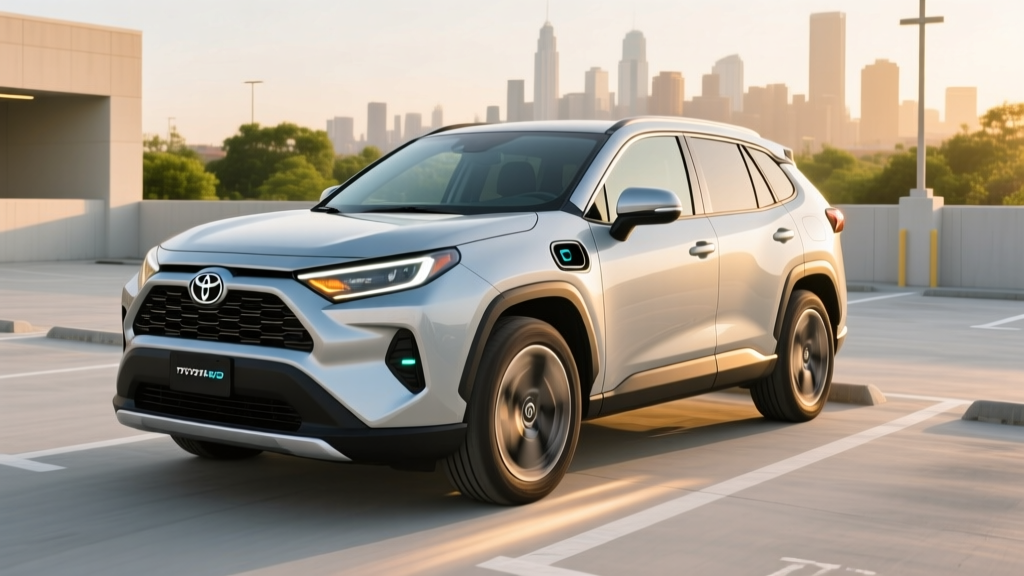
The Toyota RAV4 Hybrid has held the compact hybrid SUV crown for years, and the question buyers ask most often is about its real-world acceleration: what is the actual 0-60 mph time for the RAV4 Hybrid, and does it feel quick enough for highway merging? The short answer is that the current-generation RAV4 Hybrid hits 60 mph in approximately 7.4 seconds, while the plug-in RAV4 Prime drops that to a sports-sedan-rivaling 5.7 seconds. But acceleration is only one dimension of a vehicle that routinely delivers over 40 MPG in city driving. This guide breaks down every number that matters — from EPA fuel economy to battery longevity — so you can decide whether the HEV, the PHEV Prime, or a full EV is the right call.
RAV4 Hybrid vs RAV4 Prime: HEV and PHEV Explained
Before diving into specs, it is critical to understand that Toyota sells two electrified RAV4 variants that are fundamentally different:
RAV4 Hybrid (HEV)
- Type: Conventional self-charging hybrid — no plug required
- How it charges: Regenerative braking and the gasoline engine recharge the small 1.6 kWh battery automatically
- Electric-only driving: Very short, low-speed EV bursts (under ~1 mile); not a meaningful electric-only range
- Best for: Drivers who want maximum MPG without changing their fueling habits
- Federal tax credit: Not eligible under IRS §30D (requires plug-in capability)
RAV4 Prime (PHEV)
- Type: Plug-in hybrid — has a larger battery and a charge port
- How it charges: Plug into a Level 1 (120V) or Level 2 (240V) charger; also recovers energy via regen and engine
- Electric-only range: EPA-rated 42 miles on electricity alone before the gas engine kicks in
- Best for: Drivers with home charging who want EV-like daily commuting with gas backup for road trips
- Federal tax credit: Previously eligible; as of 2026, check current IRS §30D eligibility as sourcing and MSRP caps apply
The RAV4 Hybrid (HEV) is the mainstream volume seller. The RAV4 Prime (PHEV) costs significantly more but delivers dramatically more power and a genuine electric commuting range. They share the same 2.5-liter four-cylinder engine architecture, but the Prime adds a much larger battery and more powerful electric motors.
0-60 Times and Powertrain Specs
The reason the RAV4 Hybrid 0-60 time outperforms many competitors in the compact SUV segment is Toyota's electronic all-wheel-drive system (AWD-i), which uses a dedicated rear electric motor for instant torque distribution. Here is the full powertrain breakdown:
| Specification | RAV4 Hybrid (HEV) | RAV4 Prime (PHEV) |
|---|---|---|
| Engine | 2.5L 4-cyl Atkinson-cycle | 2.5L 4-cyl Atkinson-cycle |
| Engine HP | 176 hp / 163 lb-ft | 177 hp / 165 lb-ft |
| Front Electric Motor | 118 hp / 149 lb-ft | 180 hp / 199 lb-ft |
| Rear Electric Motor | 54 hp / 89 lb-ft | 54 hp / 89 lb-ft |
| Net Combined HP | 219 hp | 302 hp |
| 0-60 mph | 7.4 seconds | 5.7 seconds |
| Transmission | eCVT | eCVT |
| Drivetrain | AWD-i (standard) | AWD-i (standard) |
| Battery Capacity | ~1.6 kWh (NiMH) | 18.1 kWh (Lithium-ion) |
| Curb Weight (approx.) | ~3,800 lbs | ~4,300 lbs |
The RAV4 Hybrid's 7.4-second 0-60 time is brisk for a family SUV. For context, the non-hybrid gas RAV4 AWD runs 0-60 in about 8.8 seconds. The hybrid is quicker because electric motors deliver peak torque from zero RPM — there is no waiting for the engine to rev into its power band. The eCVT (planetary gearset, not a belt-driven CVT) provides seamless power delivery without the rubber-band feeling some drivers associate with traditional CVTs.
The Prime's 5.7-second run puts it in the territory of a V6 sports sedan. Toyota's decision to pair a 302-hp combined output with a relatively compact SUV creates a vehicle that is genuinely quick off the line, even with the ~500-lb weight penalty from the larger battery pack.
Fuel Economy: EPA Ratings and Real-World MPG
| Model | City MPG | Highway MPG | Combined MPG |
|---|---|---|---|
| RAV4 Hybrid (AWD-i) | 41 | 38 | 39 |
| RAV4 Hybrid (LE FWD)* | 41 | 38 | 40 |
| RAV4 Prime (PHEV, gas mode) | 40 | 36 | 38 |
| RAV4 Prime (PHEV, EV mode) | 94 MPGe combined / 42 miles electric range | ||
| Gas RAV4 (AWD, baseline) | 27 | 34 | 30 |
*FWD availability varies by trim and model year; AWD-i is standard on most trims. Source: fueleconomy.gov
Real-World MPG: What to Actually Expect
The RAV4 Hybrid's EPA rating of 39-40 MPG combined is one of the rare cases where real-world results often exceed the sticker — particularly in city driving. Hybrid powertrains thrive in stop-and-go traffic where regenerative braking recovers energy constantly and the engine shuts off at stops. Owners routinely report 42-45 MPG in urban commutes during mild weather.
Highway driving is a different story. At sustained 70-80 mph speeds, aerodynamic drag dominates and the hybrid system offers less benefit. Expect 34-37 MPG on the highway, particularly with roof racks, cargo, or in cold weather. In sub-freezing temperatures, the engine runs more frequently for cabin heat and battery conditioning, which can drop city MPG into the mid-30s until the system warms up.
The RAV4 Prime in EV mode delivers its full 42 miles of electric range at moderate speeds and temperatures. Cold weather (below 32°F) typically reduces that to 32-36 miles due to battery chemistry limitations and cabin heating demands. Once the battery depletes, the Prime operates as a conventional hybrid at approximately 38 MPG combined.
RAV4 Prime PHEV: Charging, Battery, and Electric Range
If you are considering the RAV4 Prime, charging logistics matter. The Prime's 18.1 kWh lithium-ion battery pack provides 42 miles of EPA-rated electric range — enough for most daily commutes without burning a drop of gasoline. Here is what charging looks like:
| Charging Method | Power | Time (0-100%) | Notes |
|---|---|---|---|
| Level 1 (120V household) | ~1.4 kW | ~12 hours | Works for overnight if you drive <40 mi/day |
| Level 2 (240V, standard) | 3.3 kW (Prime base) | ~5.5 hours | Standard onboard charger |
| Level 2 (240V, Premium pkg) | 6.6 kW (optional) | ~2.5 hours | Available on select trims; halves charge time |
| DC Fast Charge | Not available | N/A | No DC fast charging on RAV4 Prime |
A critical limitation: the RAV4 Prime does not support DC fast charging. This is common among PHEVs — their smaller batteries make DCFC infrastructure cost-prohibitive, and Level 2 is sufficient for overnight replenishment. If you need rapid public charging, a full BEV with DCFC capability (like the Tesla Model Y or Hyundai Ioniq 5) is the better choice.
The 6.6 kW onboard charger option is worth seeking if you can find it. It cuts Level 2 charging from 5.5 hours to about 2.5 hours, meaning you can top off the battery during a workday or while running errands if you have access to a Level 2 destination charger.
Pricing, Tax Credits, and Total Cost
| Model / Trim | Approx. 2026 MSRP | Federal Tax Credit (§30D) |
|---|---|---|
| RAV4 Hybrid LE (base) | ~$33,500 | Not eligible (HEV, not plug-in) |
| RAV4 Hybrid XLE | ~$35,500 | Not eligible |
| RAV4 Hybrid Limited | ~$40,000 | Not eligible |
| RAV4 Prime SE | ~$45,000 | Check current eligibility |
| RAV4 Prime XSE | ~$48,500 | Check current eligibility |
Important tax credit context: The conventional RAV4 Hybrid (HEV) does not qualify for the federal §30D Clean Vehicle Credit because it lacks plug-in capability. The RAV4 Prime (PHEV) has historically qualified, but eligibility under current IRS rules depends on battery component sourcing, critical mineral requirements, MSRP caps ($80,000 for SUVs), and buyer income limits ($300,000 joint / $150,000 single). These rules shift frequently — verify current eligibility before purchase and consult a tax professional.
The RAV4 Prime commands a substantial premium over the Hybrid — roughly $11,000-$12,000 more at base trim. That premium buys you 302 hp, 42 miles of electric range, and potential tax credit eligibility. The breakeven math depends on your commute length, electricity cost, and how often you can charge at home. For a 30-mile round-trip commute charged nightly, the Prime can eliminate nearly all weekday gasoline consumption. For longer commutes where the engine runs frequently anyway, the Hybrid HEV at $11,000 less may be the smarter financial play.
Battery Warranty, Reliability, and Replacement Cost
Hybrid Battery Warranty Coverage
- Hybrid battery: 10 years / 150,000 miles (whichever comes first) — Toyota's current standard for hybrid battery coverage
- Hybrid system components: 8 years / 100,000 miles (inverter, transaxle, control module)
- Basic vehicle: 3 years / 36,000 miles
- Powertrain: 5 years / 60,000 miles
Toyota's hybrid battery warranty is among the most comprehensive in the industry. California-emissions states may see extended coverage terms.
The reliability question is where the RAV4 Hybrid truly separates itself from the pack. Toyota has been refining its Hybrid Synergy Drive system since the original Prius in 1997. The eCVT planetary gearset has no belts, clutches, or torque converters to wear out — it is mechanically simpler than a conventional automatic transmission. The hybrid battery in the standard RAV4 Hybrid is a nickel-metal hydride (NiMH) pack that has proven extremely durable; reports of failures before 150,000 miles are rare.
The RAV4 Prime's larger lithium-ion pack operates under more stress due to higher power output and deeper cycling, but Toyota engineers conservatively buffer the usable capacity to protect long-term health. Owners with 100,000+ miles on early RAV4 Primes report minimal capacity degradation.
Battery replacement cost: If a hybrid battery does fail outside warranty, expect approximately $3,000-$5,000 for the RAV4 Hybrid NiMH pack (parts and labor) and $8,000-$12,000 for the Prime's larger lithium-ion pack. Third-party refurbished options exist for the Hybrid at roughly $2,000-$3,000. However, given the 10-year/150,000-mile warranty and Toyota's track record, out-of-pocket battery replacement is statistically unlikely for most original owners.
RAV4 Hybrid vs PHEV vs Full EV: Which Is Right for You?
Choose the RAV4 Hybrid (HEV) if:
- You cannot charge at home or work (apartment, street parking, no outlet access)
- You want a simple ownership experience — no plugs, no apps, no charging planning
- Your priority is low purchase price with excellent fuel economy
- You take frequent long road trips and want zero range or charging anxiety
- You want proven reliability with a lower upfront investment (~$33,500+)
Choose the RAV4 Prime (PHEV) if:
- You have reliable home Level 2 charging and a commute under 42 miles round-trip
- You want EV-like silent, instant-torque daily driving with gasoline backup for road trips
- Performance matters — the 302 hp / 5.7-second 0-60 is genuinely fast for an SUV
- You can take advantage of federal/state PHEV incentives to offset the price premium
- You are not ready to commit to a full EV but want to reduce gasoline consumption dramatically
Choose a Full EV (e.g., Tesla Model Y, Hyundai Ioniq 5) if:
- You want zero tailpipe emissions and the lowest per-mile fuel cost
- You have home charging and access to DC fast charging for road trips
- You want the full $7,500 federal tax credit (subject to eligibility) and lowest maintenance costs
- You are comfortable planning charging stops on longer trips
Pros and Cons at a Glance
Pros
- 41 MPG city — often exceeded in real-world stop-and-go driving
- Standard AWD-i on all trims (rear electric motor, no mechanical driveshaft)
- 7.4-second 0-60 (HEV) / 5.7-second (Prime) — quick for the class
- 10-year/150,000-mile hybrid battery warranty
- Toyota's proven hybrid reliability and strong resale value
- No plug-in required (HEV) — works with existing fueling habits
- Prime offers 42 mi electric range for near-zero-emission commuting
Cons
- Highway MPG drops to 34-37 at sustained 75+ mph speeds
- Prime carries a ~$11,000-$12,000 premium over Hybrid base
- Prime has no DC fast charging capability
- HEV not eligible for any federal tax credit
- Infotainment and cabin materials lag behind Hyundai/Kia competitors
- Prime availability often constrained — dealer markups common
- Cold weather reduces HEV MPG and Prime EV range by 15-25%
Frequently Asked Questions
How many MPG does the RAV4 Hybrid actually get in real driving?
The EPA rates the RAV4 Hybrid AWD at 41 city / 38 highway / 39 combined. In real-world driving, city MPG frequently exceeds the EPA estimate — many owners report 42-45 MPG in urban commuting during mild weather. Highway driving at 70-80 mph typically yields 34-37 MPG. Cold weather (below freezing) can drop overall efficiency by 15-25% due to increased engine runtime for cabin heat and reduced battery efficiency.
How far can the RAV4 Prime go on electric power only?
The EPA rates the RAV4 Prime at 42 miles of electric-only range. In practice, expect 38-42 miles in mild weather at moderate speeds, and 32-36 miles in cold weather or at highway speeds. Once the battery depletes, the Prime seamlessly switches to hybrid mode and delivers approximately 38 MPG combined — so you are never stranded.
What is the 0-60 time for the RAV4 Hybrid, and does it feel slow?
The RAV4 Hybrid (HEV) reaches 0-60 mph in approximately 7.4 seconds. This is quicker than the gas-only RAV4 (8.8 seconds) and competitive with turbocharged compact SUVs like the Honda CR-V Turbo. The electric motor's instant torque makes it feel responsive in everyday driving — passing maneuvers and highway on-ramps are confident. The RAV4 Prime at 5.7 seconds is dramatically quicker and feels genuinely sporty.
Is the RAV4 Hybrid reliable, and what does a battery replacement cost?
Toyota's hybrid system is among the most proven in the industry, with over 25 years of continuous refinement. The RAV4 Hybrid carries a 10-year/150,000-mile hybrid battery warranty. Out-of-warranty replacement runs approximately $3,000-$5,000 for the HEV NiMH pack and $8,000-$12,000 for the Prime lithium-ion pack, but premature failures are rare based on long-term fleet and owner data.
Does the RAV4 Hybrid qualify for any tax credits?
The conventional RAV4 Hybrid (HEV) does not qualify for the federal §30D Clean Vehicle Credit because it is not a plug-in vehicle. The RAV4 Prime (PHEV) may qualify depending on current IRS sourcing, MSRP, and buyer income rules — check irs.gov for the latest eligibility criteria. Some states offer additional rebates for PHEVs; check your state's energy office or AFDC incentive database for local programs.
Do I need to plug in the RAV4 Hybrid?
No. The standard RAV4 Hybrid (HEV) is a self-charging hybrid — it recovers energy through regenerative braking and the gasoline engine. There is no plug, no charging cable, and no change to your fueling routine. Only the RAV4 Prime (PHEV) requires plugging in to access its electric-only range; if you never plug in the Prime, it simply operates as a conventional hybrid.
How does the RAV4 Hybrid compare to the Honda CR-V Hybrid?
The RAV4 Hybrid (219 hp, 7.4s 0-60, 39 MPG combined) and the CR-V Hybrid (204 hp, ~7.6s 0-60, 37-40 MPG combined) are closely matched. The RAV4 Hybrid has a slight power edge and standard AWD across all trims, while the CR-V Hybrid offers a more refined interior and slightly more cargo space. Both are strong choices — the RAV4 wins on acceleration and powertrain simplicity (eCVT planetary vs. Honda's two-motor system), while the CR-V leads in cabin quality.