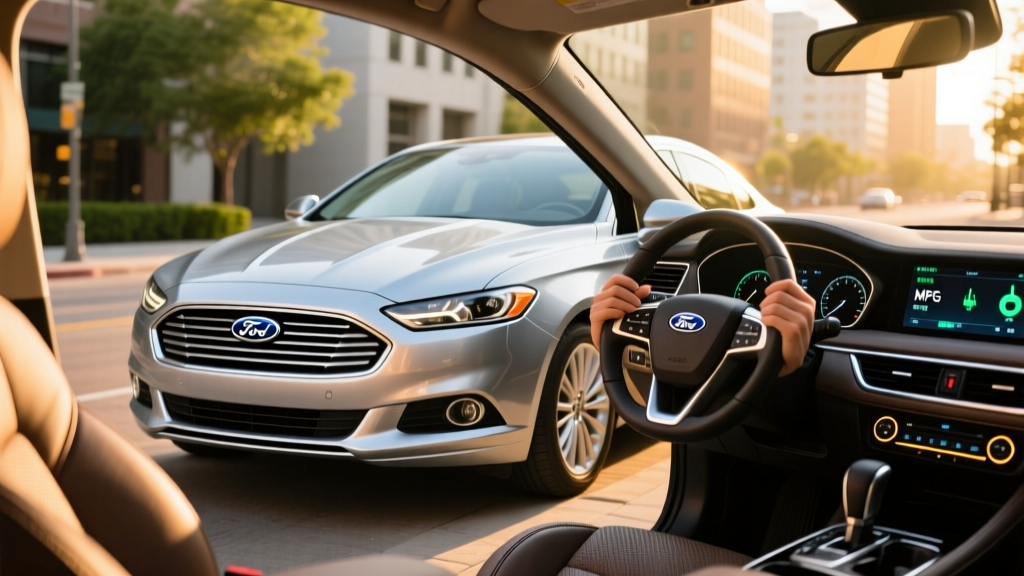
The Ford Fusion SE Hybrid occupies a specific niche in the used-car market: a midsize sedan that sips fuel without asking you to plug in, change your driving habits, or pay an EV premium. Discontinued after the 2020 model year when Ford exited the sedan segment, the Fusion Hybrid remains a high-value proposition on the pre-owned market, particularly for commuters who rack up city miles and want proven hybrid reliability without the complexity of a plug-in hybrid or full battery-electric vehicle.
This guide focuses on the second-generation Fusion Hybrid (2013–2020), with emphasis on the SE trim — the volume seller that balances features and price. We'll cover exact EPA fuel economy, the powertrain architecture, real-world MPG expectations, battery longevity, and how the Fusion Hybrid stacks up against PHEVs and EVs for different driving patterns.
HEV vs. PHEV: Understanding What the Fusion Hybrid Is (and Isn't)
Before diving into specs, it's essential to distinguish between the two electrified Fusion variants Ford produced, because buyers frequently confuse them:
Ford Fusion Hybrid (HEV)
- No plug required — the battery charges via regenerative braking and the gasoline engine
- 1.4 kWh battery (usable capacity ~1.0 kWh)
- Electric-only driving: brief, low-speed bursts (under ~1 mile, under ~25 mph)
- Fuel economy: 42 MPG combined (EPA)
- Operation: the gas engine and electric motor work in tandem seamlessly; no range anxiety, no charging infrastructure needed
Ford Fusion Energi (PHEV)
- Plug-in required for maximum benefit — charges via Level 1 (120V) or Level 2 (240V)
- 9.0 kWh battery (usable ~7.6 kWh, 2019–2020 models)
- Electric-only range: 26 miles EPA (2019–2020); earlier models rated at 21 miles
- Total range: ~610 miles combined (electric + gasoline)
- Fuel economy after battery depletion: 42 MPG combined as a hybrid
- No DC fast charging — Level 2 full charge in approximately 2.5 hours
The Fusion SE Hybrid is the conventional HEV. You never plug it in. You fuel it like any gasoline car, and the hybrid system recaptures braking energy and optimizes engine operation to cut fuel consumption roughly in half compared to a conventional midsize sedan. If you want plug-in electric-only range, you're looking for the Fusion Energi, which was sold in Titanium trim only — a different vehicle with a larger battery, a trunk compromised by battery packaging, and a higher used-market price.
Ford Fusion SE Hybrid Fuel Economy: EPA Ratings and Real-World MPG
The 2020 Ford Fusion Hybrid (final model year) carries the following EPA fuel-economy ratings, which remained consistent from the 2017 refresh through 2020:
| Metric | EPA Rating | Real-World Expectation |
|---|---|---|
| City MPG | 43 MPG | 42–47 MPG (hybrids often beat EPA city) |
| Highway MPG | 41 MPG | 37–40 MPG (sustained 70+ mph reduces regen benefit) |
| Combined MPG | 42 MPG | 39–44 MPG depending on driving mix |
| Fuel Tank Capacity | 13.5 gallons | ~500–570 miles per tank real-world |
| Annual Fuel Cost (15K mi/yr) | ~$1,150 (at $3.20/gal) | Varies with local fuel prices |
Why real-world city MPG often exceeds the EPA sticker: Hybrid systems extract maximum benefit from stop-and-go driving. Every deceleration event sends energy back into the battery via regenerative braking, and the engine shuts off at stops. In dense urban traffic with frequent stops, owners regularly report 45–48 MPG. Conversely, sustained highway cruising at 75–80 mph yields less regenerative benefit and more aerodynamic drag, pulling highway figures below the EPA rating. This is the inverse of a conventional gasoline car, which typically gets better mileage on the highway.
Cold-weather impact: Expect a 5–10% fuel-economy reduction in winter months (roughly 38–40 MPG combined). The gasoline engine runs more frequently to provide cabin heat and maintain battery temperature, reducing the system's ability to operate in electric-only mode at low speeds.
Powertrain and Performance Specifications
| Specification | 2017–2020 Ford Fusion Hybrid SE |
|---|---|
| Engine | 2.0L Atkinson-cycle 4-cylinder |
| Engine Output | 141 HP @ 6,000 rpm / 129 lb-ft torque |
| Electric Motor | Permanent-magnet synchronous AC motor, 88 kW (118 HP) |
| Combined System Output | 195 HP |
| Transmission | eCVT (planetary gearset, not a belt-driven CVT) |
| Battery | 1.4 kWh lithium-ion (air-cooled) |
| 0–60 MPH | ~7.8 seconds (independent testing) |
| Drivetrain | Front-wheel drive |
| Curb Weight | ~3,600 lbs |
| Cargo Volume | 12.0 cu ft (trunk) |
The Fusion Hybrid uses Ford's fourth-generation hybrid powertrain, shared with the Lincoln MKZ Hybrid. The Atkinson-cycle engine sacrifices low-end torque for thermal efficiency, while the electric motor fills in the torque gap off the line. The eCVT is a planetary gearset design — fundamentally different from the rubber-belt CVTs found in some competitors — and is widely regarded as one of the most durable hybrid transmissions in production. There are no gears to shift, no clutch packs to wear, and no torque converter to fail.
Acceleration is adequate for merging and passing. The 195 combined HP figure makes the Fusion Hybrid quicker than a Toyota Camry Hybrid LE (208 HP combined, but heavier) and comparable to the Honda Accord Hybrid. The transition between electric-only and gasoline operation is seamless; most drivers won't notice when the engine engages.
Battery Longevity, Warranty, and Replacement Costs
Hybrid Battery Warranty Coverage
Original factory warranty: 8 years / 100,000 miles (whichever comes first) for hybrid battery components, per federal emissions warranty requirements. In California Air Resources Board (CARB) states, coverage extends to 10 years / 150,000 miles.
What's covered: The high-voltage traction battery, battery control module, and associated power electronics. Coverage applies if the battery drops below Ford's capacity retention threshold (typically ~70% of original capacity).
Real-world battery lifespan: The 1.4 kWh lithium-ion pack in the Fusion Hybrid is small and conservatively managed. Ford's battery management system keeps the state of charge within a narrow operating window — typically between 40% and 60% — which dramatically reduces cell degradation compared to a full EV battery that cycles through a wider range. Data from fleet operators and high-mileage owners indicates that Fusion Hybrid batteries routinely exceed 150,000 miles with minimal capacity loss. Failures before 100,000 miles are uncommon.
Battery replacement cost (if needed out of warranty):
- OEM replacement battery: $2,500–$4,000 (part only, varies by model year)
- Refurbished/remanufactured battery: $1,200–$2,200
- Individual cell/module replacement: $500–$1,200 (if only specific modules have degraded — a hybrid specialist can test and replace individual modules rather than the entire pack)
- Labor: $300–$600 at an independent hybrid specialist; higher at a Ford dealer
For context, the Fusion Hybrid's battery replacement cost is significantly lower than a full EV battery replacement (which can exceed $10,000–$20,000) because the pack is small and accessible. The 12V auxiliary battery — a separate, conventional lead-acid battery that powers accessories and starts the hybrid system — should be replaced every 4–6 years at a cost of $150–$250, identical to any gasoline car.
Reliability track record: The Fusion Hybrid powertrain has proven notably reliable. Consumer Reports has historically rated the Fusion Hybrid above average for powertrain reliability. The eCVT transmission is essentially bulletproof. The most common complaints relate to infotainment software (SYNC 3 can be slow) and interior trim wear — not hybrid-specific components. NHTSA complaint data shows minimal powertrain-related filings for the Fusion Hybrid.
Used Market Pricing and Tax Credit Eligibility
Because the Fusion Hybrid was discontinued after 2020, all examples are now purchased on the used market. Pricing varies significantly by model year, mileage, and condition:
| Model Year Range | Typical Mileage | Used Price Range (2026 Market) |
|---|---|---|
| 2013–2016 (1st-gen refresh) | 80,000–140,000 mi | $7,000–$11,000 |
| 2017–2018 (2nd-gen refresh) | 50,000–90,000 mi | $11,000–$15,000 |
| 2019–2020 (final years) | 25,000–60,000 mi | $14,000–$19,000 |
SE trim specifics: The SE was the mid-level trim and the most common. Standard equipment includes SYNC infotainment, dual-zone automatic climate control, power driver seat, 17-inch alloy wheels, and Ford's Co-Pilot360 suite (2019–2020 models with automatic emergency braking, lane-keeping assist, and blind-spot monitoring). The SE trim offers the best value in the used market — the base S trim is sparse, and the Titanium commands a premium for features that don't affect fuel economy.
Does a Used Ford Fusion Hybrid Qualify for a Tax Credit?
- Federal §30D new-vehicle credit: Not applicable — the Fusion Hybrid is no longer sold new.
- Federal §25E used-EV credit: The Fusion Hybrid (HEV) does not qualify. The §25E credit applies only to used battery-electric vehicles (BEVs) and plug-in hybrids (PHEVs) with a battery capacity of at least 7 kWh. The Fusion Hybrid's 1.4 kWh battery falls well below this threshold. The Fusion Energi (PHEV) with its 9.0 kWh battery may qualify for up to $4,000 under §25E, subject to income caps (modified AGI ≤ $75,000 single / $150,000 joint), sale price cap ($25,000), and dealer reporting requirements. Verify current rules at IRS.gov §25E.
- State incentives: Some states offer used-hybrid incentives or HOV lane access, but these vary by jurisdiction. Check your state's energy office or DMV for current programs.
Who Should Choose the Fusion SE Hybrid vs. a PHEV or Full EV?
Choose the Ford Fusion SE Hybrid (HEV) If:
- You drive 12,000–20,000 miles per year with a mix of city and highway commuting
- You lack access to home or workplace charging (apartment, street parking, no garage)
- You want to minimize fuel costs without changing your refueling habits
- Your budget is $8,000–$18,000 for a reliable used sedan
- You want a proven, low-risk hybrid with inexpensive battery replacement if needed
- You drive in a region with extreme cold where EV range loss is a concern
Choose a PHEV (e.g., Toyota Prius Prime, Hyundai Tucson PHEV) If:
- You have reliable Level 2 home charging and a commute under 30–40 miles
- You want electric-only driving for daily commuting but gasoline flexibility for road trips
- You want to qualify for the §30D federal tax credit (up to $7,500 for new PHEVs meeting sourcing requirements) or the §25E used credit
- You're willing to pay a purchase premium for the dual powertrain
Choose a Full EV (e.g., Tesla Model 3, Chevrolet Bolt) If:
- You have home Level 2 charging and your daily driving is under 250 miles
- You want zero tailpipe emissions and minimal maintenance (no oil changes, no engine)
- You want to maximize fuel savings (electricity at $0.12/kWh costs roughly $0.04/mile vs. $0.08–$0.10/mile for the Fusion Hybrid)
- You're purchasing new and qualify for the full §30D credit
- You accept higher upfront cost for lower operating cost over 5+ years of ownership
The Fusion SE Hybrid's sweet spot is the buyer who wants hybrid fuel savings with zero lifestyle change. No plug, no range planning, no charging apps. You fill up at any gas station and drive. For high-mileage urban commuters — rideshare drivers, sales reps with city territories, parents doing school runs and errands — the 42–45 MPG real-world economy translates to $600–$900 annual fuel savings over a comparable 28 MPG gasoline midsize sedan.
Pros and Cons of the Ford Fusion SE Hybrid
Pros
- 42 MPG combined EPA; often exceeds 45 MPG in city driving
- No plug-in required — zero infrastructure dependency
- eCVT transmission is extremely durable with no belt or clutch wear
- Conservative battery management yields 150,000+ mile battery lifespan
- Low battery replacement cost ($1,200–$4,000) vs. full EV
- Comfortable, quiet midsize sedan with solid highway manners
- Co-Pilot360 safety suite on 2019–2020 models
- Strong used-market availability and competitive pricing
Cons
- Discontinued — no new examples available; limited late-model supply
- Trunk space reduced to 12.0 cu ft (vs. 16.0 cu ft in gas Fusion) due to battery placement
- No electric-only commuting capability (unlike a PHEV)
- No federal tax credit eligibility for the HEV variant
- SYNC 3 infotainment feels dated by 2026 standards
- Highway MPG drops below EPA rating at sustained 75+ mph speeds
- 195 HP is adequate but not quick for highway merging when fully loaded
Frequently Asked Questions
How many MPG does the Ford Fusion SE Hybrid get?
The EPA rates the 2017–2020 Fusion Hybrid at 43 city / 41 highway / 42 combined MPG. In real-world driving, city-heavy commuters regularly achieve 44–48 MPG thanks to regenerative braking. Highway-dominant driving at 75+ mph typically yields 37–40 MPG. Expect 39–44 MPG combined for a typical commute mix.
Do I need to plug in the Ford Fusion Hybrid?
No. The Fusion Hybrid is a conventional HEV. The 1.4 kWh battery charges entirely through regenerative braking and the gasoline engine. You never plug it in. If you want a plug-in Fusion with electric-only range, you need the Fusion Energi (PHEV), which is a different model.
How long does the Fusion Hybrid battery last?
Ford warrants the hybrid battery for 8 years / 100,000 miles (10 years / 150,000 miles in CARB states). In practice, the conservative battery management system — which keeps the pack between roughly 40% and 60% state of charge — allows most Fusion Hybrid batteries to exceed 150,000 miles with minimal degradation. Many fleet examples have surpassed 200,000 miles on the original battery.
What does it cost to replace the Fusion Hybrid battery?
An OEM replacement battery costs $2,500–$4,000 for the part, plus $300–$600 in labor. Refurbished batteries are available for $1,200–$2,200. In some cases, a hybrid specialist can replace individual degraded modules within the pack for $500–$1,200 rather than replacing the entire assembly. These costs are significantly lower than full EV battery replacements.
Does the Ford Fusion Hybrid qualify for any tax credit?
The conventional Fusion Hybrid (HEV) does not qualify for the federal §30D new-vehicle credit (it's no longer sold new) or the §25E used-vehicle credit (its 1.4 kWh battery is below the 7 kWh minimum). The Fusion Energi PHEV variant may qualify for the §25E used credit of up to $4,000, subject to income limits, price caps, and dealer reporting requirements per IRS guidelines.
Is the Fusion Hybrid good for highway driving?
It's competent but not exceptional on the highway. The hybrid system's biggest advantage — regenerative braking — provides minimal benefit during sustained cruising. Highway fuel economy settles around 37–40 MPG at 70–80 mph, which is still excellent but less impressive than the city figures. Ride quality and cabin noise are comfortable for long trips. The 195 HP combined output provides adequate passing power.
How does the Fusion Hybrid compare to the Toyota Camry Hybrid?
The Camry Hybrid LE (2018+) rates at 52 MPG combined EPA — a significant 10 MPG advantage over the Fusion Hybrid. However, the Camry Hybrid typically commands $3,000–$5,000 more on the used market for equivalent model years. The Fusion Hybrid offers a slightly quieter ride, a more traditional driving feel, and a lower entry price. If maximum fuel economy is the priority, the Camry Hybrid wins. If value and comfort are weighted equally, the Fusion Hybrid is compelling.
What should I check when buying a used Fusion Hybrid?
Prioritize: (1) hybrid battery health — ask for a battery health report from a Ford dealer or hybrid specialist showing capacity retention; (2) maintenance records — the gasoline engine still requires regular oil changes every 5,000–7,500 miles; (3) brake wear — regenerative braking extends pad life significantly (60,000–100,000 miles is common), but rotors can corrode in salt-belt states if the friction brakes are rarely applied; (4) 12V battery age — a weak 12V battery can prevent the hybrid system from starting even if the high-voltage battery is healthy.