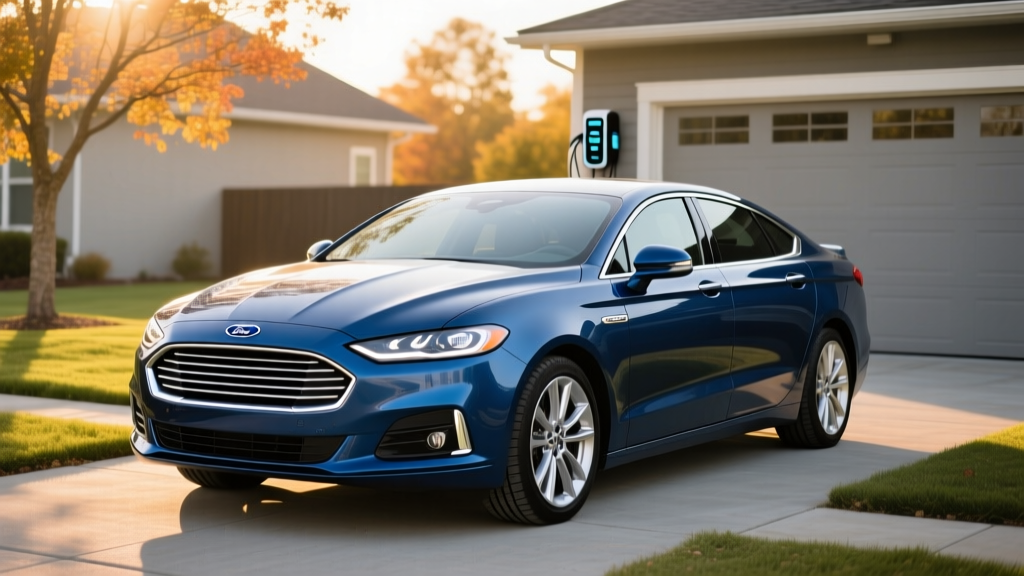
The Ford Fusion Hybrid was discontinued after the 2020 model year, but its reputation as a dependable, fuel-efficient midsize sedan keeps it high on the used-car radar in 2026. With gasoline prices remaining volatile and new hybrid inventory still tight, buyers are asking a pointed question: how does Ford Fusion Hybrid reliability hold up past 100,000 miles?
This guide breaks down the Fusion Hybrid's powertrain, real-world fuel economy, battery longevity, and ownership costs — and compares it against the plug-in hybrid variant (Fusion Energi) so you know exactly which version fits your driving pattern.
Ford Fusion Hybrid at a Glance: HEV vs. PHEV (Energi)
Ford offered two electrified Fusion variants. Understanding the difference is essential before shopping the used market:
| Attribute | Fusion Hybrid (HEV) | Fusion Energi (PHEV) |
|---|---|---|
| Powertrain type | Conventional hybrid — no plug | Plug-in hybrid — charges via outlet/charger |
| Battery capacity | 1.4 kWh (usable ~1.1 kWh) | 7.6 kWh usable (9.0 kWh gross) |
| EPA combined MPG | 42 MPG | 42 MPG (charge-sustaining) / 103 MPGe (charge-depleting) |
| Electric-only range | N/A (EV assist only, ~1 mi) | 26 miles (EPA) |
| Total range | ~560 miles | ~610 miles (EV + gas) |
| DC fast charging | No | No — Level 1/Level 2 only |
| Combined horsepower | 188 hp | 188 hp |
| Production years | 2013–2020 | 2013–2020 |
The conventional Fusion Hybrid generates all its electricity from regenerative braking and the gasoline engine — you never plug it in. The Fusion Energi, by contrast, can be charged at home on a standard 120V outlet (Level 1, ~7 hours for a full charge) or a 240V Level 2 charger (~2.5 hours). Neither variant supports DC fast charging.
Fuel Economy: EPA Sticker vs. Real-World MPG
The EPA rated the 2020 Ford Fusion Hybrid at 43 city / 41 highway / 42 combined MPG (fueleconomy.gov). The Fusion Energi, operating in hybrid mode after its electric range is depleted, matches that 42 MPG combined figure.
| Driving Scenario | Fusion Hybrid EPA | Fusion Hybrid Real-World |
|---|---|---|
| City | 43 MPG | 44–48 MPG (regen-heavy routes) |
| Highway (70 mph) | 41 MPG | 36–39 MPG |
| Combined | 42 MPG | 39–44 MPG |
| Cold weather (below 32°F) | — | 34–38 MPG |
Real-world insight: Like most hybrids, the Fusion Hybrid excels in stop-and-go city driving where regenerative braking recovers energy constantly. Owners commuting in dense urban areas routinely report 45+ MPG. Highway driving at sustained 70+ mph reduces the advantage — the 2.0L Atkinson-cycle engine does more work, and aerodynamic drag dominates. In winter, expect a 10–15% drop as the engine runs more frequently for cabin heat and the battery's charge/discharge efficiency decreases in cold temperatures.
Powertrain Specs and How the Hybrid System Works
Both the Fusion Hybrid and Energi share Ford's 2.0L inline-4 Atkinson-cycle engine paired with an electric motor and a planetary gearset eCVT (no traditional multi-speed transmission). Combined system output is 188 horsepower (141 hp from the engine, 118 hp from the electric motor — figures don't add linearly due to power-split architecture).
The eCVT is a key reliability advantage: it contains no belts, clutches, or bands to wear. Unlike conventional automatics or CVTs with push belts, the planetary gearset has proven extremely durable across Toyota and Ford hybrid platforms.
| Spec | Fusion Hybrid / Energi |
|---|---|
| Engine | 2.0L I-4 Atkinson cycle |
| Engine power | 141 hp @ 6,000 rpm |
| Electric motor | 118 hp permanent-magnet synchronous |
| Combined system output | 188 hp |
| Transmission | eCVT (planetary gearset) |
| 0–60 mph | ~8.1 seconds |
| Drivetrain | Front-wheel drive |
| Cargo volume | 12.0 cu ft (Hybrid) / 8.2 cu ft (Energi — battery intrudes) |
The Energi's larger battery pack eats into trunk space (8.2 vs 12.0 cu ft), which matters if you regularly haul luggage or gear. This is a practical trade-off that catches some used buyers off guard.
Ford Fusion Hybrid Reliability: Battery, Drivetrain, and Common Issues
Hybrid Battery Warranty (Original): 8 years / 100,000 miles (10 years / 150,000 miles in California and CARB-adopting states). Capacity retention threshold: Ford warranted the battery would not fall below a specified capacity during the warranty period. For used buyers in 2026, most Fusion Hybrids are approaching or past the original federal warranty window.
The Fusion Hybrid's high-voltage nickel-metal hydride (NiMH) battery pack (lithium-ion in later model years, starting with the 2013 refresh for the Energi and 2013+ for the Hybrid) has proven robust. Based on owner surveys and aggregated reliability data from sources like Consumer Reports, the Fusion Hybrid consistently scores average to above-average in powertrain reliability.
Battery Degradation and Replacement Cost
Hybrid battery degradation in the Fusion is gradual, not catastrophic. Most owners report 10–15% capacity loss by 120,000 miles — noticeable as a slight reduction in EV-assist frequency and a small MPG dip (1–2 MPG), but not a drivability issue. Complete battery failure before 150,000 miles is uncommon.
If replacement is needed:
- New OEM battery pack: $2,500–$4,000 installed at a Ford dealer
- Refurbished/remanufactured pack: $1,500–$2,500 installed at an independent hybrid specialist
- Individual cell/module replacement: $800–$1,500 (if only a subset of cells has failed — a hybrid shop can test and swap modules)
For context, a Toyota Camry Hybrid battery replacement runs a similar range. The Fusion's NiMH chemistry (in earlier models) is less energy-dense than modern NMC lithium-ion but is well-understood by independent repair shops, which keeps costs manageable.
Common Non-Battery Issues
- 12V auxiliary battery: Like all hybrids, the Fusion has a standard 12V battery that powers electronics. These typically last 3–5 years and cost $150–$250 to replace. A dead 12V battery will prevent the car from starting even if the hybrid battery is fully charged.
- Brake actuator: Some 2013–2014 models experienced brake booster issues addressed under extended warranty campaigns. Later model years (2017+) are largely unaffected.
- Coolant pump (inverter): A known wear item around 100,000–130,000 miles. Replacement runs $400–$700. Watch for a "Check Hybrid System" warning paired with reduced power.
- eCVT transmission: Extremely reliable. Failures are rare and typically linked to neglected coolant service rather than inherent design flaws.
Pricing in 2026: Used Market Values and Tax Credit Reality
Since the Fusion Hybrid was discontinued after 2020, no new units are available. Used pricing in early 2026:
| Model Year | Typical Mileage | Price Range (Private/Dealer) |
|---|---|---|
| 2017–2018 Hybrid | 70K–100K | $11,000–$15,500 |
| 2019–2020 Hybrid | 40K–75K | $15,000–$20,000 |
| 2017–2018 Energi (PHEV) | 70K–100K | $12,000–$16,500 |
| 2019–2020 Energi (PHEV) | 40K–75K | $16,000–$21,000 |
Tax credit situation: The federal §30D new-vehicle credit does not apply to the Fusion — it's discontinued and was never eligible under current battery-sourcing rules. However, the used clean vehicle credit (up to $4,000 or 30% of sale price, whichever is lower) may apply if you purchase a qualifying used Fusion Energi from a dealer for $25,000 or less and meet IRS income caps (IRS used EV credit rules). The conventional Hybrid does not qualify for this credit — it must be a plug-in vehicle with at least 7 kWh of battery capacity. Key caveats:
- Buyer AGI must not exceed $75,000 (single) / $150,000 (joint)
- Vehicle must be purchased from a licensed dealer (not private party)
- Vehicle must be at least 2 model years old
- Credit is non-refundable — you must have sufficient tax liability to use it
- Verify eligibility via the IRS and your tax professional before purchase
Hybrid vs. PHEV vs. Full EV: Which Fits Your Situation?
Choose the Fusion Hybrid (HEV) if:
- You lack home or workplace charging access
- You want maximum simplicity — no plugs, no charging apps, no range planning
- Your commute is 20–50 miles with frequent stop-and-go traffic
- You want the lowest purchase price and lowest maintenance overhead
Choose the Fusion Energi (PHEV) if:
- You can charge at home (even a standard 120V outlet covers the 26-mile EV range overnight)
- Your daily commute is under 25 miles round-trip — you'll drive almost entirely on electricity
- You still want gas-engine flexibility for road trips without range anxiety
- You want to potentially claim the used clean vehicle tax credit
Choose a full EV (e.g., Tesla Model 3, Hyundai Ioniq 6) if:
- You have reliable Level 2 home charging
- Your daily driving is under 250 miles and you can plan road-trip charging
- You want to eliminate gasoline entirely and minimize moving parts
- You qualify for the full $7,500 §30D new-vehicle credit on a current model
The Fusion Hybrid's biggest advantage over a full EV is zero infrastructure dependency. If you park on the street, live in an apartment without charging, or frequently drive rural routes with sparse DC fast-charging coverage, the conventional hybrid removes every charging-related variable from your life while still delivering 40+ MPG.
Pros and Cons: 2026 Used-Buyer Verdict
Pros
- Proven 42 MPG combined — real-world city driving often exceeds 45 MPG
- eCVT planetary gearset is one of the most durable transmissions in any vehicle class
- Hybrid battery replacement cost is manageable ($1,500–$4,000) with multiple options
- Strong parts availability and independent hybrid-shop support nationwide
- Energi PHEV variant may qualify for up to $4,000 used-vehicle federal tax credit
- Comfortable ride, spacious rear seat, composed highway manners
Cons
- Discontinued — no new models, no factory warranty remaining on most examples
- Highway MPG drops to 36–39 at 70+ mph (less highway-efficient than some rivals)
- Energi trunk space is only 8.2 cu ft due to battery placement
- No DC fast charging on Energi (Level 2 only — limits road-trip EV replenishment)
- Infotainment (SYNC 3) feels dated vs. 2026 competitors
- Hybrid battery is outside original warranty for most 2013–2016 examples
Frequently Asked Questions
How many MPG does the Ford Fusion Hybrid actually get?
The EPA rates it at 43 city / 41 highway / 42 combined. In real-world driving, city commuters regularly see 44–48 MPG thanks to regenerative braking. Highway cruising at 70+ mph typically yields 36–39 MPG. Cold weather (below freezing) can drop combined figures to 34–38 MPG.
How far can the Fusion Energi go on electric only?
The EPA-rated electric-only range is 26 miles. In mild weather at city speeds, some owners squeeze out 28–30 miles. At highway speeds or in cold weather, expect 20–22 miles before the gas engine engages. Total combined range (EV + gas) is approximately 610 miles.
Is the Ford Fusion Hybrid reliable past 100,000 miles?
Yes, with proper maintenance. The eCVT transmission and hybrid battery have proven durable well past 150,000 miles. The most common high-mileage expense is the inverter coolant pump ($400–$700) and eventual hybrid battery service. Overall, it rates as one of the more reliable midsize sedans in Ford's recent lineup, though it trails the Toyota Camry Hybrid in long-term reliability surveys.
What does a Fusion Hybrid battery replacement cost?
A new OEM pack from a Ford dealer runs $2,500–$4,000 installed. Refurbished packs from independent hybrid specialists cost $1,500–$2,500. Individual module replacement (if only partial failure) can be as low as $800–$1,500. Most batteries last 150,000+ miles before needing service.
Does the Ford Fusion Hybrid or Energi qualify for any tax credit in 2026?
The new-vehicle §30D credit does not apply — the Fusion is discontinued. However, the used clean vehicle credit (up to $4,000) may apply to the Fusion Energi (PHEV) if purchased from a dealer for under $25,000, subject to buyer income limits ($75K single / $150K joint). The conventional Hybrid does not qualify. Always confirm with a tax professional and review IRS guidelines before purchase.
Does the Fusion Hybrid need to be plugged in?
No. The conventional Fusion Hybrid (HEV) charges its battery entirely through regenerative braking and the gasoline engine. You fuel it like any other car. Only the Fusion Energi (PHEV) can be plugged in to charge its larger battery for electric-only driving.
How does Fusion Hybrid reliability compare to the Toyota Camry Hybrid?
The Camry Hybrid generally edges out the Fusion in long-term reliability ratings, particularly for battery longevity (Toyota's hybrid system has a longer track record). However, the Fusion offers competitive fuel economy, a more engaging driving feel, and lower used-market prices in 2026, making it a strong value pick if you budget for potential battery service.