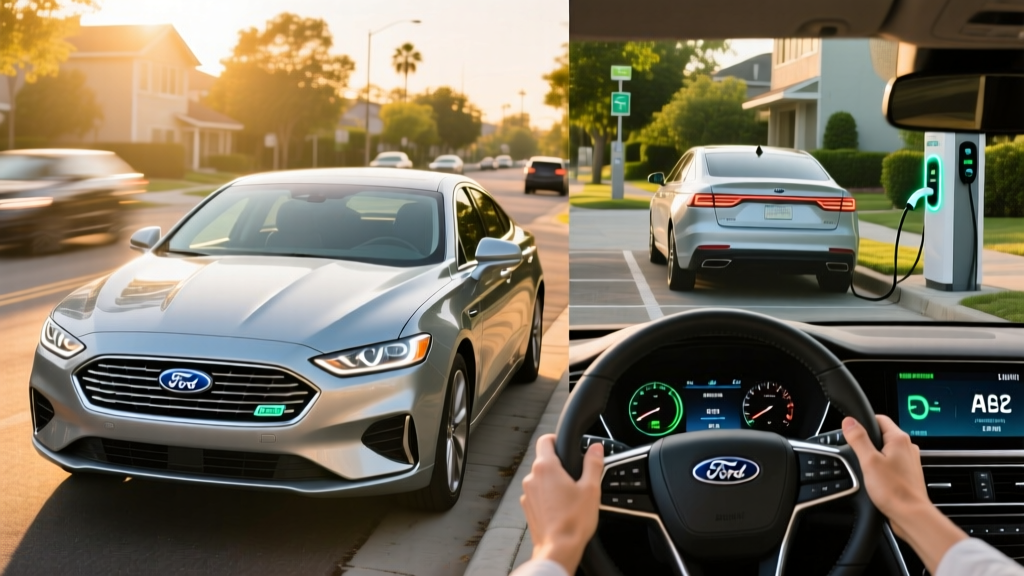
The Ford Fusion Hybrid was discontinued after the 2020 model year, but its reputation as one of the most fuel-efficient midsize sedans of its era keeps it in high demand on the used market in 2026. If you're researching Ford Fusion Hybrid fuel economy, you're likely weighing a used purchase against newer hybrids or full EVs — and you need exact numbers, not marketing nostalgia.
This guide breaks down the EPA and real-world MPG for both the conventional Fusion Hybrid (HEV) and the plug-in Fusion Energi (PHEV), battery reliability expectations, replacement costs, and whether either version still makes financial sense today.
Ford Fusion Hybrid vs. Fusion Energi: HEV and PHEV Explained
Ford sold two electrified Fusion variants, and confusing them is the most common buyer mistake. Here's the critical distinction:
Fusion Hybrid (HEV)
A conventional, self-charging hybrid. It pairs a 2.0L Atkinson-cycle gasoline engine with an electric motor and a small 1.4 kWh lithium-ion traction battery. You never plug it in. The battery recharges through regenerative braking and the engine. It operates seamlessly between electric and gas power, prioritizing electric drive at low speeds.
Fusion Energi (PHEV)
A plug-in hybrid with a larger 7.6 kWh lithium-ion battery (usable ~5.8 kWh) that you charge via a standard 120V outlet or a 240V Level 2 charger. It delivers a pure electric-only range before the gas engine engages, functioning as a conventional hybrid afterward.
Neither variant supports DC fast charging. The Energi charges exclusively on AC power (Level 1 or Level 2).
Ford Fusion Hybrid Fuel Economy: EPA and Real-World MPG
According to fueleconomy.gov, the 2020 Ford Fusion Hybrid (final model year) carries the following EPA estimates:
| Metric | EPA Estimate | Real-World Expectation |
|---|---|---|
| City MPG | 43 MPG | 40–46 MPG (hybrids excel in stop-and-go) |
| Highway MPG | 41 MPG | 36–40 MPG (sustained 70+ mph reduces regen benefit) |
| Combined MPG | 42 MPG | 38–44 MPG depending on driving mix |
| Annual Fuel Cost* | ~$1,250 | Varies with local gas prices and mileage |
*Based on 15,000 miles/year, 55% city driving, and $3.50/gallon regular unleaded.
Real-World MPG Insight
Conventional hybrids like the Fusion HEV often exceed their EPA city estimate in real-world driving. Regenerative braking recaptures energy at every stoplight, and the engine shuts off at idle. Owners who drive predominantly in urban or suburban conditions routinely report 44–47 MPG on forums and fuel-tracking apps like Fuelly. Highway-heavy commutes at 75+ mph will pull the average closer to 36–38 MPG, as aerodynamic drag dominates and the electric motor contributes less at sustained speed.
Fusion Energi PHEV: Electric-Only Range and Combined Efficiency
The Fusion Energi trades some trunk space (the larger battery intrudes into the cargo area) for the ability to drive on electricity alone. Here are the 2020 model-year figures from the EPA:
| Electric-Only Range | 26 miles (EPA) |
| Total Combined Range | ~370 miles (electric + gas) |
| MPGe (Electric Mode) | 103 MPGe combined |
| Gas-Only MPG (After Battery Depletes) | 42 MPG combined |
| Battery Capacity (Total / Usable) | 7.6 kWh / ~5.8 kWh |
| Level 1 Charge Time (120V) | ~7 hours (full) |
| Level 2 Charge Time (240V, 3.6 kW) | ~2.5 hours (full) |
| DC Fast Charge | Not supported |
| Combined Horsepower | 195 HP (engine + motor) |
| Engine | 2.0L Atkinson-cycle I4 (141 HP) + 88 kW electric motor |
The 26-mile electric-only range covers most daily commutes and errands. After the battery depletes, the car seamlessly transitions to hybrid mode at 42 MPG combined — identical to the standard Fusion Hybrid. This makes the Energi uniquely practical: pure electric for short trips, no range anxiety for long ones.
Charging practicality: Most Energi owners charge overnight on a standard 120V household outlet (Level 1). A full charge takes about 7 hours, which is sufficient if you plug in when you get home. A 240V Level 2 home charger cuts that to roughly 2.5 hours, useful if you need a midday top-up.
Powertrain Performance and Driving Dynamics
Both the Fusion Hybrid and Energi share Ford's eCVT powertrain architecture, which uses a planetary gearset to blend engine and motor power — not a traditional belt-driven CVT. This results in smooth, linear acceleration without the rubber-band feel associated with some CVTs.
The combined system output is 195 horsepower. The 0–60 mph time sits in the mid-8-second range, which is adequate for merging and passing but won't win any drag races. The Energi is slightly heavier due to its larger battery, adding roughly 300 lbs, which is noticeable in cornering but not in straight-line acceleration.
Regenerative braking in both models is moderate — it doesn't offer true one-pedal driving like a full BEV, but it does slow the car noticeably when you lift off the accelerator, reducing brake wear significantly. Many owners report original brake pads lasting 80,000+ miles.
Battery Reliability, Warranty, and Replacement Cost
Hybrid battery longevity is the top concern for used-buyers, and it's warranted concern — but the data is reassuring.
Original Battery Warranty
Ford covered the Fusion Hybrid and Energi high-voltage battery for 8 years or 100,000 miles (whichever comes first), with a capacity retention threshold of approximately 70%. In California Air Resources Board (CARB) states, the warranty extended to 10 years or 150,000 miles.
Since the last Fusion Hybrid rolled off the line in 2020, most examples in 2026 are now out of original factory warranty unless they have exceptionally low mileage or were sold in CARB states with the extended coverage.
Real-world degradation data: The Fusion's lithium-ion hybrid battery has proven durable. Taxi fleets and high-mileage owners have reported 200,000+ miles on the original pack with minimal capacity loss. The battery management system (BMS) keeps the pack in a conservative state-of-charge window (roughly 40–80%), which dramatically slows degradation compared to full EVs that regularly charge to 100%.
Replacement cost (2026 estimates):
- Fusion Hybrid (HEV) battery replacement: $2,500–$4,000 (remanufactured or new OEM pack, installed)
- Fusion Energi (PHEV) battery replacement: $5,000–$8,000 (larger pack, higher parts cost)
- Independent hybrid shops can often replace individual failed cells or modules for $800–$1,500, extending the pack's life at a fraction of full replacement cost
For context, a well-maintained Fusion Hybrid with 120,000 miles and a healthy battery represents a strong value proposition at $12,000–$16,000 in the 2026 used market. Budgeting $3,000–$4,000 as a battery replacement reserve eliminates the financial risk.
Tax Credits and Incentives for Used Hybrid Buyers
When new, the Fusion Energi qualified for a $4,007 federal tax credit under the old §30D rules. The standard Fusion Hybrid never qualified for a federal credit because it is not a plug-in vehicle.
As of 2026, the relevant incentive for used buyers is the Used Clean Vehicle Credit (§25E), which provides up to $4,000 or 30% of the sale price (whichever is lower) for qualified used plug-in hybrids and EVs purchased from a dealer. Key requirements per the IRS:
- Sale price must be $25,000 or less
- Buyer income caps: $75,000 (single), $112,500 (head of household), $150,000 (joint)
- Vehicle must be at least 2 model years old (all Fusions qualify)
- Must purchase from a licensed dealer (private-party sales excluded)
- The Fusion Energi (PHEV) qualifies; the standard Fusion Hybrid (HEV) does not qualify
- Credit is applied at point of sale or claimed on your tax return
Practical example: A used 2019 Fusion Energi purchased from a dealer for $17,000 by a qualifying buyer would yield a $4,000 credit (30% of $17,000 = $5,100, capped at $4,000), effectively reducing the cost to $13,000. This makes the Energi one of the best value propositions in the used PHEV market.
Some states offer additional rebates for used PHEVs. Check your state's energy office or the AFDC state incentive database for current programs.
Fusion Hybrid vs. Newer Alternatives: Which Should You Choose?
Choose the Used Fusion Hybrid If:
- Your budget is $12,000–$18,000 and you want proven hybrid efficiency
- You drive mostly city/suburban miles where it hits 44+ MPG
- You want a midsize sedan with a comfortable ride and strong safety ratings (IIHS Top Safety Pick)
- You don't have access to home charging (no plug needed)
- You want low maintenance costs and excellent parts availability
Choose the Fusion Energi PHEV If:
- Your daily commute is under 25 miles and you can charge at home
- You want to drive mostly on electricity but need gas flexibility for road trips
- You qualify for the $4,000 used clean vehicle credit
- You're willing to sacrifice ~5 cu ft of trunk space for the larger battery
- You want 103 MPGe for local driving with 370+ miles total range
Hybrid vs. PHEV vs. Full EV: The Decision Framework
Choose the Fusion Hybrid (HEV) if you have no reliable access to charging — no home outlet, no workplace charger — and simply want excellent fuel economy without changing any habits. It's the lowest-risk, lowest-complexity electrified option.
Choose the Fusion Energi (PHEV) if you can charge at home (even a standard 120V outlet works), your daily driving is under 30 miles, and you want to minimize gas consumption without committing to a full EV. The used §25E credit makes this the best financial play for qualifying buyers.
Choose a full EV (like a used Chevy Bolt, Tesla Model 3, or Hyundai Ioniq 5) if you have reliable Level 2 home charging, your daily driving is under 250 miles, and you want to eliminate gas entirely. Full EVs have lower operating costs but higher upfront prices and require charging infrastructure planning.
Ownership Costs and Long-Term Value
The Fusion Hybrid's ownership economics remain compelling in 2026. At 42 MPG combined and $3.50/gallon gas, fuel costs roughly $0.083 per mile. A comparable gas-only midsize sedan at 28 MPG costs $0.125 per mile — a difference of $630 per year at 15,000 miles annually.
Maintenance costs are below average for the segment. The hybrid system eliminates the traditional starter motor and reduces brake wear through regeneration. Oil changes are the primary recurring expense, and the eCVT transmission has no belts or fluid that requires regular replacement.
Insurance rates for the Fusion Hybrid are typically 5–10% lower than equivalent full EVs, reflecting lower repair costs and a mature parts supply chain.
Frequently Asked Questions
How many MPG does the Ford Fusion Hybrid actually get?
The EPA rates the 2020 Fusion Hybrid at 43 city / 41 highway / 42 combined MPG. In real-world driving, city-heavy commuters often see 44–47 MPG thanks to regenerative braking, while highway-dominant driving at 75+ mph yields 36–38 MPG. Your actual results depend heavily on your driving mix, speed, and climate.
How far can the Fusion Energi go on electric only?
The 2020 Fusion Energi has an EPA-rated 26 miles of electric-only range. In mild weather at moderate speeds (under 45 mph), some owners report 28–30 miles. In cold weather (below 35°F) or at highway speeds, expect 20–22 miles before the gas engine engages.
Does the Ford Fusion Hybrid need to be plugged in?
No. The standard Fusion Hybrid (HEV) charges its battery entirely through regenerative braking and the gasoline engine. You never plug it in. Only the Fusion Energi (PHEV) requires plugging in to access its electric-only range — but it will still function as a regular hybrid if you never charge it.
Is the Ford Fusion Hybrid reliable, and what does a battery replacement cost?
The Fusion Hybrid has a strong reliability record, with many examples exceeding 200,000 miles on the original battery. A replacement hybrid battery (HEV) costs $2,500–$4,000 installed; the Energi PHEV battery runs $5,000–$8,000. Independent hybrid specialists can often repair individual cells for $800–$1,500.
Does the Ford Fusion Hybrid or Energi qualify for a tax credit in 2026?
The standard Fusion Hybrid does not qualify for any federal tax credit. The Fusion Energi (PHEV) can qualify for the Used Clean Vehicle Credit (§25E) — up to $4,000 or 30% of the sale price — if you buy from a dealer for $25,000 or less and meet income requirements. Consult a tax professional for your specific eligibility.
How does the Fusion Hybrid compare to a Toyota Camry Hybrid?
The 2026 Toyota Camry Hybrid (LE) is EPA-rated at 52 MPG combined — 10 MPG better than the Fusion. However, a used 2019–2020 Camry Hybrid typically costs $20,000–$26,000, while a comparable Fusion Hybrid runs $12,000–$16,000. The Fusion trades some efficiency for a significantly lower entry price, and its real-world city MPG often narrows the gap.
What is the Fusion Hybrid's battery warranty in 2026?
Original factory coverage was 8 years/100,000 miles (10 years/150,000 miles in CARB states). Since the Fusion was discontinued after 2020, most examples are now beyond the standard warranty period unless they have very low mileage or were sold in California, New York, or other CARB-adopting states with the extended 10-year coverage.