Quick Verdict: The 2018 Ford Fusion Hybrid in 2026
The 2018 Ford Fusion Hybrid is a conventional hybrid electric vehicle (HEV) — meaning it never plugs in, generates its own electricity through regenerative braking and its gasoline engine, and delivers strong city fuel economy without any charging infrastructure. Ford discontinued the Fusion after the 2020 model year, so every 2018 Fusion Hybrid you encounter today is a used vehicle. That shifts the buying calculus entirely: instead of comparing MSRP and federal tax credits, you're evaluating battery health, remaining warranty, used-car pricing, and whether a seven-year-old hybrid still delivers on its efficiency promises.
The short answer: it often does. The 2018 Fusion Hybrid's powertrain is proven, its battery warranty may still have teeth, and its real-world city MPG frequently beats the EPA sticker. But highway drivers and those wanting electric-only commuting should look elsewhere.
Ford Fusion Hybrid vs. Fusion Energi: HEV and PHEV Explained
Ford sold two electrified Fusion variants in 2018, and confusing them is the most common mistake used buyers make. Here's the critical distinction:
Fusion Hybrid (HEV)
- Type: Conventional hybrid — no plug
- Battery: 1.4 kWh lithium-ion (usable ~1.0 kWh)
- Electric-only driving: Brief low-speed EV mode (~1 mile max)
- Refueling: Gasoline only, regenerative braking recharges battery
- EPA MPG: 43 city / 41 highway / 42 combined
Fusion Energi (PHEV)
- Type: Plug-in hybrid — requires charging for full benefit
- Battery: 7.6 kWh lithium-ion (usable ~5.8 kWh)
- Electric-only range: EPA-rated 21 miles
- Refueling: Plug in for EV range, then gasoline engine takes over
- MPGe: 97 MPGe (electric + gas combined); 42 MPG gas-only
This article focuses on the Fusion Hybrid (HEV). If you see a charge port on the front fender, you're looking at the Energi PHEV — a fundamentally different vehicle with different ownership economics. The Hybrid has no charge port anywhere on the body.
Fuel Economy: EPA Ratings vs. Real-World MPG
| Driving Condition | EPA Rating | Real-World Expectation |
|---|---|---|
| City | 43 MPG | 44–48 MPG (hybrids excel in stop-and-go) |
| Highway | 41 MPG | 37–40 MPG (electric assist diminishes at sustained speed) |
| Combined | 42 MPG | 40–44 MPG depending on driving mix |
| Cold weather (below 35°F) | — | 34–38 MPG (engine runs more for cabin heat) |
The 2018 Fusion Hybrid's 2.0-liter Atkinson-cycle four-cylinder engine pairs with an electric motor and Ford's eCVT (electronically controlled continuously variable transmission). Unlike some competitors, the Fusion Hybrid actually posts a higher city rating than highway — a hallmark of strong hybrid systems that recapture braking energy in urban driving.
In real-world ownership, city-dominant commuters regularly report 45+ MPG on forums and fueleconomy.gov user data. Highway-heavy drivers should expect to fall 2–4 MPG below the EPA combined figure. Cold weather hits all hybrids hard: the engine must run more frequently to provide cabin heat, and battery efficiency drops, reducing regenerative braking effectiveness.
For context, a comparably equipped 2018 Fusion with the 1.5L EcoBoost gas engine rates 23 city / 34 highway / 27 combined — making the Hybrid roughly 55% more efficient in mixed driving.
Powertrain and Performance Specs
| Specification | 2018 Ford Fusion Hybrid |
|---|---|
| Engine | 2.0L Atkinson-cycle I4 |
| Engine horsepower | 141 HP @ 6,000 RPM |
| Electric motor output | 120 HP (88 kW) |
| Combined system horsepower | 188 HP |
| Combined system torque | 129 lb-ft (engine) + motor torque |
| Transmission | eCVT (planetary gearset, not a belt CVT) |
| 0–60 mph | ~7.8 seconds |
| Drivetrain | Front-wheel drive |
| Battery chemistry | Lithium-ion (NMC) |
| Battery capacity | 1.4 kWh gross (~1.0 kWh usable) |
| Fuel tank | 13.5 gallons |
| Total driving range | ~567 miles (EPA combined) |
| Cargo volume | 12.0 cu ft (trunk; battery reduces space vs. gas model) |
The 188 combined horsepower is adequate for merging and passing, though the Fusion Hybrid won't feel quick. The eCVT uses a planetary gearset — fundamentally different from the rubber-belt CVTs in some competitors — and delivers smooth, seamless power delivery without the "rubber band" sensation. Ford's hybrid powertrain control software is mature by 2018, having been refined since the 2013 Fusion Hybrid launch.
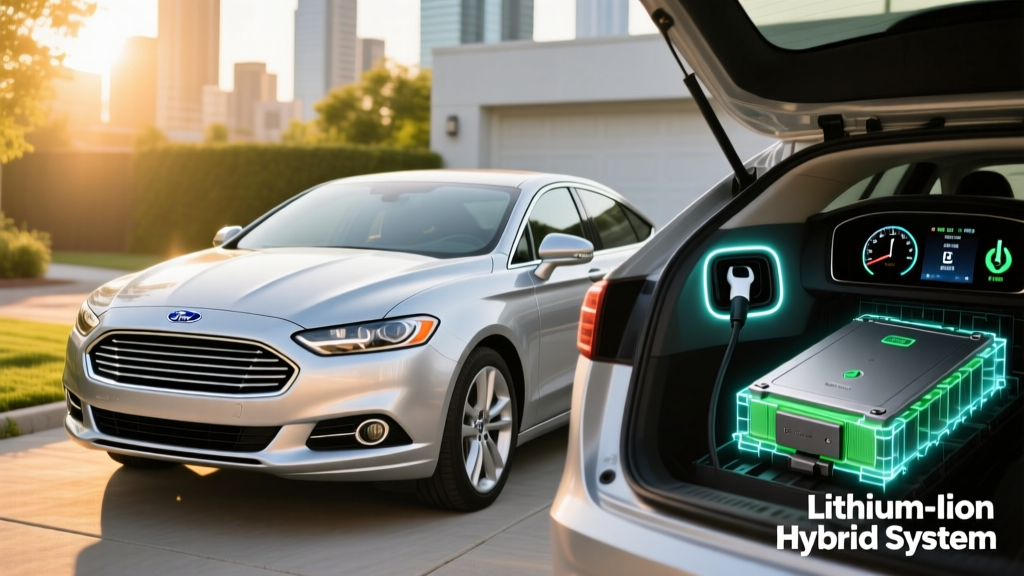
One practical note: the hybrid battery pack sits behind the rear seats, reducing trunk volume to 12.0 cubic feet compared to 16.0 cu ft in the gas-only Fusion. That's a meaningful loss for families who need luggage space.
Battery Lifespan, Warranty, and Replacement Cost
Ford Hybrid Battery Warranty
Coverage: 8 years / 100,000 miles (whichever comes first)
Capacity threshold: Ford warrants the battery against defects and abnormal capacity loss. If the battery fails to hold sufficient charge to operate the hybrid system properly, Ford will repair or replace it.
For a 2018 model in 2026: The original 8-year warranty is expiring or has expired depending on the in-service date. A vehicle first sold in March 2018 would see warranty expiration in March 2026. Verify remaining coverage with a Ford dealer using the VIN.
California/PZEV states: Hybrid components may carry extended 10-year/150,000-mile emissions-related warranty in CARB states (CA, CT, ME, MD, MA, NJ, NY, OR, RI, VT, WA). Check your state's rules.
The 2018 Fusion Hybrid's lithium-ion battery pack is smaller and less stressed than a full EV battery — it rarely sees deep discharge cycles, and the hybrid control system keeps it in a narrow state-of-charge window (roughly 40–60% SoC) to maximize longevity. This is why hybrid batteries routinely outlast their warranty periods.
Degradation reality: Most 2013–2018 Fusion Hybrid owners report minimal noticeable degradation at 100,000+ miles. The small battery isn't asked to deliver long EV range, so even 15–20% capacity loss is largely invisible in daily driving — you might see 1–2 MPG reduction over many years.
Replacement cost if out of warranty: A new OEM hybrid battery pack from Ford runs approximately $2,000–$3,500 for the part, with labor adding $500–$1,000. Total replacement typically lands between $2,500 and $4,500 at a dealership. Independent hybrid specialists and refurbished battery options can reduce this to $1,500–$2,500. This is dramatically less than EV battery replacement, which can exceed $10,000–$15,000 for larger packs.
Pricing, Trim Levels, and Tax Credit Reality
The 2018 Fusion Hybrid was sold in three trims:
- S Hybrid: ~$25,905 MSRP (base)
- SE Hybrid: ~$28,495 MSRP
- Platinum Hybrid: ~$35,195 MSRP (top trim, replaced Titanium for 2018)
Used market pricing in 2026: Expect to pay roughly $11,000–$16,000 for a 2018 Fusion Hybrid depending on mileage, condition, and trim. SE models with 60,000–90,000 miles cluster around $13,000–$14,500. Low-mileage Platinum trims may command $16,000–$18,000.
Federal tax credit: The 2018 Fusion Hybrid does not qualify for the federal §30D new clean vehicle credit — that credit applies only to new plug-in vehicles (EVs and PHEVs with sufficient battery capacity), and conventional HEVs have never qualified. The used clean vehicle credit (up to $4,000 or 30% of sale price, whichever is less) under §25E may apply if you purchase from a dealer and meet income requirements, but the vehicle must be at least two model years old (which a 2018 satisfies) and the sale price must be $25,000 or less. Given typical 2018 Fusion Hybrid used pricing falls well under $25,000, qualifying buyers could receive 30% of the purchase price as a credit — for example, $3,900 on a $13,000 purchase. Verify current eligibility on IRS.gov and consult a tax professional, as income caps ($75,000 single / $150,000 joint) apply.
Who Should Buy the 2018 Fusion Hybrid in 2026?
Choose the Fusion Hybrid If:
- Your commute is city-heavy with frequent stops (maximizes regen braking and MPG)
- You have no access to home or workplace charging (no plug needed)
- You want proven, low-risk hybrid technology with cheap battery replacement
- You're budget-conscious and want a comfortable midsize sedan under $15,000
- You drive 10,000–15,000 miles/year and want to cut fuel costs vs. a gas sedan
Look Elsewhere If:
- Your driving is mostly highway (a gas Fusion or a diesel may close the MPG gap)
- You want electric-only commuting (consider the Fusion Energi PHEV, or a used EV)
- You need maximum trunk space (the battery eats 4 cu ft of cargo room)
- You want the latest safety tech — the 2018 model lacks standard automatic emergency braking
- You want a vehicle still in production with long-term parts availability guarantees
Hybrid vs. PHEV vs. Full EV: Which Fits Your Situation?
| Factor | HEV (Fusion Hybrid) | PHEV (Fusion Energi) | Full EV (e.g., Tesla Model 3) |
|---|---|---|---|
| Plug-in required? | No | Yes, for EV range benefit | Yes, always |
| Electric-only range | ~1 mile at low speed | 21 miles (EPA) | 250–350+ miles |
| Total range | ~567 miles | ~610 miles (EV + gas) | 250–350 miles |
| Home charging needed? | No | Recommended (Level 1/2) | Essential (Level 2 strongly recommended) |
| Fuel cost per mile | ~$0.09 (at $3.50/gal) | ~$0.04 electric / $0.09 gas | ~$0.03–$0.05 (home charging) |
| Maintenance complexity | Low (proven hybrid) | Moderate (two full systems) | Lowest (no engine, oil, exhaust) |
| Used price range (2026) | $11,000–$16,000 | $12,000–$18,000 | $18,000–$30,000+ |
| Best for | No-charging commuters | Short-commute plug-in users | Home-charging households |
The decision framework is straightforward: if you cannot charge at home or work, the HEV is your only practical electrified option. If you can charge and your commute is under 20 miles, the Energi PHEV lets you drive mostly electric while keeping a gas backup. If you can install Level 2 home charging and want to eliminate gasoline entirely, a used EV offers the lowest operating cost — but at a higher purchase price.
Reliability, Safety, and Known Issues
The 2018 Fusion Hybrid benefits from Ford's second-generation hybrid system, which had most early bugs resolved by the 2017 refresh. The NHTSA gave the Fusion a 5-star overall safety rating. However, the 2018 model year predates Ford's standardization of automatic emergency braking — it was optional on SE and standard on Platinum, so verify equipment on any used example.
Common issues to inspect:
- 12V auxiliary battery: Like all hybrids, the Fusion has a conventional 12V battery that can fail independently of the hybrid pack. Symptoms include failure to start the hybrid system. Replace with an AGM-type battery (~$200–$300).
- Brake feel: The transition between regenerative and friction braking can feel slightly grabby as the pads engage — this is normal for the system, not a defect, but inspect brake pads and rotors as part of any used-car evaluation.
- Coolant system: The hybrid inverter and motor have a separate coolant loop. Verify service records show coolant checks. Inverter coolant pump failures are uncommon but can cause hybrid system warnings.
- Infotainment: SYNC 3 is reliable by 2018 standards but may feel dated. Apple CarPlay and Android Auto are standard on SE and above.
Parts availability remains strong in 2026 because the Fusion was one of Ford's highest-volume sedans, and the hybrid powertrain shares components with the Escape Hybrid, C-Max Hybrid, and Lincoln MKZ Hybrid. Ford has committed to supporting the Fusion platform with parts for years after discontinuation.
Frequently Asked Questions
How many MPG does the 2018 Ford Fusion Hybrid actually get?
The EPA rates it at 43 city / 41 highway / 42 combined. In real-world city-dominant driving, owners frequently achieve 44–48 MPG thanks to aggressive regenerative braking. Highway-heavy drivers should expect 37–40 MPG. Cold weather can drop combined figures to the mid-30s.
Does the 2018 Fusion Hybrid need to be plugged in?
No. The Fusion Hybrid is a conventional HEV — it charges its small battery entirely through regenerative braking and the gasoline engine. There is no charge port on the vehicle. If you see a charge port, it's the Fusion Energi PHEV, a different model.
Is the hybrid battery reliable, and what does replacement cost?
Ford's hybrid battery packs have a strong longevity record, often exceeding 150,000 miles with minimal degradation. The original warranty was 8 years/100,000 miles, which is expiring for 2018 models in 2026. Out-of-warranty replacement runs $2,500–$4,500 at a dealer or $1,500–$2,500 through independent hybrid shops using refurbished packs.
Does the 2018 Fusion Hybrid qualify for any tax credit?
Not the new-vehicle §30D credit — that's only for plug-in vehicles. However, the federal used clean vehicle credit (§25E) may apply: if you buy from a dealer for $25,000 or less and meet income caps ($75,000 single / $150,000 joint), you could receive 30% of the purchase price (up to $4,000) as a tax credit. Confirm details on IRS.gov.
Should I buy the Fusion Hybrid or the Fusion Energi PHEV?
Choose the Hybrid if you cannot charge at home and want maximum simplicity. Choose the Energi if you have home charging and a commute under 21 miles — you'll drive mostly electric on weekdays and use gas only for longer trips. The Energi's trunk is even smaller (8.2 cu ft) due to its larger battery, so cargo needs matter too.
Is the 2018 Fusion Hybrid still a smart buy in 2026?
For the right buyer, yes. At $11,000–$16,000, it offers midsize sedan comfort, strong city fuel economy, low operating costs, and proven reliability. The main risks are expiring battery warranty, discontinued-model parts uncertainty (though shared powertrain components mitigate this), and a trunk that's smaller than competitors. If your driving profile matches its strengths, it remains one of the best-value used hybrids on the market.