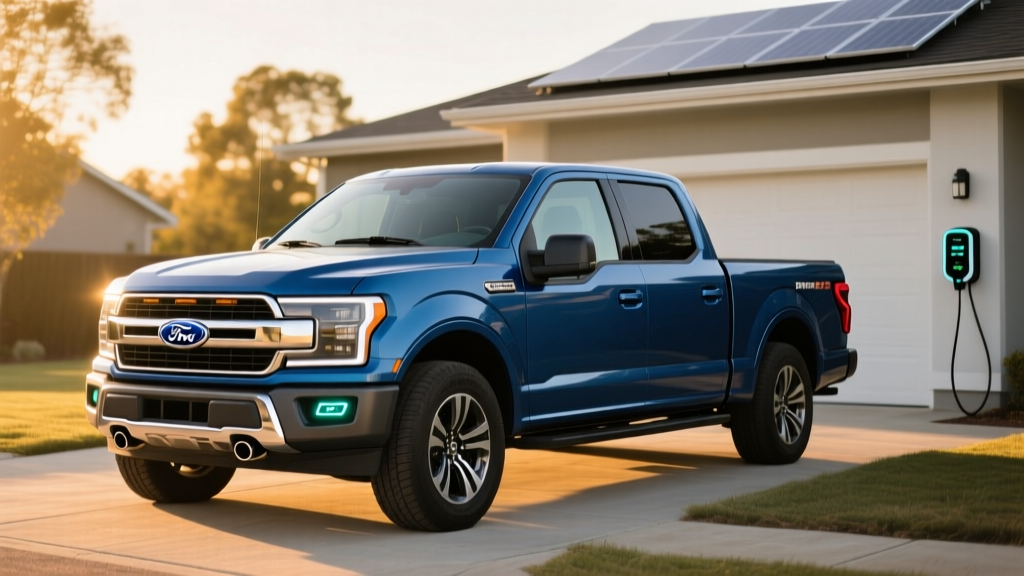
The Ford F-150 PowerBoost hybrid truck occupies a specific niche that full-electric pickups like the F-150 Lightning and gas-only F-150s cannot fill: it offers the range and refueling speed of a conventional truck with meaningful fuel savings and a built-in mobile generator, all without requiring a single plug-in charge. For 2026, the PowerBoost remains Ford's full hybrid (HEV) powertrain for the F-150 — it is not a plug-in hybrid (PHEV), and understanding that distinction is essential before you walk into a dealership.
This guide breaks down the exact numbers — EPA MPG, real-world fuel economy, towing capacity, battery warranty, and total cost of ownership — so you can decide whether the PowerBoost is the right F-150 powertrain for your driving pattern.
HEV vs PHEV: What the PowerBoost Actually Is
Conventional Hybrid (HEV) — Ford F-150 PowerBoost: The 1.5 kWh lithium-ion battery charges exclusively through regenerative braking and the gasoline engine. You never plug it in. The electric motor assists the engine and enables brief electric-only operation at low speeds, but the truck cannot travel meaningful distances on electricity alone.
Plug-In Hybrid (PHEV) — e.g., Ford Escape PHEV: A larger battery (typically 14+ kWh) charges from a wall outlet or public charger, enabling 30-40 miles of electric-only driving before the gas engine engages. PHEVs require regular plug-in charging to realize their efficiency advantage.
The PowerBoost is firmly in the HEV camp. If you want a truck you can drive on electricity alone for daily commutes, you would need to look at the F-150 Lightning (full BEV) or wait for Ford to potentially offer a PHEV variant — which as of 2026, does not exist for the F-150.
Ford F-150 PowerBoost Powertrain Specs
| Specification | 2026 F-150 PowerBoost |
|---|---|
| Engine | 3.5L twin-turbo V6 |
| Electric Motor | 47 hp (35 kW) integrated into 10-speed automatic transmission |
| Combined System Output | 430 hp / 570 lb-ft torque |
| Hybrid Battery | 1.5 kWh lithium-ion (not plug-in) |
| Transmission | 10-speed automatic |
| Drivetrain | RWD or 4WD |
| 0-60 mph | ~5.7 seconds (4WD) |
| Max Towing Capacity | 7,200 lbs (properly equipped) |
| Max Payload | 2,120 lbs |
| Pro Power Onboard | 2.4 kW standard / 7.2 kW available (bed outlets) |
| Fuel Tank | 30.6 gallons |
The 430 hp combined output puts the PowerBoost between the 3.5L EcoBoost V6 (400 hp) and the high-output variants. The 570 lb-ft of torque is the headline figure — it matches the diesel-like grunt that makes towing feel effortless, and the electric motor's instant torque fill eliminates the turbo lag you feel in the non-hybrid 3.5L EcoBoost.
EPA Fuel Economy and Real-World MPG
| Configuration | City MPG | Highway MPG | Combined MPG |
|---|---|---|---|
| PowerBoost 4x2 (RWD) | 25 | 26 | 25 |
| PowerBoost 4x4 | 23 | 24 | 23 |
| 3.5L EcoBoost 4x4 (non-hybrid baseline) | 18 | 23 | 20 |
Source: EPA Fuel Economy Guide (fueleconomy.gov)
Real-World MPG: What to Actually Expect
Full hybrids like the PowerBoost tend to meet or exceed EPA city estimates in real-world stop-and-go driving because regenerative braking recaptures energy that a gas truck wastes as heat. In mixed suburban driving, owners commonly report 23-26 MPG in the 4x4 configuration, aligning closely with the EPA sticker.
Highway fuel economy is where the advantage narrows. At sustained 75-80 mph, the electric motor contributes minimally and the truck's aerodynamic profile dominates fuel consumption. Expect 21-23 MPG on the highway in 4x4 trim — still better than the non-hybrid EcoBoost's ~19-20 MPG highway, but not the dramatic improvement you see in city driving.
Cold-weather impact: Unlike EVs, which can lose 20-30% range in sub-freezing temperatures, the PowerBoost's hybrid system is minimally affected. You may see a 1-2 MPG dip in winter due to cold-start enrichment and increased accessory loads, but the gas engine warms the cabin efficiently without the range penalty a BEV faces.
Total range on a single tank (4x4): Approximately 700 miles (30.6 gal × 23 MPG combined). This is a significant advantage over the F-150 Lightning's EPA range of 230-320 miles, especially for remote work sites and rural towing routes where DC fast chargers are scarce.
Pro Power Onboard: The Jobsite Generator
The PowerBoost's hybrid battery and motor enable a feature no gas-only F-150 can match: Pro Power Onboard. This system turns the truck into a mobile power source with outlets mounted in the bed.
- 2.4 kW (standard): Two 120V/20A outlets in the bed. Sufficient for power tools, a job-site radio, charging laptops, or running a small compressor.
- 7.2 kW (optional): Four 120V/20A outlets plus one 240V/30A outlet. Can run a welder, large air compressor, or provide backup power to essential home circuits during an outage via a transfer switch.
The 7.2 kW system can run for approximately 32 hours on a full tank at half load, or 8 hours at full load. For contractors who currently carry a separate Honda or Generac generator in the bed, Pro Power Onboard eliminates that equipment and frees up payload capacity.
Pricing, Trims, and Tax Credit Eligibility
The 2026 F-150 PowerBoost is available across multiple trim levels. Pricing reflects the hybrid premium over the equivalent 3.5L EcoBoost:
| Trim | Approx. Starting MSRP (4x2) | PowerBoost Availability |
|---|---|---|
| XLT | ~$55,000 | Available (option package) |
| Lariat | ~$62,000 | Available (option package) |
| King Ranch | ~$70,000 | Available |
| Platinum | ~$73,000 | Available |
| Limited | ~$85,000 | Standard |
The PowerBoost package typically adds $2,500-$4,400 over the 3.5L EcoBoost depending on trim, but it also includes the Pro Power Onboard 2.4 kW system and upgraded cooling.
Federal Tax Credit Status
The Ford F-150 PowerBoost does NOT qualify for the federal §30D Clean Vehicle Credit. The IRS restricts this credit to plug-in electric vehicles (BEVs and PHEVs) with a minimum battery capacity of 7 kWh and the ability to charge from an external source. The PowerBoost's 1.5 kWh self-charging battery does not meet these criteria.
If federal tax incentives are a primary purchase driver, the F-150 Lightning (full BEV) may qualify for up to $7,500 depending on battery sourcing, buyer income limits (AGI caps: $150K single / $300K joint), and MSRP caps ($80K for trucks). Consult a tax professional for your specific eligibility.
Hybrid Battery Warranty, Reliability, and Replacement Cost
Ford Hybrid Battery Warranty: 8 years / 100,000 miles (whichever comes first), covering defects and capacity loss below a defined threshold. In California Air Resources Board (CARB) states, the warranty extends to 10 years / 150,000 miles.
Expected Battery Lifespan: The 1.5 kWh battery is small, operates within a narrow state-of-charge window (never fully charged or fully depleted), and uses conservative thermal management. Based on Ford's hybrid track record with the Fusion Hybrid and Escape Hybrid — many of which exceed 200,000 miles on the original battery — PowerBoost owners should expect the hybrid battery to last the functional life of the truck under normal use.
Replacement Cost (out of warranty): Approximately $2,000-$3,500 for the hybrid battery module based on current Ford hybrid parts pricing. This is far less than a full EV traction battery replacement ($10,000-$20,000+) because the PowerBoost battery is small and modular.
Overall reliability for the PowerBoost powertrain has been solid since its 2021 introduction. The 3.5L twin-turbo V6 is one of Ford's most proven engines, and the hybrid system adds relatively few failure-prone components. The 10-speed automatic transmission, shared across the F-150 lineup, has had some historical complaints in non-hybrid applications, but the hybrid's electric motor smooths shift events and reduces clutch-pack wear.
PowerBoost vs Lightning vs Gas EcoBoost: Which F-150 Fits You?
Choose the PowerBoost Hybrid if:
- You tow frequently and need 700+ miles of range between fuel stops
- You work on job sites without charging infrastructure and need Pro Power Onboard
- You drive in rural areas or remote regions with limited DC fast charger access
- You want 15-20% better fuel economy than the gas EcoBoost without changing your refueling habits
- You need a truck today without waiting for charging-network buildout
Choose the F-150 Lightning (BEV) if:
- You can charge at home (Level 2) and your daily driving is under 250 miles
- You want to eliminate gasoline costs entirely ($0.04-$0.15/mile equivalent vs $0.18-$0.25/mile for PowerBoost)
- You qualify for the $7,500 federal tax credit (subject to income, MSRP, and sourcing rules)
- You want instant torque, a front trunk (frunk), and near-silent operation
- Your towing needs are moderate (Lightning max tow: 10,000 lbs, but range drops significantly when towing)
Choose the Gas 3.5L EcoBoost if:
- Your budget is tightest and you don't need Pro Power Onboard
- You drive primarily highway miles where the hybrid advantage is smallest
- You plan to keep the truck for a very short ownership cycle (2-3 years) where fuel savings won't offset the hybrid premium
5-Year Cost of Ownership Comparison
| Factor | PowerBoost 4x4 | 3.5L EcoBoost 4x4 | Lightning Lariat 4x4 |
|---|---|---|---|
| MSRP (approx.) | $62,000 | $58,500 | $70,000 |
| Federal Tax Credit | $0 | $0 | Up to $7,500* |
| Fuel/Energy (75K mi) | ~$9,800 | ~$11,400 | ~$3,400 |
| Maintenance (5 yr) | ~$3,200 | ~$3,800 | ~$1,800 |
| 5-Year Total (est.) | ~$75,000 | ~$73,700 | ~$67,700 |
*Lightning credit eligibility depends on battery sourcing, buyer AGI, and MSRP cap compliance. Assumes $0.14/kWh home charging. Gas at $3.50/gal. Source: fueleconomy.gov and manufacturer MSRP.
The PowerBoost saves roughly $1,600 in fuel over the gas EcoBoost across 75,000 miles — enough to partially offset the hybrid premium. Against the Lightning, it costs more to operate but eliminates range anxiety and charging dependency entirely.
Pros and Cons at a Glance
Pros
- 23-25 MPG combined — 15-20% better than gas EcoBoost in real-world driving
- 700+ mile total range on a single 30.6-gallon tank
- 570 lb-ft torque with instant electric torque fill — excellent for towing
- Pro Power Onboard (up to 7.2 kW) eliminates the need for a separate generator
- No plug-in charging required — operates exactly like a conventional truck
- Minimal cold-weather fuel economy penalty vs BEV range loss
- 8 yr / 100K mi hybrid battery warranty (10 yr / 150K mi in CARB states)
Cons
- $2,500-$4,400 hybrid premium over equivalent EcoBoost
- No federal tax credit eligibility (HEV, not PHEV or BEV)
- Highway MPG advantage over gas model is modest (~3 MPG)
- 7,200-lb max tow is lower than the 3.5L EcoBoost's 13,000-lb max (with Max Tow package)
- 1.5 kWh battery provides only brief electric-only operation at low speeds
- Heavier than non-hybrid F-150, slightly reducing payload capacity
Frequently Asked Questions
How many MPG does the Ford F-150 PowerBoost hybrid get?
The EPA rates the 2026 F-150 PowerBoost 4x4 at 23 city / 24 highway / 23 combined MPG. The 4x2 (RWD) version rates 25/26/25 MPG. In real-world suburban and city driving, owners typically match or slightly exceed EPA figures thanks to regenerative braking. Highway driving at 75+ mph yields 21-23 MPG in 4x4 trim.
Does the F-150 PowerBoost need to be plugged in?
No. The PowerBoost is a conventional full hybrid (HEV), not a plug-in hybrid (PHEV). The 1.5 kWh battery charges through regenerative braking and the gasoline engine. You refuel at any gas station and never need a charger.
How far can the F-150 PowerBoost drive on electric only?
The PowerBoost can operate on electric power alone only at very low speeds (under ~25 mph) for very short distances — typically a fraction of a mile, such as creeping through a drive-through or moving quietly in a residential area. It is not designed for electric-only commuting. If you need electric-only range, consider the F-150 Lightning (230-320 miles EPA) or a PHEV.
Is the F-150 PowerBoost hybrid reliable?
Ford's full-hybrid system has proven reliable since its introduction in the 2021 F-150 and its predecessors in the Fusion Hybrid and Escape Hybrid. The 3.5L EcoBoost V6 is a well-established engine, and the small 1.5 kWh battery operates conservatively within a narrow charge window, which promotes longevity. The hybrid battery carries an 8-year/100,000-mile warranty (10 years/150,000 miles in CARB states). Out-of-pocket replacement, if ever needed, is estimated at $2,000-$3,500.
Does the F-150 PowerBoost qualify for any tax credit?
No. The federal §30D Clean Vehicle Credit applies only to plug-in vehicles (BEVs and PHEVs) with at least 7 kWh of battery capacity and external charging capability. The PowerBoost's 1.5 kWh self-charging battery does not qualify. Some states may offer separate incentives for hybrid vehicles — check your state's energy or environmental agency for current programs.
How does PowerBoost towing compare to the gas F-150 and Lightning?
The PowerBoost maxes out at 7,200 lbs of towing capacity. The gas 3.5L EcoBoost with the Max Tow Package can tow up to 13,000 lbs. The F-150 Lightning can tow up to 10,000 lbs, though towing significantly reduces its electric range (expect roughly 50-60% range reduction when towing heavy loads). If your primary need is maximum towing, the gas EcoBoost with Max Tow remains the strongest choice.
What is Pro Power Onboard and is it worth it?
Pro Power Onboard converts the PowerBoost's hybrid system into a mobile generator with 120V and (on the 7.2 kW version) 240V outlets in the truck bed. For contractors, tradespeople, or homeowners who need portable power for tools, equipment, or emergency backup, it eliminates the need for a standalone generator. The 7.2 kW system can run for up to 32 hours on a full tank at half load. If you regularly use a portable generator, this feature alone can justify the hybrid premium.
Specifications based on Ford manufacturer data and EPA Fuel Economy Guide. Pricing reflects approximate MSRP and may vary by dealer, region, and configuration. Tax credit rules per IRS §30D guidelines are subject to change; consult a tax professional for eligibility.