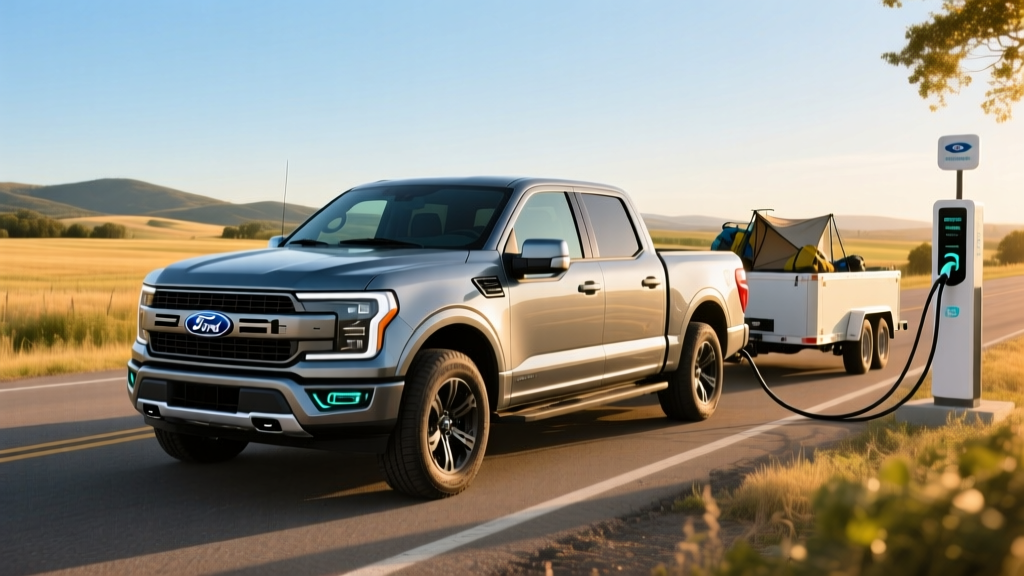
Ford's full-size truck strategy in 2026 runs on three powertrains: the EcoBoost V6 gasoline engines, the Lightning battery-electric, and the PowerBoost Full Hybrid sitting squarely in between. For buyers who need serious towing capability but want to cut fuel costs without plugging in, the Ford hybrid trucks lineup — anchored by the F-150 PowerBoost — remains one of the most practical electrified options on the market.
This guide covers exactly what the PowerBoost system delivers in real-world driving, how its fuel economy stacks up against the EPA sticker, what you'll pay across trims, and whether a conventional hybrid (HEV), plug-in hybrid (PHEV), or full battery-electric (BEV) truck is the right call for your situation.
Ford F-150 PowerBoost: The Only Full-Size Hybrid Truck That Tow
The F-150 PowerBoost pairs Ford's twin-turbocharged 3.5-liter EcoBoost V6 with a 35 kW (47 hp) electric motor integrated directly into the 10-speed automatic transmission. Combined output is 430 horsepower and 570 lb-ft of torque — figures that put it ahead of the standard 3.5L EcoBoost and in the same territory as Ford's 5.0L V8, but with substantially better fuel economy.
Unlike the F-150 Lightning, the PowerBoost is a conventional hybrid (HEV). It cannot plug in. A 1.5 kWh lithium-ion battery pack captures energy from regenerative braking and engine overrun, then deploys it for electric assist during acceleration, low-speed crawling, and engine-start smoothing. You never charge it externally — you simply fuel up and drive.
| Spec | Value |
|---|---|
| Powertrain | 3.5L Twin-Turbo V6 + 35 kW electric motor |
| Combined Output | 430 hp / 570 lb-ft torque |
| Transmission | 10-speed automatic |
| Drivetrain | RWD or 4WD |
| Battery | 1.5 kWh lithium-ion (not plug-in) |
| EPA Fuel Economy (4WD) | 23 city / 24 hwy / 24 combined MPG |
| EPA Fuel Economy (RWD) | 25 city / 26 hwy / 25 combined MPG |
| Max Towing Capacity | 7,800 lbs (properly equipped) |
| Max Payload | ~2,120 lbs |
| 0–60 mph | ~5.8 seconds |
| Pro Power Onboard | Up to 7.2 kW (standard on PowerBoost) |
| Base MSRP (2026) | ~$55,000 (XLT PowerBoost 4WD) |
The PowerBoost is available across several trims — typically XLT, Lariat, King Ranch, and Platinum — though availability shifts by model year. Ford positions it as a premium powertrain upgrade, so expect a $3,000–$4,000 upcharge over the equivalent 3.5L EcoBoost depending on trim.
Real-World MPG: What Owners Actually See
The EPA rates the F-150 PowerBoost 4WD at 24 MPG combined (23 city / 24 highway), per fueleconomy.gov. The RWD variant bumps that to 25 combined.
In practice, hybrid trucks behave differently than their EPA numbers suggest depending on driving style:
- City and suburban driving: This is where hybrids shine. Frequent stops let regenerative braking recharge the 1.5 kWh battery, and the electric motor handles low-speed launches. Owners consistently report 24–27 MPG in city-heavy commuting, sometimes exceeding the EPA city figure.
- Highway cruising at 70–80 mph: Aerodynamic drag dominates, and the hybrid advantage narrows. Expect 21–23 MPG on sustained interstate runs — slightly below the EPA highway rating.
- Towing and heavy payload: Fuel economy drops significantly when pulling 5,000+ lbs. Owners report 12–16 MPG while towing, which is still competitive with non-hybrid V6 and V8 trucks under load but far from the EPA combined figure.
- Cold weather: Battery efficiency drops and the engine runs more frequently for cabin heat. Expect a 1–3 MPG reduction in sustained sub-freezing temperatures.
| Driving Scenario | EPA Estimate | Real-World Expectation |
|---|---|---|
| City (stop-and-go) | 23 MPG | 24–27 MPG |
| Highway (70 mph cruise) | 24 MPG | 21–23 MPG |
| Combined | 24 MPG | 22–25 MPG |
| Towing (5,000+ lbs) | N/A | 12–16 MPG |
| Cold weather (below 32°F) | N/A | 20–22 MPG combined |
The bottom line: if your driving is mostly city and suburban with light loads, the PowerBoost delivers measurable fuel savings over a conventional 3.5L EcoBoost (rated at 20 MPG combined 4WD). On a 15,000-mile year, that's roughly 125 fewer gallons — about $400–$500 in fuel savings at $3.50/gallon.
HEV vs. PHEV vs. BEV: Which Ford Truck Fits Your Life?
Ford offers three electrified paths for truck buyers in 2026. Understanding the distinction between a conventional hybrid (HEV), a plug-in hybrid (PHEV), and a battery-electric vehicle (BEV) is essential before choosing.
| Factor | F-150 PowerBoost (HEV) | Maverick PHEV (if available) | F-150 Lightning (BEV) |
|---|---|---|---|
| Plug-in required? | No — gas only | Yes — for EV range | Yes — always |
| Electric-only range | None (motor assist only) | ~30–40 mi (est. PHEV) | 230–320 mi (EPA) |
| Total range | ~700+ mi | ~500+ mi | 230–320 mi |
| Towing (max) | 7,800 lbs | ~2,000 lbs | 7,700–10,000 lbs |
| Fuel/energy cost per mile | ~$0.15 | ~$0.06 (EV) / $0.13 (gas) | ~$0.05–$0.08 |
| Federal tax credit (§30D) | Not eligible | Up to $7,500 (if qualifies) | Up to $7,500 (if qualifies) |
| Home charging needed? | No | Recommended (Level 2) | Essential (Level 2) |
| Best for | Tow-heavy, no plug access | Short commutes + weekend hauling | Home-charging access, daily driver |
Choose the PowerBoost HEV if: You tow frequently, lack home charging access, drive in rural areas with sparse charging infrastructure, or want zero lifestyle change from your current gas truck while still reducing fuel consumption.
Choose a PHEV if: Your daily commute is under 40 miles, you can install a Level 2 charger at home, and you only tow occasionally. Ford's compact Maverick has been a strong seller, and a PHEV variant (announced/expected) would let you run most daily miles on electricity while keeping a gas engine for longer trips.
Choose the F-150 Lightning BEV if: You have reliable home Level 2 charging, your daily driving is under 250 miles, you want the lowest per-mile operating cost, and you're willing to plan around charging on road trips. The Lightning qualifies for the §30D federal tax credit (subject to income, MSRP, and battery-sourcing requirements — see the tax credit section below).
Pricing, Trims, and the Tax Credit Question
The 2026 F-150 PowerBoost is not a budget truck. As a premium powertrain option, it pushes F-150 pricing into the mid-$50K range and above:
- XLT PowerBoost 4WD: ~$55,000 MSRP
- Lariat PowerBoost 4WD: ~$62,000 MSRP
- King Ranch / Platinum PowerBoost: ~$70,000–$78,000 MSRP
Prices vary by options, packages, and dealer markups. Ford periodically adjusts powertrain availability by trim, so confirm with your local dealer or Ford's build-and-price tool.
Does the F-150 PowerBoost Qualify for a Federal Tax Credit?
No. The IRS §30D New Clean Vehicle Credit applies only to plug-in electric vehicles — battery-electric (BEV) and plug-in hybrid (PHEV) models that meet battery capacity, critical-mineral sourcing, MSRP caps, and buyer income thresholds. The PowerBoost is a conventional hybrid (HEV) with a 1.5 kWh battery and no plug-in capability. It does not qualify for the federal EV tax credit.
Some states offer separate incentives for conventional hybrids, but these are increasingly rare as state programs shift focus to plug-in vehicles. Check your state's energy or environmental agency website for current programs.
Battery & Powertrain Warranty
Ford covers the F-150 PowerBoost hybrid battery and hybrid-specific components under its Hybrid/Electric Vehicle Component Warranty: 8 years or 100,000 miles (whichever comes first). The standard powertrain warranty covers the engine and transmission for 5 years or 60,000 miles. The hybrid battery is sealed and maintenance-free — there is no scheduled replacement interval. Real-world data from Ford's earlier hybrid systems (Escape Hybrid, Fusion Hybrid) shows these batteries routinely lasting 150,000+ miles with minimal degradation due to the small 1.5 kWh capacity and conservative state-of-charge management.
Pro Power Onboard: The Jobsite Advantage
One feature unique to the PowerBoost (and Lightning) is Ford's Pro Power Onboard, which turns the truck into a mobile generator. The PowerBoost comes standard with a 7.2 kW onboard generator — enough to simultaneously run:
- A 120V circular saw and a jobsite radio
- A 240V welder (within wattage limits)
- Multiple 120V outlets in the bed and cabin
- Campsite appliances, tailgate setups, or emergency home backup via transfer switch
The 7.2 kW system is a genuine differentiator over the standard 2.0 kW or 4.0 kW Pro Power options on gas-only F-150s. For contractors, it eliminates the need for a separate tow-behind generator. For homeowners, it can power essential circuits during an outage for hours on a single tank of gas.
Reliability and Long-Term Ownership Costs
Ford's PowerBoost system has been in production since the 2021 model year, giving it several years of real-world data. Key reliability considerations:
- Hybrid battery longevity: The 1.5 kWh pack is small and managed conservatively — it never fully charges or fully depletes, which is the single best predictor of lithium-ion longevity. Ford's earlier hybrid vehicles (Escape, Fusion) have demonstrated battery lifespans well beyond 150,000 miles. Replacement cost, if needed outside warranty, is estimated at $2,000–$4,000 for the small pack — far less than a full EV battery replacement.
- Transmission: The 10-speed automatic (co-developed with GM) has had software refinement updates across model years. It is well-proven in millions of Ford and GM vehicles.
- Brakes: Regenerative braking reduces wear on the friction brakes. Many hybrid truck owners report brake pad life exceeding 80,000 miles.
- Insurance: Hybrid F-150s typically carry insurance premiums similar to EcoBoost variants — slightly higher than base V6 models due to the higher MSRP, but lower than Lightning premiums in most states.
Pros
- 24 MPG combined is exceptional for a 7,800-lb-tow-capable truck
- 430 hp / 570 lb-ft provides strong acceleration and passing power
- 7.2 kW Pro Power Onboard standard — true mobile generator
- No plug-in required — zero infrastructure dependency
- 8-year/100,000-mile hybrid component warranty
- Proven 10-speed automatic transmission
- Regenerative braking extends brake pad life significantly
Cons
- No federal tax credit eligibility (HEV, not PHEV/BEV)
- $3,000–$4,000 upcharge over standard 3.5L EcoBoost
- Highway MPG drops below EPA estimate at sustained 75+ mph
- Towing MPG falls to 12–16 MPG (no hybrid magic under heavy load)
- Not available in base XL trim (premium trims only)
- 1.5 kWh battery provides no electric-only driving capability
Who Should Buy a Ford Hybrid Truck — And Who Shouldn't
The PowerBoost occupies a specific niche. Here's the decision framework:
Buy the F-150 PowerBoost if:
- You tow a boat, camper, or trailer regularly and need max towing capacity
- You live in an apartment, rent, or lack access to home EV charging
- Your daily driving includes substantial city and suburban stop-and-go miles
- You want onboard generator capability (Pro Power 7.2 kW) for work or recreation
- You want lower fuel costs without changing your fueling habits
Look elsewhere if:
- Your commute is short and predictable — a PHEV or BEV will save more per mile
- You want federal tax credit eligibility — only plug-in vehicles qualify under §30D
- You primarily drive highway miles at 75+ mph — the hybrid advantage is minimal
- You want the lowest possible operating cost — the Lightning BEV wins on cents-per-mile
- You're on a tight budget — the PowerBoost requires mid-to-high trim levels ($55K+)
Frequently Asked Questions
How many MPG does the Ford F-150 PowerBoost hybrid get?
The EPA rates the 2026 F-150 PowerBoost 4WD at 23 city / 24 highway / 24 combined MPG. The RWD version is rated at 25 city / 26 highway / 25 combined. In real-world driving, city-heavy commutes often yield 24–27 MPG thanks to regenerative braking, while sustained highway driving at 75+ mph typically returns 21–23 MPG. Source: fueleconomy.gov.
Can the F-150 PowerBoost drive on electric power alone?
No. The PowerBoost is a conventional hybrid (HEV), not a plug-in hybrid. The 1.5 kWh battery and 35 kW electric motor assist the gasoline engine during acceleration and low-speed operation but cannot propel the truck on electricity alone for any meaningful distance. You will never see an "EV mode" range display.
Is the F-150 PowerBoost hybrid reliable?
Ford's hybrid system has been in production since 2021 in the F-150, with predecessor hybrid systems in the Escape and Fusion dating back to 2005. The hybrid battery is small (1.5 kWh) and managed conservatively — it never reaches full charge or full depletion, which maximizes lithium-ion cycle life. The 8-year/100,000-mile hybrid component warranty provides substantial coverage. No widespread battery failure patterns have been reported for the PowerBoost system.
What does it cost to replace the F-150 PowerBoost hybrid battery?
If replacement is needed outside the 8-year/100,000-mile warranty, the 1.5 kWh hybrid battery pack is estimated at $2,000–$4,000 installed. This is a fraction of a full EV battery replacement ($10,000–$20,000+) because the pack is small. Based on Ford's hybrid track record, most owners will never need a battery replacement during typical ownership.
Does the F-150 PowerBoost qualify for the $7,500 federal EV tax credit?
No. The IRS §30D New Clean Vehicle Credit applies only to plug-in vehicles — battery-electric (BEV) and plug-in hybrid (PHEV) models that meet specific battery capacity, critical-mineral sourcing, MSRP, and buyer income requirements. The PowerBoost is a conventional hybrid with no plug-in capability and is not eligible. The F-150 Lightning (BEV) may qualify, depending on your income, the vehicle's MSRP, and current battery-sourcing rules. Always verify eligibility at irs.gov or with a tax professional.
How does the PowerBoost compare to the F-150 Lightning for towing?
The PowerBoost is rated for up to 7,800 lbs of towing, while the Lightning Extended Range can tow up to 10,000 lbs. However, towing dramatically reduces the Lightning's range — expect a 40–60% reduction at highway speeds with a heavy trailer, meaning a 320-mile EPA truck may deliver only 130–190 miles between charges. The PowerBoost loses MPG while towing (12–16 MPG) but can refuel in five minutes at any gas station. For frequent long-distance towing, the PowerBoost remains the more practical choice in 2026.
Does the PowerBoost require premium fuel?
No. The 3.5L EcoBoost V6 in the PowerBoost runs on regular 87-octane unleaded gasoline. Ford recommends premium for maximum performance in extreme conditions (high ambient temperature, heavy towing at altitude), but it is not required for normal operation.