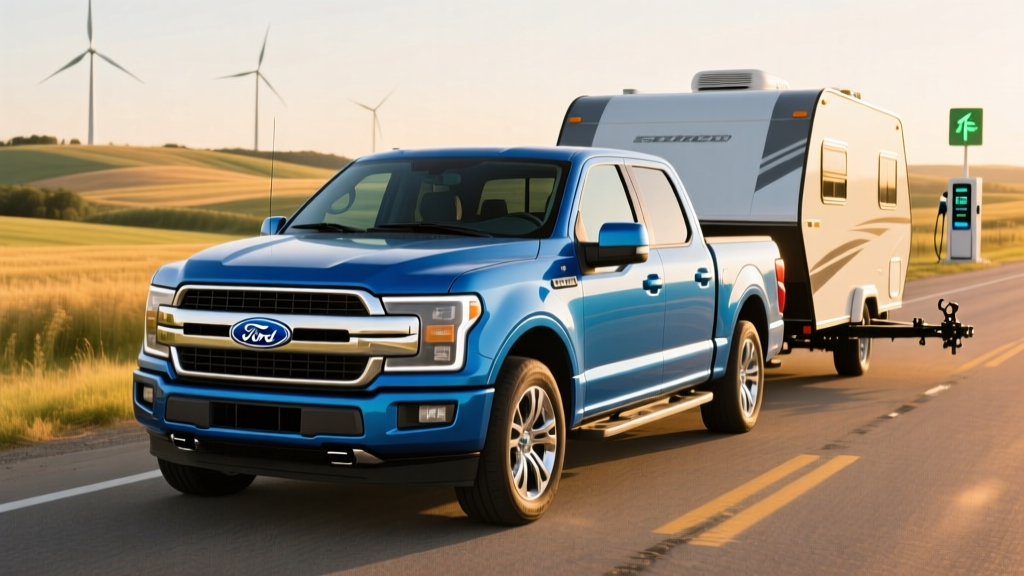
The Ford F-150 PowerBoost pairs a twin-turbo V6 with a 47-horsepower electric motor sandwiched into a 10-speed automatic transmission. The result is Ford's most potent F-150 gasoline powertrain at 430 combined horsepower and 570 lb-ft of torque — plus the best fuel economy in the half-ton truck segment. Unlike a plug-in hybrid, the 3.5L PowerBoost Full Hybrid V6 is a conventional hybrid (HEV): it never plugs in, regenerates energy during braking, and runs on regular fuel. For truck buyers who tow, haul, and commute without wanting to manage a charging routine, it occupies a narrow but compelling middle ground between a traditional gas truck and a full EV like the F-150 Lightning.
PowerBoost Powertrain: How the Hybrid V6 Works
The 3.5L PowerBoost Full Hybrid V6 isn't a detuned engine with a small electric assist. It combines a 400-hp twin-turbocharged 3.5-liter EcoBoost V6 with a 47-hp (35 kW) electric motor integrated directly into the modular hybrid transmission (MHT). The system routes torque through a 10-speed automatic to either rear- or four-wheel drive.
| Specification | Value |
|---|---|
| Combined Horsepower | 430 hp |
| Combined Torque | 570 lb-ft |
| Engine | 3.5L twin-turbo V6 (400 hp / 370 lb-ft) |
| Electric Motor | 47 hp (35 kW) / 221 lb-ft, integrated in MHT |
| Hybrid Battery | 1.5 kWh lithium-ion (non-plug-in HEV) |
| Transmission | 10-speed automatic |
| Drivetrain | RWD or 4WD |
| Max Towing (properly equipped) | 7,800 lbs (4WD); 7,400 lbs (RWD) |
| Max Payload | ~2,120 lbs |
| Pro Power Onboard | 2.4 kW standard / 7.2 kW optional |
| 0-60 mph | ~5.8 seconds (MotorTrend tested) |
Because the battery is only 1.5 kWh, it serves as a buffer rather than a primary energy source. The motor smooths out turbo lag, provides silent low-speed electric-only creeping (typically under 1 mile at low speeds), and captures regenerative braking energy. You never plug it in — the gasoline engine recharges the pack while driving.
HEV vs PHEV vs EV: Where PowerBoost Fits
Truck buyers now face a genuine three-way choice. Here's how the PowerBoost compares structurally to a plug-in hybrid truck (such as the Ram 1500 Ramcharger EREV expected for 2026) and the battery-electric F-150 Lightning:
| Category | HEV (PowerBoost) | PHEV / EREV (e.g., Ramcharger) | BEV (F-150 Lightning) |
|---|---|---|---|
| Plug-in Required? | No | Yes (for EV range) | Yes (always) |
| Electric-Only Range | ~0.5-1 mi at low speed | ~60-70 mi (announced) | 230-320 mi (EPA) |
| Total Range | ~700+ mi | ~690 mi combined | 230-320 mi |
| Fuel/Energy Cost per Mile | ~$0.16 (gas) | ~$0.05 (EV) / $0.14 (gas) | ~$0.04-$0.08 |
| Towing Range Impact | Moderate MPG drop | Severe EV range loss | Severe range loss (40-60%) |
| Federal Tax Credit (§30D) | Not eligible | Up to $7,500 (if qualified) | Up to $7,500 (if qualified) |
The PowerBoost's advantage is simplicity: no plug, no range anxiety while towing, no charging-curve math on road trips. Its trade-off is higher per-mile fuel cost versus either electrified alternative on daily commuting.
EPA Fuel Economy and Real-World MPG
| Drivetrain | City | Highway | Combined |
|---|---|---|---|
| RWD | 25 MPG | 26 MPG | 25 MPG |
| 4WD | 23 MPG | 24 MPG | 24 MPG |
Source: fueleconomy.gov (EPA estimates; verify current model year).
In mixed suburban driving with moderate loads, owners consistently report 22-26 MPG combined — sometimes beating the EPA city figure because regenerative braking rewards stop-and-go traffic. Highway cruising at 75+ mph with an empty bed typically yields 21-23 MPG in 4WD models. When towing a 5,000-lb travel trailer, expect 10-13 MPG — a significant drop but still better than the 3.5L EcoBoost gas counterpart under the same load. Cold weather and short trips can knock city MPG down to 18-20 until the engine reaches operating temperature.
Compared to the non-hybrid 3.5L EcoBoost V6 (EPA 19/24/21 for 4WD), the PowerBoost saves roughly 3 MPG combined — translating to approximately 80 fewer gallons per year at 15,000 miles, or about $240 annually at $3/gallon.
Pro Power Onboard: The Worksite Advantage
One feature unique to Ford's hybrid truck is Pro Power Onboard — an integrated generator that turns the PowerBoost's hybrid battery and gasoline engine into a mobile power source. The standard 2.4 kW system handles job-site tools and camping gear; the optional 7.2 kW version can run a welder, circular saw, and air compressor simultaneously, or back up essential home circuits during an outage via a transfer switch.
This is where the hybrid's value proposition sharpens: a competing gas truck idling to run a generator burns fuel loudly and inefficiently, while the PowerBoost's electric motor and buffered battery deliver clean, quiet, sustained AC power. For contractors, emergency responders, and off-grid campers, this capability often justifies the hybrid premium on its own.
Trims, Pricing, and Tax Credit Eligibility
The PowerBoost is available on most F-150 trims from XLT upward, typically as a $2,500-$3,300 upgrade over the equivalent 3.5L EcoBoost depending on trim. Approximate 2026 MSRP ranges (including destination):
- XLT PowerBoost 4WD: ~$55,000-$58,000
- Lariat PowerBoost 4WD: ~$64,000-$68,000
- King Ranch / Platinum: ~$72,000-$78,000
- Limited: ~$86,000+
Because the 3.5L PowerBoost Full Hybrid V6 is a conventional HEV — not a plug-in — it does not qualify for the federal §30D clean vehicle tax credit (up to $7,500). That credit applies only to battery-electric and plug-in hybrid vehicles meeting battery-sourcing and buyer-income requirements per IRS rules. Some states and utilities offer modest rebates for any hybrid purchase; check your local program. The PowerBoost's financial case rests on fuel savings, Pro Power Onboard utility, and resale value rather than purchase incentives.
Battery Warranty, Reliability, and Replacement Cost
Ford covers the PowerBoost hybrid battery and hybrid-specific components for 8 years or 100,000 miles (whichever comes first), in compliance with CARB-emissions states; in states following federal emissions rules, coverage is 8 years/80,000 miles. The powertrain (engine, transmission, motor) is also covered for 5 years/60,000 miles under Ford's standard powertrain warranty.
Hybrid battery longevity data from Ford's earlier Fusion Hybrid and Escape Hybrid platforms — many of which are still running past 200,000 miles on original packs — suggests the 1.5 kWh PowerBoost pack is conservatively sized and thermally managed for long life. Because the pack is small and rarely cycled deeply, degradation risk is low compared to a full BEV or PHEV battery.
If replacement is ever needed out of warranty, current dealer pricing for a PowerBoost hybrid battery module ranges roughly $2,500-$4,000 installed — far less than a full BEV traction battery. The 3.5L EcoBoost engine itself is a proven, high-volume Ford design with extensive service history; the hybrid-specific components (MHT motor, inverter) have proven reliable in fleet use.
Who Should Choose the PowerBoost Hybrid?
Choose the 3.5L PowerBoost Full Hybrid V6 if:
- You tow regularly (5,000+ lbs) and need the 700+ mile total range gas provides
- You lack home charging access and don't want to depend on public DC fast chargers
- You need Pro Power Onboard for worksite, camping, or home backup
- You want the most fuel-efficient gas truck without changing your fueling habits
- You drive 15,000+ miles/year where the 3-MPG advantage compounds into real savings
Look at a PHEV or full EV instead if:
- Your daily commute is under 40 miles and you can charge at home (a PHEV or BEV slashes fuel cost dramatically)
- You rarely tow and prioritize lowest per-mile energy cost
- You want access to the §30D federal tax credit or HOV-lane perks
- You have access to cheap home or workplace electricity
PowerBoost Pros
- Best-in-class gas-truck fuel economy (25 MPG combined RWD)
- 430 hp / 570 lb-ft — most powerful gas F-150
- Pro Power Onboard up to 7.2 kW
- No plug-in required; 700+ mile range
- Strong towing (7,800 lbs) with less MPG penalty than pure gas
- Proven 3.5L EcoBoost architecture
PowerBoost Cons
- No federal tax credit (HEV, not PHEV/BEV)
- $2,500-$3,300 hybrid premium over EcoBoost
- Electric-only mode limited to under 1 mile at low speed
- Towing MPG still drops to 10-13 MPG
- Heavier than non-hybrid (slight payload penalty)
- Higher MSRP trims push past $75,000
Frequently Asked Questions
How many MPG does the 3.5L PowerBoost Full Hybrid V6 get?
The EPA rates the 2026 F-150 PowerBoost at 25 city / 26 highway / 25 combined (RWD) or 23/24/24 (4WD). Real-world owners typically report 22-26 combined, with city driving sometimes exceeding the EPA figure thanks to regenerative braking. Towing drops economy to roughly 10-13 MPG depending on trailer weight and terrain.
Is the PowerBoost a plug-in hybrid?
No. The 3.5L PowerBoost Full Hybrid V6 is a conventional hybrid (HEV). It never plugs in. The 1.5 kWh battery charges via regenerative braking and the gasoline engine. If you want plug-in capability in a Ford truck, you'd look at the F-150 Lightning (full EV) or wait for Ford's future PHEV offerings.
How far can the PowerBoost drive on electric power alone?
Only a fraction of a mile at very low speeds (parking lots, traffic creep). The hybrid system is designed to assist the gas engine and recover braking energy, not to provide meaningful electric-only range like a PHEV or BEV. Its electric motor's primary job is torque-fill and efficiency, not propulsion independence.
Is the PowerBoost hybrid reliable, and what does battery replacement cost?
Ford's hybrid systems have proven durable across the Fusion, Escape, and Maverick lineups, with many packs exceeding 200,000 miles. The PowerBoost battery is covered for 8 years/100,000 miles. Out-of-warranty replacement currently runs approximately $2,500-$4,000 installed — modest compared to a full BEV battery.
Does the F-150 PowerBoost qualify for a federal tax credit?
No. The IRS §30D clean vehicle credit applies only to plug-in electric vehicles (BEVs and PHEVs) meeting battery-sourcing and buyer-income requirements. The PowerBoost, as a non-plug-in HEV, does not qualify. Some states or utilities offer small hybrid rebates; verify with your local program and a tax professional.
How does PowerBoost compare to the F-150 Lightning for towing?
The Lightning offers 230-320 miles of EPA range unloaded but can lose 40-60% of that range when towing a heavy trailer — cutting practical towing range to 120-180 miles. The PowerBoost sacrifices MPG while towing (10-13 MPG) but retains its full 700+ mile range from a gas tank, making it far more practical for long-distance trailer hauling where charging infrastructure is sparse.
Sources: fueleconomy.gov (EPA estimates), Ford Motor Company official specifications, IRS §30D guidance. Always verify current model-year specs with your dealer and tax eligibility with a qualified tax professional.