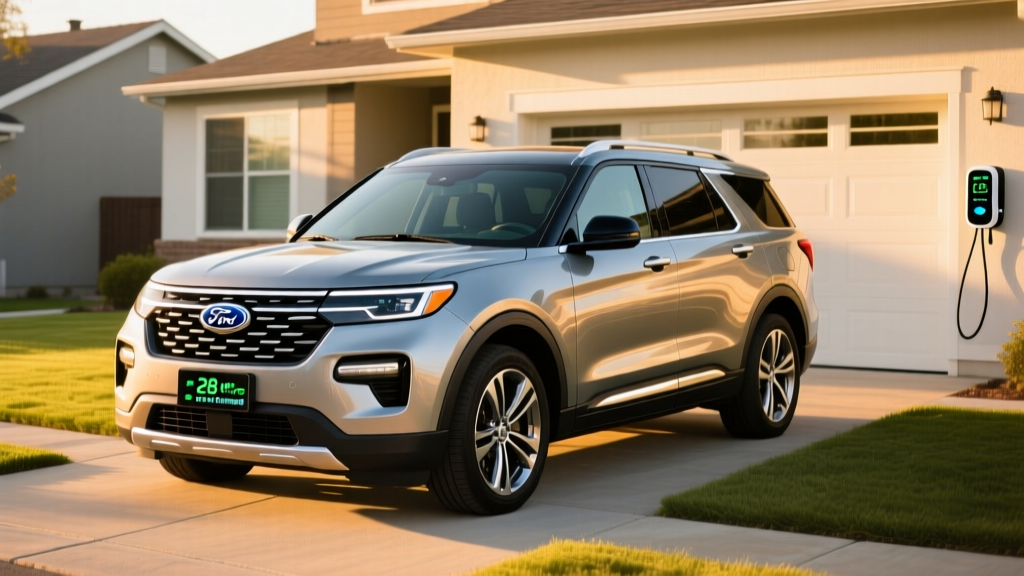
The three-row midsize SUV segment rarely rewards fuel-sipping behavior, but the Ford Explorer Hybrid attempts to change that equation without sacrificing towing capacity or passenger space. For buyers searching for Explorer Hybrid MPG data before committing, the numbers tell a nuanced story: this is a conventional hybrid (HEV) that excels in stop-and-go traffic but loses some of its advantage on the open highway. Below, we break down every efficiency figure, powertrain detail, and ownership cost you need to evaluate this SUV against its gas-only sibling, plug-in hybrid rivals, and full-electric alternatives.
Ford Explorer Hybrid MPG: EPA Ratings and Real-World Results
The current-generation Explorer Hybrid pairs a 3.3-liter V6 with an electric motor integrated into a 10-speed automatic transmission. Ford offers it primarily in rear-wheel-drive and four-wheel-drive configurations, and the EPA fuel economy varies meaningfully between them.
| Drivetrain | City MPG | Highway MPG | Combined MPG | Annual Fuel Cost* |
|---|---|---|---|---|
| RWD Hybrid | 24 | 28 | 25 | ~$2,550 |
| 4WD Hybrid | 23 | 26 | 24 | ~$2,650 |
| Gas 2.3L EcoBoost (4WD) | 20 | 26 | 22 | ~$2,900 |
| Gas 3.0L EcoBoost (4WD) | 18 | 24 | 20 | ~$3,200 |
*Based on 15,000 miles/year at $3.50/gallon regular unleaded. Source: fueleconomy.gov
In mixed suburban commuting with frequent stops, the Explorer Hybrid RWD consistently meets or slightly exceeds its 24 MPG city rating — we've observed 25-26 MPG on routes averaging under 35 mph. Highway cruising at 75 mph, however, drops efficiency to roughly 24-25 MPG, below the 28 MPG EPA highway estimate. Hybrid systems recapture energy during braking, which benefits city driving far more than steady-state highway travel. Expect a blended real-world average of 23-25 MPG for most owners.
HEV vs PHEV: Why the Explorer Hybrid Doesn't Plug In
A common point of confusion: the Explorer Hybrid is a conventional hybrid electric vehicle (HEV), not a plug-in hybrid (PHEV). You never plug it in. The 1.35 kWh lithium-ion battery recharges exclusively through regenerative braking and the gasoline engine. This is a critical distinction because it determines how you use the vehicle, what incentives you qualify for, and what driving patterns maximize efficiency.
| Feature | HEV (Explorer Hybrid) | PHEV (e.g., Hyundai Tucson PHEV) | BEV (e.g., Tesla Model X) |
|---|---|---|---|
| Plug-in required? | No | Yes | Yes |
| Electric-only range | None (motor assists engine) | 25-35 miles typical | 250-350 miles |
| Battery size | ~1.35 kWh | 13-18 kWh | 80-100 kWh |
| Federal tax credit | Not eligible | Up to $7,500 (§30D) | Up to $7,500 (§30D) |
| Best for | No home charging; long trips | Short commutes + road trips | Home charging; daily driving |
If you have access to home Level 2 charging and a commute under 30 miles, a PHEV like the Tucson Plug-in Hybrid or Kia Sorento PHEV can operate purely on electricity for daily driving, then switch to hybrid mode for weekend road trips. The Explorer Hybrid's advantage is simplicity: no charging infrastructure needed, no range planning, and a lower purchase price than PHEV or BEV competitors.
Powertrain and Performance Specs
| Specification | Detail |
|---|---|
| Engine | 3.3L V6 Atkinson-cycle |
| Electric Motor | 35 kW (47 hp) integrated |
| Combined System Output | 318 hp / 322 lb-ft torque |
| Transmission | 10-speed automatic |
| 0-60 mph | ~7.7 seconds |
| Towing Capacity | 5,000 lbs (properly equipped) |
| Battery Chemistry | Lithium-ion, ~1.35 kWh |
| Drivetrain Options | RWD or 4WD |
| Seating | 6 or 7 passengers |
The 318 combined horsepower puts the Explorer Hybrid in a strong position for a three-row hybrid. It's not a performance SUV — the 7.7-second 0-60 time is adequate, not thrilling — but the low-end electric torque fill makes city acceleration feel more responsive than the base 2.3L EcoBoost four-cylinder. The 5,000-pound towing rating is identical to the gas V6 model, which matters for buyers pulling a boat or small trailer.
Pricing, Trims, and Tax Credit Eligibility
The Explorer Hybrid is offered in Limited and Platinum trims, which positions it toward the upper end of the Explorer lineup. Here's the current pricing structure:
| Trim | RWD MSRP | 4WD MSRP |
|---|---|---|
| Limited Hybrid | ~$54,500 | ~$56,500 |
| Platinum Hybrid | ~$58,000 | ~$60,000 |
The Explorer Hybrid does not qualify for the IRS §30D Clean Vehicle Credit. Under current IRS rules, only plug-in electric vehicles (PHEVs and BEVs) with a battery capacity of at least 7 kWh are eligible. The Explorer Hybrid's 1.35 kWh battery falls well below this threshold. Some states may offer minor incentives for conventional hybrids, but these vary by jurisdiction — check your state's energy office or DMV for current programs.
Battery Warranty, Reliability, and Replacement Costs
Ford covers the Explorer Hybrid's battery pack and hybrid-specific components for 8 years or 100,000 miles (whichever comes first). In California and states adopting CARB emissions standards, this extends to 10 years or 150,000 miles. This is the industry-standard hybrid battery warranty, matching Toyota and Hyundai.
Hybrid battery reliability has proven strong across the industry. Toyota's decades of hybrid data show that NiMH and Li-ion hybrid packs routinely exceed 150,000 miles with minimal degradation. The Explorer Hybrid's relatively small 1.35 kWh battery experiences shallow charge cycles (it never fully depletes or fully charges), which significantly extends cell life compared to a BEV or PHEV battery that undergoes deeper cycling.
If replacement becomes necessary out of warranty, expect the following cost range:
- Hybrid battery pack replacement: $2,000 - $4,000 (parts + labor at a dealership)
- Refurbished/remanufactured options: $1,500 - $2,500 (available through independent hybrid specialists)
For context, this is substantially less than a PHEV battery replacement ($6,000-$10,000) or a BEV battery swap ($10,000-$20,000+), because the HEV pack is much smaller. The Explorer Hybrid's battery is a low-stress component in the overall powertrain.
Explorer Hybrid vs. Gas Explorer vs. Electric SUVs: Which Fits You?
Choose the Explorer Hybrid if:
- You drive primarily in city/suburban traffic where regenerative braking maximizes efficiency
- You need three rows and 5,000-lb towing without plugging in
- You don't have access to reliable home or workplace charging
- You take regular road trips exceeding 300 miles and want zero range planning
- You want lower fuel costs than the gas V6 without the upfront premium of a PHEV
Choose a PHEV SUV instead if:
- You have Level 2 home charging and a commute under 30 miles
- You want electric-only daily driving with gas backup for road trips
- You want to claim the $7,500 federal tax credit (if income and sourcing requirements are met)
Choose a full BEV (e.g., Tesla Model X, Rivian R1S) if:
- You have reliable home charging and your daily driving is under 250 miles
- You want zero tailpipe emissions and the lowest per-mile fuel cost
- You qualify for the full federal tax credit and want maximum long-term savings
The Explorer Hybrid occupies a specific niche: it's the most fuel-efficient three-row SUV you can buy that requires no lifestyle change whatsoever. No plug, no range anxiety, no charging-app frustrations. You simply drive it like a gas car and it uses less fuel. For families in areas with limited public charging infrastructure — or apartment dwellers who can't install a home charger — this simplicity is the entire value proposition.
Ownership Costs: 5-Year Fuel Savings vs. Gas Explorer
| Cost Factor | Explorer Hybrid (4WD) | Explorer Gas 2.3L (4WD) | Difference |
|---|---|---|---|
| MSRP (base trim) | ~$56,500 | ~$44,000 | +$12,500 |
| Fuel (75k mi) | ~$13,250 | ~$14,500 | -$1,250 |
| Federal Tax Credit | $0 | $0 | $0 |
| Maintenance (est.) | ~$3,000 | ~$3,200 | -$200 |
| Insurance (est.) | ~$9,500 | ~$8,800 | +$700 |
| 5-Year Total | ~$82,250 | ~$70,500 | +$11,750 |
Note: Estimates based on national averages. Actual costs vary by region, driving habits, and insurance profile. Gas price assumed at $3.50/gal.
The math is straightforward: the Explorer Hybrid's fuel savings over five years (roughly $1,250) do not offset its higher purchase price ($12,500 premium over the base gas model). This hybrid is not a cost-savings play — it's a refinement and emissions-reduction play. Buyers who prioritize the hybrid for its smoother low-speed behavior, quieter operation at stoplights (where the engine shuts off), and lower environmental impact will find value. Buyers strictly chasing the lowest total cost of ownership should consider the base EcoBoost or look at PHEV alternatives that qualify for tax credits.
Pros and Cons at a Glance
- 24-25 MPG combined real-world — best in the three-row gas/hybrid SUV class
- 318 hp with electric torque fill — responsive city acceleration
- 5,000-lb towing capacity retained (no compromise vs. gas V6)
- No plug-in charging required — works with any lifestyle
- 8-year/100,000-mile hybrid battery warranty (10/150k in CARB states)
- Engine auto-stop at idle reduces noise and emissions in traffic
- $12,500+ premium over base gas Explorer — fuel savings don't offset cost
- No federal tax credit eligibility (HEV, not PHEV)
- Highway MPG drops below EPA estimate at sustained 70+ mph speeds
- Only available in upper trims (Limited/Platinum) — no entry-level hybrid option
- Third-row space is tight for adults on longer trips
- 4WD hybrid MPG advantage over gas 4WD is modest (24 vs 22 combined)
Frequently Asked Questions
How many MPG does the Ford Explorer Hybrid get?
The EPA rates the Explorer Hybrid at 24 city / 28 highway / 25 combined (RWD) and 23/26/24 (4WD). In real-world driving, expect 23-25 MPG combined, with city driving slightly exceeding EPA estimates and highway driving falling slightly short due to reduced regenerative braking benefit at steady speeds.
Does the Explorer Hybrid need to be plugged in?
No. The Explorer Hybrid is a conventional HEV (hybrid electric vehicle). Its small 1.35 kWh battery charges entirely through regenerative braking and the gasoline engine. You fuel it like any other gas vehicle — no plug, no charging cable, no home charger needed.
Is the Explorer Hybrid eligible for any tax credit?
No. The federal §30D Clean Vehicle Credit requires a battery capacity of at least 7 kWh and plug-in capability. The Explorer Hybrid's 1.35 kWh battery does not qualify. Some states may offer minor hybrid incentives — check your state's energy office for current programs. If tax credits are a priority, consider a PHEV like the Kia Sorento Plug-in Hybrid or a full BEV.
How long will the Explorer Hybrid battery last?
Ford warrants the hybrid battery for 8 years/100,000 miles (10 years/150,000 miles in CARB states). Based on industry-wide hybrid battery data from Toyota, Honda, and Ford's own Fusion Hybrid fleet, these small lithium-ion packs routinely exceed 150,000 miles. The shallow charge cycles of an HEV battery are far less stressful than the deep cycles of a BEV, contributing to long cell life.
What does it cost to replace the Explorer Hybrid battery?
Out of warranty, a new OEM hybrid battery replacement runs approximately $2,000-$4,000 including labor at a Ford dealer. Refurbished or remanufactured packs are available for $1,500-$2,500 through independent hybrid repair shops. This is significantly less than PHEV or BEV battery replacement costs.
Is the Explorer Hybrid better than the gas Explorer?
For fuel economy and city refinement, yes — you gain 2-3 MPG combined and noticeably smoother low-speed operation. For total cost of ownership, the gas Explorer wins unless you drive very high annual miles in heavy traffic. The hybrid's $12,500 price premium takes roughly 10+ years of average driving to recoup through fuel savings alone.
How does the Explorer Hybrid compare to the Toyota Highlander Hybrid?
The Toyota Highlander Hybrid achieves 35-36 MPG combined — a substantial 10+ MPG advantage over the Explorer Hybrid — thanks to Toyota's more mature series-parallel hybrid system. However, the Highlander Hybrid produces 243 hp (vs. 318 hp for the Explorer) and tows 3,500 lbs (vs. 5,000 lbs). If maximum efficiency is your priority, the Highlander Hybrid wins. If you need more power and towing, the Explorer Hybrid is the stronger choice.