Quick Verdict: The Escape Hybrid for Efficiency-Minded SUV Buyers
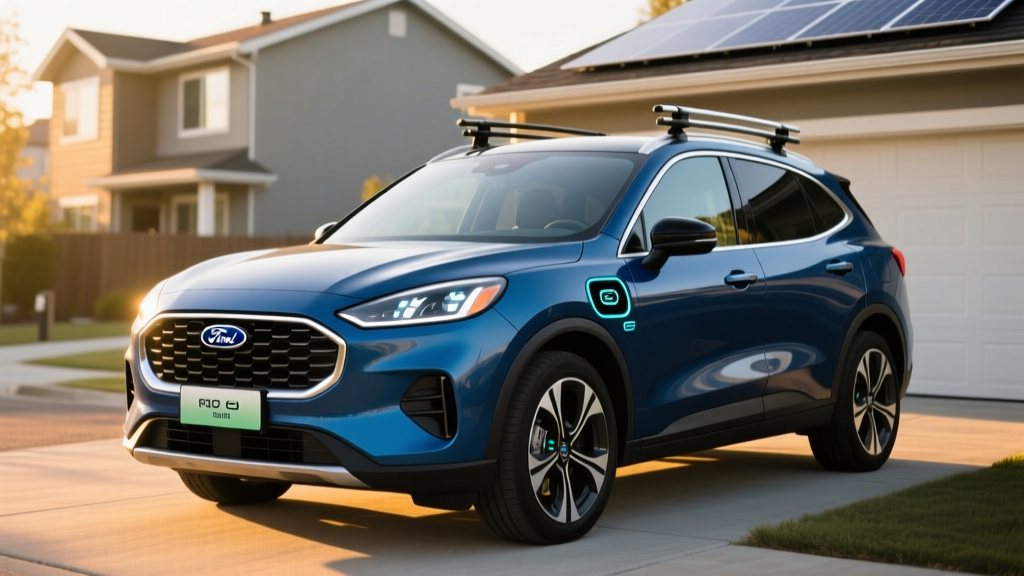
The 2026 Ford Escape Hybrid occupies a practical middle ground: a compact crossover that delivers diesel-rivaling fuel economy without requiring a plug. With an EPA-rated 39 MPG combined and 210 combined horsepower, it out-economies nearly every gas-only rival while offering standard all-wheel drive and a familiar SUV footprint. For buyers not yet ready to commit to a full battery electric vehicle (BEV) or those who lack home charging access, the Escape Hybrid makes a compelling case — especially when you factor in the real-world MPG gains hybrids tend to achieve in city driving.
| Spec | Value |
|---|---|
| EPA MPG (City / Highway / Combined) | 42 / 36 / 39 MPG |
| Combined Horsepower | 210 hp |
| Powertrain | 2.5L Atkinson-cycle I-4 + permanent-magnet electric motor |
| Drivetrain | Standard AWD (eCVT) |
| Seating | 5 passengers |
| Cargo Volume (behind rear seats) | 34.4 cu ft |
| Base MSRP (ST-Line Hybrid) | $35,990 |
| Federal EV Tax Credit (§30D) | Not eligible (HEV) |
| Hybrid Battery Warranty | 8 years / 100,000 miles |
Escape Hybrid (HEV) vs. Escape PHEV: Which Powertrain Is Right?
Ford offers the Escape in two electrified flavors for 2026, and confusing them is the single most common mistake shoppers make. Here's the distinction:
| Feature | Escape Hybrid (HEV) | Escape Plug-In Hybrid (PHEV) |
|---|---|---|
| Plug-in required? | No — self-charging via regenerative braking and engine | Yes — plug in to access electric-only range |
| Battery Size | ~1.1 kWh (small buffer) | 14.4 kWh usable |
| Electric-Only Range | Not applicable (EV assist only) | 37 miles (EPA) |
| Combined MPG / MPGe | 39 MPG combined | 40 MPG (gas) / 105 MPGe (electric + gas) |
| Total Combined Range | ~530 miles | ~520 miles (37 EV + ~483 gas) |
| DC Fast Charging | Not applicable | Not supported — Level 1/2 only |
| Level 2 Charge Time (0–100%) | N/A | ~3.5 hours at 240V / 32A |
| Federal Tax Credit | None | Not eligible for §30D (PHEV battery <16 kWh threshold for 2026 sourcing rules) |
| Base MSRP | $35,990 | $40,490 |
The HEV is the simpler, lower-cost choice. You never plug in; the gasoline engine and regenerative braking keep a small battery charged, and the electric motor assists during acceleration and low-speed driving. The PHEV adds a larger battery that gives you 37 miles of pure electric driving — enough for most daily commutes — but demands access to a Level 1 (120V) or Level 2 (240V) outlet to realize its efficiency advantage.
Key insight: If you cannot charge at home or at work, the PHEV becomes an expensive, heavier HEV. The extra $4,500 for the PHEV only pays off if you plug in regularly.
Fuel Economy: EPA Numbers vs. Real-World MPG
| Driving Cycle | EPA Rating | Real-World Expectation |
|---|---|---|
| City | 42 MPG | 43–47 MPG (hybrids excel in stop-and-go) |
| Highway | 36 MPG | 33–36 MPG (less regen benefit at steady speed) |
| Combined | 39 MPG | 37–42 MPG (depends on driving mix) |
Hybrid powertrains consistently outperform their EPA city ratings in real-world urban driving because regenerative braking recovers energy that a gas-only vehicle wastes as heat at every stoplight. On the fueleconomy.gov owner-reported data, Escape Hybrid drivers frequently log 41–44 MPG combined.
Highway driving is where the hybrid advantage narrows. At sustained 70–80 mph speeds, the electric motor provides minimal assist and the 2.5-liter Atkinson-cycle engine carries the load. Expect 33–36 MPG on long interstate trips — still competitive with a diesel, but don't expect the city numbers to carry over.
Cold-weather caveat: In temperatures below 30°F, expect a 5–10% MPG reduction as the engine runs more frequently to provide cabin heat and warm the catalytic converter. This is less severe than the 20–30% range loss a full EV experiences in cold weather, but it's real.
Powertrain Deep Dive: 210 HP Without the Guilt
The Escape Hybrid pairs a 2.5-liter Atkinson-cycle four-cylinder engine with a permanent-magnet synchronous electric motor, routed through an electronically controlled continuously variable transmission (eCVT). Combined output is 210 horsepower — adequate for highway merging and confident passing, though not sporty.
The Atkinson cycle sacrifices some low-end torque for superior thermal efficiency, which is why the electric motor fills in the gap during acceleration. The eCVT isn't a belt-and-pulley CVT like you'd find in a Nissan; it's a planetary gearset (similar to Toyota's Hybrid Synergy Drive architecture) that smoothly blends engine and motor power with no rubber-band effect.
Standard all-wheel drive on the 2026 Escape Hybrid uses a rear-mounted electric motor to power the rear axle when traction demands it — there's no mechanical driveshaft connecting front and rear. This keeps weight down and allows the system to operate as front-wheel drive during light-load cruising for maximum efficiency.
Battery Longevity, Warranty, and Replacement Costs
Hybrid Battery Warranty
Ford covers the Escape Hybrid's high-voltage battery for 8 years or 100,000 miles (whichever comes first). In states that follow California Air Resources Board (CARB) standards — including California, New York, Massachusetts, and several others — the warranty extends to 10 years or 150,000 miles.
The warranty guarantees the battery will retain sufficient capacity to function as designed. If the battery fails or degrades beyond a functional threshold during the warranty period, Ford replaces it at no cost.
The Escape Hybrid's battery pack is small (~1.1 kWh) and operates within a narrow state-of-charge window — typically between 40% and 80%. This shallow cycling is one reason hybrid batteries routinely outlast their warranties. The thermal management system is passive (air-cooled), which is simpler but less robust than the liquid-cooled systems in full EVs. In practice, Escape Hybrid batteries from previous generations (2013–2019, which used a different pack design) have shown strong longevity, with most units lasting well past 150,000 miles.
Replacement cost if out of warranty: A new OEM hybrid battery pack for the Escape Hybrid typically runs $2,500–$4,000 including labor — far less than a full EV battery replacement ($8,000–$20,000+). Independent hybrid specialists can often refurbish or replace individual cells for $1,200–$2,000.
Pricing, Trims, and Tax Credit Eligibility
The 2026 Ford Escape Hybrid is available in three trims:
- ST-Line Hybrid: $35,990 MSRP — sport-tuned suspension, 19-inch wheels, SYNC 4 with 13.2-inch touchscreen
- ST-Line Select Hybrid: $38,490 MSRP — adds leather-trimmed seats, panoramic sunroof, 10-speaker B&O audio
- Premium Hybrid: $40,990 MSRP — luxury-focused trim with ActiveGlide hands-free highway driving (Level 2 ADAS)
Federal Tax Credit Status
- §30D New Clean Vehicle Credit: The Escape Hybrid (HEV) does not qualify — this credit is reserved for plug-in vehicles (PHEVs and BEVs) meeting battery sourcing and critical mineral requirements.
- Escape PHEV: Under current 2026 IRS rules, the Escape PHEV does not qualify for the full §30D credit due to battery component and critical mineral sourcing requirements. Always verify current eligibility on irs.gov before purchasing, as rules are subject to change.
- State/local incentives: Some states offer rebates or HOV lane access for hybrids and PHEVs. Check your state's energy office or DMV for current programs — these vary widely by jurisdiction.
The absence of a federal tax credit is the Escape Hybrid's main financial disadvantage versus a qualifying PHEV or BEV. However, the lower purchase price, no charging infrastructure cost, and strong fuel economy often offset this gap over a 5-year ownership period for buyers who drive 12,000–15,000 miles per year.
Reliability, Safety, and Ownership Costs
The Escape Hybrid carries strong reliability expectations based on Ford's hybrid track record and the proven eCVT architecture. The IIHS has historically rated the Escape platform well, and the hybrid variant shares the same body structure and safety systems.
Maintenance costs are lower than a conventional gas vehicle: there's no conventional starter motor or alternator to replace (the hybrid motor/generator handles both roles), regenerative braking extends brake pad life significantly (many hybrid owners report 60,000+ miles on original pads), and the eCVT has no belts, chains, or fluid to service on a short interval.
Insurance premiums for the Escape Hybrid are typically 5–10% higher than the gas-only Escape due to the higher MSRP and the cost of hybrid-specific collision repairs, but lower than full EV insurance costs.
Pros
- 42 MPG city — real-world often higher in stop-and-go driving
- No plug-in charging required — zero lifestyle change from gas
- Standard AWD with no fuel-economy penalty vs FWD
- Proven eCVT architecture with low maintenance needs
- 8-year/100,000-mile hybrid battery warranty
- 34.4 cu ft cargo — competitive for the segment
Cons
- No federal tax credit eligibility (HEV)
- Highway MPG drops to ~34 in real-world driving
- Engine noise under hard acceleration (Atkinson-cycle drone)
- Base price $35,990 — above some gas-only rivals
- PHEV variant lacks DC fast charging
- Not as quick as turbocharged gas rivals (0–60 in ~7.8 sec)
Escape Hybrid vs. PHEV vs. Full EV: Which Fits Your Life?
Choose the Escape Hybrid (HEV) if:
- You lack reliable access to home or workplace charging
- You want maximum MPG with zero behavioral change from a gas car
- Your budget tops out around $36,000–$41,000
- You frequently take long road trips and don't want to plan around charging stops
- You live in an apartment or street-park and can't install a charger
Choose the Escape PHEV if:
- You can install a Level 2 home charger or have reliable workplace charging
- Your daily commute is under 35 miles round-trip (covering most driving on electricity)
- You want EV-like running costs on weekdays with gas flexibility for weekends
- You're willing to pay ~$4,500 more upfront for long-term fuel savings
Choose a Full EV (like the Ford Mustang Mach-E or Hyundai Ioniq 5) if:
- You have confirmed Level 2 home charging access
- You want the lowest per-mile fuel cost (~$0.04–$0.06/mile vs ~$0.10/mile for the hybrid)
- You qualify for the §30D federal tax credit ($7,500 point-of-sale reduction)
- You want near-zero maintenance (no oil changes, no spark plugs, minimal brake wear)
- Your daily range needs are under 250 miles with occasional longer trips
Frequently Asked Questions
How many MPG does the Ford Escape Hybrid get?
The 2026 Escape Hybrid is EPA-rated at 42 MPG city, 36 MPG highway, and 39 MPG combined. In real-world city driving, many owners report 43–47 MPG thanks to aggressive regenerative braking. Highway fuel economy typically lands between 33–36 MPG at sustained speeds above 70 mph.
Does the Ford Escape Hybrid need to be plugged in?
No. The Escape Hybrid (HEV) is a conventional, self-charging hybrid. The battery recharges through regenerative braking and the gasoline engine. You never plug it in. Only the Escape PHEV (Plug-In Hybrid) requires plugging in to access its 37-mile electric-only range.
How far can the Escape PHEV go on electric only?
The 2026 Escape PHEV delivers an EPA-rated 37 miles of electric-only range on its 14.4 kWh battery pack. This covers most daily commutes without using gasoline. Once the battery is depleted, the PHEV operates as a conventional hybrid at approximately 40 MPG combined.
Is the Escape Hybrid reliable, and what does battery replacement cost?
The Escape Hybrid's powertrain is based on a proven eCVT planetary gearset design with strong long-term reliability data. Ford's hybrid battery warranty covers 8 years/100,000 miles (10 years/150,000 miles in CARB states). Out-of-warranty battery replacement costs $2,500–$4,000 for a new OEM pack, or $1,200–$2,000 for an independent refurbishment. Most hybrid batteries last well beyond the warranty period.
Does the Ford Escape Hybrid qualify for any tax credit?
The conventional Escape Hybrid (HEV) does not qualify for the federal §30D clean vehicle tax credit, which is reserved for plug-in vehicles. The Escape PHEV may qualify for partial or full credit depending on current-year battery sourcing rules — always verify at irs.gov. Some states offer separate hybrid incentives; check your local energy office.
How does the Escape Hybrid compare to the Toyota RAV4 Hybrid?
The RAV4 Hybrid is the segment benchmark at 39 MPG combined and a slightly lower starting price. The Escape Hybrid matches it on combined MPG but offers a higher city rating (42 vs 41), a more tech-forward interior with the 13.2-inch SYNC 4 screen, and a sportier driving feel in the ST-Line trims. Cargo space is similar. The RAV4 has a longer track record and stronger resale value; the Escape counters with standard AWD and a more engaging infotainment system.
What is the 0–60 mph time for the Escape Hybrid?
The 2026 Escape Hybrid reaches 60 mph in approximately 7.8 seconds. That's competitive with turbocharged gas rivals in the segment, though acceleration feel is more gradual due to the eCVT's smooth power delivery rather than stepped gear changes.