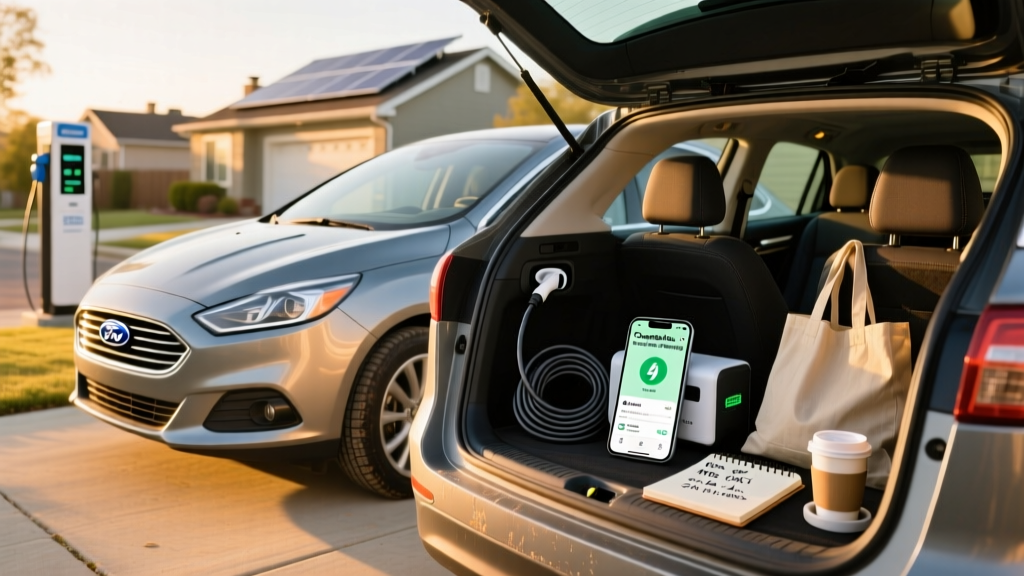
The Ford C-Max Hybrid occupies a specific niche in the electrified-vehicle landscape: a practical, tall-hatchback hybrid that delivers strong real-world fuel economy without requiring a plug. Though Ford discontinued the C-Max after the 2018 model year, it remains one of the most sought-after used hybrids on the market in 2026, particularly for buyers who want Prius-rivaling efficiency with more interior volume and a more engaging driving experience.
This guide covers everything you need to know about the C-Max Hybrid (HEV) and its plug-in sibling, the C-Max Energi (PHEV), including real-world MPG data, battery longevity, ownership costs, and how these vehicles stack up against today's hybrid and EV alternatives.
Ford C-Max Hybrid vs. C-Max Energi: HEV and PHEV Explained
Ford sold the C-Max in two distinct electrified variants. Confusing them is one of the most common buyer mistakes in the used market, so let's be precise:
C-Max Hybrid (HEV)
- Type: Conventional hybrid — no plug, no electric-only range to speak of
- Battery: 1.4 kWh lithium-ion (usable ~0.5 kWh)
- Charging: Self-charging via regenerative braking and engine; no plug-in capability
- Electric-only driving: Brief low-speed EV mode (~1 mile at under 47 mph)
- Best for: Drivers who want maximum MPG simplicity with zero charging infrastructure
C-Max Energi (PHEV)
- Type: Plug-in hybrid — can charge from a wall outlet or Level 2 station
- Battery: 7.6 kWh lithium-ion (usable ~5.8 kWh for EV mode)
- Charging: ~2.5 hours on Level 2 (240V); ~7 hours on Level 1 (120V); no DC fast charging
- Electric-only range: EPA-rated 21 miles (2013-2017 models); updated to 22 miles for 2018
- Best for: Drivers with short commutes who can charge at home and want to minimize gas use
The key distinction: the HEV never needs a plug and operates like a traditional Prius-style hybrid. The Energi PHEV can operate as an EV for roughly 20 miles before the gasoline engine kicks in, making it ideal for commutes under that threshold.
Fuel Economy: EPA Ratings and Real-World MPG
Fuel economy is the C-Max's headline feature. Here's the official EPA data from fueleconomy.gov:
| Model | City MPG | Highway MPG | Combined MPG | MPGe (Energi EV mode) |
|---|---|---|---|---|
| C-Max Hybrid (2013-2018) | 42 | 38 | 40 | N/A |
| C-Max Energi PHEV (2013-2017) | 42 (hybrid mode) | 38 (hybrid mode) | 40 (hybrid mode) | 100 MPGe |
| C-Max Energi PHEV (2018) | 42 (hybrid mode) | 38 (hybrid mode) | 40 (hybrid mode) | 104 MPGe |
Real-World MPG vs. EPA Sticker
The C-Max Hybrid's 40 MPG combined EPA rating tells only part of the story. In real-world driving, owners consistently report:
- City driving: 44-48 MPG — hybrids excel in stop-and-go traffic where regenerative braking recovers energy
- Highway driving: 36-39 MPG — the aerodynamic profile of a tall hatch works against it at sustained speeds above 70 mph
- Mixed commute: 40-44 MPG is achievable with moderate acceleration and proper tire inflation
- Cold weather penalty: Expect 5-8 MPG reduction in sub-freezing temperatures due to reduced battery efficiency and cabin heating demands
The C-Max Hybrid tends to exceed its EPA city rating in real-world urban use — a pattern common to Toyota and Ford hybrids where the EPA city test cycle doesn't fully capture regenerative braking benefits.
For the Energi PHEV, the 21-22 mile electric-only range is modest by 2026 standards (the Toyota RAV4 Prime delivers 42 miles), but it still covers the average American's one-way commute of roughly 16 miles. Once the battery is depleted, the Energi operates as a conventional hybrid at the same 40 MPG combined.
Powertrain Specs: Engine, Motor, and Combined Output
| Specification | C-Max Hybrid (HEV) | C-Max Energi (PHEV) |
|---|---|---|
| Engine | 2.0L Atkinson-cycle I4 | 2.0L Atkinson-cycle I4 |
| Engine HP | 141 hp | 141 hp |
| Electric Motor | 88 kW (118 hp) AC synchronous | 88 kW (118 hp) AC synchronous |
| Combined System HP | 188 hp | 188 hp |
| Transmission | eCVT (planetary gearset) | eCVT (planetary gearset) |
| 0-60 mph | ~8.1 seconds | ~8.4 seconds (heavier battery) |
| Drivetrain | Front-wheel drive | Front-wheel drive |
| Battery Capacity | 1.4 kWh Li-ion | 7.6 kWh Li-ion |
| Cargo Volume (rear seats up) | 24.5 cu ft | 19.2 cu ft (battery encroaches) |
| Cargo Volume (rear seats folded) | 52.6 cu ft | 42.8 cu ft |
The 188 combined horsepower puts the C-Max ahead of the contemporary Toyota Prius (134 hp in the 2015-2018 generation). The eCVT isn't a traditional belt-and-pulley CVT — it's a planetary gearset that blends engine and motor power seamlessly, with none of the rubber-band sensation associated with Nissan CVTs. Acceleration is adequate for highway merging, and the electric motor's instant torque gives it responsive off-the-line behavior.
One notable trade-off: the Energi's larger battery pack sits beneath the cargo floor, reducing rear cargo space by about 5 cubic feet compared to the HEV. If you regularly haul bulky items, the standard Hybrid is the more practical choice.
Battery Longevity, Warranty, and Replacement Costs
Hybrid Battery Warranty (Original)
- Standard coverage: 8 years / 100,000 miles (whichever comes first)
- CARB-state coverage: 10 years / 150,000 miles in California and states that follow CARB emissions standards (CT, ME, MD, MA, NJ, NY, OR, RI, VT, WA)
- Capacity threshold: Ford warranted the battery against failure or capacity loss below a defined threshold (typically ~60-70% of original capacity)
Since the newest C-Max rolled off the line in 2018, most examples in 2026 are between 8 and 13 years old. This means:
- Original 8-year/100,000-mile warranties have expired for all 2013-2017 models and most 2018 models based on age
- CARB-state 10-year/150,000-mile coverage may still apply to 2016-2018 models with lower mileage
- Any remaining warranty transfers to subsequent owners
Real-world battery durability: Ford's hybrid battery packs have proven more reliable than early industry fears suggested. Data from owner communities and repair databases show most C-Max hybrid batteries last 150,000-200,000+ miles before significant degradation. The 1.4 kWh pack in the HEV operates within a narrow state-of-charge window (roughly 40-60%), which minimizes stress on the cells.
Battery replacement cost (2026 estimates):
- C-Max Hybrid (HEV): $2,000-$3,500 for a refurbished/remanufactured pack; $4,000-$5,500 for a new OEM pack
- C-Max Energi (PHEV): $4,000-$6,500 for refurbished; $7,000-$9,000 for new OEM
- Independent hybrid shops increasingly offer cell-level repair (replacing individual bad modules) for $800-$1,500
For context, a well-maintained C-Max Hybrid with 120,000 miles and no battery issues represents a lower ownership risk than many buyers assume. The battery is not a ticking time bomb — it's a wear item with a predictable, long lifespan.
Reliability Ratings and Common Issues
The C-Max Hybrid earns solid reliability marks, though it falls short of the Toyota Prius's bulletproof reputation:
- Consumer Reports: Average to above-average reliability across most model years; 2013 models had more reported issues (early-production growing pains), while 2015-2018 models improved significantly
- RepairPal: The C-Max Hybrid rates 4.0 out of 5.0 for reliability, with an average annual repair cost of approximately $500-$600 — below the compact-car average
- NHTSA recalls: Check nhtsa.gov/recalls for specific VIN — notable recalls included a transmission software issue (2013 models) and a door-latch concern
Common issues to watch for in used examples:
- 12V auxiliary battery failure: Like all hybrids, the C-Max has a conventional 12V battery that powers electronics. It typically lasts 4-6 years and can strand the car if it dies — even though the high-voltage traction battery is fine
- Transmission shudder (2013-2014): Some early models experienced eCVT shudder; a software update largely resolved this
- Door handle and latch wear: Interior door handles on 2013-2015 models can become brittle and crack
- Infotainment glitches: Ford's SYNC system from this era can be slow and occasionally unresponsive; not a mechanical concern but a usability frustration
Pricing, Tax Credits, and Total Cost of Ownership
Since the C-Max is available only on the used market in 2026, pricing reflects age, mileage, and condition:
| Model / Year Range | Typical Used Price (2026) | Mileage Range |
|---|---|---|
| 2013-2014 C-Max Hybrid | $7,000 - $10,000 | 90,000 - 140,000 mi |
| 2015-2018 C-Max Hybrid | $10,000 - $15,500 | 50,000 - 100,000 mi |
| 2013-2015 C-Max Energi | $8,000 - $12,000 | 80,000 - 130,000 mi |
| 2016-2018 C-Max Energi | $12,000 - $17,000 | 45,000 - 95,000 mi |
Tax Credit Eligibility
- New vehicle §30D credit: Not applicable — the C-Max is no longer manufactured
- Used EV credit (§25E): The C-Max Energi PHEV may qualify for the federal used clean vehicle credit of up to $4,000 (30% of sale price, capped at $4,000) if purchased from a licensed dealer for $25,000 or less. Income limits apply: $75,000 single / $112,500 head of household / $150,000 joint filers. Verify current eligibility on irs.gov
- C-Max Hybrid (HEV): Does NOT qualify for any federal tax credit — conventional hybrids are not eligible under §30D or §25E
- State incentives: Some states offer rebates for used PHEVs; check your state's energy office or DMV for current programs
5-Year Ownership Cost Estimate (C-Max Hybrid, 12,000 mi/yr)
| Cost Category | C-Max Hybrid (40 MPG) | Comparable Gas Car (28 MPG) |
|---|---|---|
| Fuel (at $3.40/gal avg) | $5,100 | $7,286 |
| Insurance (avg) | $5,500 - $7,000 | $5,000 - $6,500 |
| Maintenance (5 yr) | $2,500 - $3,500 | $3,000 - $4,000 |
| Estimated Repairs | $1,500 - $3,000 | $1,500 - $3,000 |
| 5-Year Total (fuel + maint + ins) | $14,600 - $19,100 | $16,786 - $20,786 |
The C-Max Hybrid saves roughly $2,000-$3,000 over five years in fuel alone compared to a typical 28 MPG compact. Maintenance costs tend to be lower than gas-only vehicles because regenerative braking extends brake pad life (many owners report 80,000+ miles on original pads) and the engine runs less frequently, reducing oil degradation.
C-Max Hybrid vs. PHEV vs. Full EV: Which Fits You?
Choose the C-Max Hybrid (HEV) If:
- You cannot charge at home (apartment, street parking, no garage)
- You want zero behavior change — just fill up with gas and drive
- Your driving is a mix of city and highway with no predictable short commute
- You want a low purchase price under $15,000 with strong MPG
- Cargo space matters more than electric-only driving
Choose the C-Max Energi (PHEV) If:
- You can install a Level 2 charger at home or have access to workplace charging
- Your daily commute is under 20 miles round-trip (you'll rarely use gas)
- You take occasional road trips and don't want range anxiety from a pure EV
- You want to qualify for the used clean vehicle tax credit (up to $4,000)
- You can accept slightly less cargo space for the battery trade-off
Choose a Full EV (e.g., used Bolt EV, Leaf) Instead If:
- You have reliable home Level 2 charging
- Your daily driving stays under 150 miles
- You want to eliminate oil changes, spark plugs, and exhaust maintenance entirely
- You drive in a region with cheap electricity and expensive gasoline
- Lower total cost of ownership over 5+ years is your priority
For buyers cross-shopping in 2026, the C-Max Hybrid competes with the Toyota Prius (similar MPG, less cargo room but better reliability reputation), the Honda Insight (discontinued after 2022, sportier sedan), and the Hyundai Ioniq Hybrid (sleeker, slightly less interior space). The C-Max's advantage remains its tall-hatchback utility — it swallows more cargo than any of these sedans.
Pros and Cons at a Glance
Pros
- 42 city MPG exceeds EPA sticker in real-world urban driving
- 188 hp provides confident highway merging (significantly more than contemporary Prius)
- Tall hatchback body offers 24.5 cu ft cargo space (HEV) — more than most compact sedans
- Regenerative braking extends brake pad life to 80,000+ miles
- Proven eCVT planetary gearset — no belt-driven CVT failure modes
- Low used-market entry price ($7,000-$15,500 for most examples)
- Energi PHEV may qualify for up to $4,000 federal used-vehicle credit
Cons
- Discontinued since 2018 — no new models, parts availability may narrow over time
- Highway MPG drops to 36-38 at sustained 70+ mph speeds
- Energi PHEV electric-only range (21 mi) is modest vs. modern PHEVs (RAV4 Prime: 42 mi)
- Energi battery pack reduces cargo volume by ~5 cu ft
- Ford SYNC infotainment is dated and occasionally glitchy
- 2013-2014 model years had more reported issues; prefer 2015+ if budget allows
- HEV version qualifies for no federal tax credits
Frequently Asked Questions
How many MPG does the Ford C-Max Hybrid get?
The EPA rates the C-Max Hybrid at 42 city / 38 highway / 40 combined MPG. In real-world city driving, many owners report 44-48 MPG thanks to aggressive regenerative braking. Highway driving at 75+ mph typically yields 35-38 MPG. Expect a 5-8 MPG reduction in sustained sub-freezing temperatures.
How far can the C-Max Energi go on electric only?
The C-Max Energi PHEV delivers an EPA-rated 21 miles of electric-only range (2013-2017 models) or 22 miles (2018 model). Real-world EV range is typically 18-22 miles depending on temperature, terrain, and driving style. At highway speeds in cold weather, expect closer to 15-17 miles before the engine engages.
Does the C-Max Hybrid need to be plugged in?
No. The C-Max Hybrid (HEV) is a conventional hybrid that charges its small battery entirely through regenerative braking and the gasoline engine. You never plug it in. Only the C-Max Energi (PHEV) requires plugging in to access its electric-only range — and even the Energi operates as a regular hybrid if you don't charge it.
Is the C-Max Hybrid reliable, and what does battery replacement cost?
The C-Max Hybrid rates above average for reliability, particularly 2015-2018 model years. The hybrid battery typically lasts 150,000-200,000+ miles. Replacement costs range from $2,000-$3,500 (refurbished) to $4,000-$5,500 (new OEM) for the HEV, and $4,000-$9,000 for the Energi PHEV. Independent shops increasingly offer cell-level repairs for $800-$1,500.
Does the Ford C-Max qualify for any tax credit in 2026?
The C-Max Hybrid (HEV) does not qualify for any federal tax credit. The C-Max Energi (PHEV) may qualify for the federal used clean vehicle credit (§25E) of up to $4,000 when purchased from a dealer for $25,000 or less, subject to buyer income limits ($75K single / $150K joint). Always verify current rules at irs.gov before purchasing, as credit availability and eligible vehicle lists are updated periodically.
How does the C-Max Hybrid compare to a Toyota Prius?
The C-Max Hybrid matches or slightly exceeds the 2013-2018 Prius in fuel economy (40 vs. 50 MPG combined for the Prius Eco) and offers significantly more horsepower (188 vs. 134 hp). The Prius wins on long-term reliability track record, slightly better highway MPG, and stronger parts availability. The C-Max wins on cargo versatility (hatchback height), driving engagement, and lower used-market pricing in 2026.
What's the difference between the C-Max Hybrid and C-Max Energi?
The C-Max Hybrid is a conventional HEV with a 1.4 kWh battery that never needs plugging in. The C-Max Energi is a PHEV with a 7.6 kWh battery that can be plugged in for 21-22 miles of electric-only range. The Energi costs more to purchase, has less cargo space (the bigger battery sits under the load floor), but can eliminate gasoline use for short commutes when charged regularly.
The Ford C-Max Hybrid remains one of the smartest used-hybrid purchases in 2026 for buyers who value cargo versatility, strong city MPG, and a low entry price. While it lacks the Toyota Prius's legendary reliability reputation and the Energi's EV range is modest by modern standards, both variants deliver genuine fuel savings without the complexity of a full EV. For budget-conscious buyers who can't charge at home, the C-Max Hybrid is a compelling, data-backed choice.