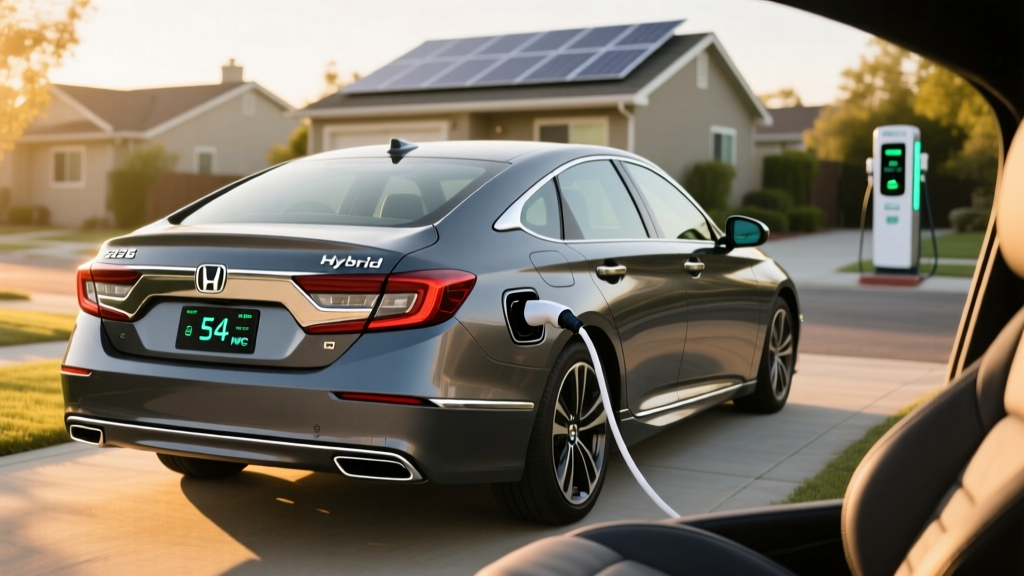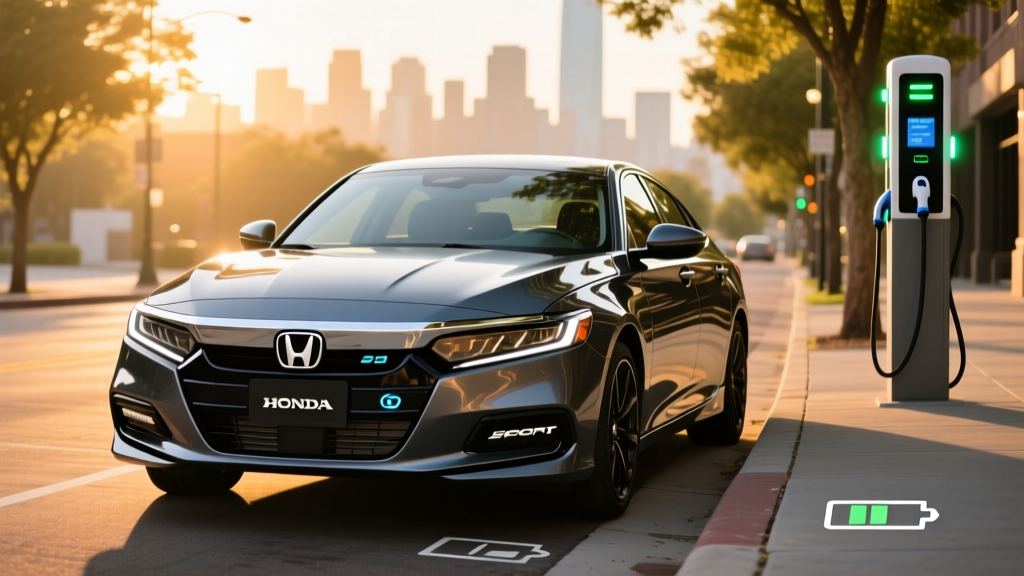
The midsize hybrid sedan segment doesn't forgive mediocrity, and the 2023 Honda Accord Hybrid Sport arrives with a specific mission: deliver the sportiest driving dynamics in the Accord Hybrid lineup without sacrificing the fuel economy that makes the HEV powertrain worthwhile. As a conventional hybrid (HEV) — not a plug-in — it requires no charging infrastructure, no range planning, and no behavior change from its gasoline-only counterpart. But does the Sport trim's firmer tuning and 19-inch wheels come at an efficiency cost? And in a market increasingly pulling buyers toward full EVs and PHEVs, where does this car actually fit?
This guide breaks down the 2023 Accord Hybrid Sport's real-world fuel economy, powertrain behavior, battery longevity, pricing, and how it stacks up against plug-in alternatives and full battery-electric vehicles.
2023 Honda Accord Hybrid Sport: Core Specifications
| Attribute | Specification |
|---|---|
| Powertrain Type | Series-parallel HEV (conventional hybrid, no plug) |
| Engine | 2.0L Atkinson-cycle inline-4 |
| Combined System Output | 204 hp / 247 lb-ft torque |
| Electric Motors | Two-motor system (drive + generator) |
| Transmission | e-CVT (no traditional gears) |
| EPA Fuel Economy | 46 city / 41 highway / 44 combined MPG |
| Fuel Tank Capacity | 12.8 gallons |
| Total Driving Range | ~589 miles (EPA combined) |
| 0–60 mph | ~7.2 seconds (est.) |
| Curb Weight | ~3,477 lbs |
| Base MSRP (2023) | $32,895 (Sport trim) |
| Hybrid Battery Warranty | 8 years / 100,000 miles (10 yr/150,000 mi in CARB states) |
Fuel Economy: EPA Numbers vs. Real-World Driving
The EPA rates the 2023 Accord Hybrid at 46 city / 41 highway / 44 combined MPG for the Sport trim, which rides on 19-inch wheels. The lower trims (EX-L Hybrid) with smaller 17-inch wheels achieve slightly better highway figures at 48/47/48 MPG combined, but the Sport's wheel-and-tire package trades a few MPG for sharper handling response.
| Condition | EPA Estimate | Real-World Expectation |
|---|---|---|
| City Driving | 46 MPG | 47–52 MPG (hybrids excel in stop-and-go regen) |
| Highway (65–70 mph) | 41 MPG | 38–42 MPG (aero drag, less regen benefit) |
| Combined | 44 MPG | 42–48 MPG (mix dependent) |
| Cold Weather (below 32°F) | N/A | 36–40 MPG (engine runs more for cabin heat) |
Understanding the Two-Motor Hybrid Powertrain
The Accord Hybrid uses Honda's fourth-generation two-motor system, which operates differently from a Toyota-style planetary-gear hybrid. Here's how it works across three modes:
- EV Drive: The lithium-ion battery powers the drive motor directly. The gasoline engine is off. Used at low speeds and light loads.
- Hybrid Drive: The engine spins the generator motor, which produces electricity to feed the drive motor. The engine is not mechanically connected to the wheels. This is the dominant mode at moderate speeds.
- Engine Drive: At highway cruising speeds, a lock-up clutch connects the engine directly to the front wheels for maximum efficiency. The drive motor assists during acceleration.
This architecture gives the Accord Hybrid a more EV-like feel at city speeds — smooth, linear torque delivery with no gear shifts — while maintaining highway efficiency. The 204 combined horsepower (146 hp from the engine, 181 hp from the drive motor, with system net output capped at 204) provides confident passing power, and the 247 lb-ft of torque from the electric motor is available from zero RPM.
HEV vs. PHEV vs. Full EV: Which Powertrain Fits You?
The Accord Hybrid Sport is a conventional hybrid (HEV). It has no plug, no electric-only range to manage, and no charging requirement. For buyers cross-shopping powertrain types, here's how the three electrified options compare:
| Factor | HEV (Accord Hybrid) | PHEV (e.g., Toyota Prius Prime) | Full EV (e.g., Tesla Model 3) |
|---|---|---|---|
| Plug Required? | No | Yes (for EV range benefit) | Yes |
| Electric-Only Range | ~1 mile at low speed | 25–44 miles | 250–350+ miles |
| Total Range | ~589 miles | ~600+ miles | 250–350 miles (then charge) |
| Home Charging Needed? | No | Recommended (Level 1 or 2) | Essential (Level 2 strongly recommended) |
| Fuel Cost per Mile | ~$0.09 (at $3.50/gal, 44 MPG) | ~$0.04 (electric) / ~$0.09 (gas) | ~$0.04 (at $0.14/kWh) |
| Upfront Cost | ~$32,900 | ~$33,000–$40,000 | ~$38,000–$50,000+ |
| Federal Tax Credit | None (not a PHEV/EV) | Up to $7,500 (§30D, if eligible) | Up to $7,500 (§30D, if eligible) |
| Best For | No charging access, long highway commutes | Home charging + short daily commute | Home charging, daily driving under 300 mi |
- You have no access to home or workplace charging
- You regularly drive 400+ miles between fuel stops
- You want EV-like city smoothness without range planning
- Your budget prioritizes lower upfront cost over per-mile fuel savings
- You can install a Level 2 charger at home
- Your daily commute is under 40 miles round-trip (you'd rarely use gas)
- You want to qualify for the federal §30D tax credit
- You have reliable home Level 2 charging
- You want the lowest per-mile cost and minimal maintenance
- Your typical trips are under 250 miles
Pricing, Trims, and Tax Credit Eligibility
The 2023 Honda Accord Hybrid was offered in three trims. The Sport sits between the EX-L and the top Touring:
| Trim | 2023 MSRP | Key Features |
|---|---|---|
| EX-L Hybrid | $32,895 | Leather seats, heated front seats, 17-inch wheels, 48 MPG combined |
| Sport Hybrid | $32,995 | Sport-tuned suspension, 19-inch wheels, black accents, paddle shifters, 44 MPG combined |
| Sport-L Hybrid | $34,995 | Sport features + leather, heated steering wheel |
| Touring Hybrid | $38,990 | Full LED headlights, ventilated front seats, wireless CarPlay, navigation, 44 MPG combined |
Federal Tax Credit: The 2023 Accord Hybrid is a conventional HEV — it does not qualify for the IRS §30D Clean Vehicle Credit. That credit applies only to plug-in electric vehicles (PHEVs and BEVs) that meet battery capacity, critical-mineral sourcing, MSRP caps ($55,000 for sedans), and buyer income limits ($150,000 single / $300,000 joint). The Accord Hybrid's efficiency comes entirely from its internal powertrain, with no external charging and no federal purchase incentive.
Some states and municipalities offer rebates for hybrid vehicles, but these vary widely by jurisdiction. Check your state's energy office or department of environmental quality for current programs.
Battery Longevity, Warranty, and Replacement Costs
- Federal (non-CARB states): 8 years / 100,000 miles
- CARB states (CA, CO, CT, ME, MD, MA, NJ, NY, OR, RI, VT, WA): 10 years / 150,000 miles
- Coverage: Defects and capacity loss below a defined threshold (typically ~60–70% of original capacity)
The Accord Hybrid's lithium-ion battery pack is relatively small — approximately 1.0 kWh of usable capacity — because its role is to buffer energy for short EV-mode bursts and regenerative braking, not to provide extended electric-only driving. This small size works in the battery's favor for longevity: shallow charge-discharge cycles cause far less stress than the deep cycles seen in full EVs.
Real-world degradation data: Honda's hybrid battery systems have demonstrated strong longevity in fleet and owner reporting. Most Accord Hybrid batteries retain 90%+ of their original capacity after 100,000 miles, with failures before the warranty period being uncommon. The system's thermal management and conservative state-of-charge window (the battery never fully charges or fully depletes) protect against accelerated degradation.
Replacement cost if out of warranty: A new OEM hybrid battery pack for the Accord Hybrid typically runs $3,000–$4,500 including labor at a Honda dealership. Third-party refurbishment shops offer reconditioned packs for $1,500–$2,500. For context, this is substantially less than a full EV traction battery replacement, which can exceed $10,000–$18,000.
Driving Dynamics: What the Sport Trim Actually Changes
The Sport trim isn't merely an appearance package. Honda retuned the suspension damping and spring rates for the Sport, and the 19-inch wheels with lower-profile tires (235/40R19) provide sharper turn-in response and more road feedback than the EX-L's 17-inch setup. The trade-off is a slightly firmer ride over broken pavement — noticeable on expansion joints and pothole-riddled city streets, but generally well-damped on smooth highways.
The paddle shifters on the Sport allow simulated gear "steps" in the e-CVT, which doesn't change actual performance but reduces the drone sensation some drivers dislike in continuously variable transmissions. The steering is weighted heavier than the EX-L, giving a more planted feel during highway lane changes.
One-pedal driving is not available in the Accord Hybrid — Honda reserves that for its EVs. However, the regenerative braking is adjustable via paddles, with the strongest setting providing moderate deceleration (approximately 0.15g) when lifting off the accelerator. It won't bring you to a full stop like a true one-pedal EV system, but it reduces brake wear significantly in city driving.
Reliability Ratings and Safety
Honda's hybrid powertrain has built a strong reliability record across multiple generations. The Accord Hybrid avoids several common failure points in other vehicles: there's no traditional transmission (the e-CVT has no belts, pulleys, or friction clutches to wear), no starter motor, no alternator, and the regenerative braking system extends pad and rotor life to 80,000–100,000+ miles in typical use.
The 2023 Accord Hybrid earned a 5-star overall safety rating from NHTSA, and the IIHS named the Accord a Top Safety Pick+ when equipped with specific headlights. Honda Sensing — the brand's ADAS suite — is standard on all trims and includes adaptive cruise control, lane-keeping assist, forward collision warning with automatic emergency braking, and traffic sign recognition. This is an SAE Level 2 driver-assistance system, meaning the driver must remain fully engaged and hands-on at all times.
Pros and Cons at a Glance
Pros
- Real-world city MPG often exceeds EPA (48–52 MPG achievable)
- No charging infrastructure required — fuel at any gas station
- 589-mile total range eliminates range anxiety entirely
- EV-like smoothness in city driving with linear torque delivery
- Sport suspension tuning adds genuine handling improvement
- Strong battery reliability record with 8–10 year warranty
- Low brake wear from regenerative braking
- Top Safety Pick+ from IIHS
Cons
- No federal tax credit (HEV, not PHEV/EV)
- Highway MPG drops to 38–40 at sustained 75+ mph
- 19-inch wheels reduce efficiency vs. lower trims (44 vs. 48 combined)
- No plug-in option — can't drive on electricity alone for commutes
- Firmer Sport ride may not suit all buyers
- No one-pedal driving mode
- Higher per-mile fuel cost than a PHEV on electric or a full EV
Frequently Asked Questions
How many MPG does the 2023 Honda Accord Hybrid Sport get?
The EPA rates the Sport trim at 46 city / 41 highway / 44 combined MPG. In real-world city driving, many owners report 48–52 MPG thanks to the hybrid system's regenerative braking and frequent EV-mode operation. Highway driving at sustained high speeds yields closer to 38–42 MPG. Cold weather (below freezing) can reduce combined economy to 36–40 MPG as the engine runs more frequently for cabin heating.
Does the Accord Hybrid need to be plugged in?
No. The Accord Hybrid is a conventional hybrid (HEV), not a plug-in hybrid (PHEV). It charges its small battery entirely through regenerative braking and the gasoline engine. You fuel it at a gas station like any conventional car. There is no plug, no charging cable, and no electric-only commuting range to manage.
How far can the Accord Hybrid drive on electric power alone?
Approximately 1 mile at very low speeds (under 25 mph) on a fully charged battery. This is not a meaningful electric-only range — it's designed for creeping through parking lots or residential streets silently, not for commuting. If you want 25–44 miles of electric-only driving, you need a PHEV like the Toyota Prius Prime or a full EV.
Is the hybrid battery reliable, and what does replacement cost?
Honda's hybrid battery systems have demonstrated excellent reliability, with most retaining 90%+ capacity at 100,000 miles. The battery is covered by an 8-year/100,000-mile warranty (10 years/150,000 miles in CARB states). Out-of-warranty replacement costs $3,000–$4,500 at a dealership or $1,500–$2,500 for a reconditioned pack. For most owners, the battery will last the life of the vehicle.
Does the 2023 Accord Hybrid qualify for any tax credit?
No federal tax credit applies. The IRS §30D Clean Vehicle Credit is available only for plug-in vehicles (PHEVs and BEVs) that meet specific battery sourcing, MSRP, and buyer income requirements. As a conventional HEV, the Accord Hybrid does not qualify. Some state or local programs may offer hybrid incentives — check your state's energy office for current availability.
How does the Accord Hybrid compare to a full EV for daily commuting?
If you have home charging and a commute under 40 miles, a full EV will cost roughly $0.04 per mile in electricity versus $0.09 per mile in gasoline for the Accord Hybrid — saving approximately $750–$1,000 annually for a 15,000-mile driver. However, the EV requires charging infrastructure ($500–$2,000 for a Level 2 home install), has higher upfront cost, and requires planning for road trips over 250 miles. The Accord Hybrid eliminates all charging concerns at the cost of higher per-mile fuel expense.
What maintenance does the Accord Hybrid require?
Standard maintenance includes oil changes (every 7,500–10,000 miles with synthetic oil), tire rotations, cabin air filter replacement, and brake fluid checks. The hybrid system adds no routine maintenance items — there's no hybrid-specific service interval. Brake pads and rotors typically last 80,000–100,000+ miles thanks to regenerative braking handling most deceleration. The e-CVT has no transmission fluid change interval under normal driving conditions.