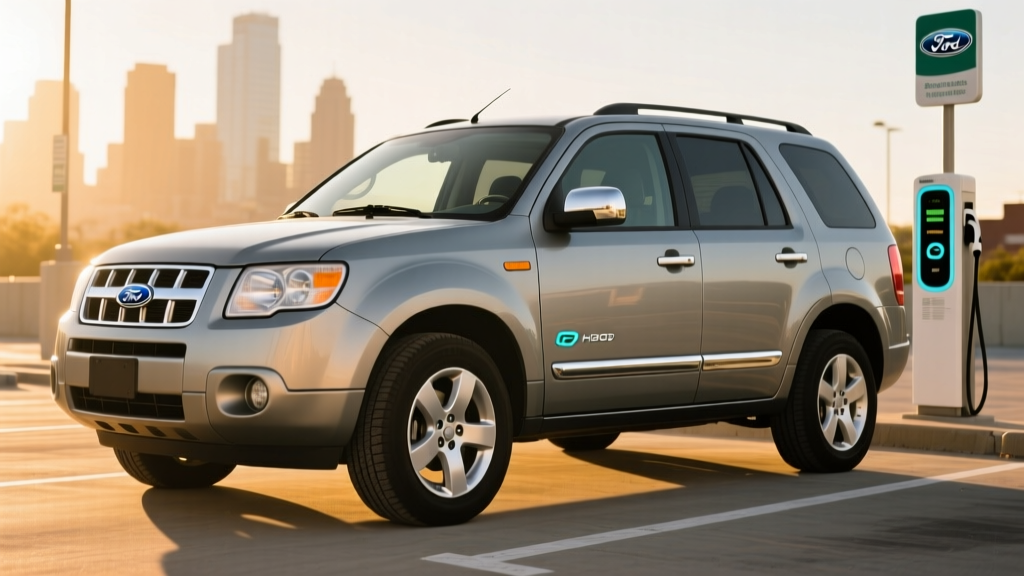
The Ford 2006 Escape Hybrid holds a unique place in automotive history. As Ford's first hybrid vehicle and the world's first hybrid SUV, it arrived years before the Toyota RAV4 Hybrid or Honda CR-V Hybrid existed. Nearly two decades later, these vehicles are still circulating on the used market at bargain prices. If you're researching the Ford 2006 Escape Hybrid as a potential budget commuter or curious about its longevity, this guide covers every number that matters — from real-world MPG to battery replacement costs in 2026.
HEV vs PHEV: What the 2006 Escape Hybrid Actually Is
Before evaluating specs, it's critical to understand the powertrain type. The Ford 2006 Escape Hybrid is a conventional hybrid electric vehicle (HEV). It is not a plug-in hybrid (PHEV), and it does not have an electric-only driving mode of any meaningful distance.
HEV vs PHEV — Quick Distinction
| Feature | HEV (2006 Escape Hybrid) | PHEV (e.g., 2026 Escape PHEV) |
|---|---|---|
| Plugs in to charge? | No — charges via regenerative braking and engine | Yes — Level 1/Level 2 charging |
| Electric-only range | ~0.5 miles at low speed | 30-40 miles typical |
| Battery size | 1.3 kWh (NiMH) | 14-19 kWh (lithium-ion) |
| Federal tax credit (§30D) | Not eligible | Up to $7,500 if eligible |
| Primary fuel | Gasoline (hybrid assists) | Electricity + gasoline |
The 2006 Escape Hybrid uses a parallel hybrid system where the electric motor assists the gasoline engine and captures energy during braking. You never plug it in. You simply fill it with gas and drive — the hybrid system works automatically in the background to reduce fuel consumption, especially in stop-and-go city traffic.
Fuel Economy: EPA Ratings and Real-World MPG
The headline number for any hybrid buyer is fuel economy. Here's how the 2006 Escape Hybrid breaks down according to EPA estimates on fueleconomy.gov:
| Configuration | City MPG | Highway MPG | Combined MPG |
|---|---|---|---|
| FWD (Front-Wheel Drive) | 33 | 29 | 31 |
| AWD (All-Wheel Drive / e4WD) | 30 | 27 | 28 |
Real-World MPG: What Owners Actually Report
One of the defining characteristics of conventional hybrids is that they often exceed EPA city estimates in real-world urban driving. The regenerative braking system recaptures more energy in heavy traffic, and the engine shuts off at stops. Many owners report 34-36 MPG in city driving with the FWD model — slightly above the EPA sticker.
However, highway driving tells a different story. At sustained 70+ mph speeds, the electric motor provides minimal assistance, and the 2.3L four-cylinder engine does most of the work while pushing a 3,700-pound SUV. Expect 26-28 MPG highway in real-world conditions, which is slightly below the EPA estimate.
Real-World Fuel Economy Expectation: FWD models average 30-33 MPG combined in mixed driving. AWD models average 26-29 MPG combined. Cold weather (below 30°F) reduces MPG by 5-10% due to longer engine warm-up cycles and reduced battery efficiency in the NiMH pack.
Powertrain Specs: Engine, Motor, and Combined Output
| Specification | Detail |
|---|---|
| Gasoline Engine | 2.3L Atkinson-cycle inline-4 |
| Engine Horsepower | 133 HP @ 6,000 RPM |
| Electric Motor | Permanent magnet synchronous (AC) |
| Motor Output | 94 HP (70 kW) |
| Combined System Output | 155 HP (net) |
| Transmission | Electronically controlled CVT (eCVT) |
| 0-60 mph | ~10.8 seconds (FWD) |
| Drivetrain Options | FWD or e4WD (AWD) |
| Curb Weight | ~3,680-3,795 lbs |
| Fuel Tank | 15.0 gallons |
| Total Driving Range | ~450-495 miles (FWD) |
The Atkinson-cycle 2.3L engine sacrifices some peak power for greater thermal efficiency — a hallmark of hybrid powertrains that Toyota also used in the Prius. The eCVT is not a belt-driven CVT like those found in some Nissan models; it's a planetary gearset that seamlessly blends power from the engine and motor. This design has proven extremely durable, with no belts or clutches to wear out.
The 155 HP combined output was adequate for 2006 but feels underpowered by 2026 standards. Merging onto highways requires planning, and passing at speed demands a full-throttle downshift. This is a fuel-economy-first vehicle, not a performance vehicle.
Battery Technology: NiMH Pack, Degradation, and Replacement Costs
The 2006 Escape Hybrid uses a 330-volt nickel-metal hydride (NiMH) battery pack located under the cargo floor. This is not the lithium-ion chemistry found in modern EVs and PHEVs. NiMH was the proven hybrid battery technology of the era — the same chemistry used in the Toyota Prius through 2015.
Original Battery Warranty
Ford originally warranted the hybrid battery for 8 years / 100,000 miles (10 years / 150,000 miles in California Air Resources Board states). This warranty has expired for all 2006 models. Any battery replacement is now an out-of-pocket expense for the owner.
NiMH Battery Degradation Reality
NiMH batteries degrade differently than lithium-ion. Rather than losing capacity in a linear fashion, NiMH cells tend to develop weak individual cells within the pack over time. A single weak cell can drag down the entire pack's performance, triggering reduced fuel economy and eventually a check-engine light (common codes: P0A80, P0A7F).
At 18-20 years old, most original battery packs in the 2006 Escape Hybrid have either already been replaced, reconditioned, or are showing significant degradation. Here's what to expect:
- Original pack still functional: Possible, but expect 20-30% capacity loss. The vehicle still drives, but the electric motor assists less, and MPG drops to 24-27 combined.
- Reconditioned pack installed: $1,200-$2,000 from aftermarket shops. Restores ~80-85% of original capacity. Typical lifespan: 4-7 years.
- New OEM replacement: $3,000-$4,500 including labor at a Ford dealer (if still available — Ford has discontinued some older hybrid battery SKUs). Aftermarket new packs from suppliers like Green Bean Battery or Dorman range from $1,800-$2,800.
- Used/salvage pack: $500-$1,200 from a junkyard. High risk — you're inheriting someone else's degradation curve.
Reliability and Common Issues Beyond the Battery
The 2006 Escape Hybrid's powertrain is surprisingly robust. The eCVT transmission, being a planetary gearset rather than a traditional automatic or belt-driven CVT, rarely fails. The gasoline engine is a straightforward design without turbochargers or complex emissions equipment.
However, non-powertrain issues common to the 2006 Escape platform include:
- Blend door actuator failure: HVAC system stops directing air correctly. $200-$400 repair.
- Power steering pump leaks: The hybrid uses an electric power steering pump that can fail around 120,000-150,000 miles. $400-$700 replacement.
- Rear wheel bearing wear: Common on all Escape models of this era, especially AWD. $300-$500 per side.
- Brake actuator assembly: The regenerative braking system uses a specialized brake actuator. Replacement runs $800-$1,400 if it fails — significantly more than conventional brake service.
- 12V auxiliary battery: Located in the rear cargo area (not the engine bay). If the 12V battery dies, the hybrid system cannot boot up, even if the high-voltage pack is fully charged.
For a 2006 model with 150,000+ miles, budget $1,500-$3,000 annually for maintenance and unexpected repairs. The hybrid-specific components are reliable, but the vehicle's age means rubber, plastic, and electronic components are reaching end-of-life.
Pricing and Tax Credit Eligibility in 2026
The Ford 2006 Escape Hybrid is only available on the used market. Pricing in 2026 varies significantly based on mileage, condition, and battery health:
| Condition | Mileage Range | Typical Price (2026) |
|---|---|---|
| Excellent (battery replaced recently) | 80,000-120,000 | $5,500-$7,500 |
| Good (original or reconditioned battery) | 120,000-170,000 | $3,500-$5,500 |
| Fair (needs battery work) | 150,000-200,000+ | $1,800-$3,500 |
| Project/parts car | 200,000+ | $500-$1,800 |
Federal Tax Credit Status
The 2006 Escape Hybrid does not qualify for the current IRS §30D federal EV tax credit. That credit applies only to new plug-in electric vehicles (BEVs and PHEVs) meeting specific battery sourcing, MSRP, and buyer income requirements. The 2006 Escape Hybrid is a conventional HEV with no plug-in capability.
The original federal hybrid tax credit (up to $2,600 for this model) phased out for Ford in 2010 and has been unavailable for over a decade. There is no federal, and very rarely any state, incentive for purchasing a used conventional hybrid in 2026.
Who Should Buy the 2006 Escape Hybrid vs Alternatives
Choose the 2006 Escape Hybrid If:
- You need a budget-friendly commuter under $5,000 with better city MPG than a comparable gas-only SUV
- You drive primarily in stop-and-go city traffic where hybrid efficiency shines (33+ MPG city)
- You cannot install a home charger and don't want to rely on public charging infrastructure
- You need SUV cargo space and optional AWD but can't afford a modern hybrid
- You're mechanically inclined and comfortable with a 18-20 year old vehicle's maintenance needs
Choose a Modern Hybrid Instead (2024-2026 RAV4, CR-V Hybrid) If:
- You want current safety features (automatic emergency braking, lane-keeping, blind-spot monitoring)
- You want a factory battery warranty still in effect
- You plan to keep the vehicle 8+ years and want predictable ownership costs
- You value modern infotainment, Apple CarPlay/Android Auto, and backup cameras
Choose a PHEV or Full BEV Instead If:
- You have access to home Level 2 charging and want to minimize gasoline use
- You qualify for the §30D federal tax credit (up to $7,500 for eligible new PHEVs/BEVs per IRS guidelines)
- Your commute is under 35 miles round-trip (a PHEV covers this entirely on electricity)
- You want lower long-term fuel costs and reduced maintenance (no oil changes on a BEV)
Pros
- 33 MPG city still competitive with many 2026 gas-only compact SUVs
- eCVT planetary gearset is one of the most durable transmissions ever made
- Low purchase price ($3,000-$6,000 for a running example)
- No plug-in required — works with existing gas station infrastructure
- Adequate cargo space (67.2 cu ft with rear seats folded)
- Available AWD for snow-belt buyers
Cons
- 155 HP feels sluggish by modern standards (0-60 in ~10.8 seconds)
- NiMH battery likely needs replacement or has been replaced with aftermarket cells
- No modern driver-assistance features (no AEB, no lane-keeping, no backup camera on base trims)
- Outdated infotainment — no Bluetooth audio streaming, no smartphone integration
- No federal or state tax incentives available
- Parts availability declining for hybrid-specific components
- High-mileage examples carry significant repair risk beyond the hybrid system
Pre-Purchase Checklist: Inspecting a Used 2006 Escape Hybrid
If you're seriously considering one, these steps are non-negotiable before handing over cash:
- Check the hybrid battery state of health (SoH). Ask a Ford dealer or hybrid specialist to run a battery diagnostic. Look for individual cell voltage variance — more than 0.2V between cells signals imminent failure.
- Verify the battery replacement history. If the seller claims a "new battery," get the receipt. An OEM replacement from a Ford dealer carries different confidence than an undocumented swap.
- Test the regenerative braking. On a safe downhill stretch, lift off the accelerator. You should feel distinct deceleration from regen. If braking feels like a conventional car, the hybrid system may not be engaging.
- Scan for stored diagnostic trouble codes. Even if the check-engine light is off, pending codes in the hybrid control module can reveal developing problems. Any OBD-II scanner with hybrid capability will work.
- Check the 12V battery age. A failing 12V battery can prevent the hybrid system from starting, mimicking a high-voltage battery failure. The 12V battery should be less than 4 years old.
- Inspect the brake actuator. Press the brake pedal with the car off. It should feel firm. If it sinks to the floor or feels spongy, the brake actuator may need service — an expensive repair.
Frequently Asked Questions
How many MPG does the Ford 2006 Escape Hybrid get?
The EPA rates the FWD model at 33 city / 29 highway / 31 combined MPG. The AWD (e4WD) model is rated at 30 city / 27 highway / 28 combined. In real-world city driving, many owners report 34-36 MPG with the FWD model, while highway driving at 70+ mph typically yields 26-28 MPG.
Is the Ford 2006 Escape Hybrid a plug-in hybrid?
No. The 2006 Escape Hybrid is a conventional hybrid (HEV). It charges its battery exclusively through regenerative braking and the gasoline engine. There is no charging port, no plug, and no meaningful electric-only driving range. You fuel it with gasoline like any other car.
How much does it cost to replace the hybrid battery?
In 2026, expect to pay $1,800-$2,800 for an aftermarket new or reconditioned NiMH battery pack, or $3,000-$4,500 for an OEM replacement if available through Ford. Used/salvage packs run $500-$1,200 but carry high risk. Labor adds $300-$600 depending on the shop.
Does the 2006 Escape Hybrid qualify for any tax credit?
No. The current IRS §30D federal tax credit applies only to new plug-in electric vehicles (BEVs and PHEVs). The 2006 Escape Hybrid is a conventional HEV and does not qualify. The original hybrid tax credit for this model phased out in 2010. Check your state's specific incentives, but most states do not offer credits for used conventional hybrids.
How long do Ford Escape Hybrid batteries last?
The original NiMH battery pack was designed for 10-15 years or 150,000+ miles. Many original packs lasted 12-15 years before significant degradation. Replacement packs (aftermarket reconditioned) typically last 4-7 years depending on driving habits and climate. Hot climates accelerate NiMH degradation more than cold climates.
Is the 2006 Escape Hybrid reliable overall?
The hybrid powertrain (engine + eCVT + motor) is one of the most reliable Ford has ever built. The planetary eCVT rarely fails. However, the vehicle is now 20 years old, and age-related failures in suspension, HVAC, power steering, and brake components are common. Reliability depends heavily on maintenance history and whether the hybrid battery has been addressed.
Hybrid vs PHEV vs EV — which should I choose?
Choose a conventional hybrid (HEV) like the 2006 Escape Hybrid if you want better MPG with zero lifestyle change — no plug, no range planning, just gas and go. Choose a PHEV if you can charge at home and want 30-40 miles of electric commuting with a gas backup for road trips. Choose a full BEV if you want the lowest operating costs, have reliable charging access, and are ready to plan longer trips around DC fast-charging stops. For a deeper comparison of current options, see the EPA's side-by-side comparison tool on fueleconomy.gov.
Can I still get parts for the 2006 Escape Hybrid?
Mechanical parts for the Escape platform (brakes, suspension, engine components) are widely available from aftermarket suppliers. Hybrid-specific parts — particularly the high-voltage battery pack, brake actuator, and inverter — are becoming harder to source from Ford directly. Aftermarket and reconditioned hybrid components remain available from specialty suppliers, but lead times may be longer than for a current-model vehicle.