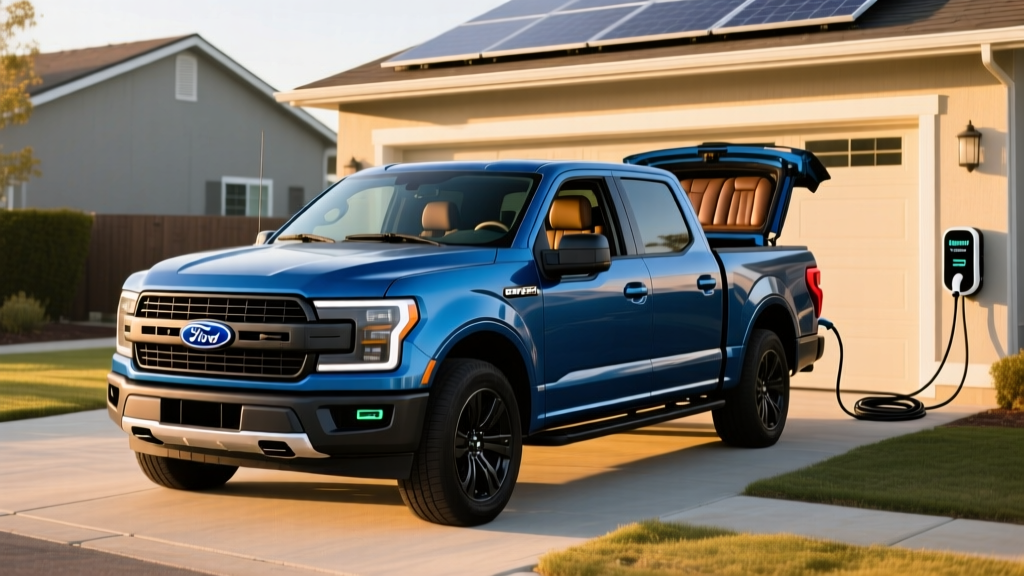
The Ford F-150 PowerBoost hybrid occupies a specific niche in the full-size truck market: it delivers meaningful fuel-economy gains over the V6 and V8 alternatives without sacrificing towing, payload, or the truck capability buyers demand. For the 2026 model year, the PowerBoost remains the only full-hybrid (HEV) powertrain available in a half-ton pickup, making it a default choice for buyers who want electrified efficiency without plugging in.
This guide covers everything a prospective buyer needs — EPA fuel economy, real-world MPG expectations, powertrain specs, pricing, tax-credit eligibility, battery longevity, and how the F-150 hybrid stacks up against full EVs like the F-150 Lightning and conventional gas models.
PowerBoost Powertrain: What's Under the Hood
The F-150 PowerBoost pairs a 3.5-liter twin-turbo V6 engine with a 35-kW (47-hp) electric motor integrated into the 10-speed automatic transmission. The combined system output is 430 horsepower and 570 lb-ft of torque, which exceeds the standard 3.5L EcoBoost V6 (400 hp / 500 lb-ft) and the 5.0L V8 (400 hp / 410 lb-ft).
The 1.5-kWh lithium-ion battery pack is mounted under the bed and recharges exclusively through regenerative braking and the engine — you never plug it in. This is a conventional hybrid (HEV), not a plug-in hybrid (PHEV). Ford does not currently offer a plug-in F-150 in the U.S. market.
| Specification | Value |
|---|---|
| Engine | 3.5L twin-turbo V6 + 35-kW electric motor |
| Combined Horsepower | 430 hp |
| Combined Torque | 570 lb-ft |
| Transmission | 10-speed automatic |
| Battery Capacity | 1.5 kWh (lithium-ion) |
| Drivetrain | RWD or 4WD |
| Max Towing Capacity | Up to 11,200 lbs (properly equipped) |
| Max Payload | Up to 2,120 lbs |
| 0–60 mph | ~5.9 seconds (4WD) |
The electric motor fills in torque at low RPMs before the turbos fully spool, which gives the PowerBoost a noticeably responsive feel from a stop — something the standard EcoBoost can't quite match off the line. This also enables Pro Power Onboard, which can export up to 7.2 kW of 120V/240V power from the bed outlets, effectively turning the truck into a mobile generator.
EPA Fuel Economy and Real-World MPG
According to fueleconomy.gov, the 2026 F-150 PowerBoost 4WD achieves:
| Driving Condition | MPG |
|---|---|
| City | 22 |
| Highway | 24 |
| Combined | 23 |
The 2WD variant bumps those figures slightly to 25 city / 26 highway / 25 combined.
Compared to the non-hybrid 3.5L EcoBoost 4WD (19 city / 24 highway / 21 combined per the EPA), the PowerBoost delivers a 2-MPG combined improvement on paper but a more substantial 3–5 MPG gain in real-world city driving. Over 15,000 miles per year, that translates to roughly $300–$450 in fuel savings at $3.50/gallon.
HEV vs. PHEV vs. EV: Which F-150 Fits You?
Ford's F-150 lineup offers three powertrain philosophies for buyers considering efficiency gains. Understanding the distinction is critical before committing to a purchase.
Conventional Hybrid (HEV) — F-150 PowerBoost
How it works: Small battery recharges via regenerative braking and engine. Never plugged in. Electric motor assists the gas engine but cannot drive the truck alone for meaningful distances.
Best for: Buyers who want better MPG without changing fueling habits, need maximum towing range, or lack home-charging access.
Plug-In Hybrid (PHEV) — Not Offered
Ford does not sell a plug-in hybrid F-150. If you want electric-only driving in a Ford truck, the Lightning is the only option. Competitors like the Ram 1500 have announced PHEV variants (the Ramcharger EREV) but these use a different architecture — a range-extender engine that generates electricity rather than driving the wheels.
Full Electric (BEV) — F-150 Lightning
How it works: Large battery (98–131 kWh), no gas engine, charges via plug. EPA range 230–320 miles depending on battery pack.
Best for: Buyers with reliable home charging, shorter daily commutes, or who prioritize low operating cost and zero tailpipe emissions over maximum range and towing.
• Choose the PowerBoost HEV if you tow frequently over 300+ miles, lack dependable Level 2 home charging, or want fuel savings without range compromises.
• Choose the Lightning BEV if you can charge at home, drive under 250 miles daily, and want the lowest per-mile cost (roughly $0.04–$0.06/mile on electricity vs. $0.17–$0.20/mile on gas).
• Stick with the EcoBoost gas V6 if upfront cost is the priority — it's $2,000–$4,000 cheaper than the PowerBoost and the MPG difference may not justify the premium for low-mileage drivers.
Pricing, Trims, and Tax-Credit Eligibility
The PowerBoost hybrid is available across most F-150 trims for 2026, from XLT through Platinum and Limited. The hybrid powertrain is typically a $2,500–$3,500 option depending on trim, though Ford has bundled it as standard on certain configurations.
| Trim | Starting MSRP (approx.) |
|---|---|
| XLT (with PowerBoost option) | ~$56,000 |
| Lariat | ~$64,000 |
| King Ranch | ~$72,000 |
| Platinum | ~$75,000 |
| Limited | ~$86,000 |
Federal Tax Credit: Does the F-150 Hybrid Qualify?
No. The F-150 PowerBoost is a conventional hybrid (HEV), and the IRS §30D Clean Vehicle Credit applies only to plug-in electric vehicles (BEVs and PHEVs) with minimum battery capacities of 7 kWh or more. The PowerBoost's 1.5-kWh battery does not qualify.
The F-150 Lightning (BEV) may qualify for up to $7,500 under §30D, subject to MSRP caps ($80,000 for trucks), buyer income limits ($300,000 MFJ / $150,000 single), and battery-component/critical-mineral sourcing requirements that have tightened significantly since 2024. Always verify current eligibility on the IRS website or with a tax professional before assuming credit availability.
Some states offer separate hybrid or clean-vehicle rebates that may apply to HEVs — check your state energy office or the AFDC state incentive database for local programs.
Battery Longevity, Warranty, and Replacement Cost
Hybrid batteries in Ford's lineup — drawing from two decades of experience with the Escape Hybrid, Fusion Hybrid, and Maverick Hybrid — have proven durable. The 1.5-kWh pack in the PowerBoost is small and operates within a narrow state-of-charge window (roughly 40–60%), which minimizes degradation stress. Most owners will never see meaningful capacity loss within the warranty period.
Battery Replacement Cost
If the hybrid battery fails outside warranty, replacement cost runs approximately $2,500–$4,500 including parts and labor at a Ford dealer. This is significantly less than EV battery replacement ($10,000–$25,000+) because the pack is small and the labor is straightforward — the battery sits under the bed, not integrated into the chassis structure.
Independent hybrid-battery refurbishment shops offer reconditioned packs for $1,500–$2,500, though these may carry shorter warranties. For context, the Maverick Hybrid and Escape Hybrid have shown very low battery-failure rates even at 150,000+ miles in fleet and owner data.
Reliability and Long-Term Ownership
The F-150 PowerBoost has been in production since the 2021 model year, giving Ford five years of field data. Early (2021–2022) models experienced some electrical-system gremlins and infotainment bugs that Ford addressed through software updates and a few recalls. The hybrid powertrain itself — the engine-motor integration and battery — has been largely trouble-free.
On NHTSA, the F-150 has accumulated recalls across all powertrains (mostly related to windshield bonding, driveline fasteners, and electrical connectors), but none specific to the hybrid battery or motor assembly as of early 2026.
The 10-speed automatic transmission paired with the hybrid system has been smoother than in non-hybrid EcoBoost models, as the electric motor helps mask the gear-hunting behavior some owners report with the standard powertrain. Maintenance costs are comparable to a conventional F-150: the hybrid system adds no extra service items (no separate coolant loop to maintain, no additional filters), and regenerative braking actually extends brake-pad life.
Pros, Cons, and the Bottom Line
Pros
- Best-in-class fuel economy for a full-size 4WD truck (25 MPG combined 2WD)
- 430 hp / 570 lb-ft — more torque than the 5.0L V8
- 7.2 kW Pro Power Onboard turns the truck into a jobsite generator
- Full towing (11,200 lbs) and payload — no compromises vs. gas models
- No plug-in required — zero change to fueling routine
- 8-year / 100,000-mile hybrid battery warranty
- Real-world city MPG often exceeds EPA estimate
Cons
- $2,500–$3,500 price premium over equivalent gas EcoBoost
- No federal tax credit (HEV, not a plug-in vehicle)
- Highway MPG advantage over EcoBoost is modest (1–2 MPG)
- Towing fuel economy still poor (11–13 MPG) — hybrid doesn't help much under heavy load
- 1.5-kWh battery too small for any electric-only driving
- Availability can be limited — dealers often stock fewer PowerBoost configurations
Frequently Asked Questions
How many MPG does the F-150 hybrid get?
The EPA rates the 2026 F-150 PowerBoost 4WD at 22 city / 24 highway / 23 combined. The 2WD model achieves 25 city / 26 highway / 25 combined. In real-world suburban driving, many owners report 24–27 MPG, especially in stop-and-go traffic where the hybrid system excels.
Is the F-150 hybrid a plug-in?
No. The PowerBoost is a conventional hybrid (HEV). It recharges its small 1.5-kWh battery through regenerative braking and the gas engine. You never plug it in. Ford does not currently offer a plug-in hybrid (PHEV) F-150.
Can the F-150 hybrid drive on electric power alone?
Only for very brief, low-speed moments (under 1 mile, under ~25 mph) such as creeping through a parking lot or in heavy traffic. The 35-kW motor and 1.5-kWh battery are designed to assist the engine, not replace it. If you want meaningful electric-only range, you need the F-150 Lightning or a competitor's PHEV.
Does the F-150 hybrid qualify for a tax credit?
Not at the federal level. The IRS §30D Clean Vehicle Credit requires a plug-in vehicle with at least 7 kWh of battery capacity. The PowerBoost's 1.5-kWh pack does not qualify. Some state-level incentives may apply — check your state's clean-vehicle program.
How long will the F-150 hybrid battery last?
Ford warranties the hybrid battery for 8 years / 100,000 miles. Based on Ford's track record with hybrid batteries across the Escape, Fusion, and Maverick, most packs last well beyond 150,000 miles without significant degradation. The small pack size and conservative charge window (operating between roughly 40–60% state of charge) minimize wear.
What does it cost to replace the hybrid battery?
Dealer replacement runs approximately $2,500–$4,500 including labor. Refurbished packs from independent shops cost $1,500–$2,500. This is a fraction of EV battery replacement costs, which typically range from $10,000 to $25,000+.
PowerBoost hybrid vs. F-150 Lightning — which should I buy?
Choose the PowerBoost if you tow over 300+ miles regularly, lack reliable home Level 2 charging, or need the full 11,200-lb towing capacity without range anxiety. Choose the Lightning if you can charge at home, your daily driving is under 250 miles, and you want dramatically lower operating costs (roughly 4–6 cents per mile on electricity vs. 17–20 cents on gas). The Lightning's operating-cost advantage is substantial over 5 years, but the PowerBoost eliminates range and charging-infrastructure concerns entirely.
How much does the hybrid option cost?
The PowerBoost is typically a $2,500–$3,500 upcharge depending on trim and configuration. At 15,000 miles per year and a 3-MPG real-world advantage, expect $300–$450 in annual fuel savings. The payback period is roughly 6–10 years on fuel alone, though the additional torque, Pro Power Onboard, and potential resale value may shorten the effective payback.