Quick Verdict: What the Tucson Hybrid Can (and Can't) Tow
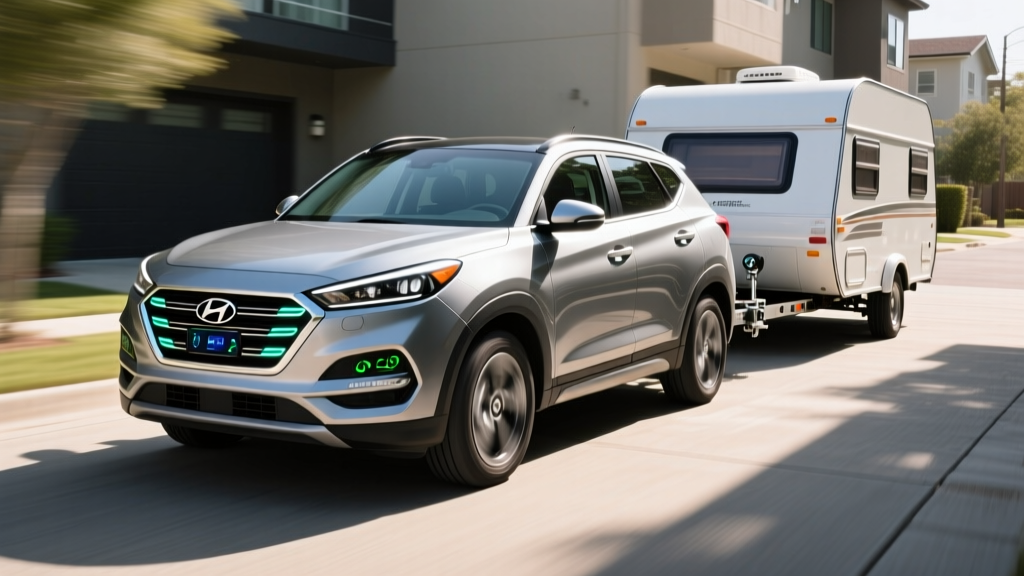
The 2025 Hyundai Tucson Hybrid is rated to tow 2,000 pounds when properly equipped — enough for a small utility trailer, a pair of jet skis, or a lightweight pop-up camper, but not a full-size travel trailer or a loaded boat. That figure applies to both the conventional hybrid (HEV) and the plug-in hybrid (PHEV) variants, making it competitive with the Toyota RAV4 Hybrid (1,750 lbs) but trailing the Ford Escape Hybrid (3,500 lbs with the tow package).
For compact SUV buyers who need occasional light towing without sacrificing fuel economy, the Tucson Hybrid occupies a practical middle ground. Below, we break down every spec that matters — from real-world MPG to battery longevity — so you can decide whether this hybrid fits your garage.
HEV vs PHEV: Which Tucson Hybrid Are We Talking About?
Hyundai sells two electrified Tucson models for 2025, and confusing them is the most common buyer mistake. Here is the fundamental difference:
| Attribute | Tucson Hybrid (HEV) | Tucson Plug-In Hybrid (PHEV) |
|---|---|---|
| Needs to plug in? | No — charges via regen & engine | Yes — plug in for electric-only miles |
| Battery size | 1.49 kWh (small buffer) | 13.8 kWh usable |
| Electric-only range | N/A (motor assists engine only) | 33 miles (EPA) |
| EPA combined MPG / MPGe | 38 MPG combined | 80 MPGe combined; 35 MPG gas-only |
| Towing capacity | 2,000 lbs | 2,000 lbs |
| Combined horsepower | 231 hp / 271 lb-ft | 268 hp / 271 lb-ft |
| DC fast charging | N/A | No — AC Level 2 only |
| Federal tax credit (§30D) | Not eligible | Eligible — up to $7,500 (see rules) |
The HEV is a self-charging system: the gasoline engine and regenerative braking keep a small battery topped up, and the electric motor provides low-speed assist and smooth stop-start. You never plug it in. The PHEV adds a much larger battery and a more powerful motor, giving you 33 miles of pure electric driving before the gasoline engine engages — but you must plug in regularly to capture that benefit.
Towing Specs: The 2,000-Pound Ceiling Explained
Hyundai rates both Tucson hybrid variants at 2,000 pounds maximum tow capacity with a factory-installed tow hitch and wiring harness. This rating assumes:
- Properly equipped with the Hyundai tow hitch accessory (dealer-installed or port-installed)
- Gross Combined Weight Rating (GCWR) not exceeded — the combined weight of the loaded vehicle plus trailer cannot surpass the GCWR posted on the driver's door jamb sticker
- Trailer brakes recommended above 1,000 lbs (and legally required in many states above 1,500–3,000 lbs)
- Tongue weight limited to approximately 200 lbs (10% of max trailer weight)
What 2,000 lbs gets you: A small 5×8 enclosed utility trailer (~1,000 lbs empty), two personal watercraft on a single-axle trailer (~1,500 lbs total), or a lightweight teardrop camper (~1,200–1,800 lbs).
What it doesn't cover: A 20-foot pontoon boat (~2,500+ lbs), a loaded horse trailer, or any travel trailer with a slide-out. For those, you need a midsize SUV or truck rated for 3,500–5,000+ lbs.
Note that Hyundai does not offer a factory tow package that increases this rating — unlike the Ford Escape Hybrid, which can reach 3,500 lbs with its Class II tow package. The Tucson Hybrid's 2,000-lb cap is a hard ceiling across all trims.
Powertrain: How 231–268 HP Moves the Tucson Hybrid
Both Tucson hybrids pair a 1.6-liter turbocharged four-cylinder engine with an electric motor and a six-speed automatic transmission — no CVT here, which matters for towing because a conventional automatic delivers more predictable low-end torque under load.
| Specification | Tucson HEV | Tucson PHEV |
|---|---|---|
| Engine | 1.6L turbo I-4 | 1.6L turbo I-4 |
| Engine output | 178 hp / 195 lb-ft | 178 hp / 195 lb-ft |
| Electric motor | 47.7 kW (64 hp) | 74.2 kW (99 hp) |
| Combined system output | 231 hp / 271 lb-ft | 268 hp / 271 lb-ft |
| Transmission | 6-speed automatic | 6-speed automatic |
| Drivetrain | AWD (standard) | AWD (standard) |
| 0–60 mph | ~7.1 sec | ~6.3 sec |
| Max towing | 2,000 lbs | 2,000 lbs |
The PHEV's larger motor gives it a noticeable acceleration advantage — the 268 combined horsepower makes highway merging and uphill towing less strained. Both models come standard with Hyundai's HTRAC all-wheel drive, which distributes torque front-to-rear and provides stability when pulling a trailer on wet or uneven surfaces.
Fuel Economy: EPA MPG and Real-World Numbers
Efficiency is where the Tucson Hybrid earns its keep, especially if your daily driving involves stop-and-go city traffic where the electric motor does the heavy lifting.
| EPA Rating | Tucson HEV | Tucson PHEV (gas only) | Tucson PHEV (charge-sustaining) |
|---|---|---|---|
| City | 38 MPG | 35 MPG | 80 MPGe (with charge) |
| Highway | 38 MPG | 35 MPG | — |
| Combined | 38 MPG | 35 MPG | 80 MPGe combined |
Real-world MPG reality check: According to fueleconomy.gov, owner-reported fuel economy for the Tucson HEV clusters around 36–40 MPG combined. Hybrids tend to exceed EPA city estimates because regenerative braking recovers energy in stop-and-go traffic — the scenario where gas cars are least efficient. Highway driving at 75+ mph, however, will drop real-world numbers to 33–35 MPG since the engine carries most of the load at sustained speed.
For the PHEV, the 33 miles of electric-only range (EPA-rated) covers most daily commutes. Once the battery depletes, the gasoline engine takes over at 35 MPG combined. If you plug in nightly and drive under 33 miles daily, your gasoline consumption approaches zero — but skip the plug-in routine and you are simply driving a slightly heavier, slightly less efficient hybrid.
Towing fuel economy note: Expect MPG to drop significantly while towing — typically 40–60% depending on trailer weight and terrain. Plan for 16–22 MPG combined with a 1,500-lb trailer in tow.
PHEV Charging: Battery, Speed, and Limitations
The Tucson PHEV's 13.8 kWh battery (lithium-ion polymer) provides its 33-mile electric range and can be replenished two ways:
- Level 1 (120V household outlet): ~7 kW → approximately 12 hours for a full charge. Practical only for overnight top-ups if your daily drive is short.
- Level 2 (240V home charger or public station): 7.2 kW onboard charger → approximately 2 hours from empty to full.
Critical limitation: The Tucson PHEV does not support DC fast charging. There is no CCS or NACS port for rapid top-ups on road trips. This is typical for PHEVs — the battery is small enough that Level 2 charging suffices for overnight replenishment — but it means you cannot add electric range during a highway stop.
For comparison, a full EV like the Hyundai Ioniq 5 supports up to 240 kW DC fast charging, adding 200+ miles of range in 18 minutes. The PHEV's value proposition is fundamentally different: short electric commutes backed by a gas engine for longer trips, not road-trip fast-charging capability.
Pricing, Trims, and Tax Credit Eligibility
The 2025 Tucson Hybrid lineup starts at approximately $32,975 MSRP (Blue HEV trim, including destination) and climbs to around $40,000 for the Limited HEV. The PHEV trims (SEL Convenience and Limited) range from approximately $39,975 to $46,000.
Federal §30D Tax Credit — PHEV Only:
- Maximum credit: up to $7,500 for the Tucson PHEV
- MSRP cap: SUVs must be under $80,000 (Tucson PHEV qualifies)
- Buyer income cap: $150,000 single / $300,000 married filing jointly AGI
- Battery sourcing: Critical minerals and battery component rules apply — check current IRS guidance as requirements tighten annually through 2032
- Point-of-sale transfer: Eligible buyers can transfer the credit to the dealer at purchase, reducing the out-of-pocket price immediately
- HEV models: Not eligible for §30D (no plug-in capability)
The HEV qualifies for no federal purchase credit, though some states and utilities offer rebates for any electrified vehicle. Consult IRS.gov and a tax professional for your specific eligibility, as battery sourcing rules change frequently.
Reliability, Battery Warranty, and Replacement Costs
Hyundai Hybrid/PHEV Battery Warranty:
- Duration: 10 years / 100,000 miles (whichever comes first)
- Coverage: Battery capacity below a defined threshold (typically 70% state of health) and defects
- Transferable: Yes, to subsequent owners (check warranty documentation for terms)
- Hybrid system components: 10 years / 100,000 miles including inverter, motor, and related electronics
Hyundai's 10-year/100,000-mile hybrid battery warranty is among the best in the industry and should cover most owners through the vehicle's primary ownership cycle. Real-world data from Hyundai's hybrid lineup (Sonata Hybrid, Ioniq Hybrid) shows battery degradation of approximately 5–10% over 100,000 miles — well within the warranty threshold.
Battery replacement cost (out of warranty): Based on current parts pricing, a Tucson Hybrid battery replacement runs approximately $2,500–$4,500 (HEV) or $5,000–$8,000 (PHEV) including labor. These figures are estimates; actual costs vary by dealer and region. The HEV's smaller 1.49 kWh battery is significantly cheaper to replace than the PHEV's 13.8 kWh pack.
For reliability context, the Tucson nameplate has performed well in IIHS testing, earning top marks in crashworthiness. Hyundai's hybrid powertrain has proven durable across its model range, with few widespread failure reports through the 2023–2024 model years.
Who Should Choose the Tucson Hybrid vs a Full EV or Gas SUV?
Choose the Tucson HEV if:
- You want better fuel economy without changing your fueling habits (no plug-in required)
- Your commute is mostly city driving where regenerative braking maximizes MPG
- You need light towing (2,000 lbs) for weekend gear or a small trailer
- Your budget is under $40,000 and you want AWD standard
Choose the Tucson PHEV if:
- You have home charging access (garage or driveway with a 120V or 240V outlet)
- Your daily round-trip commute is under 33 miles — you could burn almost no gasoline
- You want the federal tax credit (up to $7,500) to offset the higher MSRP
- You take occasional long road trips and want gas-engine range without range anxiety
Choose a full EV (e.g., Hyundai Ioniq 5) if:
- You have reliable home Level 2 charging and access to DC fast chargers for road trips
- You want zero tailpipe emissions and the lowest per-mile fuel cost (~$0.04–$0.06/mi on home electricity)
- You do not need to tow — most compact EV SUVs are rated for 1,500–2,300 lbs, similar to the Tucson Hybrid
- You want to maximize federal and state incentives
Choose a gas-only Tucson if:
- Your budget is tight (gas Tucson starts ~$4,000–$5,000 less than the HEV)
- You drive mostly highway miles where hybrid advantages are minimal
- You plan to keep the vehicle under 5 years and want the lowest upfront cost
Pros
- 38 MPG combined (HEV) — best-in-class for AWD compact hybrid SUVs
- 2,000-lb towing covers most light-duty needs
- Standard AWD across all hybrid trims
- 6-speed automatic (no CVT drone under load)
- 10-year/100,000-mile hybrid battery warranty
- PHEV eligible for up to $7,500 federal credit
Cons
- 2,000-lb tow cap is fixed — no factory upgrade available
- PHEV has no DC fast charging
- Tongue weight limited to ~200 lbs
- PHEV premium of ~$7,000 over HEV requires tax credit to justify
- Real-world highway MPG drops to ~33–35 at 75+ mph
- Towing MPG falls sharply (expect 16–22 MPG with trailer)
Frequently Asked Questions
How many MPG does the 2025 Hyundai Tucson Hybrid get?
The Tucson HEV is EPA-rated at 38 MPG city, 38 MPG highway, and 38 MPG combined. Real-world owners report 36–40 MPG combined, with city driving often exceeding the EPA estimate thanks to regenerative braking. Highway driving above 75 mph typically yields 33–35 MPG.
How far can the Tucson PHEV go on electric only?
The 2025 Tucson Plug-In Hybrid achieves an EPA-rated 33 miles on electric power alone before the gasoline engine engages. This is sufficient for most daily commutes. Total combined range (electric + gasoline) exceeds 400 miles.
Does the 2025 Tucson Hybrid qualify for any tax credit?
The conventional Tucson HEV does not qualify for the federal §30D clean vehicle credit. The Tucson PHEV may qualify for up to $7,500, subject to buyer income limits ($150K single / $300K joint AGI), MSRP caps (under $80,000 for SUVs), and battery sourcing requirements. Rules change annually — verify current eligibility on IRS.gov.
Is the Hyundai Tucson Hybrid reliable, and what does battery replacement cost?
Hyundai's hybrid system has demonstrated strong reliability across its lineup. The hybrid battery is covered by a 10-year/100,000-mile warranty. Out-of-warranty replacement costs approximately $2,500–$4,500 for the HEV battery and $5,000–$8,000 for the PHEV battery, including labor.
Can the Tucson Hybrid tow a camper or boat?
The 2,000-lb towing capacity handles small utility trailers, jet skis, and lightweight teardrop campers (under ~1,800 lbs loaded). It cannot tow most travel trailers, pontoon boats, or horse trailers, which typically require 3,500+ lb ratings found on midsize SUVs and trucks.
Do I need to plug in the Tucson Hybrid?
No — the conventional Tucson HEV never needs plugging in. It charges its small battery through regenerative braking and the gasoline engine. Only the Tucson PHEV requires plug-in charging to access its 33-mile electric-only range; without plugging in, it operates as a conventional hybrid at 35 MPG combined.