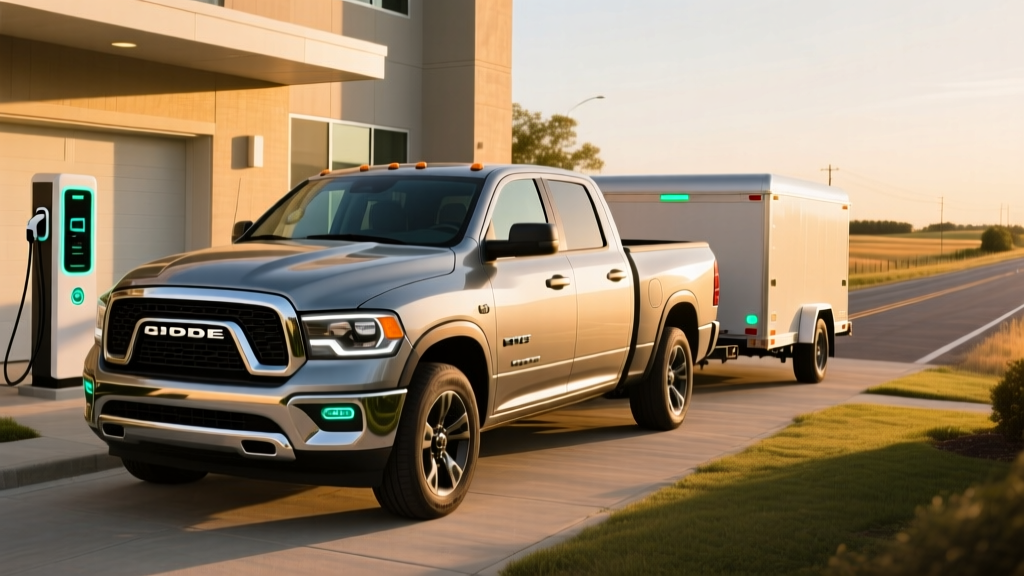
If you've been searching for a Dodge hybrid truck, you've likely hit a wall of conflicting information. Dodge itself doesn't build trucks — that's Ram, its sister brand under Stellantis. And while Ram has electrified its half-ton pickup lineup, the result isn't the plug-in hybrid (PHEV) or conventional hybrid (HEV) many buyers expect. Let's cut through the noise and examine exactly what's available for 2026, what's coming, and whether a Ram hybrid truck actually fits your needs.
The Ram 1500 eTorque: Mild Hybrid, Not a True HEV or PHEV
The most common source of confusion is Ram's eTorque mild-hybrid system, which was available on the previous-generation Ram 1500 (2019–2024). Here's the critical distinction:
HEV vs. PHEV vs. Mild Hybrid (MHEV) — What's the Difference?
| Type | Plugs In? | Electric-Only Driving? | How It Helps |
|---|---|---|---|
| Mild Hybrid (MHEV) | No | No | Small motor assists gas engine; smoother stop-start; minor MPG boost |
| Conventional Hybrid (HEV) | No | Brief, low-speed only | Larger motor + battery; engine and motor share driving; major MPG gains |
| Plug-in Hybrid (PHEV) | Yes | Yes (20–50 mi typical) | Largest battery; true EV mode for daily commutes; gas engine for longer trips |
The Ram 1500 eTorque uses a 48-volt belt-driven motor-generator paired with a small lithium-ion battery pack (roughly 0.8 kWh). It cannot propel the truck on electricity alone. Instead, it smooths out the automatic stop-start system, provides a brief torque fill during acceleration, and enables modest regenerative braking. Think of it as an enhanced starter-generator — not a hybrid in the Toyota Prius or Ford Maverick sense.
Ram 1500 Powertrain Options for 2026: Where Electrification Stands
For the 2026 model year, Ram has restructured its half-ton powertrain lineup around the new 3.0L Hurricane twin-turbo inline-six engines, replacing the legendary 5.7L Hemi V8. Here's what's available:
| Powertrain | Horsepower | Torque (lb-ft) | Electrified? | Availability |
|---|---|---|---|---|
| 3.0L Hurricane I6 (Standard Output) | 420 hp | 468 | No (pure ICE) | Available now |
| 3.0L Hurricane I6 (High Output) | 540 hp | 521 | No (pure ICE) | Available now |
| 3.6L Pentastar V6 + eTorque | 305 hp | 269 | Mild hybrid (48V) | Discontinued after 2024 MY |
| 5.7L Hemi V8 + eTorque | 395 hp | 410 | Mild hybrid (48V) | Discontinued after 2024 MY |
| Ram 1500 REV (Full EV) | 654 hp (est.) | 620 (est.) | Battery electric | Announced/Upcoming |
| Ram 1500 Ramcharger (EREV) | 663 hp | 615 | Extended-range EV | Expected 2026 |
The key takeaway: the 2026 Ram 1500 does not offer a conventional hybrid (HEV) or plug-in hybrid (PHEV) powertrain. The eTorque mild-hybrid system was phased out alongside the Hemi V8 and the Pentastar V6 in the previous generation. If you're shopping a new 2026 Ram 1500, you're choosing between two Hurricane turbo-six variants (pure gasoline) or waiting for the electrified Ramcharger EREV.
The Ram 1500 Ramcharger: An EREV, Not a Traditional Hybrid
The Ram 1500 Ramcharger is the closest thing to a "Dodge hybrid truck" that Stellantis has announced. But it's not a hybrid in any conventional sense — it's an extended-range electric vehicle (EREV).
Here's how the Ramcharger works: the truck is driven entirely by electric motors (front and rear, for AWD). A 3.6L Pentastar V6 engine is onboard, but it never drives the wheels directly. Instead, it acts as an onboard generator, producing electricity to extend range once the battery is depleted. This is the same architecture used by the Chevrolet Volt (2011–2019) and the BMW i3 REx, scaled up to a full-size pickup.
| Spec | Ram 1500 Ramcharger (Announced/Estimated) |
|---|---|
| Battery Capacity | 92 kWh (usable, estimated) |
| Electric-Only Range | ~145 miles (EPA est., preliminary) |
| Total Range (Battery + Generator) | ~690 miles (target) |
| Combined Horsepower | 663 hp |
| Combined Torque | 615 lb-ft |
| 0-60 mph | ~4.4 seconds (est.) |
| DC Fast Charging | Yes (Level 3 capable, rate TBD) |
| Towing Capacity | ~14,000 lbs (target) |
| Starting MSRP | TBD — expected $60,000–$70,000 range |
Real-World Range Expectations: The Ramcharger's 145-mile electric-only estimate is preliminary. In real-world use, expect highway driving at 70+ mph to reduce that to roughly 110–125 miles. Cold-weather operation (below freezing) could drop electric-only range by 20–30%, putting winter EV-mode range in the 100–115 mile bracket. Once the gas generator engages, total range will depend heavily on driving style and load — towing will dramatically increase fuel consumption even in generator mode.
The Ramcharger is expected to arrive as a 2026 model, though Ram has adjusted its timeline multiple times. As of early 2026, it has not yet entered full production. Buyers should treat all specs as preliminary until EPA certification figures are published.
Fuel Economy: What MPG Can You Expect?
Since the 2026 Ram 1500 lineup currently consists of pure-gasoline Hurricane I6 engines, let's look at real EPA data for these powertrains, plus projected efficiency for the Ramcharger EREV:
| Powertrain | City MPG | Highway MPG | Combined MPG | Notes |
|---|---|---|---|---|
| 3.0L Hurricane SO I6 (4WD, 2026) | 17 | 24 | 20 | Source: fueleconomy.gov |
| 3.0L Hurricane HO I6 (4WD, 2026) | 15 | 21 | 17 | High-output, Raptor-competitor tunes |
| 3.6L V6 + eTorque (4WD, 2024) | 19 | 24 | 21 | Previous-gen, discontinued |
| 5.7L Hemi + eTorque (4WD, 2024) | 15 | 21 | 17 | Previous-gen, discontinued |
| Ramcharger EREV (est.) | N/A (EV mode) | N/A (EV mode) | ~75 MPGe (est. EV) / ~20 MPG (gen mode) | Preliminary, not EPA-certified |
Real-world MPG note: The Hurricane I6 engines deliver strong highway efficiency for a full-size truck, but city driving and towing will push consumption well above EPA estimates. Owners who tow frequently should expect 10–13 MPG under load. The previous eTorque mild-hybrid system provided only a 1–2 MPG improvement over non-eTorque equivalents — it was never a meaningful fuel-saving technology.
The Ramcharger's efficiency story is fundamentally different. For daily commutes under 145 miles, most owners could drive entirely on electricity, paying the equivalent of $0.10–$0.15 per mile depending on local electricity rates. On long road trips where the generator runs continuously, expect fuel economy similar to a conventional V6 Ram — around 18–22 MPG combined.
Pricing, Tax Credits, and Total Cost
Here's where the picture gets nuanced for electrified truck shoppers:
2026 Ram 1500 Gasoline Pricing
The 2026 Ram 1500 with the Hurricane SO I6 starts around $47,275 (Tradesman trim, 2WD). The popular Laramie 4WD with the Hurricane SO sits near $60,000–$65,000 depending on options. The High Output engine is reserved for the RHO and Limited trims, pushing MSRP well above $75,000.
Ramcharger Pricing and Tax Credit Eligibility
Ram has not confirmed final MSRP for the Ramcharger, but industry estimates place it between $60,000 and $70,000 at launch. Whether it qualifies for the federal §30D clean vehicle tax credit (up to $7,500) depends on several factors under current IRS rules:
- MSRP cap: Vans, SUVs, and pickups must have an MSRP at or below $80,000 — the Ramcharger should clear this.
- Buyer income cap: Modified adjusted gross income must not exceed $150,000 (single), $225,000 (head of household), or $300,000 (joint). See IRS §30D guidelines.
- Battery sourcing: Critical minerals and battery components must meet phased-in percentage thresholds from U.S. or free-trade-agreement partners. Stellantis has been localizing supply chains, but final certification per model year is not guaranteed.
- Point-of-sale transfer: Eligible buyers can transfer the credit to the dealer at purchase, reducing the upfront price rather than waiting for a tax refund.
Because the Ramcharger is an EREV (it has both a battery and an onboard generator), it may qualify as a plug-in hybrid under §30D rules — which is significant, because it means the $80,000 MSRP cap for trucks applies (rather than the $55,000 cap for sedans). Always verify eligibility with a tax professional before purchase.
Battery Warranty and Longevity
What We Know About Ram's Electrified Powertrain Warranties
For the previous-generation eTorque mild-hybrid system, Ram provided an 8-year/100,000-mile warranty on the 48V battery pack and related components. This is consistent with industry norms for hybrid battery coverage.
For the Ramcharger EREV, Ram has not yet published final warranty terms. However, federal law mandates that emissions-related components on PHEVs and EREVs carry at minimum an 8-year/80,000-mile warranty, and most manufacturers extend battery coverage to 8 years/100,000 miles with a capacity retention threshold (typically 70% of original capacity). Stellantis has historically matched or exceeded these benchmarks on its electrified vehicles.
Battery replacement cost: For a 92 kWh pack of the Ramcharger's size, out-of-warranty replacement would likely cost between $12,000 and $18,000 based on current industry pricing of $130–$200 per kWh for replacement modules. However, modern lithium-ion packs are designed to last 15–20 years with gradual degradation — full pack replacement is rare. Most degradation-related claims involve individual module swaps at far lower cost.
For buyers considering a used Ram 1500 with the discontinued eTorque system, the 48V battery is small and inexpensive to replace relative to full-hybrid packs — typically $1,500–$3,000 if it ever fails outside warranty.
Ramcharger vs. the Competition: Hybrid and Electrified Truck Alternatives
If a "Dodge hybrid truck" isn't quite what you expected, here's how the Ramcharger stacks up against actual hybrid and electrified trucks currently on the market:
| Spec | Ram 1500 Ramcharger (EREV) | Ford F-150 PowerBoost (HEV) | Toyota Tundra i-FORCE MAX (HEV) | Chevy Silverado 1500 (ICE) |
|---|---|---|---|---|
| Powertrain Type | Extended-Range EV | Full Hybrid (HEV) | Full Hybrid (HEV) | Turbo I6 / V8 (ICE) |
| Combined HP | 663 | 430 | 437 | 355–420 |
| Combined MPG | ~75 MPGe / ~20 gen | 23–25 | 20–22 | 16–21 |
| Electric-Only Range | ~145 mi | 0 mi | 0 mi | 0 mi |
| Plugs In? | Yes | No | No | No |
| Towing (max) | ~14,000 lbs | ~12,700 lbs | ~12,000 lbs | ~13,300 lbs |
| Starting MSRP (est.) | ~$60,000+ | ~$58,000 | ~$57,000 | ~$40,000 |
| Federal Tax Credit | Potential $7,500 | None | None | None |
The Ford F-150 PowerBoost and Toyota Tundra i-FORCE MAX are true conventional hybrids — no plug needed, and both deliver real fuel economy improvements over their non-hybrid siblings. Neither qualifies for a federal tax credit because they can't plug in. The Ramcharger occupies a unique position: it offers genuine electric-only commuting range while eliminating range anxiety for long hauls and towing.
Who Should Wait for the Ramcharger — and Who Should Look Elsewhere?
Decision Framework: Which Electrified Truck Fits You?
Choose the Ram 1500 Ramcharger (when available) if:
- Your daily commute is under 100 miles round-trip and you can charge at home
- You want electric daily driving but regularly tow or take road trips beyond 300 miles
- You want a full-size truck with over 600 hp and don't want a pure EV
- You can potentially benefit from the $7,500 federal tax credit
Choose the Ford F-150 PowerBoost (HEV) if:
- You can't charge at home (no garage, no Level 2 access)
- You want a proven, currently available hybrid truck with strong towing
- You want a simpler ownership experience — no plug, no battery management
Choose the Toyota Tundra i-FORCE MAX (HEV) if:
- Long-term reliability is your top priority (Toyota's hybrid track record is unmatched)
- You want a hybrid truck with strong resale value
- You don't need electric-only driving capability
Choose a full EV (Ford F-150 Lightning, Rivian R1T, Ram 1500 REV) if:
- You can install a Level 2 home charger and rarely tow beyond 200 miles from home
- You want the lowest per-mile fuel cost and minimal drivetrain maintenance
Frequently Asked Questions
Does Dodge make a hybrid truck?
Dodge itself does not manufacture trucks — Ram, a separate Stellantis brand, handles all pickups. The previous-generation Ram 1500 (through 2024) offered the eTorque mild-hybrid system, but this is not a true hybrid. For 2026, Ram has announced the Ramcharger extended-range EV, which combines a large battery with a gas-powered generator, but it is not a conventional hybrid (HEV) or standard plug-in hybrid (PHEV).
How many MPG does the Ram 1500 hybrid get?
The 2026 Ram 1500 with the 3.0L Hurricane Standard Output I6 achieves an EPA-estimated 17 city / 24 highway / 20 combined MPG with 4WD. The previous-generation eTorque mild-hybrid V6 managed 19/24/21 MPG. The Ramcharger EREV is expected to deliver roughly 75 MPGe in electric mode and around 20 MPG when the gas generator is running, though these figures are preliminary and not yet EPA-certified.
How far can the Ram Ramcharger go on electric only?
Ram estimates approximately 145 miles of electric-only range from the Ramcharger's 92 kWh battery pack. Real-world highway driving and cold weather will reduce this — expect roughly 110–125 miles at highway speeds and potentially 100–115 miles in freezing temperatures.
Is the Ramcharger a hybrid or an electric vehicle?
Technically, it's an extended-range electric vehicle (EREV). The wheels are always driven by electric motors. The onboard 3.6L V6 engine generates electricity but never mechanically drives the wheels. This differs from a PHEV (like the Toyota RAV4 Prime), where the gas engine can directly drive the wheels. The distinction matters for efficiency: EREVs are most efficient in city and stop-and-go driving, while PHEVs may be more efficient at sustained highway speeds.
Does the Ram Ramcharger qualify for a tax credit?
It's expected to be eligible for the federal §30D clean vehicle tax credit of up to $7,500, subject to buyer income limits, MSRP caps ($80,000 for trucks), and battery-sourcing requirements. Final eligibility depends on IRS certification at the time of sale. Consult a tax professional and check the latest IRS guidance before purchasing.
Is the Ram eTorque mild-hybrid system reliable?
The eTorque 48V system is relatively simple and has not been associated with widespread failures. The small lithium-ion battery pack and belt-driven motor-generator are less complex than full-hybrid systems. Ram covered the eTorque battery with an 8-year/100,000-mile warranty. However, the eTorque system has been discontinued after the 2024 model year, so long-term parts support should be confirmed with your dealer.
What is the battery replacement cost for a Ram hybrid?
For the eTorque mild-hybrid (2019–2024), the 48V battery is small (~0.8 kWh) and relatively inexpensive — estimated at $1,500–$3,000 for replacement. For the Ramcharger EREV's 92 kWh pack, out-of-warranty replacement could cost $12,000–$18,000, though full pack replacements are rare. Most manufacturers design packs for 15–20 year service life with gradual capacity loss rather than sudden failure.
The Bottom Line on a Dodge Hybrid Truck
If you're looking for a traditional hybrid Ram — something that works like a Ford F-150 PowerBoost or Toyota Tundra i-FORCE MAX, where the gas engine and electric motor share driving duties without plugging in — that truck doesn't exist from Ram as of 2026. The eTorque mild-hybrid was the closest equivalent, and it's been discontinued.
What Ram is building instead is the Ramcharger: an EREV that offers genuine electric-only commuting with a gas generator for unlimited range. It's a compelling concept for truck buyers who want to electrify their daily driving without sacrificing towing capability or long-haul range. But it's not yet in customer hands, and final specs, pricing, and tax-credit eligibility remain unconfirmed.
For buyers who need a hybrid truck today, the Ford F-150 PowerBoost (23–25 MPG combined, proven reliability, no plug required) and Toyota Tundra i-FORCE MAX (20–22 MPG combined, Toyota's hybrid durability record) are the real options. If you can wait and have home charging access, the Ramcharger could be worth watching — just don't mistake it for a conventional hybrid.